Explore Egypt with Kids: 20 Fun Egypt Facts, Printable Activities & Learning Ideas
Discover ancient pyramids, mighty pharaohs, the Nile River, fascinating animals, and fun printable activities that help kids learn about Egypt through play.
Children are naturally curious about different cultures, animals, and famous places around the world. In fact, learning about countries through stories and activities is one of the most effective ways to build a lifelong love of geography. We explored this idea in more detail in our article about why kids learn geography better through adventures, collections, and progression.
Explore Egypt Without Leaving Home
Ancient Egypt has fascinated children for generations. Giant pyramids, mysterious hieroglyphs, powerful pharaohs, hidden treasures, and the world’s longest river make Egypt one of the most exciting countries to study.
Whether you’re homeschooling, teaching geography, planning a country unit study, or simply raising a curious young explorer, Egypt offers endless opportunities for learning through stories, games, and creative activities.
The best part? Kids remember much more when they actively participate instead of just reading facts. Coloring pages, treasure hunts, quizzes, maps, matching games, and puzzles transform geography into an adventure.
In this guide, you’ll discover:
- 20 amazing Egypt facts for kids
- Fun learning activities
- Geography ideas
- Ancient Egyptian history made simple
- Printable learning inspiration for ages 6–9
Let’s begin our journey!
Where Is Egypt?
Egypt is located in northeastern Africa, although part of the country lies in Asia across the Sinai Peninsula. This unique location makes Egypt a bridge between two continents.
Egypt borders:
- Libya
- Sudan
- Israel
- The Mediterranean Sea
- The Red Sea
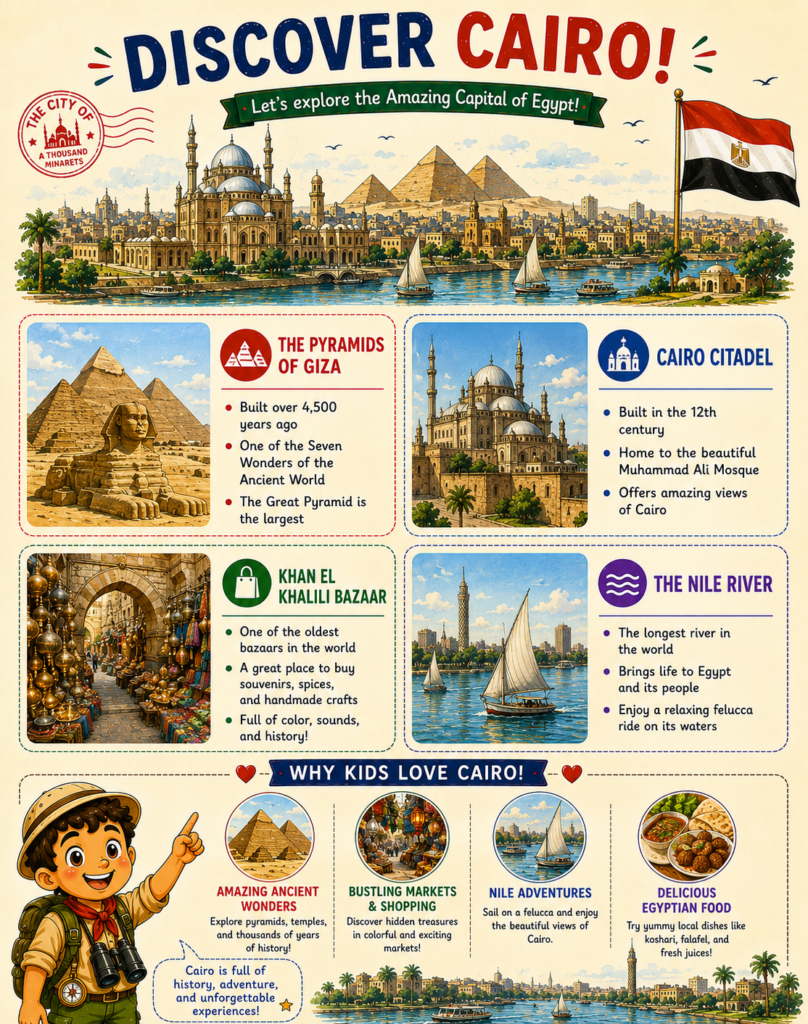
Its capital city is Cairo, one of the largest cities in Africa and the Middle East.
Because much of Egypt is covered by the Sahara Desert, almost all people live near the Nile River, where water makes farming and daily life possible.
20 Amazing Egypt Facts for Kids
1. The Nile Is the Longest River in the World
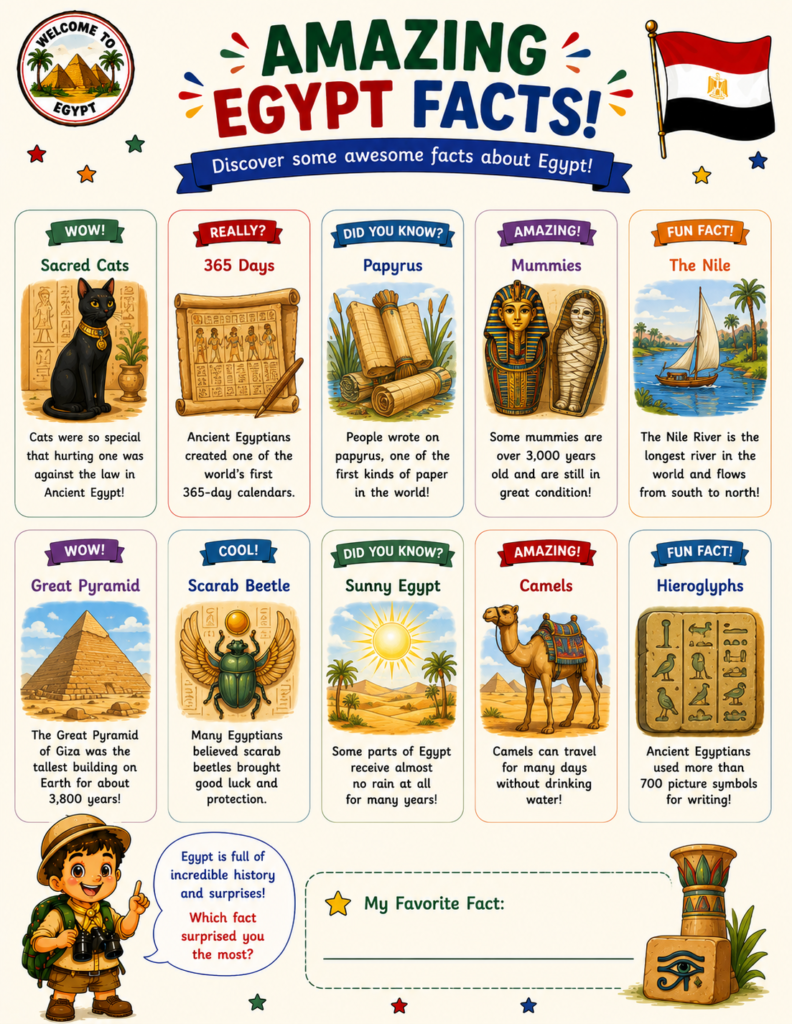
The Nile River stretches for more than 6,600 kilometers (4,100 miles).
For thousands of years, it has provided:
- fresh water
- transportation
- farming
- food
- life itself
Ancient Egyptians even called it «the gift of the Nile.»
2. Egypt Has Over 100 Pyramids
Most people know the Great Pyramid of Giza, but Egypt actually has more than one hundred pyramids.
These incredible structures were built as royal tombs for pharaohs and their families.
Even today, many pyramids are still standing after more than 4,500 years.
3. The Great Pyramid Was Once the Tallest Building on Earth
For nearly 3,800 years, no building was taller than the Great Pyramid of Giza.
Imagine building something that remains the tallest structure in the world for almost four thousand years—without modern machines!
4. The Sphinx Guards the Pyramids
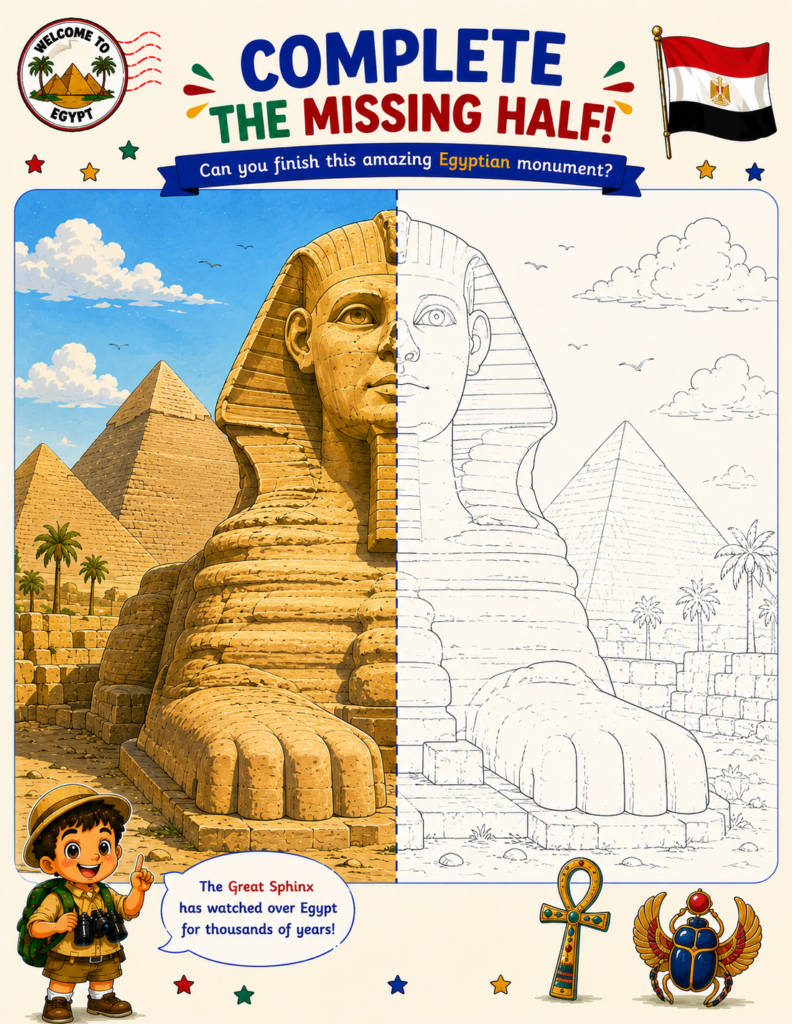
Near the pyramids sits the famous Great Sphinx.
It has:
- the body of a lion
- the head of a pharaoh
No one knows exactly why it was built, making it one of history’s greatest mysteries.
5. Cats Were Sacred Animals
Ancient Egyptians loved cats.
Cats protected homes by catching mice and snakes, and many people believed they brought good luck.
Hurting a cat was considered a serious crime.
Today, cats are still one of Egypt’s most beloved animals.
Turn Learning Into an Adventure
Children remember more when they explore instead of memorizing.
Activities like:
- treasure hunts
- map challenges
- matching games
- coloring pages
- quizzes
- word searches
help kids connect geography with fun.
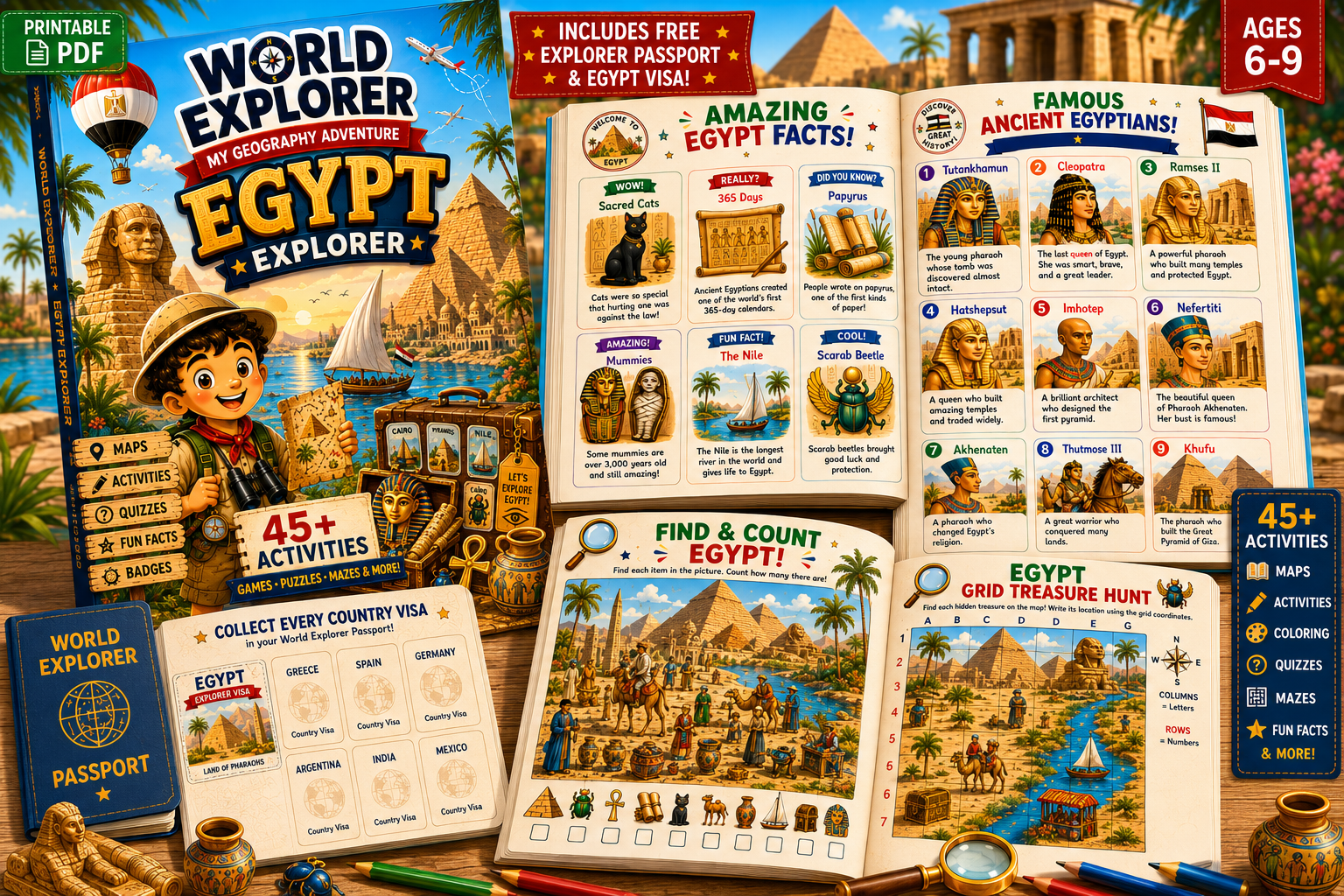
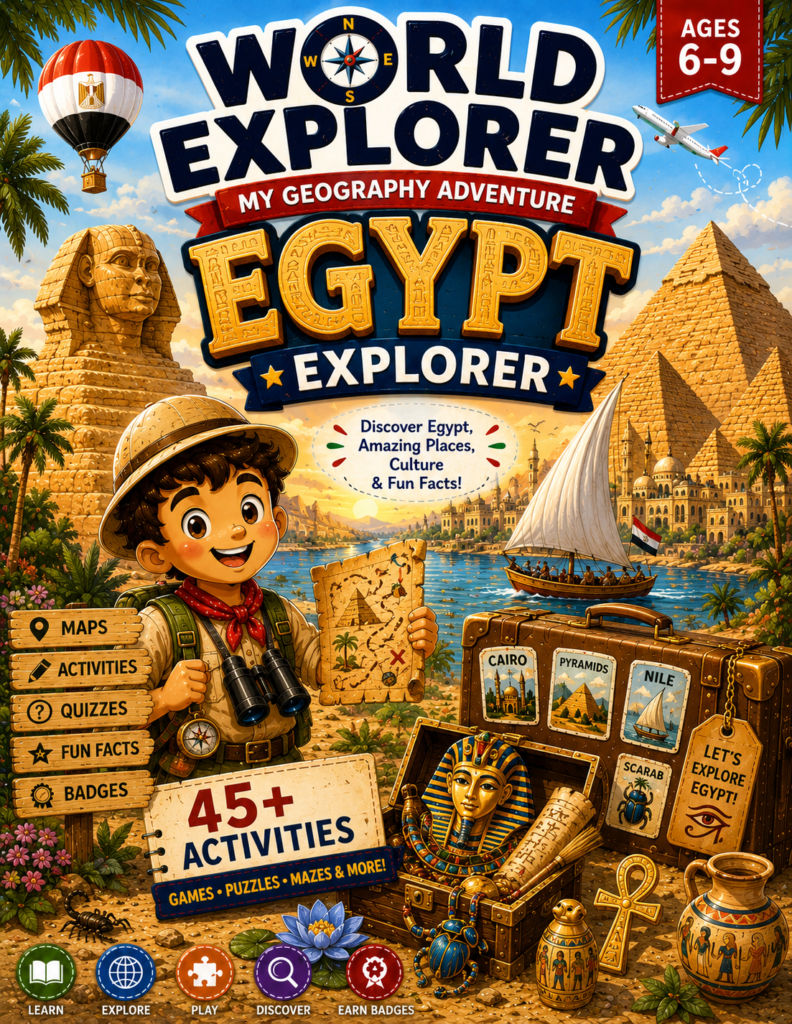
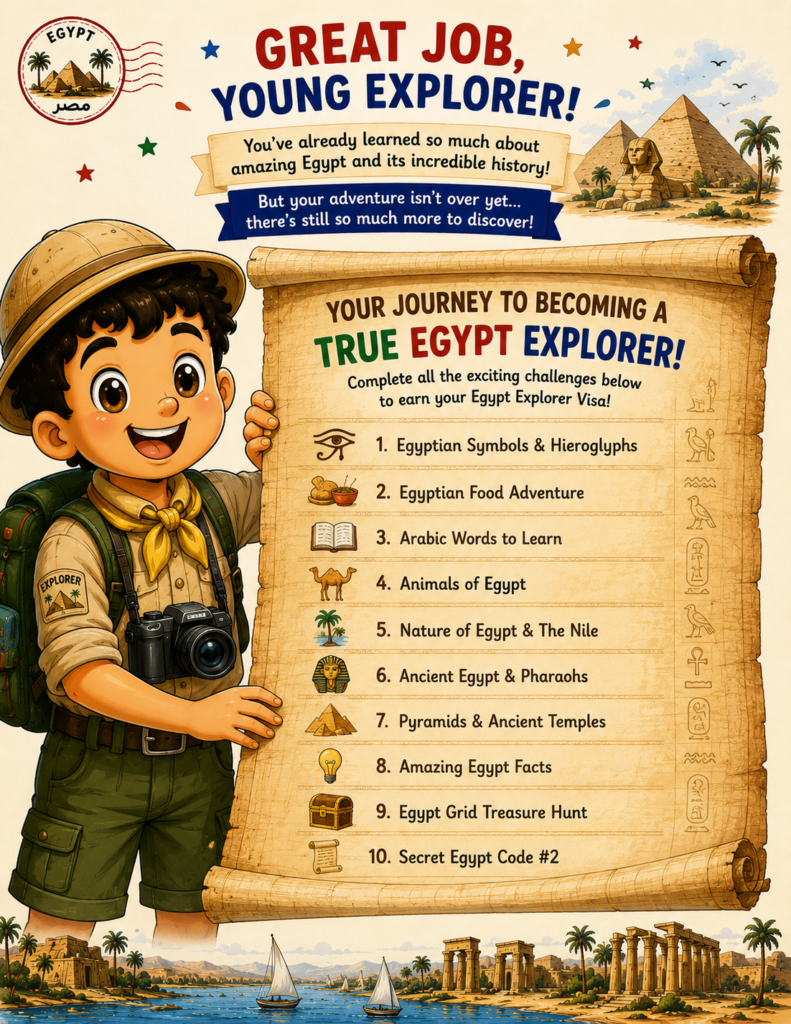
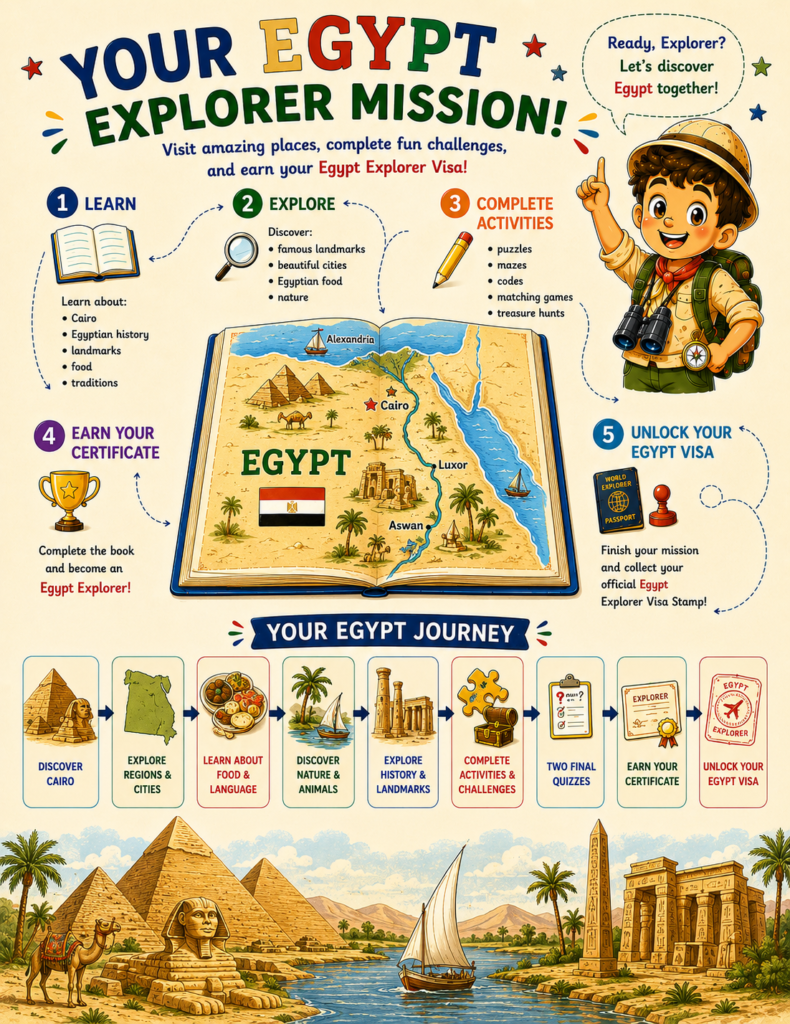
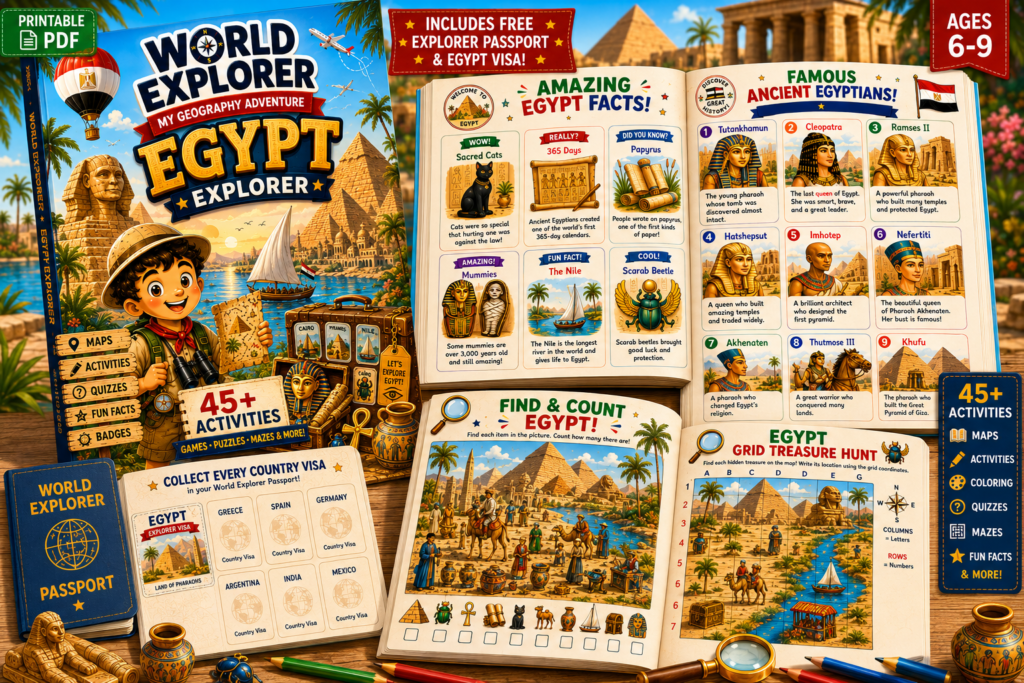
Our Egypt Explorer Workbook was created especially for children ages 6–9 and includes more than 45 printable activities covering geography, history, culture, landmarks, famous people, and exciting games.
6. Pharaohs Were Kings and Queens
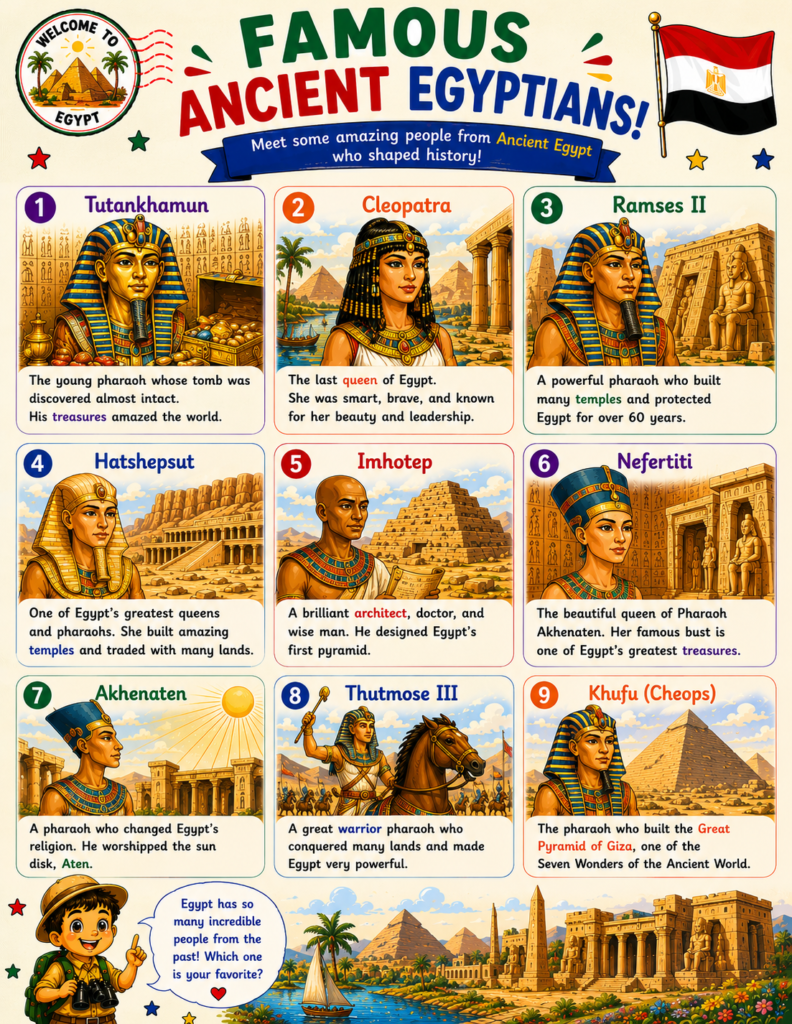
The rulers of Ancient Egypt were called pharaohs.
Some ruled for many decades and built huge temples, pyramids, and cities.
Famous pharaohs include:
- Tutankhamun
- Ramesses II
- Hatshepsut
- Akhenaten
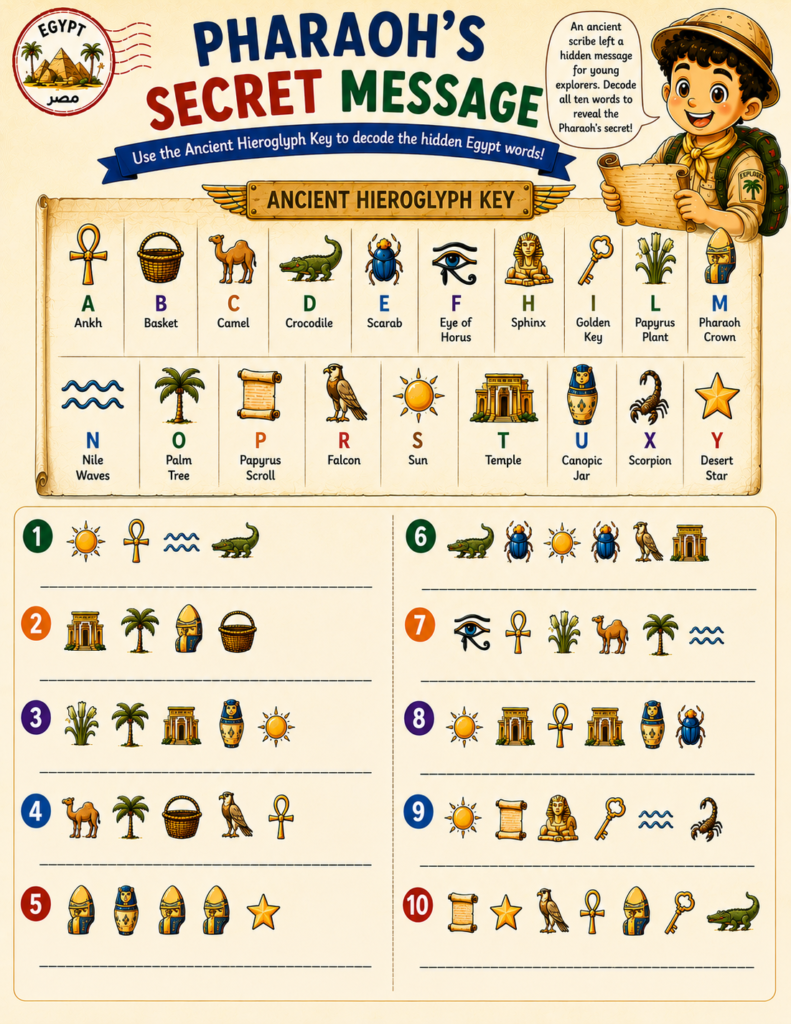
7. Hieroglyphs Were Picture Writing
Instead of using an alphabet like English, Ancient Egyptians wrote with hundreds of symbols called hieroglyphs.
Each picture represented:
- a sound
- an object
- or an idea
Learning to read hieroglyphs is still exciting for children today.
8. Egyptians Invented Papyrus
Long before notebooks existed, Egyptians made paper from a plant called papyrus.
They wrote stories, maps, laws, and important records on papyrus scrolls.
This invention helped preserve history for thousands of years.
9. Mummies Still Exist Today
When a pharaoh died, priests carefully wrapped the body in linen to create a mummy.
Many mummies have survived for over 3,000 years, allowing scientists to learn about life in Ancient Egypt.
10. Egypt Is Mostly Desert
Around 95% of Egypt is desert.
That is why nearly everyone lives close to the Nile River, where there is water for farming, drinking, and transportation.
The contrast between golden deserts and the green Nile Valley is one of Egypt’s most beautiful features.
Fun Egypt Activities Kids Love
Learning about Egypt becomes even more exciting with hands-on activities.
Here are some favorites:
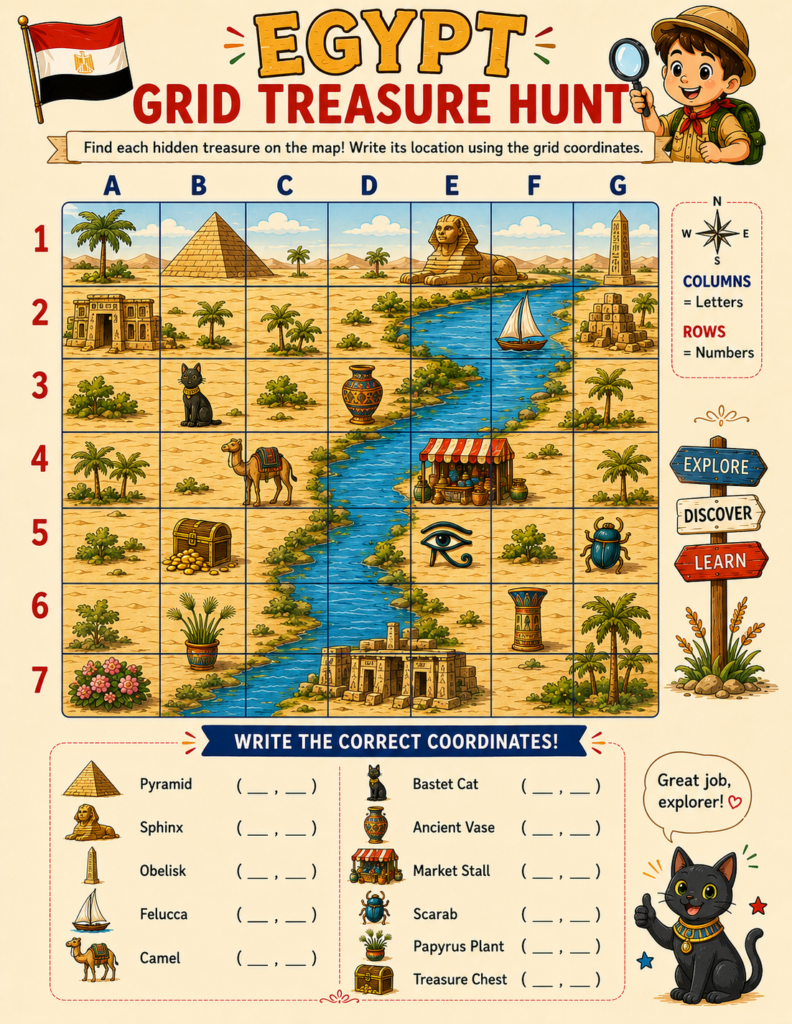
Treasure Hunt Maps
Children search for famous landmarks using map coordinates.
They learn:
- directions
- geography
- observation skills
Geography becomes even more exciting when children explore different countries through games and challenges. If your child enjoys discovering new places, you may also like our article featuring 10 amazing countries every child should explore in Asia.
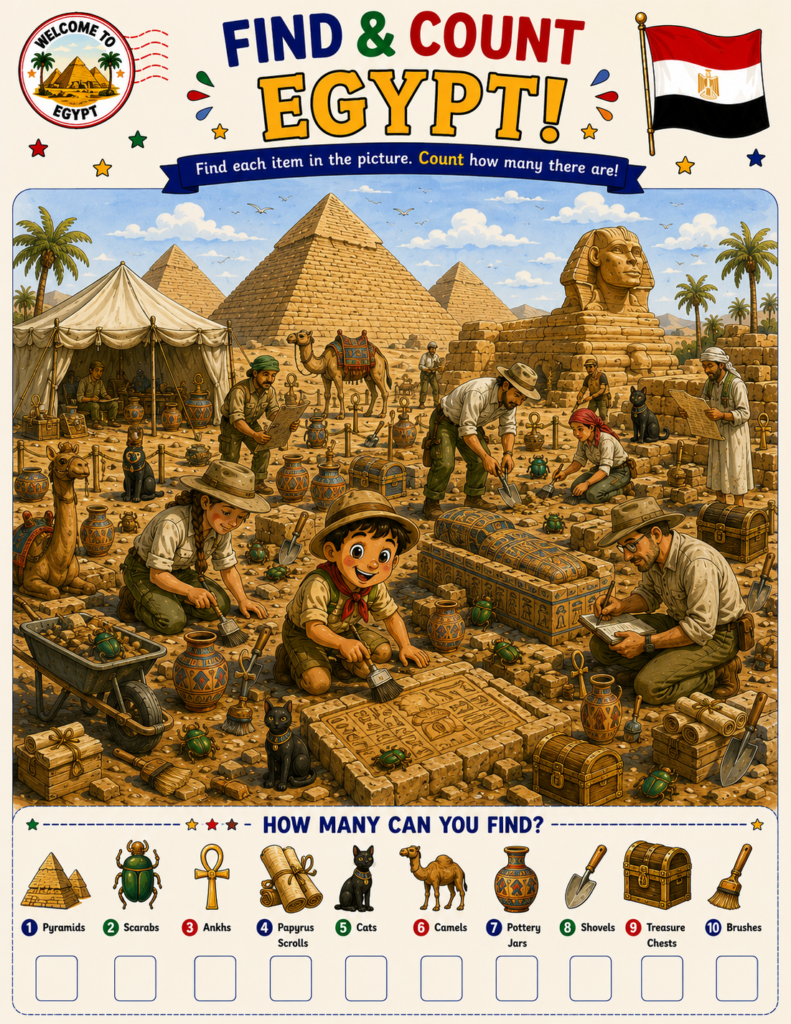
Find & Count Challenges
Kids carefully study a busy Egyptian scene and count hidden objects like:
- scarabs
- camels
- pyramids
- treasure chests
- cats
These activities improve concentration and visual skills while keeping learning fun.
Famous Egyptians Matching Games
Learning becomes easier when children match pictures with historical figures.
They quickly begin recognizing:
- Tutankhamun
- Cleopatra
- Ramesses II
- Hatshepsut
- Nefertiti
instead of simply memorizing names.
11. The Valley of the Kings Was a Royal Burial Place
Instead of building pyramids forever, later pharaohs chose a hidden place called the Valley of the Kings.
This valley contains more than 60 royal tombs, including the famous tomb of Tutankhamun.
Many walls are covered with colorful paintings that have survived for thousands of years.
12. Camels Are Known as «Ships of the Desert»
Although camels became common in Egypt after the time of the ancient pharaohs, today they are one of the country’s best-known animals.
Camels can:
- travel long distances
- carry heavy loads
- survive for days without drinking water
That’s why they are perfect for exploring the desert.
13. Egypt Has Amazing Temples
Besides the pyramids, Egypt is filled with enormous temples.
Some of the most famous include:
- Karnak Temple
- Luxor Temple
- Abu Simbel
- Temple of Hatshepsut
- Philae Temple
These buildings were decorated with giant statues, colorful carvings, and fascinating hieroglyphs.
14. The Ancient Egyptians Loved Astronomy
The stars helped Ancient Egyptians:
- create calendars
- predict the Nile floods
- organize farming seasons
Many temples were even built to align with the rising sun on special days.
15. Scarab Beetles Were Good Luck Symbols
One of Egypt’s most famous symbols is the scarab beetle.
Ancient Egyptians believed it represented:
- life
- protection
- new beginnings
- good fortune
Today, scarab designs can still be found in museums and souvenirs throughout Egypt.
16. Egypt Has Beautiful Coral Reefs
Many people think only about pyramids, but Egypt also has stunning beaches along the Red Sea.
The clear water is home to:
- colorful fish
- dolphins
- sea turtles
- coral reefs
It’s one of the world’s most popular diving destinations.
17. The Egyptian Calendar Inspired Modern Calendars
Thousands of years ago, Egyptians created a calendar with:
- 365 days
- 12 months
Their ideas influenced calendars that are still used today.
18. Tutankhamun Became the World’s Most Famous Pharaoh
King Tut ruled Egypt for only a short time.
However, when archaeologist Howard Carter discovered his nearly untouched tomb in 1922, the world was amazed.
Inside were:
- golden treasures
- jewelry
- furniture
- chariots
- beautiful artwork
Today, Tutankhamun remains one of history’s most famous rulers.
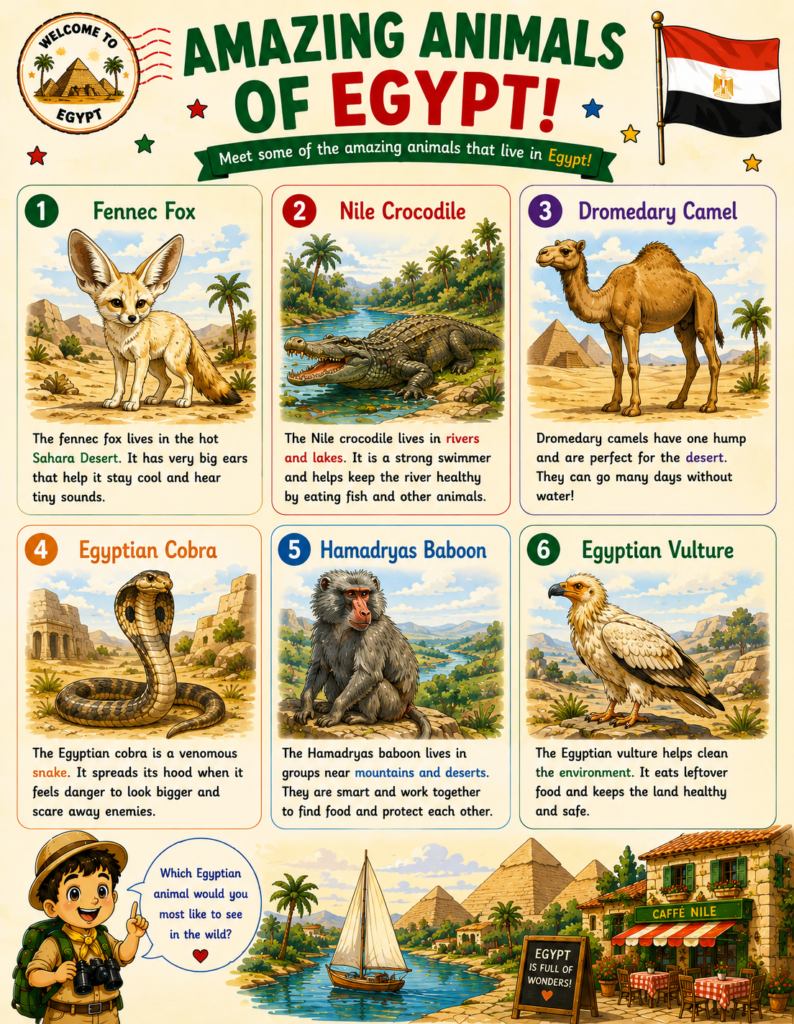
19. Egypt Is Home to Incredible Wildlife
Although much of Egypt is desert, many animals live there.
Children may discover:
- camels
- crocodiles
- flamingos
- ibises
- foxes
- desert lizards
- gazelles
The Nile River creates a rich habitat for birds and other wildlife.
20. Egypt Is One of the World’s Oldest Civilizations
Ancient Egypt began more than 5,000 years ago.
That means people were building cities, temples, writing systems, and giant monuments long before many other civilizations even existed.
Studying Egypt helps children understand how human history began.
Fun Egypt Learning Activities for Kids
Reading facts is only the beginning.
Children learn best when they actively participate, so try these engaging activities at home.
1. Build Your Own Pyramid
Use:
- LEGO bricks
- sugar cubes
- cardboard
- paper blocks
Ask your child:
Which shape makes the pyramid so strong?
2. Create Hieroglyph Messages
Write your name using simple hieroglyph symbols.
Older children can invent secret messages for family members to decode.
3. Design an Egyptian Crown
Using colored paper, markers, and stickers, children can create their own pharaoh or queen crown.
Add:
- a cobra
- a scarab
- colorful patterns
- gold decorations
4. Make a Desert Map
Draw:
- pyramids
- the Nile
- temples
- palm trees
- camels
This activity builds geography skills while encouraging creativity.
5. Go on a Treasure Hunt
Hide small objects around the house and create a simple treasure map.
Children can pretend they’re archaeologists searching for ancient artifacts.
Why Printable Geography Activities Work So Well
Many children learn more effectively when they interact with information.
Instead of simply reading:
«The Nile is the longest river.»
they remember it much better after:
- finding it on a map
- coloring it
- answering quiz questions
- solving puzzles
- matching landmarks
- completing treasure hunts
That’s why printable activities are especially popular with:
- homeschool families
- classroom teachers
- travel-themed learning
- geography clubs
- parents looking for screen-free fun
If you’re looking for more ways to make geography exciting, don’t miss our guide on how kids can learn geography without memorizing maps. It shares simple, hands-on ideas that turn learning into a real adventure for young explorers.
Inside Our Egypt Explorer Workbook
If your child enjoys learning through games, our Egypt Explorer Workbook includes over 45 printable activities designed specifically for ages 6–9.
Inside you’ll find:
✔ Geography maps
✔ Ancient Egypt facts
✔ Famous pharaohs
✔ Hieroglyph activities
✔ Coloring pages
✔ Find & Count games
✔ Grid treasure hunts
✔ Matching challenges
✔ Word searches
✔ Mazes
✔ Quizzes
✔ Creative drawing pages
✔ Explorer Certificate
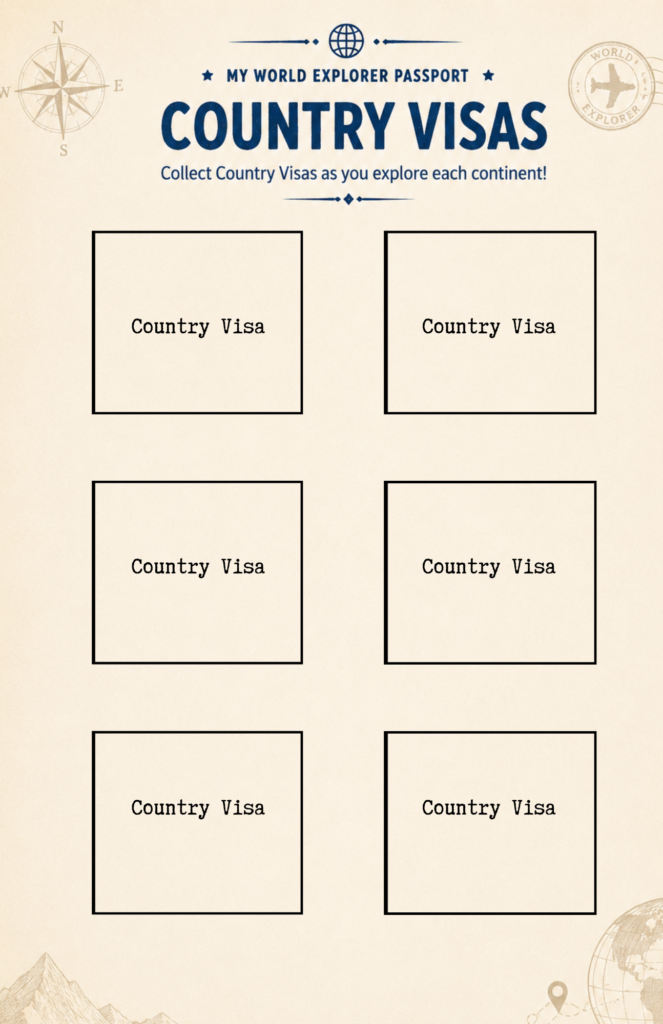
✔ Egypt Passport Visa
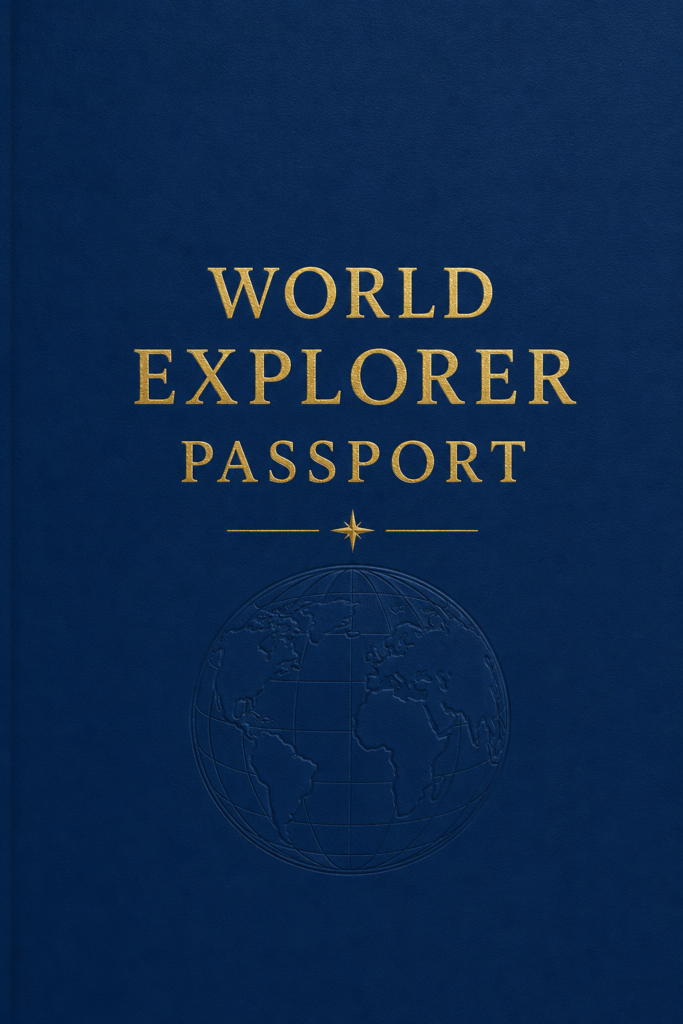
✔ World Explorer Passport bonus
Every activity is designed to make geography exciting instead of overwhelming.
One of the most exciting parts of the workbook is collecting country visas in the free World Explorer Passport. You can learn more about how the passport encourages curiosity and long-term learning in our guide below.
Frequently Asked Questions
What age is best for learning about Ancient Egypt?
Most children between 6 and 9 years old enjoy learning about Egypt because they are naturally curious about pyramids, mummies, and hidden treasures.
Can I use printable worksheets for homeschooling?
Absolutely.
Printable activity books are excellent for:
- homeschool lessons
- classroom centers
- travel learning
- rainy-day activities
- independent practice
Do children need previous geography knowledge?
Not at all.
Activities are designed to introduce concepts gradually through games, pictures, and simple explanations.
How long does it take to complete the workbook?
Most families complete several activities at a time.
The workbook can easily provide many hours of educational entertainment over multiple days or weeks.
Egypt is only one stop on an exciting journey around the world. If your young explorer enjoys learning about famous landmarks, cultures, and geography, you might also enjoy reading our guide to European countries for kids, where children can discover ten incredible destinations across Europe.
Start Your Egypt Adventure Today
Egypt is one of the most fascinating places on Earth.
From giant pyramids and mysterious hieroglyphs to powerful pharaohs and the life-giving Nile River, every page of history offers something new to discover.
When children learn through exploration, games, puzzles, and creativity, geography becomes much more than a school subject—it becomes an adventure they’ll remember.
If you’re looking for a fun, screen-free educational activity for ages 6–9, our Egypt Explorer Workbook is designed to inspire curiosity while building geography, history, reading, and observation skills through over 45 printable activities.
Happy exploring!