Why Rocks Are Not Just Heavy Stones: Teaching Geology Through Evidence and Textures
When elementary children pick up a pebble on a gravel path, they usually notice only its color and smoothness. Finding a thoughtfully sequenced rocks and the rock cycle workbook that trains young eyes to look past simple color is essential for teaching genuine earth science. This hands-on rocks and the rock cycle workbook guides learners to treat every sample as a physical historical document, where mineral grains, cooling bubbles, and layered stripes preserve the exact conditions of its formation.
Standard elementary science worksheets often reduce geology to a static three-part vocabulary drill. Students color a cartoon circle labeled igneous, sedimentary, and metamorphic, memorize that magma cools and rivers wash mud, but remain completely unable to explain why a piece of granite looks speckled while a chunk of basalt appears dark and uniform.
Moving beyond passive memorization requires treating rocks as clues that reveal dynamic planetary processes. In Rocks & the Rock Cycle Explorer: Identify Rocks & Create a Paper Rock Collection (a 32-page printable unit with 10 double-sided rock cards designed for ages 7–10), young scientists use four core investigative steps—Look, Check, Identify, and Explain—to decode the hidden history of Earth’s solid crust.

Grain Size and Cooling Rates: The Physics of Igneous Textures
The primary misconception children hold about rocks is that color is their defining characteristic. They assume that dark rocks are always made of one material and light-colored rocks are made of another.

In Rocks & the Rock Cycle Explorer, learners dismantle this assumption by comparing two igneous counterparts: speckled granite (Sample 01) and dark basalt (Sample 04):
- Granite (Intrusive): Formed when molten magma was trapped deep beneath the surface, cooling at a slow, insulated pace over thousands of years. This extended cooling window allowed individual minerals (quartz, feldspar, mica) to lock together into large, clearly visible interlocking crystal grains.
- Basalt (Extrusive): Formed when liquid lava broke onto the surface and cooled rapidly in open air or water. The quick drop in temperature froze the melt before crystals had time to expand, creating a fine-grained, uniform matrix where individual mineral pieces are too tiny to see with the naked eye.
Children also explore the extremes of volcanic cooling: obsidian cools so instantly that zero crystals form, producing natural volcanic glass, while gas-rich frothy lava solidifies into spongy pumice riddled with hollow air bubbles.
Evaluating how physical conditions dictate the final properties of a body mirrors how astronomers analyze planetary surfaces. Just as planetary geologists study how internal core heat and atmospheric pressures sculpt the crusts of inner planets—concepts explored in our guide to the Solar System Explorer Workbook—young geologists discover that Earth’s interior temperature gradients leave direct textural fingerprints on solid stone.

Mechanical Assembly: Weathering, Compaction, and Cementation
When children look at sandstone or conglomerate, they are often surprised to learn that solid stone was once loose sand drifting on a beach or pebbles tumbling in a riverbed.
The workbook guides students through the mechanical sequence of sedimentary rock formation:
- Weathering & Erosion: Physical and chemical forces break existing surface rock into loose fragments.
- Transportation & Deposition: Water currents carry the sediment until the flow slows down, allowing grains to settle in quiet lakes or ocean basins.
- Compaction: Successive layers of newly settled material press down from above, squeezing water out and packing the grains tightly together.
- Cementation: Dissolved groundwater minerals crystallize in the tiny microscopic gaps between sediment grains, gluing them into solid bedrock.
Students contrast Sample 05 (sandstone made of uniform sand grains) with Sample 07 (conglomerate holding large, rounded river stones), observing how water energy sorts materials by weight.
Understanding how water, gravity, and sediment interact introduces children to broader ecological cycles. Much like the delicate hydrological loops and soil breakdown systems that feed lush canopies—a balance detailed in our look at the Tropical Rainforest Workbook—the continuous mechanical washing of minerals from mountains to basins forms the foundation of all terrestrial landscapes.

Metamorphism: Change Under Extreme Pressure Without Melting
A major hurdle in elementary geology is grasping metamorphism. Children frequently believe that heat always melts a rock back into liquid magma.
Rocks & the Rock Cycle Explorer specifically targets this misconception on the «Changed Without Melting» spread:
- Under immense tectonic heat and directional pressure deep within mountain roots, solid minerals recrystallize and reorganize while remaining entirely in a solid state.
- Students audit and repair flawed scientific sentences, crossing out phrases like «the limestone melted» and replacing them with «the limestone changed while staying solid to become marble».
- They trace evolutionary pairings: fine-grained muddy shale transforms into durable, flat slate (Sample 03); fossil-rich limestone recrystallizes into interlocking calcite grains in marble (Sample 06); and speckled granite’s minerals realign into wavy, zebra-like bands of gneiss (Sample 09).
This principle of structural transformation under environmental pressure operates across all physical sciences. Just as plant tissues adapt their internal vascular structures to handle gravity and fluid pressure—as analyzed in our overview of the Plant Life Cycle Workbook—mineral lattices bend, re-align, and recrystallize to withstand the crushing tectonic pressures of our planet’s crust.
Scientific Skepticism: Differentiating Rocks from Look-Alikes
What makes Rocks & the Rock Cycle Explorer stand out among elementary earth science resources is its emphasis on scientific skepticism and material origin.
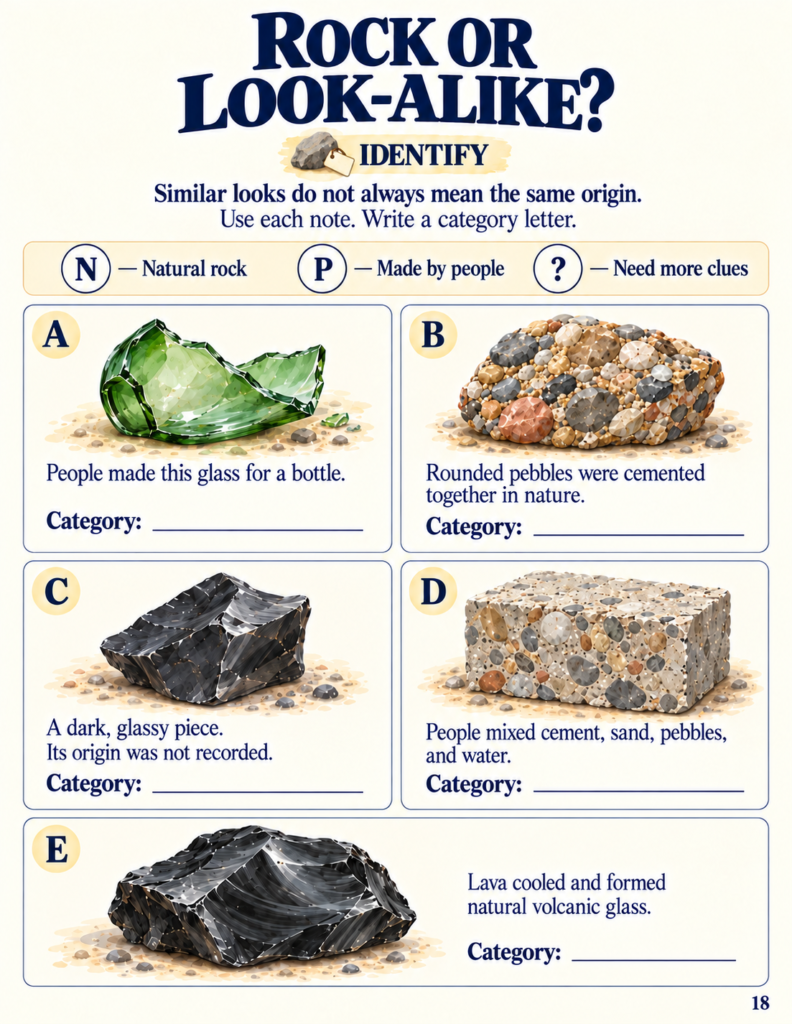
In the «Rock or Look-Alike?» investigation, students evaluate five specimens that look nearly identical at first glance:
- A piece of green broken glass from a discarded bottle versus natural volcanic obsidian.
- A poured concrete building block holding pebbles in cement versus natural river conglomerate cemented by groundwater minerals over eons.
- An unrecorded dark glassy fragment where students must choose the category «Need more clues» because its formation history was never documented.
By learning that an artifact’s physical appearance must be verified by its formation process, children gain valuable scientific discernment. They stop guessing and start asking: Where did this material originate? What forces acted on it? What does the evidence prove?
Practical Implementation for Home and Classroom
Because Rocks & the Rock Cycle Explorer is completely self-contained with illustrated specimens, a 10-card cutout paper collection, and complete answer keys, it fits smoothly into diverse instructional routines:
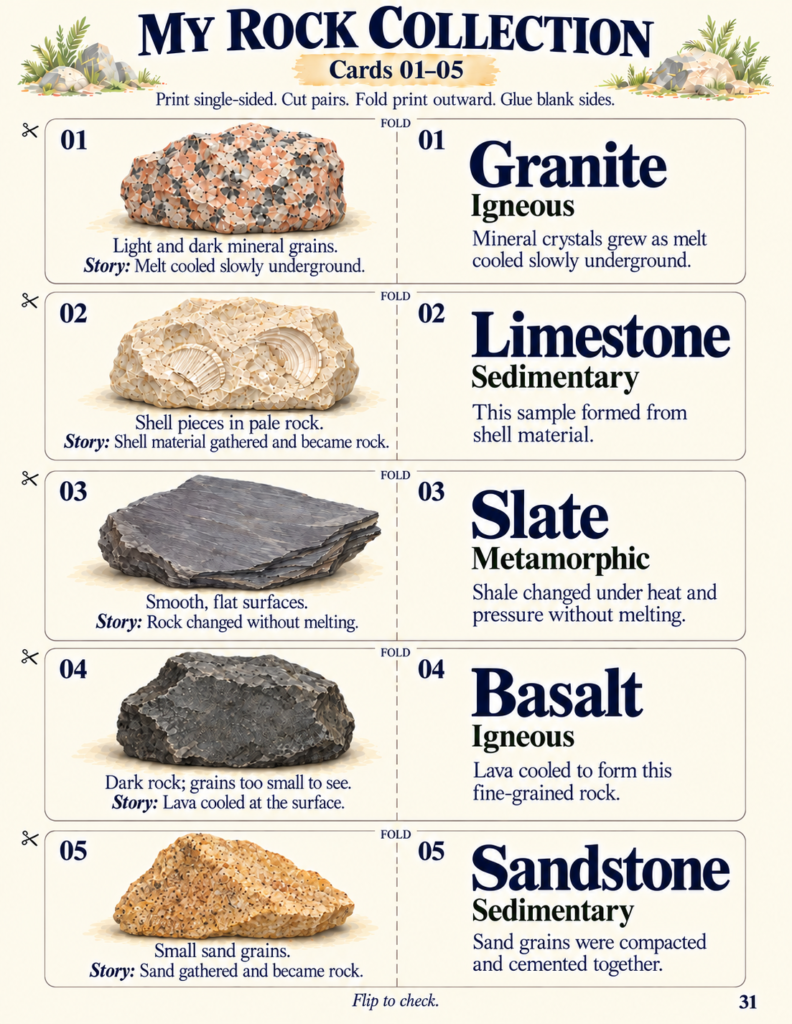

- Homeschool Earth Science Unit: Complete two pages daily over three weeks, pairing paper activities with the included physical cards to practice sorting by formation group (igneous, sedimentary, metamorphic).
- Hands-On Field Guide Capstone: Have students select one sample to create a comprehensive «Field Guide Entry» and map its possible past and future pathways through the rock cycle.
- Real-World Backyard Testing: Use the «Observation Notebook» with a magnifying glass and a drop of water to test real gravel pebbles collected outside, training children to spot wet-dry color shifts and hidden grain structures.

If you are looking for an educational printable that replaces passive coloring worksheets with authentic mineral grain analysis, dichotomous identification keys, and genuine geological reasoning, Rocks & the Rock Cycle Explorer gives young learners the scientific framework to read the solid history of Earth.