Why Plants Don’t Eat Dirt: Teaching Botany Through Experiments and Systems Thinking
Place a potted bean sprout on a kitchen scale next to a container of garden soil, and you are ready to present one of the most stubborn misconceptions in elementary science education: where does a plant actually get its mass as it grows?
Nearly every child will immediately tell you that the plant «eats» the soil through its roots. It feels intuitive: you put fertilizer and compost into the dirt, water it, and watch the stem climb upward.
Standard elementary printables rarely challenge that assumption. Instead, they hand children a cheerful cartoon daisy, ask them to color the petals, draw a line to the stem, and trace a circular arrow labeled «seed to flower.»
The real biological mechanism—that the bulk of a dried oak tree or cornstalk is plucked invisibly out of thin air via carbon dioxide—remains completely hidden.
Moving beyond passive labeling requires materials that treat flora as functioning biochemical machines. A thoughtfully sequenced plant life cycle workbook takes children out of rote memorization mode and puts them directly in charge of tracking real mass, isolating experimental variables, and mapping two-way fluid flow.
Unraveling the Soil Paradox Through Evidence
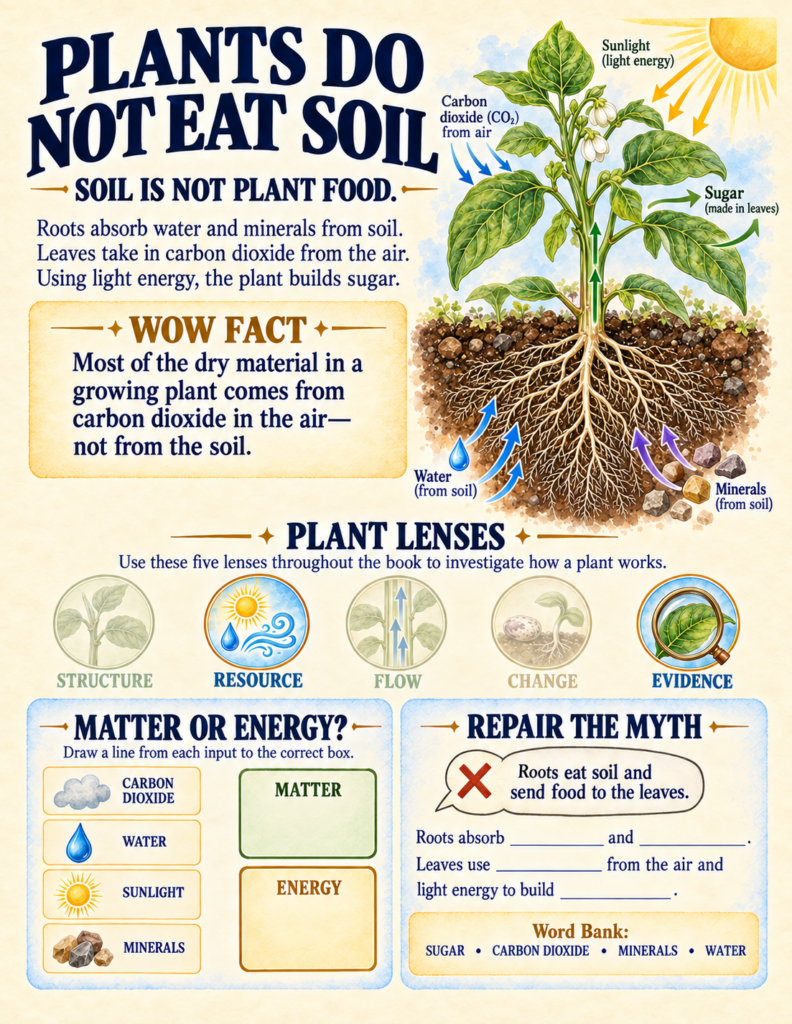
Centuries ago, Flemish scientist Jan Baptist van Helmont planted a willow tree in a measured container of dried soil, nurtured it with rainwater for five years, and discovered that while the tree gained over 150 pounds, the soil had barely lost two ounces.
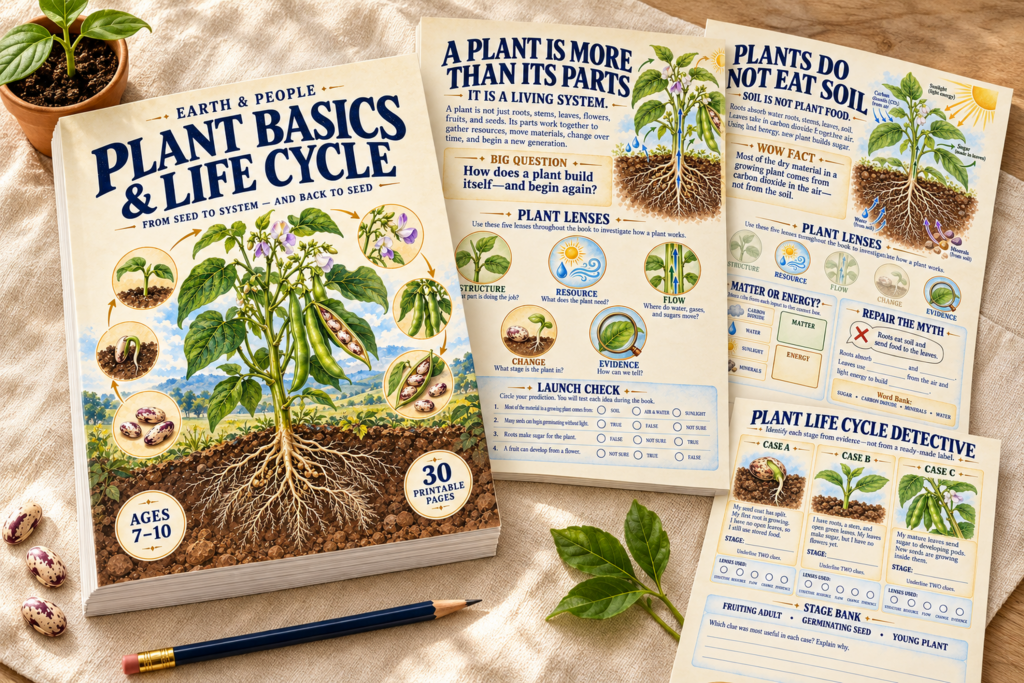
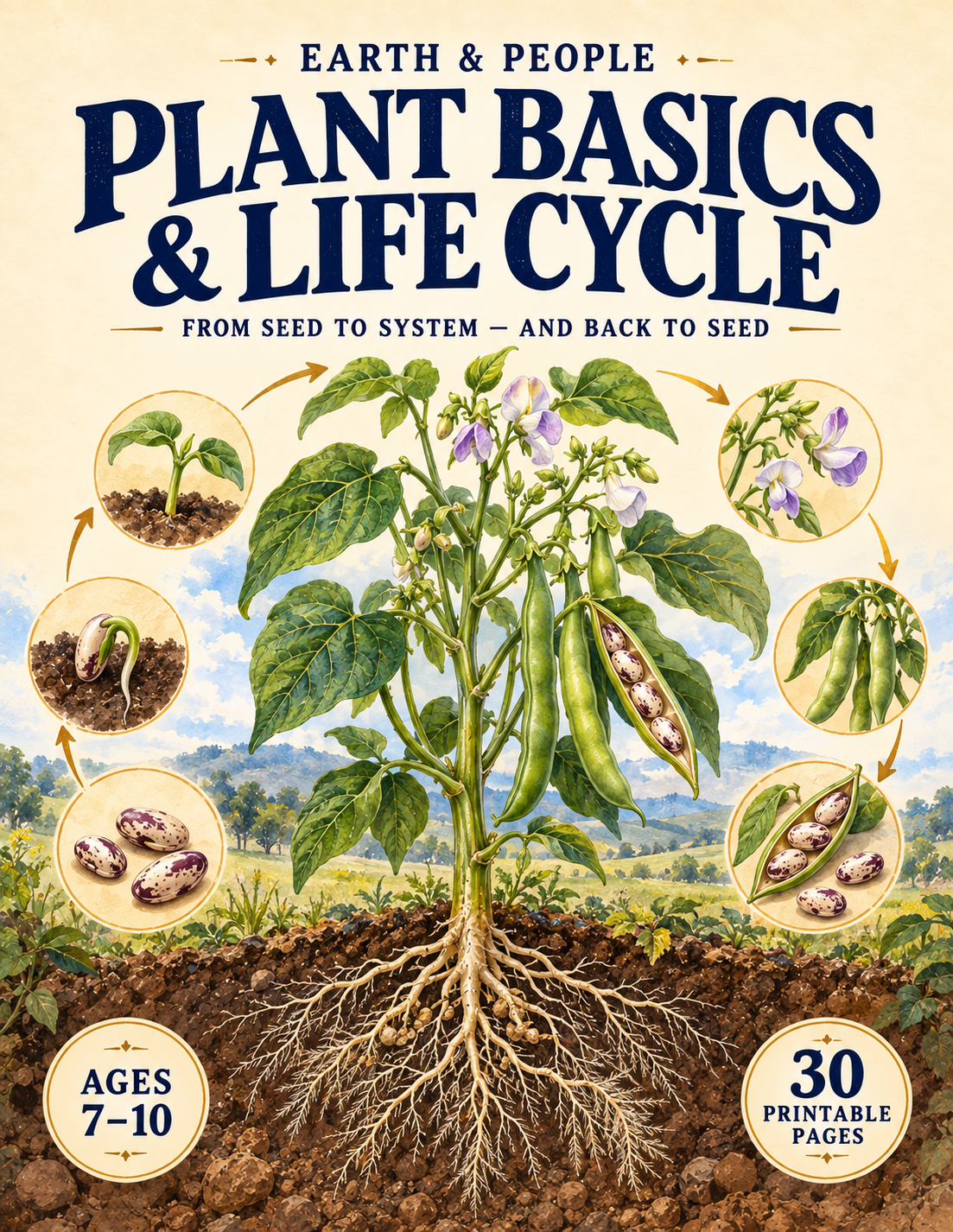
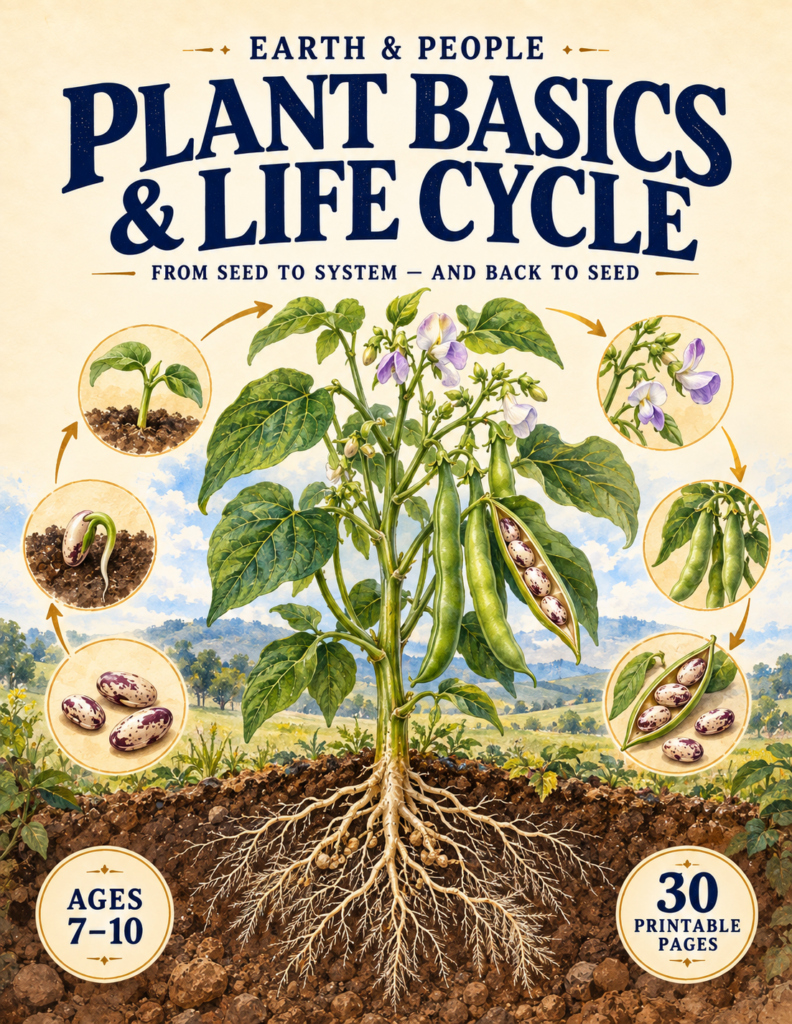
In Earth & People: Plant Basics & Life Cycle (a 30-page printable workbook created for ages 7–10), students investigate this exact quantitative puzzle on the «Growing Plant Mystery» spread:
- Before: Dry plant mass measures 5 grams; dry soil mass sits at 1,000 grams.
- After: Dry plant mass climbs to 45 grams, while the dry soil drops to 996 grams.
Faced with those explicit numbers, children must confront the evidence: if the plant gained 40 grams but the soil only shed 4 grams, dirt cannot be the plant’s food.
The workbook uses this moment to introduce the fundamental distinction between matter and energy. Soil provides water and trace minerals, but the actual carbon backbone of the plant is assembled inside the leaves using light energy to rearrange water molecules and gaseous carbon dioxide into glucose.
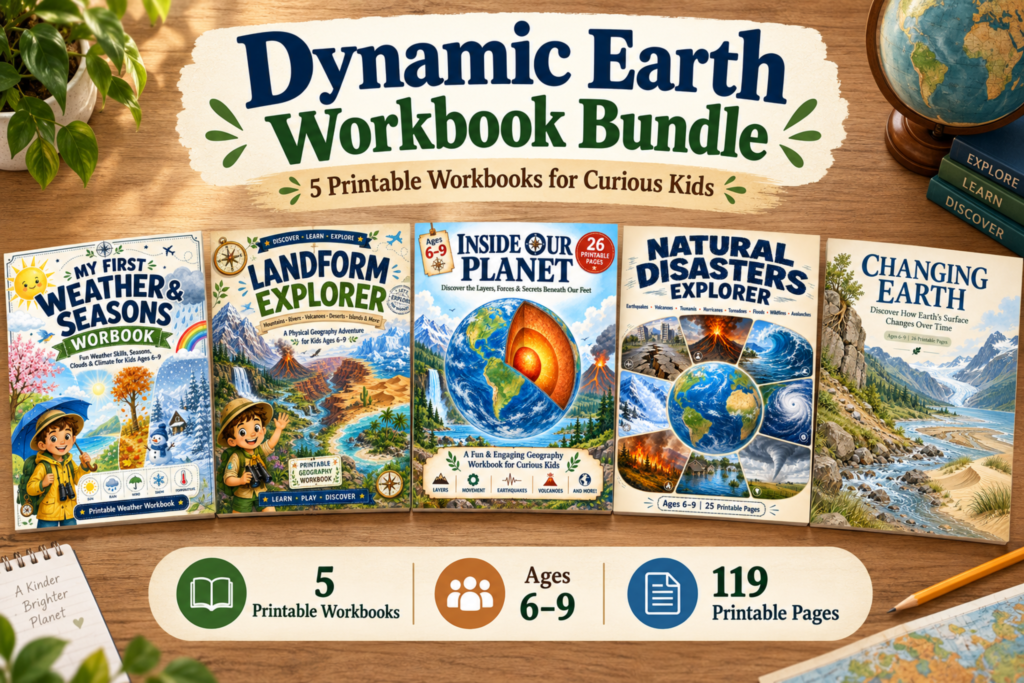
To help students ground these biochemical processes in the physical earth where roots anchor, our guide to the Dynamic Earth Workbook Bundle illustrates how weathering rock and decaying organic matter create the mineral base plants rely on.
Controlled Testing: What Truly Wakes a Seed?
Another widespread classroom myth is that seeds require bright sunlight to sprout. Because textbooks show flowers basking under a smiling cartoon sun, children assume a buried seed sits waiting for light before it can break open.
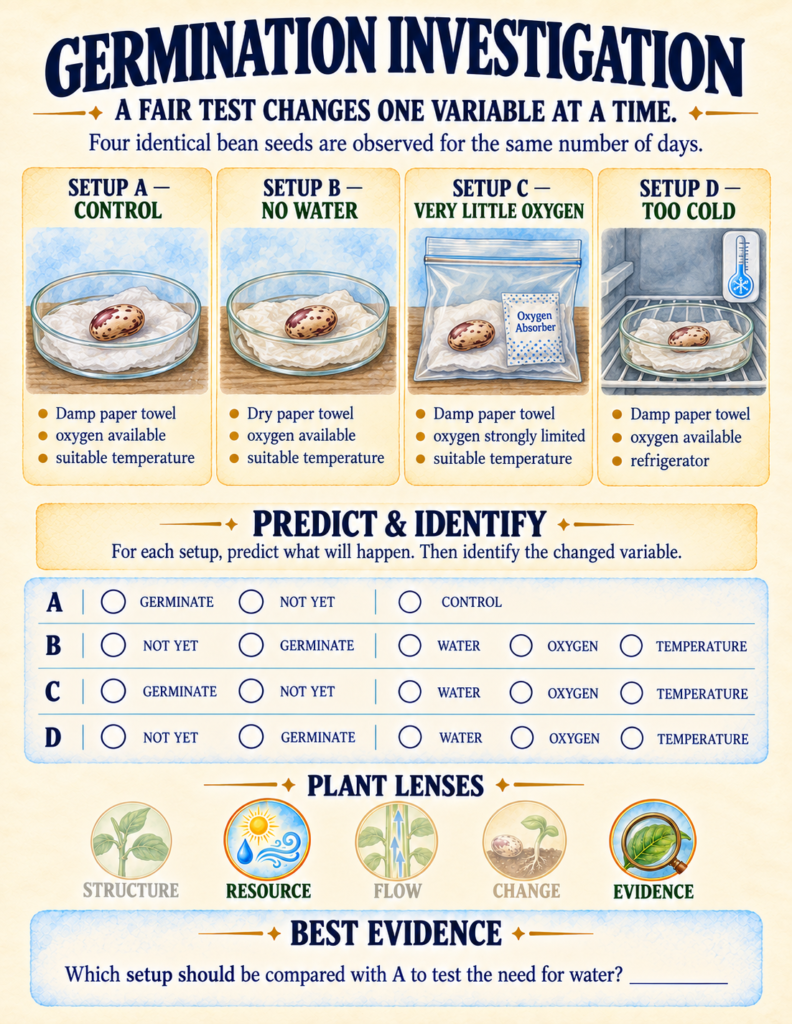
Plant Basics & Life Cycle tackles this through a rigorous fair-test investigation. Students examine four identical bean setups:
- Setup A (Control): Damp paper towel, oxygen available, suitable room temperature.
- Setup B (No Water): Dry paper towel, oxygen available, suitable room temperature.
- Setup C (Limited Oxygen): Damp paper towel, sealed oxygen-absorber pouch, suitable temperature.
- Setup D (Too Cold): Damp paper towel, oxygen available, placed inside a refrigerator.
By comparing Setups B, C, and D against Control Dish A, students discover that a seed relies on stored food within its cotyledons and requires only water, oxygen, and adequate warmth to activate germination. Sunlight only becomes essential later, when green leaves unfold and take over energy production from the dwindling cotyledons.
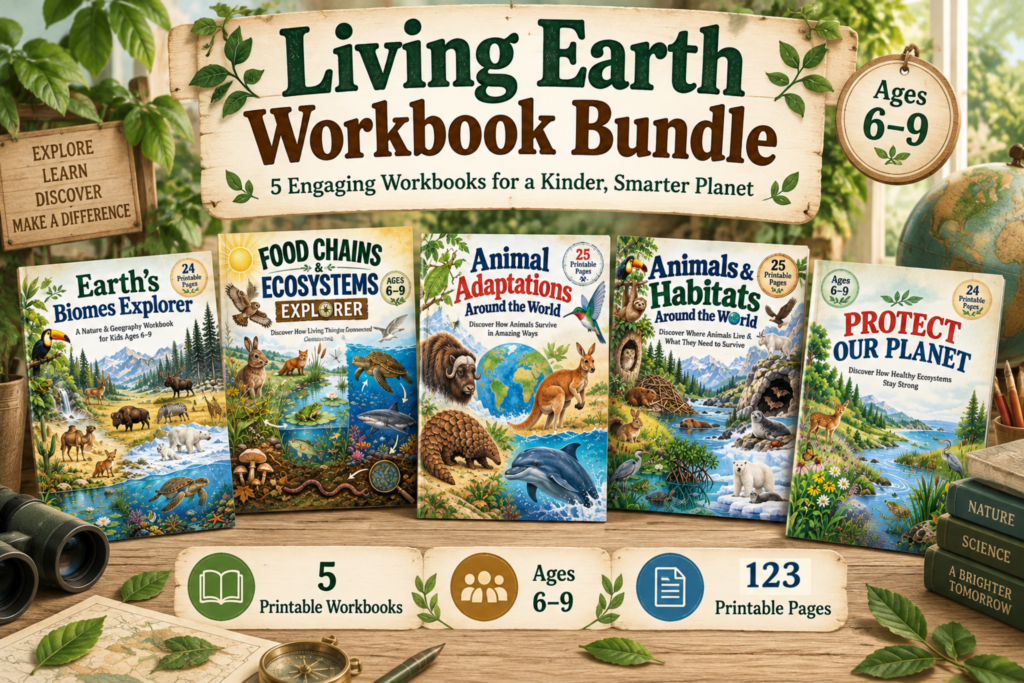
Understanding how daylight, climate zones, and changing temperatures govern plant growth across the globe is a wonderful next step. Integrating Nature Workbooks for Kids allows children to see how wild seeds adapt to seasonal weather shifts across forests, grasslands, and wetlands.
Mapping the Internal Highway: Water Up, Sugar Everywhere
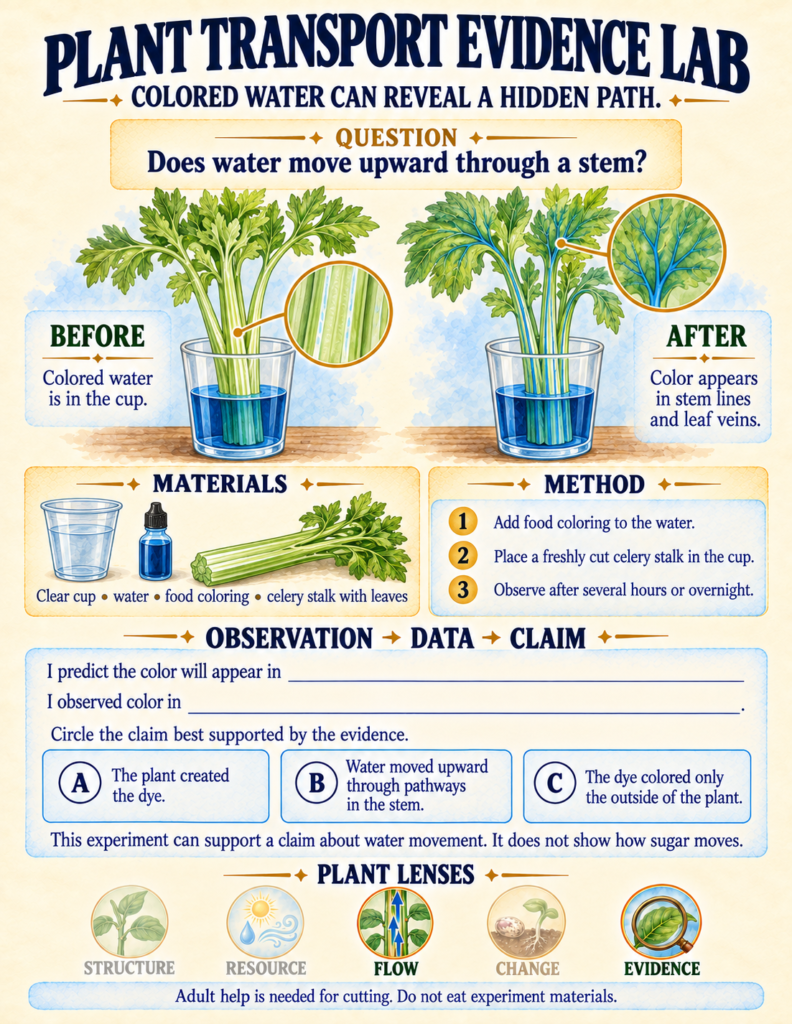
In traditional worksheet packs, the vascular system of a plant is often illustrated as a set of arrows pointing upward from root to flower.
While that describes water transport, it completely misrepresents plant metabolism. Water travels unidirectionally upward from root hairs through the stem to leaf veins, driven by transpiration. But what happens to the sugar manufactured in the canopy?
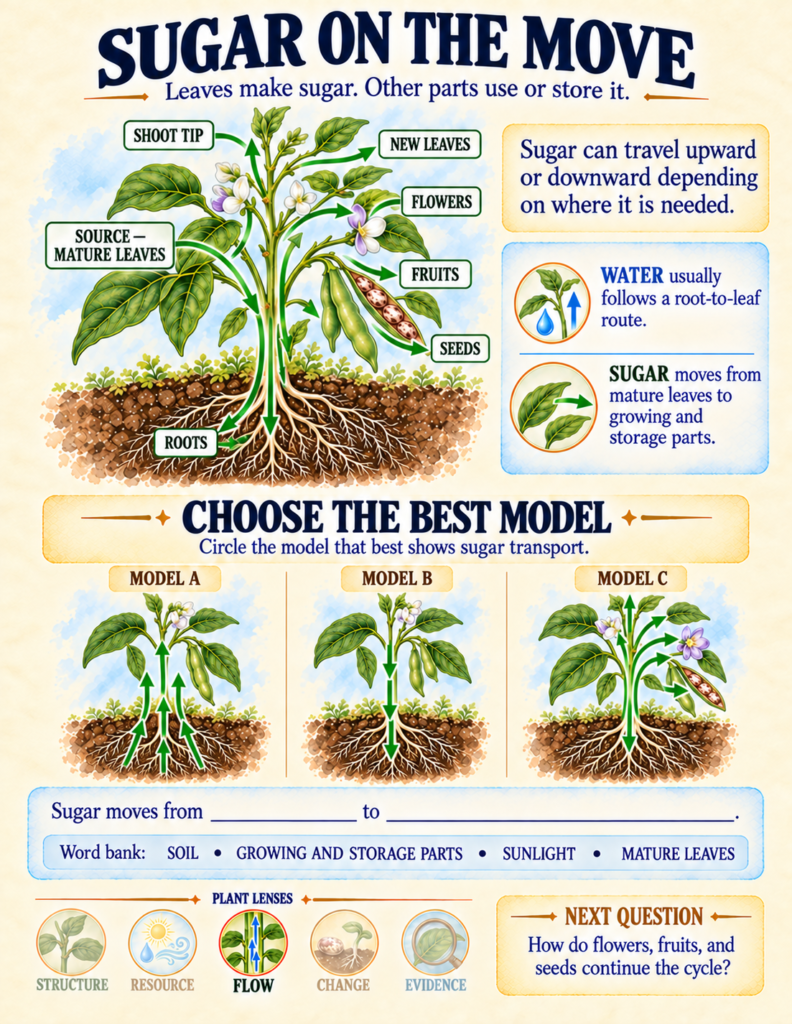
Plant Basics & Life Cycle directly addresses this with the «Sugar on the Move» modeling activity:
- Water & Minerals: Flow exclusively from soil to roots, upward through xylem vessels to the leaf blades.
- Dissolved Sugars: Move bidirectionally from mature leaf sources to wherever the plant needs energy—upward to growing shoot tips, swelling buds, and developing fruits, or downward to nourish root tips and subterranean storage tubers.
Students use colored pencils to trace both pathways side-by-side on detailed botanical diagrams, cementing the concept that a plant is a dual-circulation system rather than a one-way sponge.
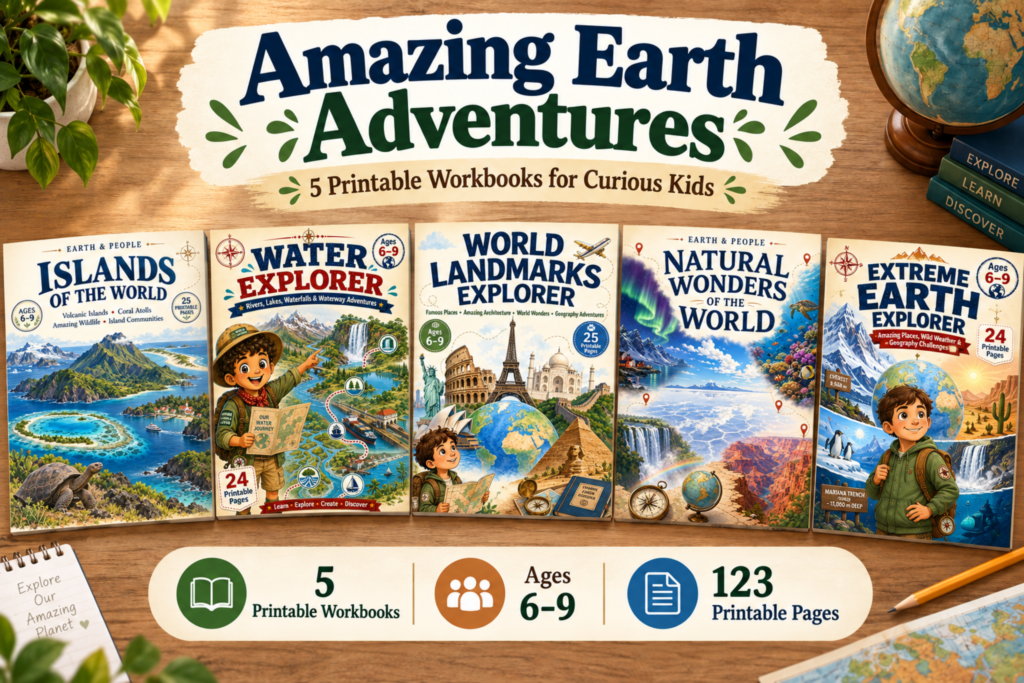
Tracing these liquid networks introduces children to the broader physics of fluids on Earth. Homeschool families frequently pair these lessons with the Amazing Earth Adventures Workbook Bundle to show how water cycling through leaves connects directly to atmospheric humidity, cloud formation, and river watersheds.
Why a Life Cycle Is a Loop, Not a Ladder
When you ask students to define a fruit, they almost always point to apples, strawberries, and oranges. But when they encounter a pea pod, a green pepper, or an acorn, they categorize them as vegetables or nuts.
Plant Basics & Life Cycle grounds botany in reproductive anatomy:
- The ovary swells to become the fruit.
- The ovules inside develop into seeds.
- Petals fade and drop away once pollination is accomplished because their visual job is complete.
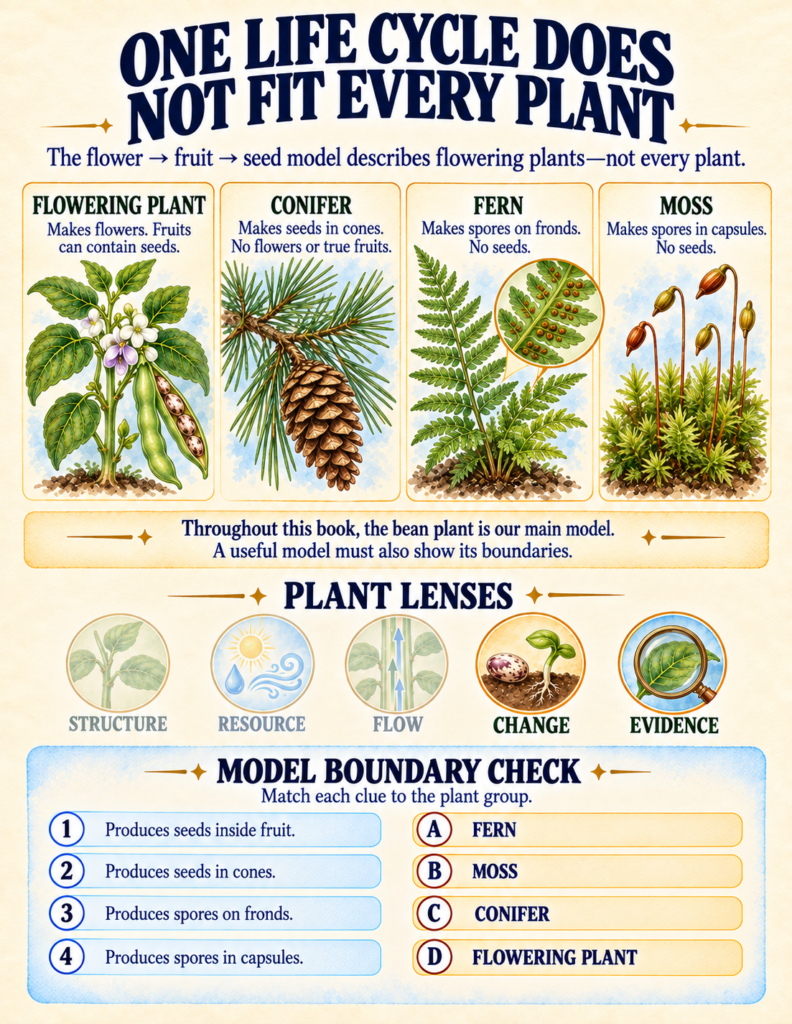
More importantly, the workbook audits the very diagrams children see in classrooms: «A Life Cycle Is a Loop, Not a Ladder.»
Students compare three distinct models: a dead-end line that stops at adulthood, an impossible circle showing a single plant transforming back into its original baby seed, and the true generational loop showing Seed A growing into an adult that produces Seed B.
They examine non-flowering exceptions—conifers bearing naked seeds in cones, ferns releasing spores from fronds, and mosses deploying spore capsules—learning that scientific models have boundaries.
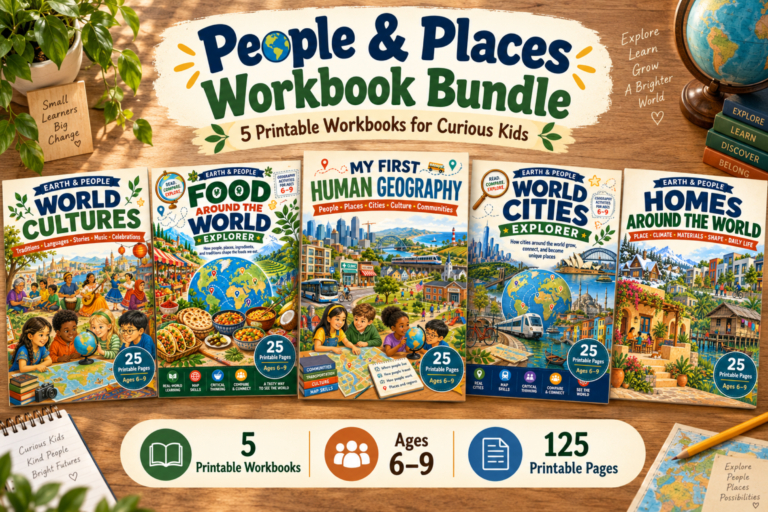
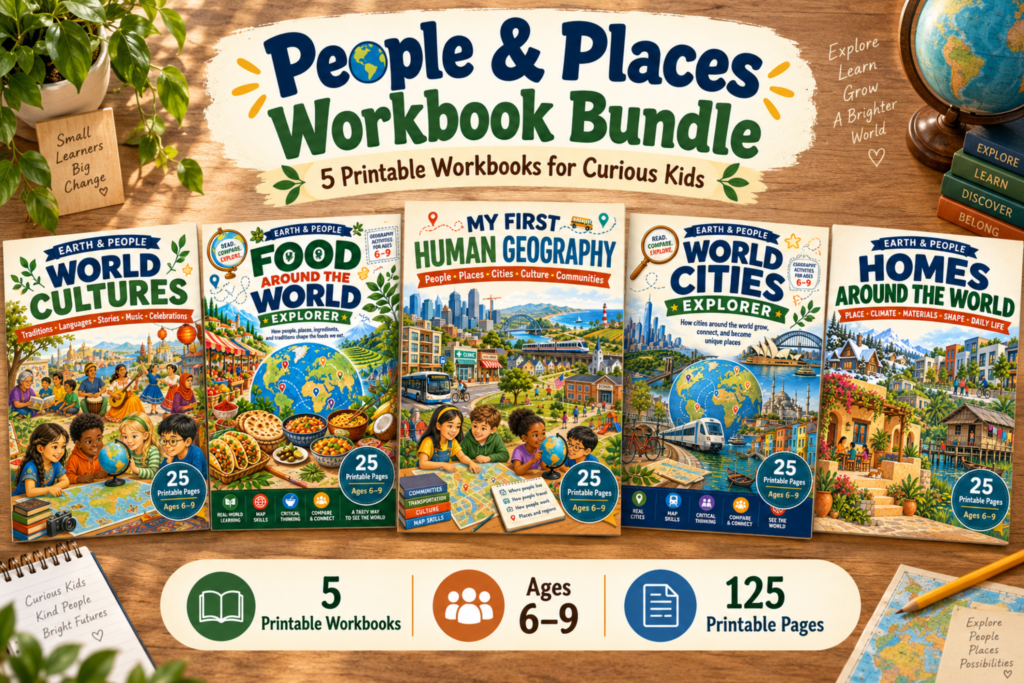
Understanding how humans historically recognized and cultivated these botanical families to feed cities connects directly to human geography. Exploring the People and Places Workbook Bundle helps students understand how early civilizations selected and farmed grain, fruit, and bean varieties around the world.
Practical Use for Home and Classroom Science
Because every activity in Plant Basics & Life Cycle relies on everyday materials (clear cups, celery, food coloring, and dried bean seeds) and includes full answer keys, it requires minimal preparation:
- Homeschool Botany Block: Run the unit over 2 to 3 weeks, combining two workbook pages daily with a simple window-sill bean germination jar.
- Classroom Science Stations: Set up the «Plant Transport Evidence Lab» or the «Plant Life Cycle Detective» case studies as independent collaborative inquiry stations.
- Nature Journal Companion: Use the multi-lens prompts to inspect real backyard weeds, parsing root hairs, leaf venation, and developing seed pods under a magnifying glass.
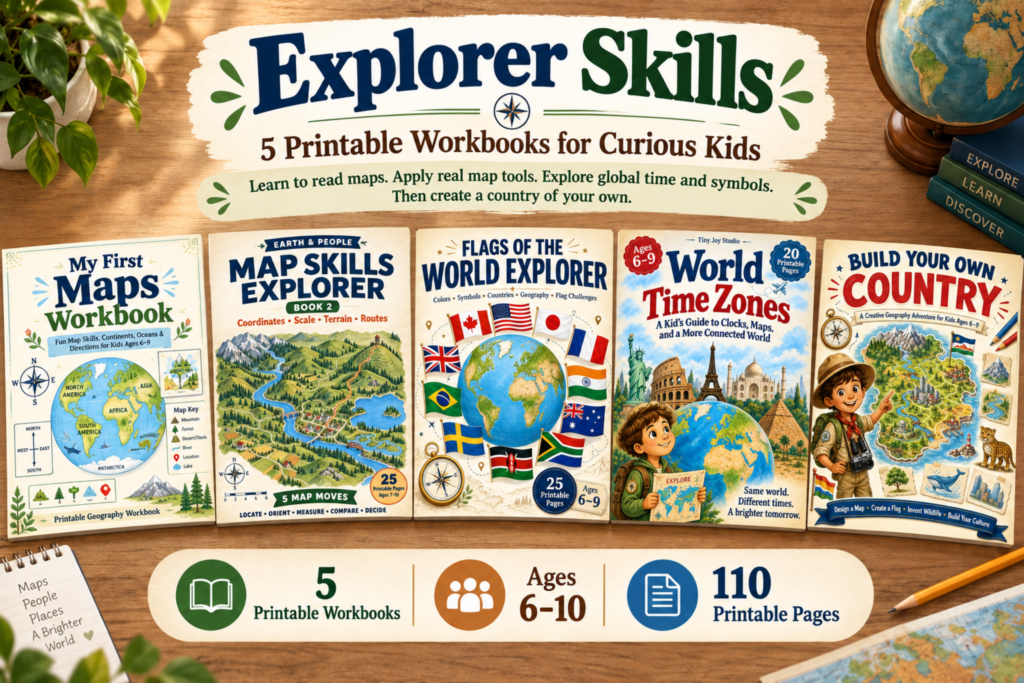
For young naturalists who love charting garden beds, reading field terrain, and keeping organized observation logs, integrating the Explorer Skills Workbook Bundle gives them the spatial tools needed to document local habitats like professional field scientists.
If you are looking for a printable science resource that trades repetitive flower coloring for real physical evidence, controlled experiments, and true systems thinking, Plant Basics & Life Cycle gives young learners the tools to understand how our green world truly builds itself.