How to Teach Space Science as a Living System (Without Boring Planet Flashcards)
Most elementary space units follow an identical, well-worn script: students color a line of eight planets spaced neatly across a sheet of paper, memorize a catchy mnemonic about pizza or noodles, and recite isolated facts about Saturn’s rings.
Yet when asked why Mercury is not the hottest planet despite being closest to the Sun, or why an astronaut cannot simply set foot on Jupiter’s striped exterior, children often find themselves at a loss.
The conventional approach to teaching astronomy treats the cosmos like a static display shelf. But in reality, the planets do not march in a neat, evenly spaced parade, nor are they interchangeable spheres of rock.
To build lasting scientific curiosity, children need more than lists of diameters and distances. A thoughtfully designed solar system workbook shifts the pedagogical focus from passive memorization to dynamic systems thinking, challenging students to investigate gravity, atmospheric thermodynamics, and empirical space evidence.
Why Space Science Requires Planetary Systems Thinking
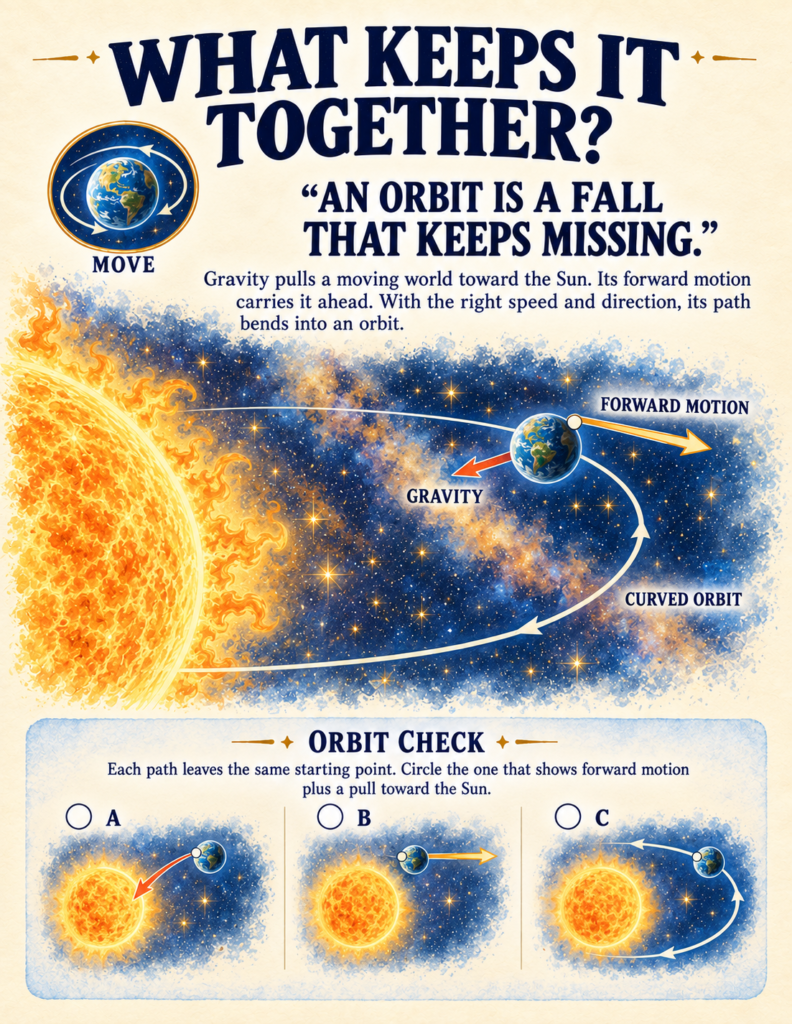
True scientific literacy begins when children realize that planetary conditions are governed by physical rules rather than arbitrary trivia. An orbit is not an abstract circular line drawn on a map; it is a continuous gravitational fall balanced by forward motion. Likewise, surface temperatures are not dictated by proximity to the Sun alone; they are dramatically transformed by atmospheric composition and heat-trapping greenhouse dynamics.
When young learners explore these physical forces, they start connecting astronomical phenomena to Earth’s own natural processes.
To help students build a solid foundation in how planetary crusts, tectonic forces, and internal heating shape rocky ground, exploring the Dynamic Earth Workbook Bundle provides a vital framework for understanding how terrestrial worlds form from the core outward.
Deconstructing Misleading Classroom Posters
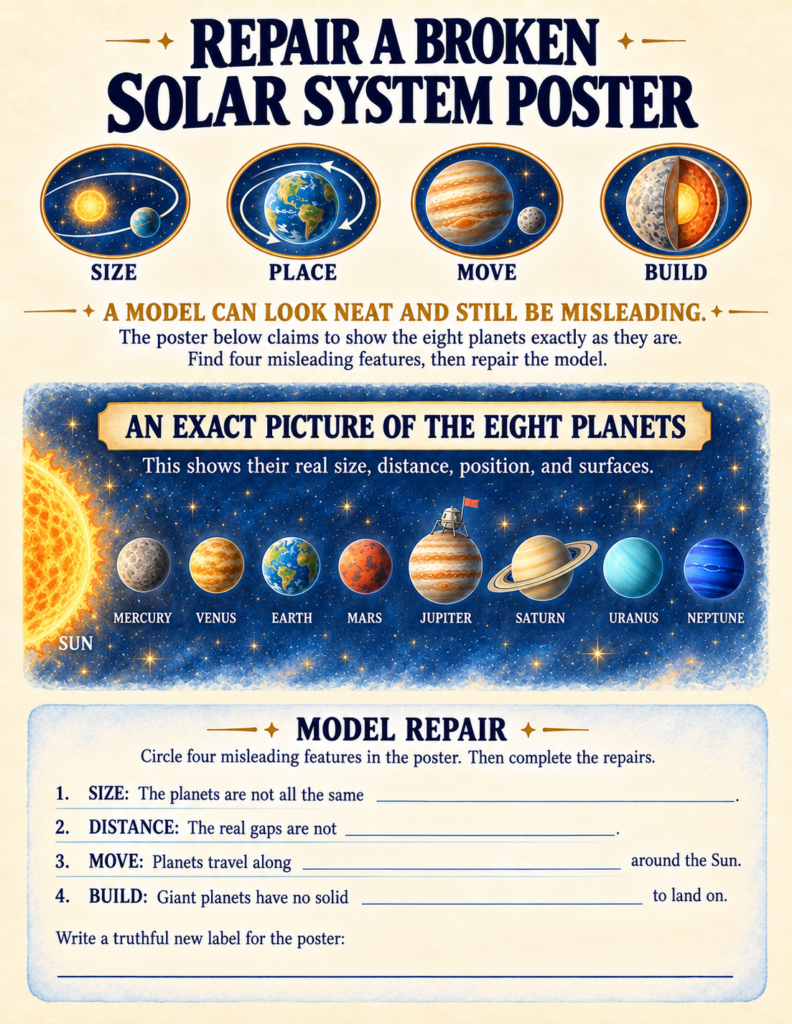
Elementary classrooms are filled with wall posters that depict planets lined up edge-to-edge, appearing similar in scale and equidistant from one another. While these diagrams simplify visual recognition, they inadvertently instill deep misconceptions about cosmic scale and physical space.
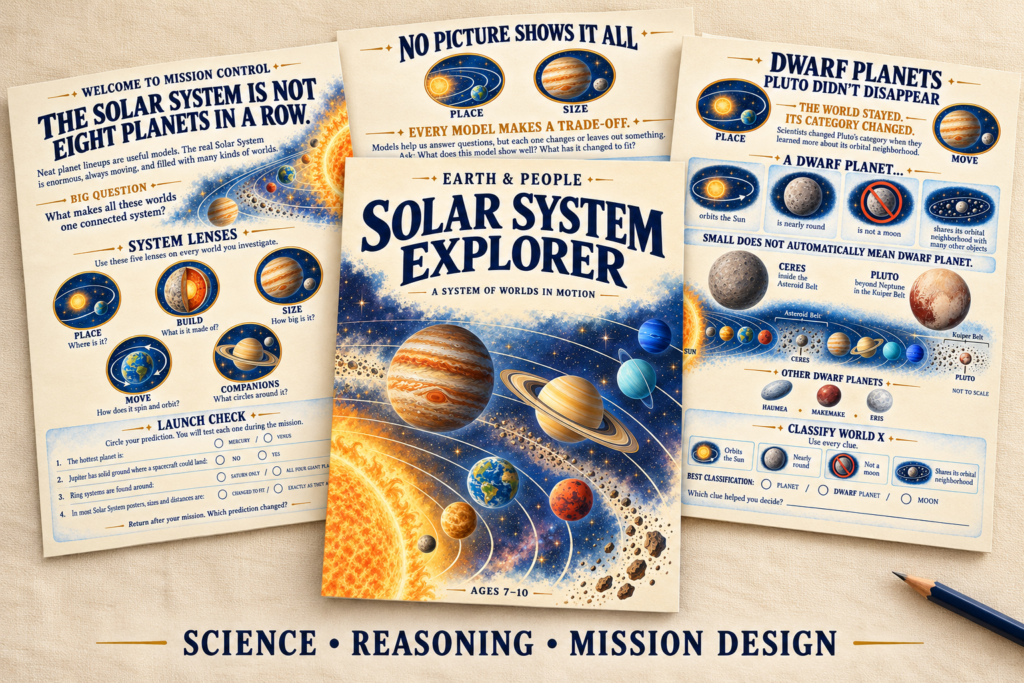
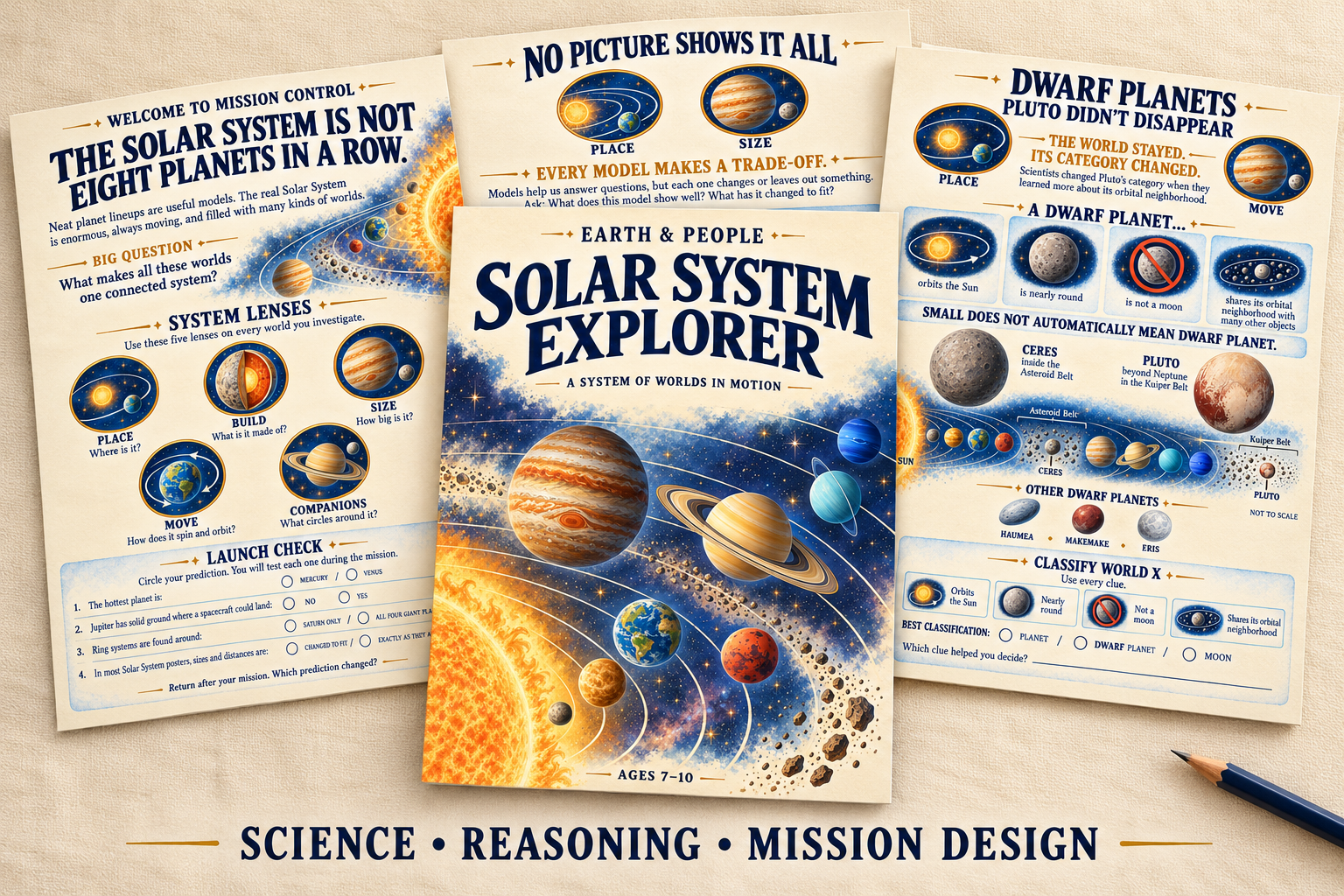
The 26-page printable Solar System Explorer: A System of Worlds in Motion (tailored for ages 7–10) directly addresses this instructional gap. Rather than asking learners to accept a single diagram as absolute truth, it trains them to evaluate visual representations through an analytical lens:
- Model A (Distance Model): Demonstrates the vast empty gaps between the outer gas giants while downplaying visible planet details.
- Model B (Order Model): Clarifies orbital sequences but distorts proportional distances and scale.
- Model C (Size Model): Accurately contrasts terrestrial planets against massive gas spheres while setting aside spatial orientation.
By engaging in structured exercises—such as the «Repair a Broken Solar System Poster» task—children identify misleading visual simplifications and rewrite labels to reflect observational reality.
To see how sunlight, seasonal shifts, and atmospheric layers support living habitats on our own globe, combining astronomy with Nature Workbooks for Kids helps children understand why Earth remains uniquely hospitable to biological life.
Investigating Worlds Through Five Observational Lenses
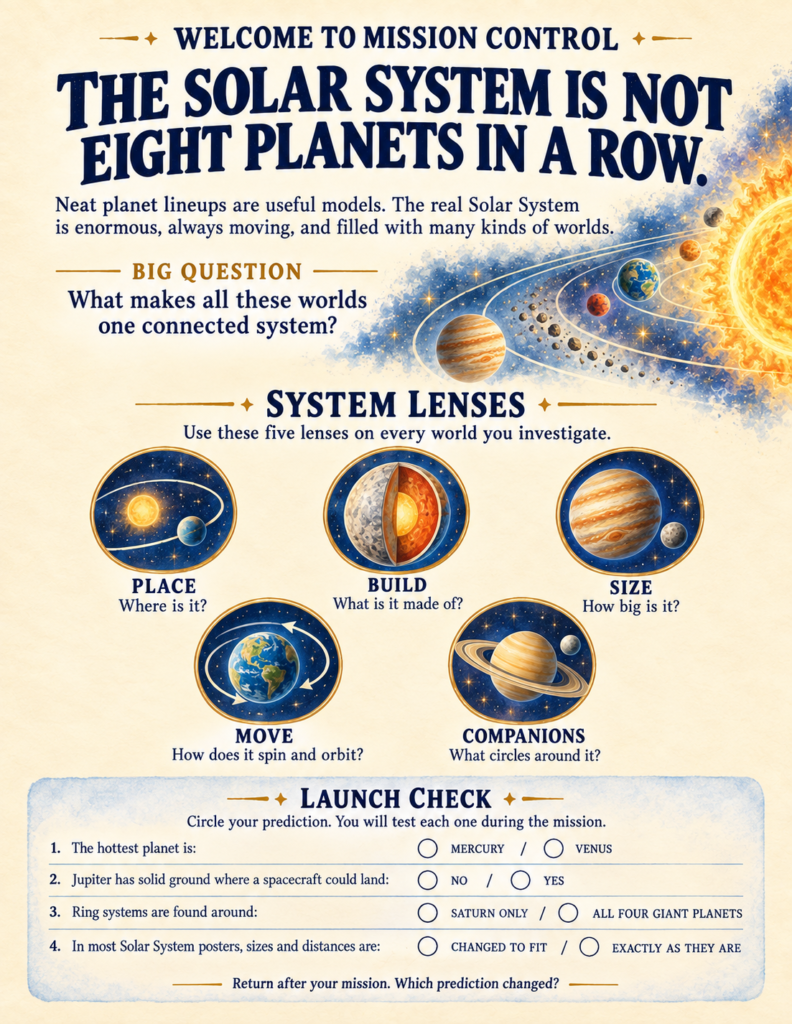
Rather than reciting disconnected bullet points, students navigate the solar system using five clear observational lenses: Place, Build, Size, Move, and Companions. This framework allows young explorers to conduct structured scientific comparisons:
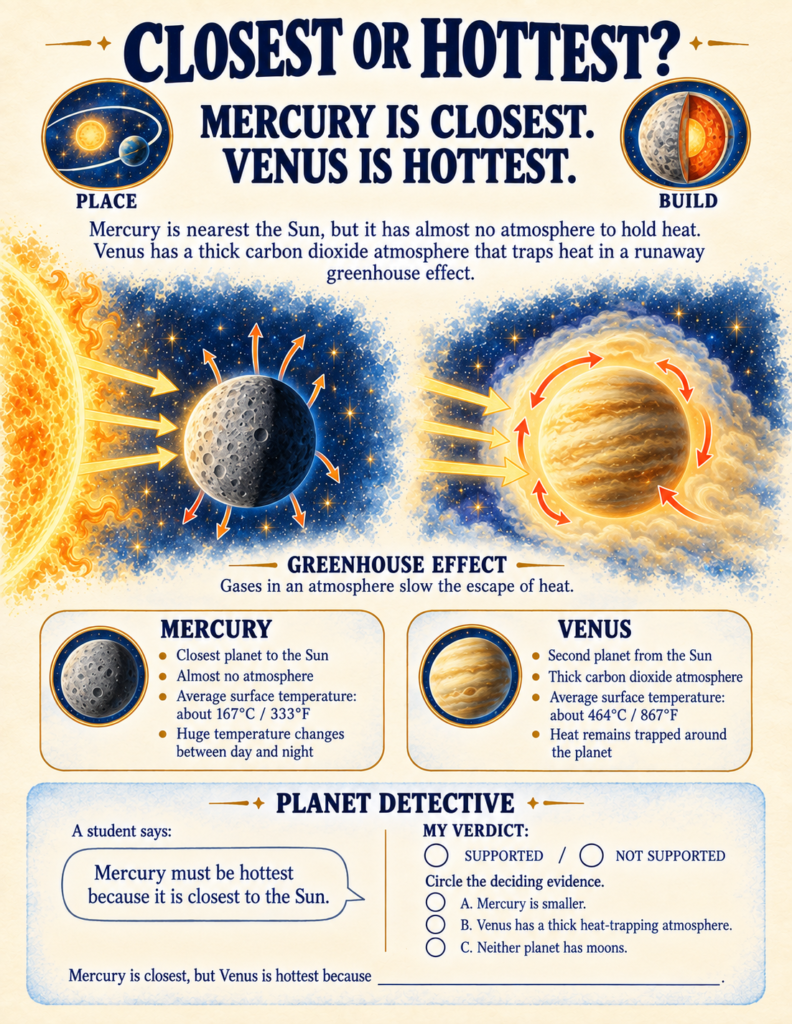
1. The Proximity vs. Atmosphere Paradox
Students tackle a common astronomical puzzle: If Mercury is nearest to the Sun, why does Venus hold the record for the highest surface temperature?
By contrasting Mercury’s virtually nonexistent exosphere ($167^\circ\text{C}$ average, with massive day-night swings) against Venus’s dense carbon dioxide atmosphere ($464^\circ\text{C}$ runaway greenhouse blanket), children learn that «Place creates the possibility, but Build changes the outcome».
2. Reconstructing Ancient Planetary Waters
When examining Mars, learners shift from passive reading to geological analysis.
They examine satellite and rover evidence—including dried river valleys, ancient deltas in Jezero Crater, and sedimentary minerals—to deduce that liquid water once flowed across Martian terrain, despite its current frigid, arid state.
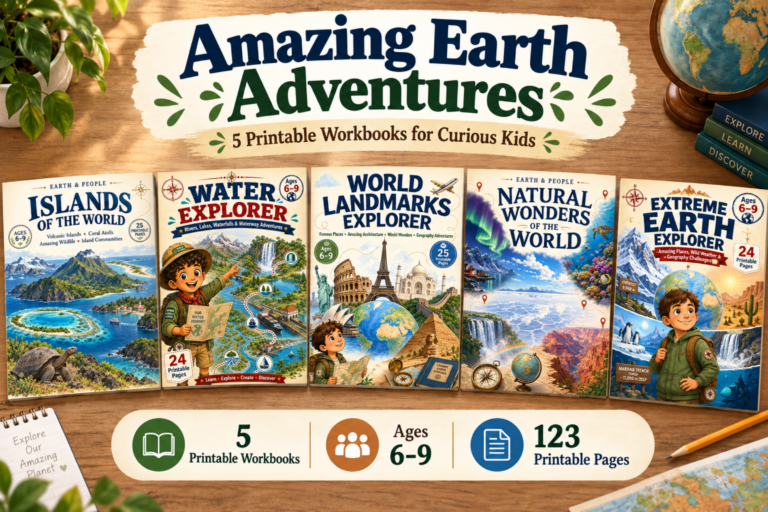
Connecting extraterrestrial geology to Earth’s breathtaking features is a natural next step for curious learners. Homeschoolers frequently pair these lessons with the Amazing Earth Adventures Workbook Bundle to compare Martian canyons and ice caps with the most extreme landforms on our home planet.
From Data Analysis to Aerospace Engineering
In the workbook’s culminating capstone, The Next Solar System Mission, learners transition from student observers to mission lead designers.
Rather than building a decorative paper rocket, students follow real aerospace workflows:
- Frame a Research Question: Choose a specific lens (e.g., investigating internal magnetism or atmospheric chemistry).
- Select the Appropriate Spacecraft: Evaluate why a rover is useless in Jupiter’s gaseous fluids, selecting instead an orbiter or descent atmospheric probe.
- Equip Specialized Scientific Payloads: Match onboard tools to the mission objective—deploying radar to map terrain beneath dense cloud cover, magnetometers to measure magnetic fields, or spectrometers to analyze atmospheric gases.
- Synthesize Mission Blueprints: Draw the custom spacecraft, incorporating required antennas, power systems, and scientific instrumentation.
To ground this high-level exploration in the geography of human innovation, exploring the People and Places Workbook Bundle highlights how international teams, spaceports, and observatories operate across different regions of our world.
Adaptable for Home and Classroom Exploration
With clear answer keys, data banks, and zero requirement for specialized science supplies, Solar System Explorer integrates effortlessly into diverse learning routines:
- Homeschool Astronomy Unit: Complete 2–3 pages daily over two weeks for an immersive, screen-free planetary science block.
- Elementary Science Stations: Print selected deduction spreads—such as the «Giant World Evidence Lab» or «Solar System Clue Detective»—for small-group collaborative problem-solving.
- Independent STEM Enrichment: Use the mission-planning capstone as a culminating project that blends physics, earth science, and creative engineering.
For students who love charting trajectories, calculating scale, and keeping scientific field records, integrating the Explorer Skills Workbook Bundle provides practical experience with cardinal directions, spatial grids, and global scales.
If you are ready to move beyond repetitive planet coloring pages and give your young explorer an authentic introduction to orbital mechanics, planetary data, and space engineering, Solar System Explorer offers an engaging, structured launchpad.