Independent Activities for Preschoolers
Introduction
There’s a special kind of confidence children build when they learn to play on their own.
Not every meaningful preschool activity needs constant instructions, supervision, or perfectly planned lessons. In fact, some of the most valuable learning happens during quiet moments when children are free to explore, create, imagine, and solve small problems independently.
For preschoolers, independent activities help develop focus, creativity, patience, emotional regulation, and self-confidence — all while giving parents a few much-needed moments to breathe.
The key is creating simple invitations to play instead of overwhelming children with too many choices.
Printable activity books, coloring pages, sensory bins, building stations, and open-ended creative setups can all encourage calm, independent learning in a way that feels playful rather than structured.
If you’re looking for easy low-prep ideas, printable preschool activity packs and coloring pages can also be a wonderful option for quiet time at home, travel days, or screen-free afternoons. Many parents love using simple printable activities because children can immediately start exploring and creating on their own.
In this guide, you’ll find easy independent activities for preschoolers that encourage learning, imagination, and confident play — without requiring complicated setups or expensive supplies.
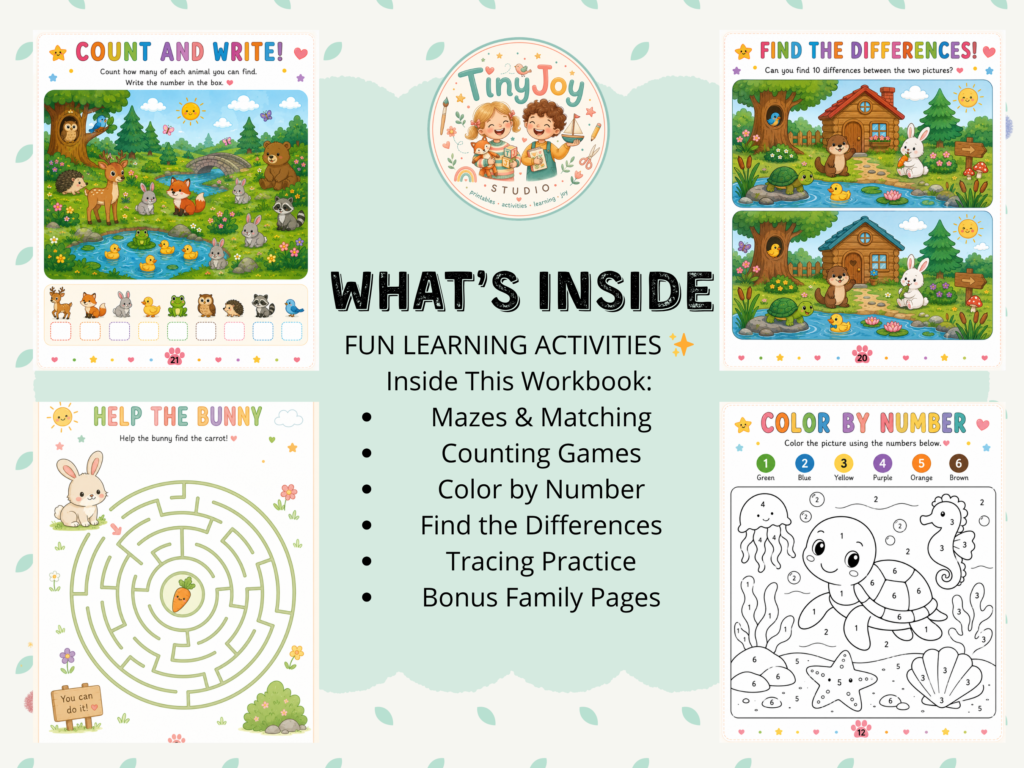
1. Printable Activity Books for Independent Learning
Sometimes the simplest activities are the ones children return to again and again.
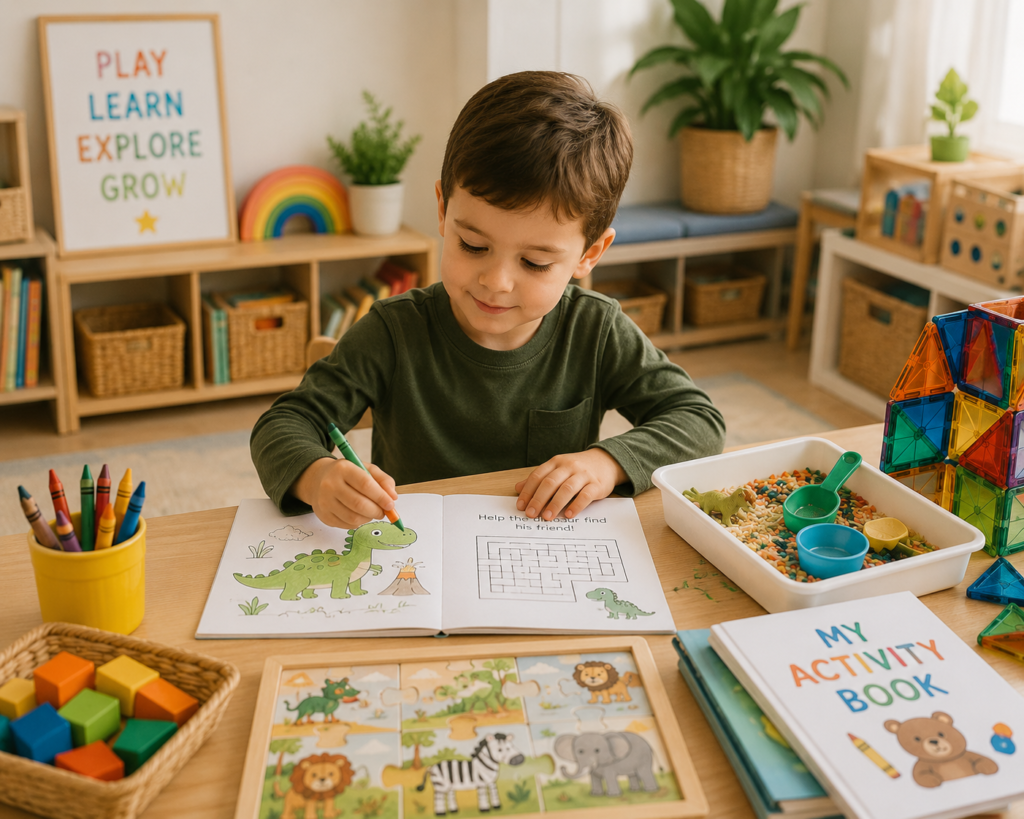
Printable activity books give preschoolers something incredibly valuable: the freedom to explore, solve, color, trace, and create at their own pace. Without loud screens or complicated instructions, children can quietly focus on one small task at a time — and that kind of calm concentration is an important skill all on its own.
For parents, printable activities are also wonderfully practical. They’re easy to prepare, easy to store, and perfect for quiet mornings, travel days, waiting rooms, rainy afternoons, or independent play time at home.
Why Preschoolers Love Printable Activities
Young children naturally enjoy activities that feel achievable.
Simple matching games, tracing pages, coloring sheets, mazes, and cut-and-paste tasks give preschoolers small moments of success that build confidence over time.
And because many printable activities are visual and hands-on, children can often complete them independently with very little adult guidance.
Easy Printable Activity Ideas
Simple Mazes
Preschool mazes help children practice problem-solving, visual tracking, and patience.
At four years old, even finishing a very simple maze can feel like a huge accomplishment.
Tracing & Pre-Writing Pages
Tracing lines, shapes, and letters strengthens the hand control children will later use for writing.
These activities are especially helpful for preschoolers who enjoy repetitive, calming tasks.
Matching Games
Matching animals, colors, shapes, or letters encourages memory and early logic skills in a playful way.
You can laminate pages for reusable learning fun or keep them as simple one-time activities.
Coloring Pages
Never underestimate the power of a good coloring page.
Coloring helps children relax, improve fine motor control, and express creativity independently — especially during quiet time.
A Gentle Tip for Parents
Try rotating printable activities instead of offering everything at once.
Children often stay engaged longer when activities feel “new” again after being put away for a few days. A small basket with a few carefully chosen printables can feel much more inviting than an overflowing shelf of options.
And sometimes, independent learning doesn’t need to look impressive.
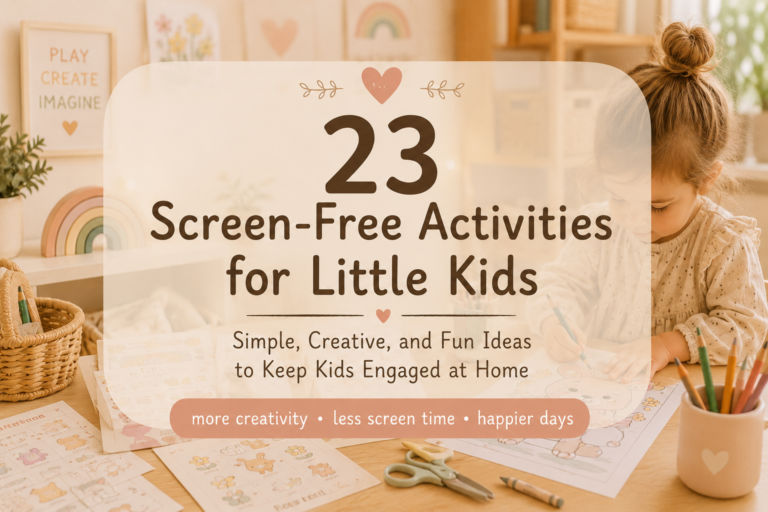
A preschooler quietly coloring at the kitchen table may be building focus, patience, creativity, and confidence all at the same time.
If your preschooler enjoys independent learning activities, printable activity books can make quiet time much more engaging and stress-free for parents.
Our printable preschool activity packs include simple mazes, tracing pages, matching games, coloring activities, and hands-on learning exercises designed especially for young children learning through play.
They’re easy to print at home and perfect for:
- quiet time,
- travel days,
- rainy afternoons,
- screen-free play,
- and independent preschool learning.
2. Sticker & Coloring Stations
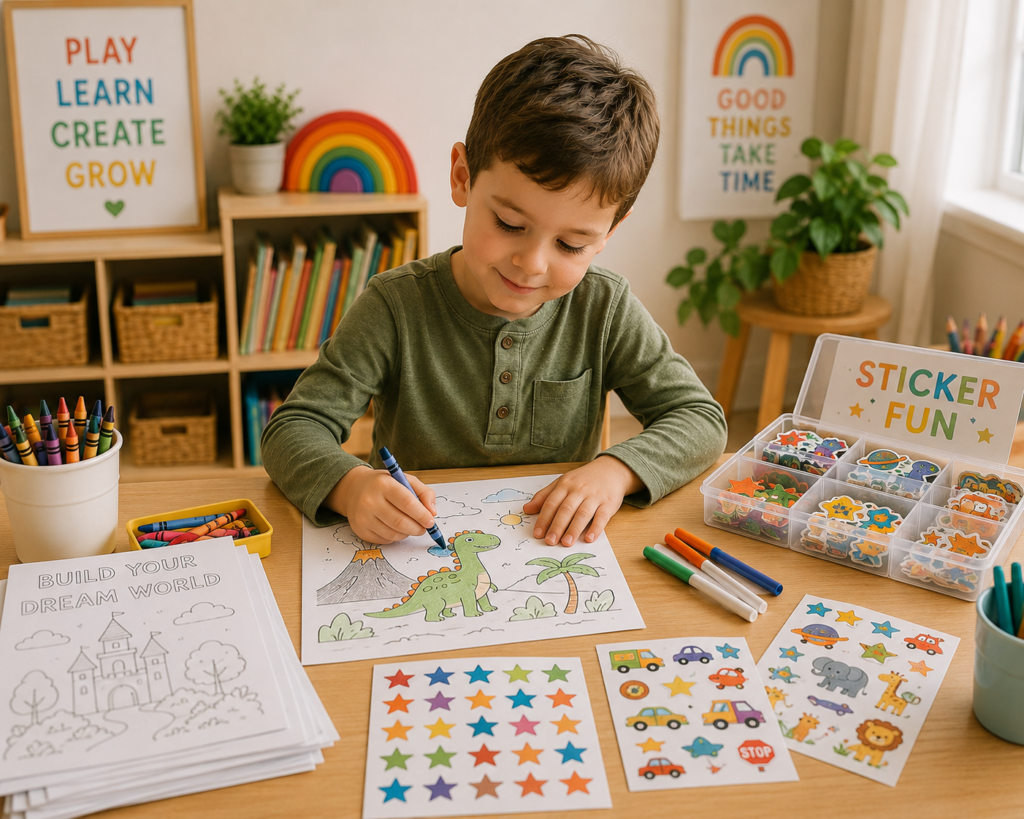
There’s a reason preschoolers can spend surprisingly long periods of time with stickers, crayons, and coloring pages.
Creative activities like these give children something many modern toys don’t always provide: open-ended freedom. There are no flashing lights, loud sounds, or “correct” ways to play. Children simply sit down and create at their own pace.
And for independent play, that’s incredibly valuable.
Sticker stations and coloring trays help preschoolers build focus, hand coordination, creativity, and decision-making skills while also creating a calm, screen-free environment that feels relaxing rather than overstimulating.
Simple Sticker & Coloring Ideas Preschoolers Love
Reusable Sticker Scenes
Create themed sticker pages like:
- farm scenes,
- dinosaurs,
- space adventures,
- under-the-sea worlds,
- or pretend towns.
Reusable stickers allow children to rearrange stories and scenes endlessly, encouraging imagination and independent storytelling.
Color-by-Shape Activities
Instead of complicated color-by-number pages, preschoolers often do better with simple color-by-shape or color matching activities.
For example:
- circles = blue
- stars = yellow
- hearts = pink
This gently combines creativity with early learning concepts.
Open-Ended Coloring Time
Not every coloring activity needs rules or goals.
Sometimes giving children complete freedom to choose colors, mix materials, and create however they want leads to the most meaningful creative play.
Purple dinosaurs? Rainbow trees? Blue suns?
Perfect.
Independent creativity grows best when children feel free to experiment.
Sticker Sorting Activities
Give preschoolers sheets of colored stickers and ask them to place matching colors onto paper, shapes, or simple charts.
This activity quietly strengthens fine motor skills, visual recognition, and concentration.
Why Quiet Creative Play Matters
In a world filled with fast-moving screens and constant stimulation, quiet creative activities can feel surprisingly powerful.
Coloring and sticker play help children slow down, focus deeply, and make independent choices without pressure or comparison.
And often, these calm little moments create something bigger than parents expect:
confidence, patience, imagination, and the ability to enjoy independent play.
Because sometimes learning doesn’t need to be loud to be meaningful.
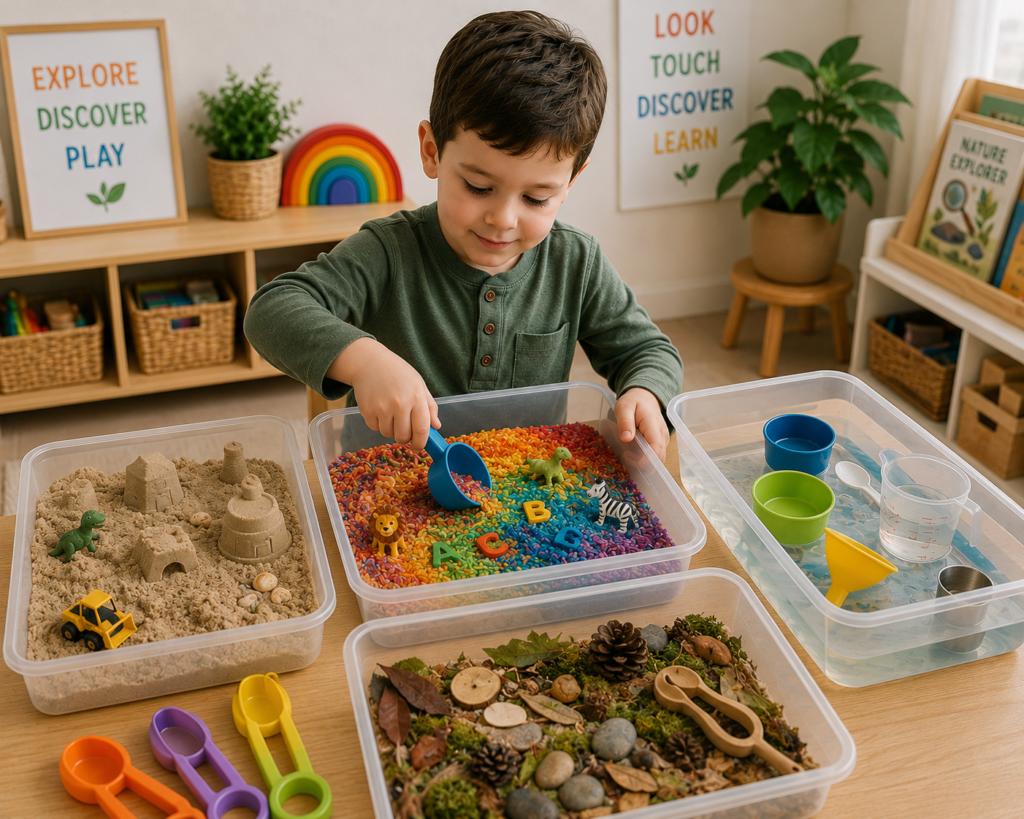
3. Sensory Bins for Quiet Play
Few preschool activities hold a child’s attention quite like a good sensory bin.
There’s something naturally calming about scooping rice, pouring water, digging through kinetic sand, or searching for tiny hidden treasures. These simple sensory experiences encourage children to slow down, focus, and explore independently without needing constant entertainment or instructions.
And for parents, sensory bins can become one of the most effective quiet-time activities in the house.
Why Sensory Play Works So Well
Sensory activities engage multiple parts of a child’s brain at the same time.
While preschoolers scoop, sort, pour, and explore textures, they’re also developing:
- fine motor skills,
- concentration,
- problem-solving abilities,
- hand-eye coordination,
- and early science concepts.
Most importantly, sensory play feels relaxing and open-ended rather than performance-based.
There’s no “perfect result” children need to achieve — only exploration.
Easy Sensory Bin Ideas for Preschoolers
Rainbow Rice Bin
Fill a container with colored rice and hide:
- toy animals,
- alphabet letters,
- pom-poms,
- or small scoops and cups.
Children can sort, search, and pour while quietly staying engaged for surprisingly long periods of time.
Kinetic Sand Tray
Kinetic sand is perfect for independent play because it’s soft, reusable, and easy to shape.
Preschoolers can build roads, castles, pretend food, or simply enjoy squeezing and molding the sand with their hands.
Water Pouring Station
Place bowls, cups, funnels, spoons, and small containers on a tray with water.
Simple pouring activities may seem basic, but they help children practice patience, coordination, and focus while creating a very calming sensory experience.
Nature Sensory Bin
Bring the outdoors inside using:
- leaves,
- rocks,
- pinecones,
- flowers,
- or small sticks.
Children naturally become curious when exploring real-world textures and objects.
A Helpful Tip for Parents
Sensory play doesn’t need to be elaborate to be effective.
Often the simplest setups create the longest engagement. A small tray with rice and measuring cups can sometimes entertain a preschooler longer than an expensive toy.
And yes — sensory bins can be messy.
But they also create moments of deep concentration, calm exploration, and independent problem-solving that are incredibly valuable during the preschool years.
Sometimes a little mess is simply evidence of meaningful learning happening nearby.
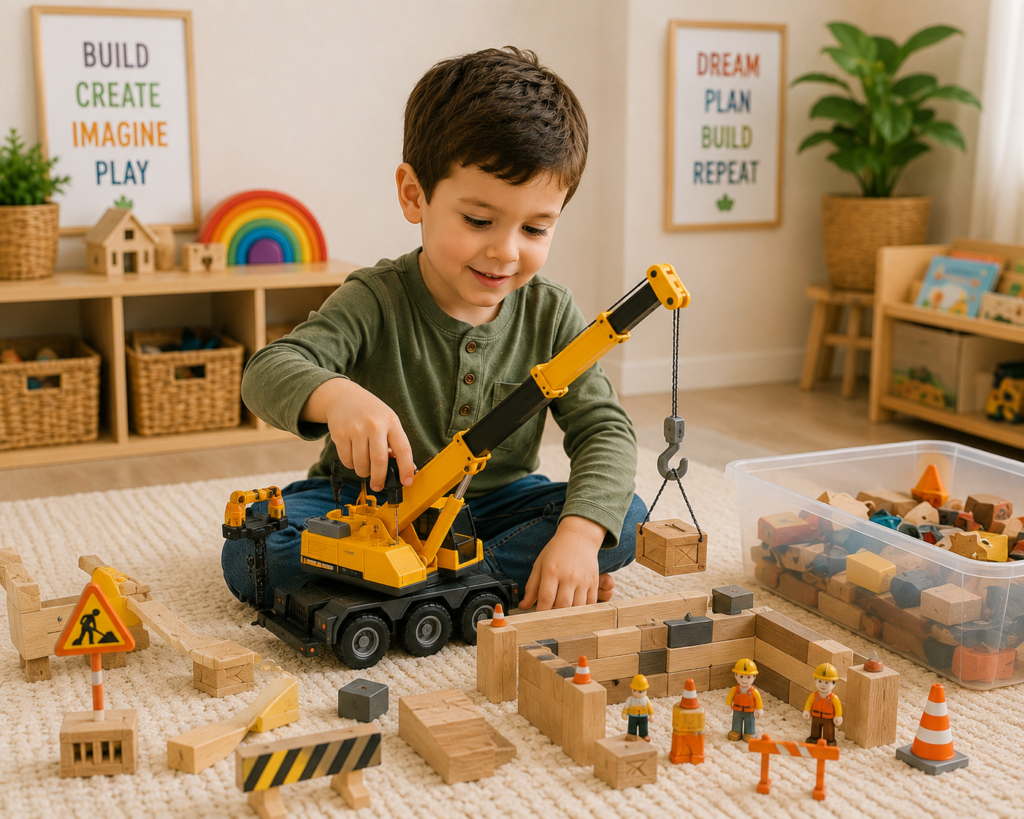
4. Building & Construction Activities
Few things make preschoolers feel more capable than building something with their own hands.
Whether it’s a tall block tower, a pretend city made from magnetic tiles, or a carefully balanced LEGO creation, construction play gives children the chance to experiment, problem-solve, and think independently in a way that feels exciting rather than instructional.
And unlike many structured activities, building play naturally grows with the child. A simple tower today can become an elaborate spaceship or miniature neighborhood tomorrow.
Why Building Activities Are So Valuable
Construction activities help preschoolers develop:
- spatial awareness,
- problem-solving skills,
- patience,
- creativity,
- hand-eye coordination,
- and persistence.
Children quickly learn that when a tower falls down, they can simply try again. That quiet resilience is an important life skill hidden inside play.
Building activities also encourage children to stay focused for longer periods of time because they feel personally invested in what they’re creating.
Easy Independent Building Activities
Block Tower Challenges
Invite your child to:
- build the tallest tower possible,
- create a bridge,
- build a house for toy animals,
- or make towers using only certain colors.
Simple prompts help spark creativity without controlling the activity.
Magnetic Tile Creations
Magnetic tiles are wonderful for open-ended preschool play because children can independently build:
- castles,
- roads,
- rockets,
- garages,
- or imaginary worlds.
There’s no single “correct” outcome, which encourages experimentation and confidence.
LEGO Invitation Trays
Set up a tray with a small pile of LEGO pieces and a simple challenge:
- “Can you build a car?”
- “Can you build an animal?”
- “Can you build something that flies?”
Small invitations like these often inspire surprisingly creative independent play.
Build a Pretend City
Using blocks, toy cars, figurines, and cardboard boxes, children can design their own miniature town.
This type of imaginative construction play combines storytelling, creativity, and engineering thinking all at once.
A Helpful Reminder for Parents
Not every building activity needs instructions or a finished goal.
Sometimes children learn the most during the process itself:
testing ideas, knocking things down, rebuilding, and experimenting freely.
A crooked tower or unfinished bridge doesn’t mean the activity failed.
It usually means real learning is happening.
Because independent play is often less about creating something perfect — and more about giving children the confidence to create something at all.
5. Pretend Play Invitations
Preschoolers have an incredible ability to transform ordinary objects into entire imaginary worlds.
A cardboard box becomes a bakery. A blanket turns into a castle. A toy stethoscope suddenly creates a busy doctor’s office filled with stuffed-animal patients.
Pretend play may look simple from the outside, but it’s actually one of the richest forms of independent learning during the preschool years.
When children engage in imaginative role play, they practice communication, emotional expression, storytelling, creativity, and problem-solving — all while having fun.
Why Pretend Play Is So Important
Pretend play allows preschoolers to process the world around them.
Children naturally reenact experiences they’ve seen in daily life:
- grocery shopping,
- cooking,
- visiting the doctor,
- caring for babies,
- building houses,
- or going on adventures.
Through imaginative play, children begin understanding emotions, social situations, routines, and relationships in a safe and playful way.
And because there are no strict rules, pretend play also builds independent thinking and creativity.
Easy Pretend Play Setups for Preschoolers
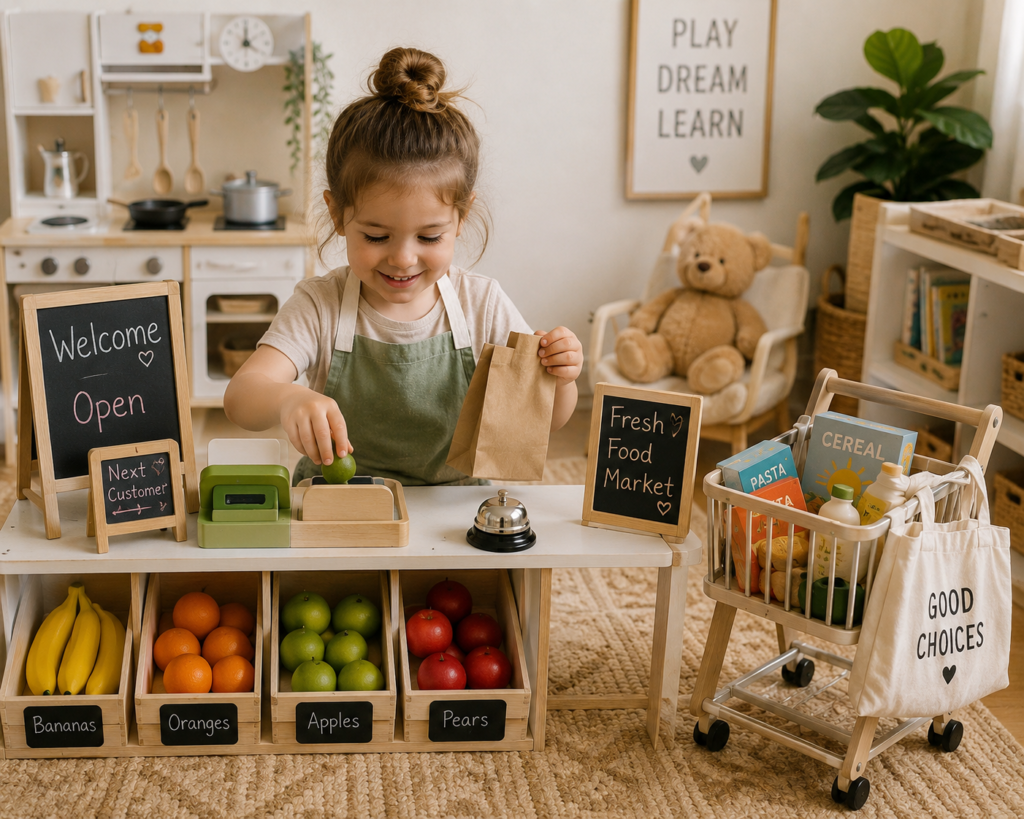
Pretend Grocery Store
Set up empty food boxes, baskets, toy money, and a small checkout station.
Children can independently “shop,” organize food, and create their own little store world for surprisingly long periods of time.
Toy Doctor Station
Using toy medical kits or simple household items, children can care for stuffed animals, dolls, or imaginary patients.
This kind of role play often helps preschoolers process emotions and feel more confident about real-life experiences.
Puppet Theater
Simple hand puppets or even paper bag puppets can inspire storytelling, conversations, and imaginative adventures.
Children love creating their own characters and little worlds.
Mini Kitchen or Café Setup
Toy kitchens remain one of the most timeless preschool activities for a reason.
Cooking pretend meals, serving customers, and organizing food encourages creativity, sequencing, and independent play skills.
A Helpful Tip for Parents
Pretend play works best when adults don’t control every detail.
Instead of directing the story, try simply setting up the environment and letting children lead the play themselves.
Often the most creative ideas appear when preschoolers are given space to imagine freely.
And sometimes, what looks like “just playing” is actually a child practicing confidence, communication, empathy, and creativity all at once.
6. Quiet Time Learning Activities
Every preschooler needs moments of calm during the day.
Not every activity has to be energetic, messy, or highly stimulating. In fact, quiet independent activities are often some of the most beneficial for helping children practice focus, patience, emotional regulation, and self-directed learning.
Quiet time activities create space for preschoolers to slow down, recharge, and feel comfortable entertaining themselves without screens or constant attention from adults.
And for many parents, these peaceful moments can feel like a small miracle.
Why Quiet Independent Play Matters
Preschoolers live in a world full of stimulation:
- screens,
- sounds,
- busy schedules,
- bright toys,
- and constant activity.
Quiet learning activities help balance all of that.
They teach children how to:
- focus independently,
- solve small problems,
- manage boredom creatively,
- and enjoy calm moments without needing constant entertainment.
These are valuable life skills that often become even more important as children grow older.
Easy Quiet Time Activities for Preschoolers
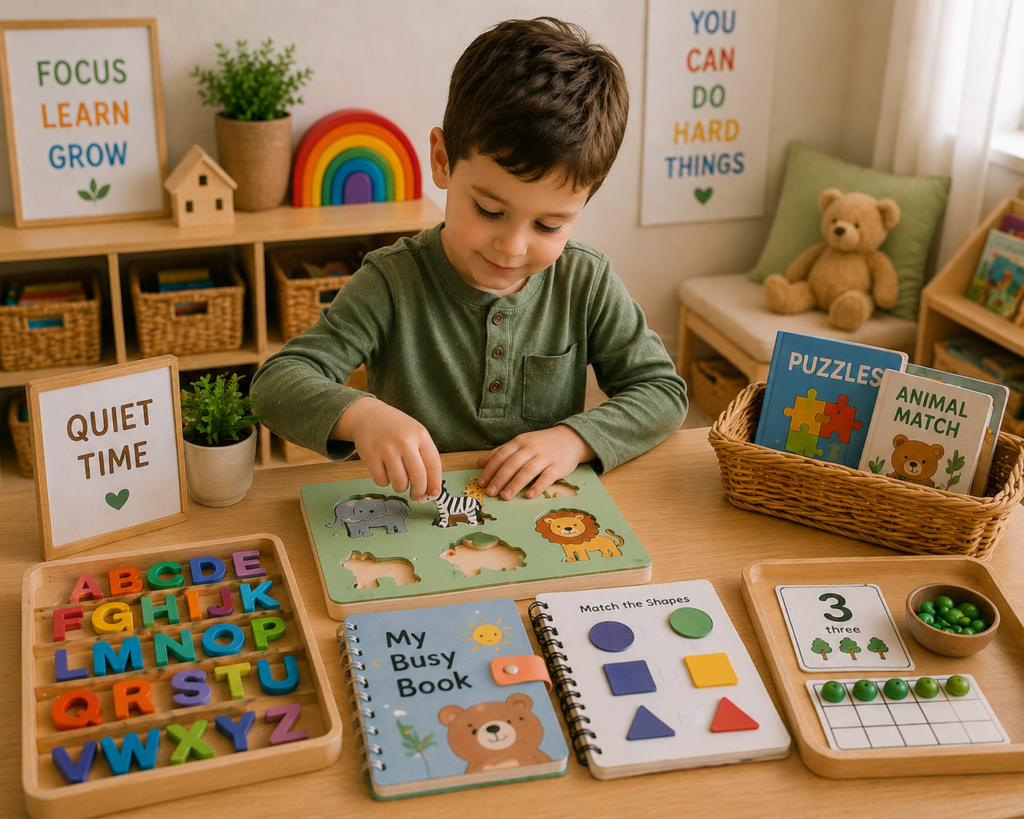
Simple Puzzles
Age-appropriate puzzles encourage problem-solving, concentration, and patience.
Even simple wooden puzzles can keep preschoolers engaged while quietly strengthening critical thinking skills.
Busy Books
Busy books filled with matching games, velcro activities, tracing pages, or sorting tasks are wonderful for independent quiet play.
Many children enjoy returning to the same activities repeatedly because repetition feels comforting and confidence-building.
Alphabet & Number Trays
Create simple trays using:
- magnetic letters,
- counting objects,
- number cards,
- or alphabet matching games.
These calm hands-on activities gently reinforce early literacy and math concepts.
Picture Matching Games
Matching cards with animals, colors, shapes, or everyday objects are simple but highly engaging for preschoolers.
And because children can play independently, these activities work beautifully during quiet afternoons or independent learning time.
A Gentle Reminder for Parents
Quiet play does not mean children need to sit perfectly still or silently for long periods of time.
Independent learning at this age should still feel warm, playful, and flexible.
Some days your preschooler may spend thirty focused minutes with puzzles or activity books. Other days they may move quickly between activities. Both are completely normal.
The goal isn’t perfect concentration.
The goal is helping children slowly build confidence in their ability to explore, create, and play independently.
And often, those small quiet moments become the moments where children grow the most.
7. Art Trays & Creative Invitations
Some of the best preschool activities begin with a simple invitation:
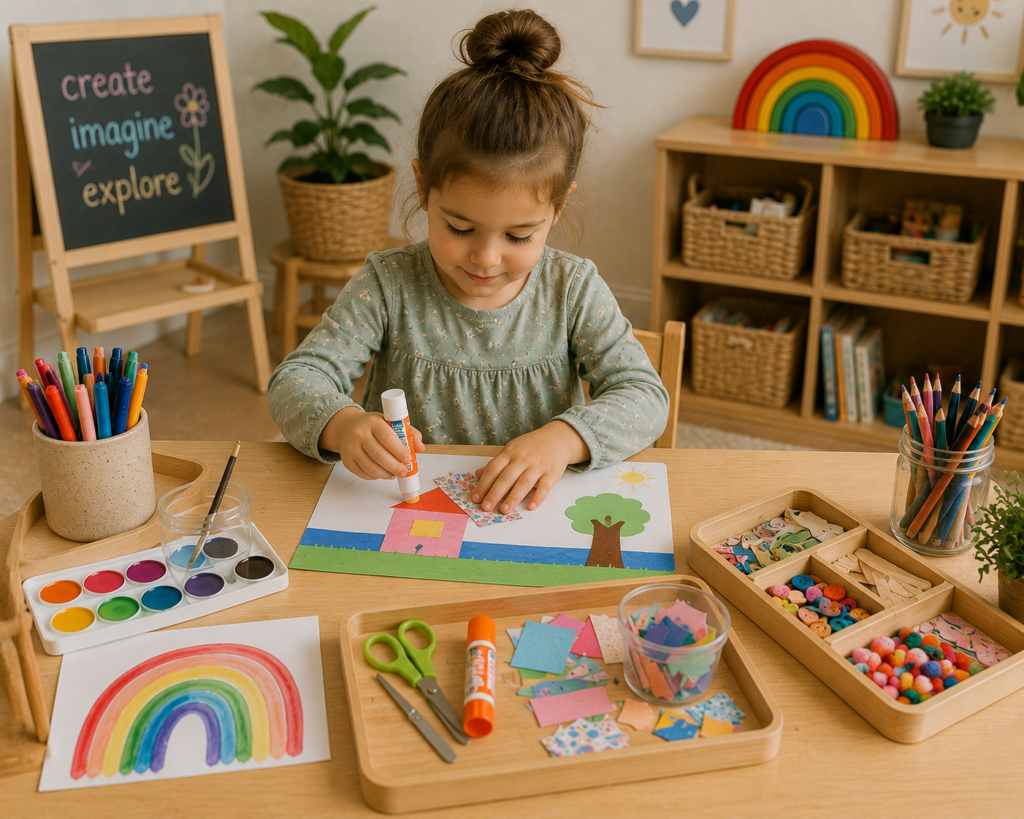
a tray of paper, crayons, scissors, glue, and the freedom to create.
Creative play doesn’t need step-by-step instructions to be meaningful. In fact, preschoolers often become most engaged when they’re given open-ended materials and the opportunity to make their own choices.
Art trays and creative stations encourage independent exploration while helping children develop confidence, imagination, and problem-solving skills in a calm and natural way.
Why Open-Ended Creativity Matters
When children create freely, they learn to trust their own ideas.
There’s no single “correct” outcome in open-ended art activities, which helps preschoolers feel more relaxed and willing to experiment.
Creative invitations also support:
- fine motor development,
- emotional expression,
- decision-making,
- focus,
- and independent thinking.
And unlike many fast-paced toys, art activities naturally encourage children to slow down and stay present in the moment.
Easy Art Tray Ideas for Preschoolers
Watercolor Painting Station
Set out:
- watercolor paints,
- thick paper,
- brushes,
- and cups of water.
Preschoolers often become deeply focused while mixing colors and experimenting freely with painting.
Cut-and-Glue Crafts
Provide child-safe scissors, scraps of colored paper, stickers, glue sticks, and simple shapes.
Children can independently create collages, imaginary animals, houses, or abstract art projects.
Loose Parts Art
Using buttons, pom-poms, leaves, craft sticks, or recycled materials, preschoolers can build creative pictures and designs.
This type of open-ended creativity encourages experimentation without pressure.
Drawing Invitations
Instead of telling children exactly what to draw, try offering simple prompts like:
- “Can you draw an imaginary animal?”
- “What would your dream playground look like?”
- “Can you create your own planet?”
These gentle prompts inspire storytelling and imagination while still allowing children full creative freedom.
A Gentle Reminder for Parents
Creative play doesn’t need to look perfect to be valuable.
A preschooler cutting uneven shapes, covering paper in random colors, or gluing stickers everywhere is still learning important skills.
The goal isn’t creating Pinterest-perfect crafts.
The goal is helping children feel confident expressing their own ideas.
Because when children are given the freedom to create independently, they’re not just making art — they’re building confidence in their ability to think, imagine, and explore the world in their own unique way.
8. Outdoor Independent Play Ideas
Sometimes the best preschool activities don’t happen inside at all.
Outdoor play gives children something many indoor activities can’t fully provide: space to move freely, explore naturally, and follow their own curiosity without constant structure.
And the wonderful thing about outdoor independent play is that it often requires very little preparation. A few simple materials, fresh air, and room to explore can keep preschoolers engaged far longer than parents expect.
Why Outdoor Play Is So Valuable
Outdoor activities help preschoolers develop:
- gross motor skills,
- confidence,
- independence,
- observation skills,
- creativity,
- and emotional regulation.
Nature also encourages a calmer kind of attention. Children naturally slow down when they’re collecting leaves, drawing with chalk, or searching for tiny bugs in the grass.
And unlike highly structured activities, outdoor play allows children to explore at their own pace.
Easy Outdoor Activities for Preschoolers
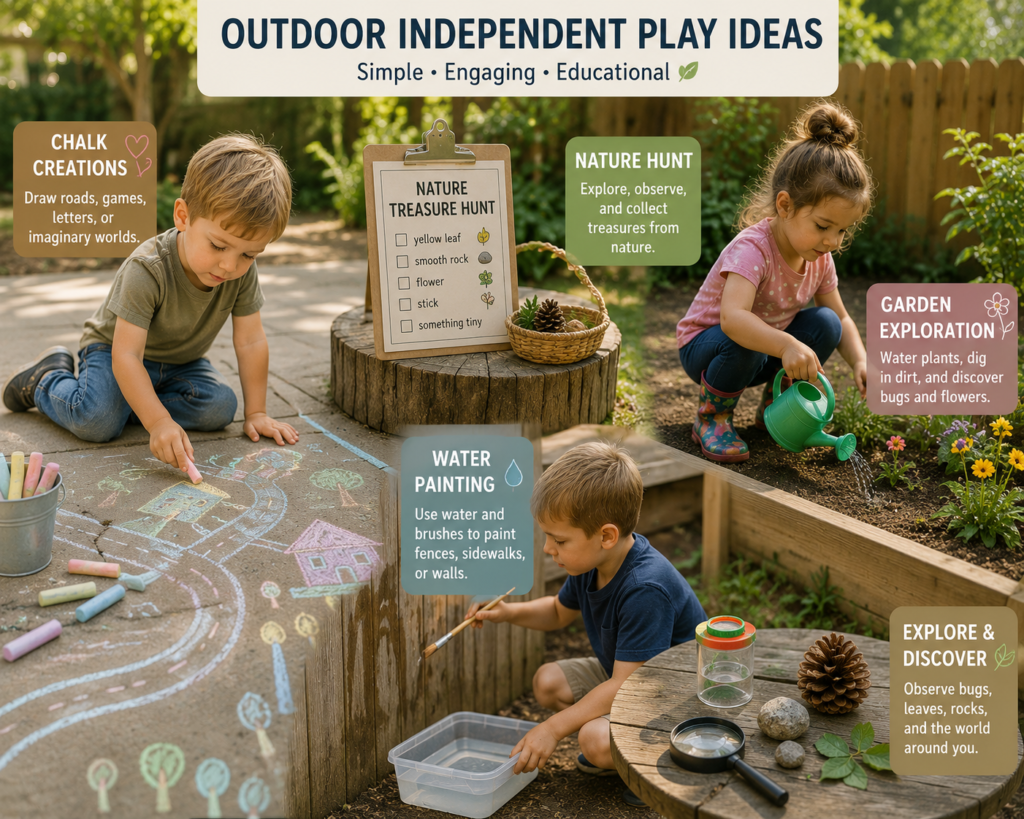
Chalk Drawing Invitations
Sidewalk chalk is one of the simplest but most versatile preschool activities.
Children can:
- draw roads,
- create obstacle courses,
- practice letters,
- make pretend towns,
- or simply explore creativity freely outdoors.
Nature Treasure Hunts
Give preschoolers a simple list of things to search for:
- a yellow leaf,
- a smooth rock,
- a flower,
- a stick,
- or something tiny.
Nature scavenger hunts build observation skills and encourage independent exploration.
Water Painting
Using a small bucket of water and paintbrushes, children can “paint” fences, sidewalks, or walls outdoors.
It’s calming, mess-free, and surprisingly engaging for preschoolers.
Garden Exploration
Even a tiny backyard or balcony can become an exciting world for preschoolers.
Children love:
- watering plants,
- digging in dirt,
- collecting leaves,
- or simply observing bugs and flowers.
Independent outdoor exploration helps children feel curious, capable, and connected to the world around them.
A Gentle Reminder for Parents
Outdoor play doesn’t need to be perfectly planned to be meaningful.
Sometimes the most memorable childhood moments come from very simple things:
collecting rocks, drawing with chalk, or pretending a stick is a magic wand.
Preschoolers don’t need constant entertainment.
Very often, they simply need time, space, and the freedom to explore independently.
And sometimes, the quiet confidence children build outdoors stays with them long after playtime ends.
Conclusion
Independent play is one of the greatest gifts we can give preschoolers.
When children are trusted with simple opportunities to explore, create, imagine, and problem-solve on their own, they begin developing something much deeper than academic skills — they develop confidence in themselves.
A child quietly building with blocks, coloring at the kitchen table, pouring water outside, or creating imaginary worlds through pretend play is learning far more than it may seem on the surface.
They’re learning how to focus.
How to make decisions.
How to stay curious.
How to feel capable without constant guidance or entertainment.
And perhaps most importantly, they’re learning that play itself is valuable.
Independent activities don’t need to be expensive, complicated, or perfectly planned to be meaningful. Very often, the simplest setups create the most memorable learning experiences.
A small sensory bin.
A basket of crayons.
A printable activity book.
A handful of blocks.
A little freedom and time.
That’s often more than enough.
Looking for Easy Preschool Printables?
If your child enjoys independent learning activities, printable activity books and coloring pages can make quiet time both fun and educational.
Our printable preschool activities are designed to encourage:
- creativity,
- fine motor skills,
- calm focus,
- early learning,
- and independent play through simple hands-on fun.
Perfect for:
✨ quiet time
✨ travel days
✨ rainy afternoons
✨ screen-free play
✨ preschool learning at home
👉 Explore our preschool printables and activity books on Etsy to create simple learning moments your child can enjoy independently.
You May Also Like
Looking for more screen-free preschool learning ideas?