Dive Into Adventure: How to Spark Your Child’s Curiosity About the Oceans (and Make Geography Fun!)
As parents and educators, we often look at the world map and wonder: How do we make this vast, beautiful planet meaningful to a child? In an era dominated by flashing screens and short-form videos, trying to teach ocean geography to kids and capture their attention long enough can feel like an uphill battle.Traditional textbooks with dense paragraphs and black-and-white maps rarely do the trick. If you are struggling with standard school materials, check out our guide on creative ways to teach geography at home to see how simple adjustments can change everything. After all, kids don’t just want to read about the world—they want to explore it. They want to be the captains of their own ships, the scientists diving into deep-sea trenches, and the pioneers unlocking hidden secrets.
The secret to teaching geography successfully isn’t memorization; it’s adventure. We’ve actually written a comprehensive breakdown on why kids learn geography better through adventures, collections, and progression, proving that a structured quest changes everything. And the best place to start that adventure is where life itself began: the ocean.
Covering more than 70% of our planet , the global ocean is a single, connected expanse of life, wonder, and mystery. From sunny, bustling coral reefs to the pitch-black depths where sunlight never reaches, the ocean is a living classroom.
In this guide, we will explore practical, creative, and highly engaging ways to turn ocean science and geography into an unforgettable journey for your little explorers. Plus, we’ll take a look at a fantastic interactive tool that pulls all these ideas together into one seamless, kid-friendly passport experience.
Why Ocean Education Matters for Young Learners
Before we dive into how to teach ocean geography, let’s talk about why it is so impactful for young minds:
- It Builds Environmental Awareness: Understanding that people all over the world depend on the oceans for food, travel, and jobs helps children develop early empathy and global awareness.
- It Connects the Sciences: Oceanography isn’t just geography; it’s a perfect blend of biology (marine life) , geology (underwater volcanoes and trenches) , and physics (ocean currents and weather forces).
- It Inspires Lifelong Curiosity: The ocean is full of extreme, bizarre, and wonderful things—like mountains longer than any on land or creatures that glow in the dark. Once a child realizes how much mystery exists under the waves, their desire to learn skyrockets.
4 Creative Strategies to Teach Ocean Geography to Kids
You don’t need a research vessel or an expensive laboratory to teach your kids about marine science. You just need to engage their senses, their love for storytelling, and their natural competitive drive. Here are four strategies you can start using today:
1. Travel via «Ocean Highways» (Teaching Currents)
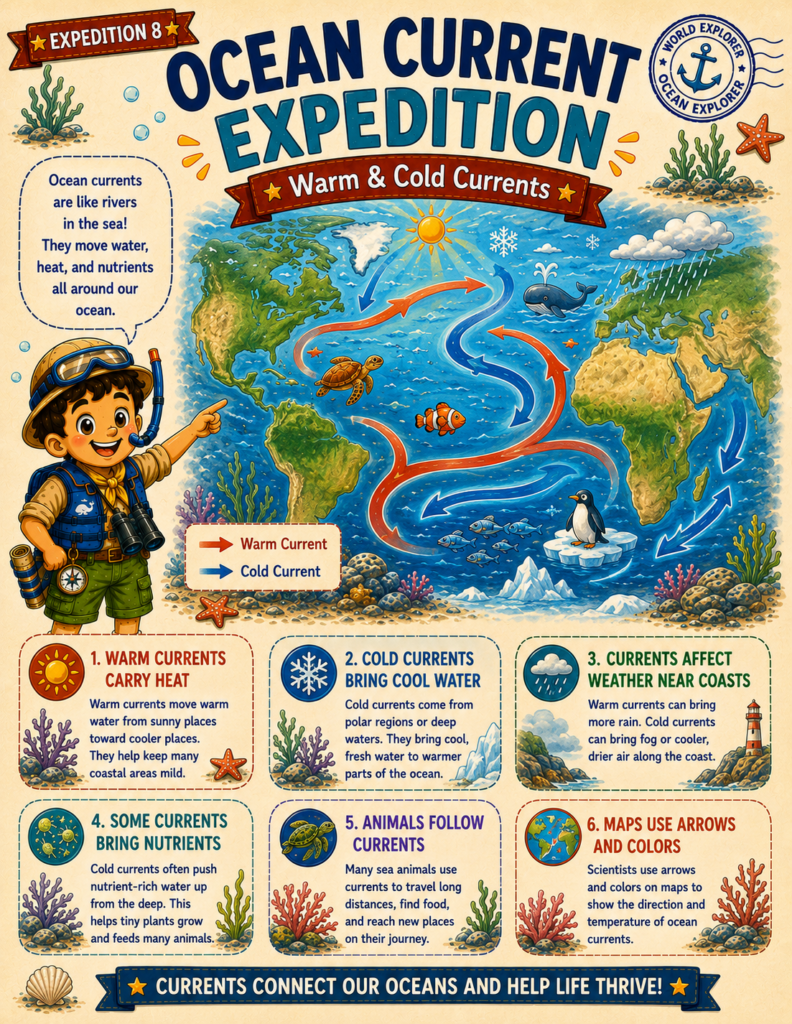
Instead of drawing flat arrows on a map, describe ocean currents as giant rivers flowing through the sea. Explain to your child that these currents act like ocean highways , moving water, heat, and nutrients all around our planet to help control our global weather.
- The Storytelling Angle: Tell the story of how sea animals use these powerful highways to travel thousands of miles, find food, and reach new homes.
- The Visual Connection: Show them how scientists use red or orange for warm currents coming from the sunny tropics, and blue for cold currents rushing from the icy poles.
2. Introduce «Superpowered» Animal Adaptations
Kids love superheroes, and marine life is packed with creatures that possess real-life superpowers. Frame animal facts around how they survive in their specific habitats:
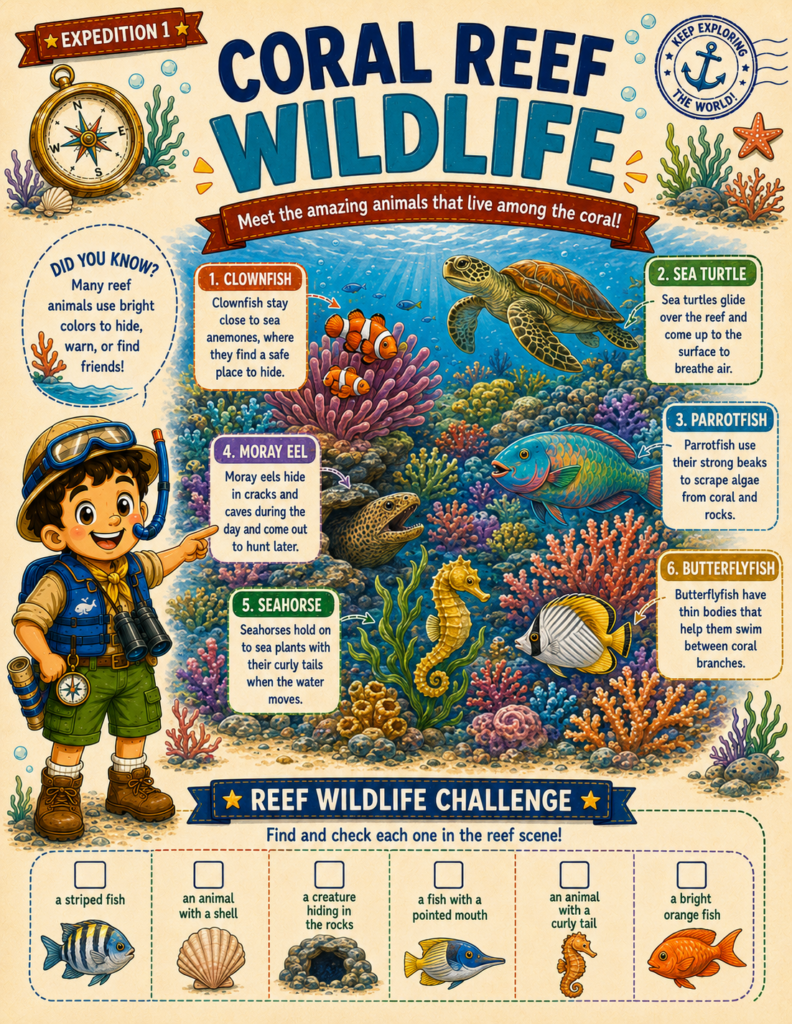
- The Clownfish’s Shield: Clownfish can live safely among venomous sea anemones because of a special protective coating on their skin.
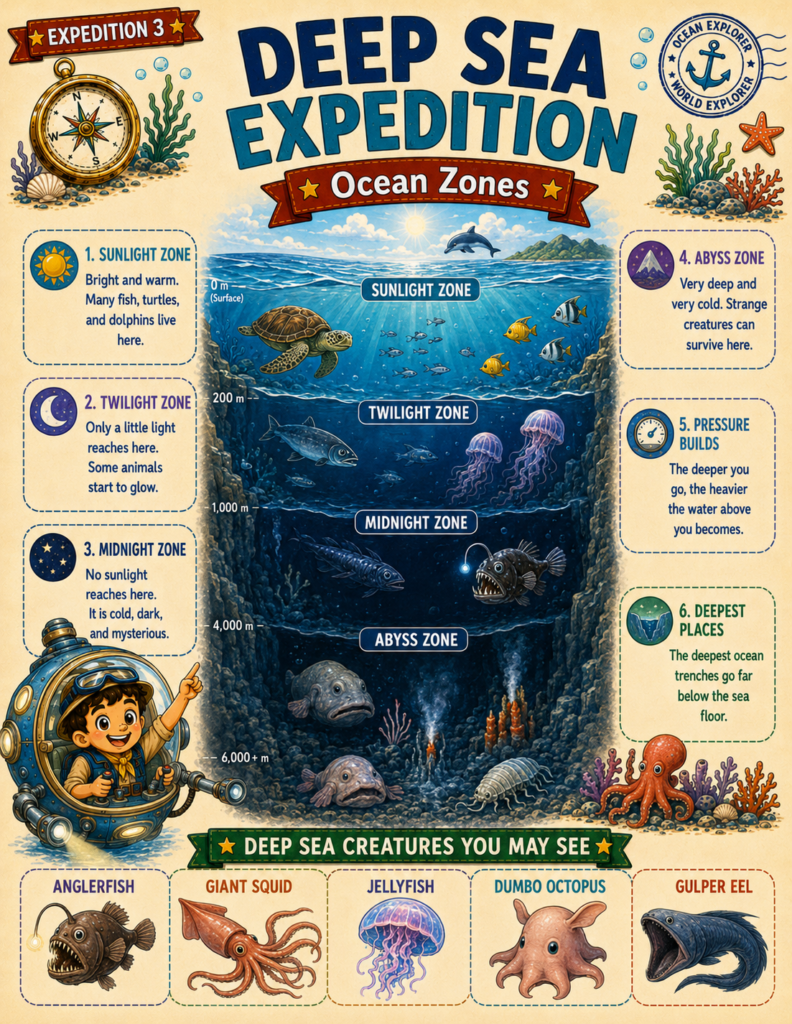
- The Anglerfish’s Lantern: In the deep Midnight Zone, where there is zero sunlight, the anglerfish uses a glowing lure attached to its head to attract prey.
- The Seahorse Dad: Seahorses swim upright, and it’s actually the father seahorse who carries the babies safely in his pouch!
By focusing on these quirky, amazing traits, geography transforms from «where things are» to «how things live».
3. Explore the Extreme Zones of the Deep Sea
Take your child on an imaginary elevator ride straight down into the ocean to explain layers and atmospheric pressure.
- Start at the Sunlight Zone (0 to 200 meters), where dolphins play and turtles glide through warm waves.
- Drop down to the Twilight Zone, where the light fades and the first glowing animals appear.
- Plunge into the Midnight Zone and Abyss Zone, explaining how the water above gets incredibly heavy (pressure builds!) and the environment becomes completely dark and mysterious.
- Finally, land at the Mariana Trench—the deepest known place on Earth. At 11,000 meters deep , it is deep enough to swallow Mount Everest with room to spare!
4. Gamify the Learning with Missions and Rewards
Children thrive when they have a goal. Instead of giving them a worksheet to grade, give them a mission. Tell them they are certified global explorers. If they successfully navigate a maze, decode a secret puzzle, or identify five different species of sharks , they earn a reward—a badge, a stamp, or an official certificate. Gamification transforms education from a chore into a rewarding game. For more inspiration on incorporating play into education, you can read our deep dive into the benefits of game-based learning for children, which explains why kids remember lessons much better when they are having fun.
Meet Your Child’s Next Big Adventure: The Ocean Explorer Activity Book
If you love the idea of turning ocean geography into a hands-on, gamified adventure but don’t have the hours required to design maps, mazes, and lessons yourself, there is a beautifully crafted solution ready for your bookshelf.
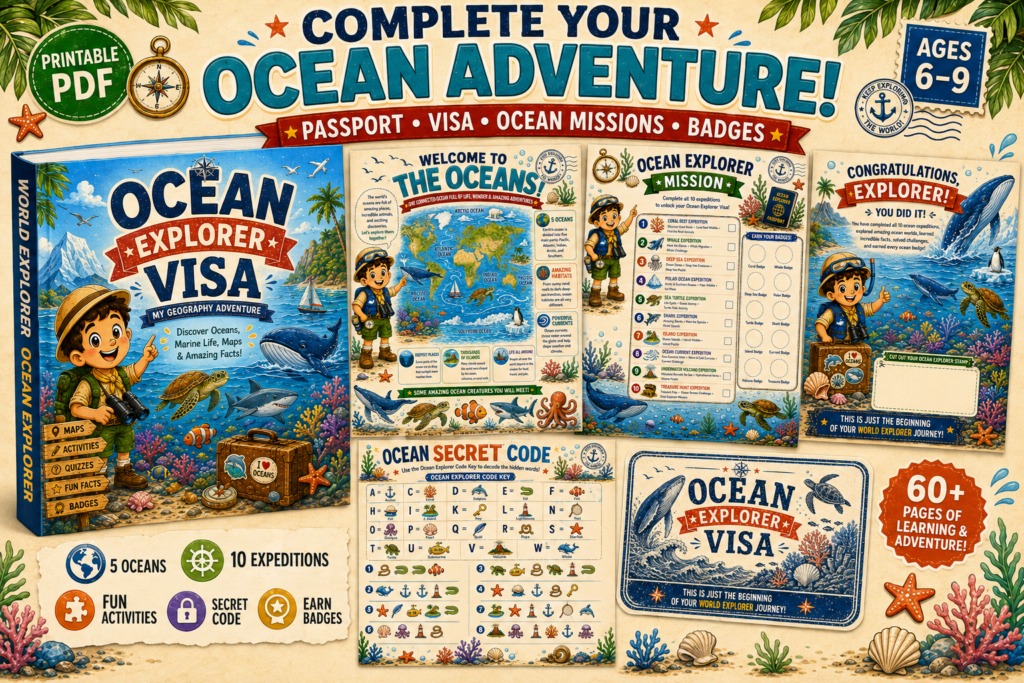
The Ocean Explorer book from the acclaimed World Explorer Series by Tiny Joy Studio is designed specifically to capture the imagination of young adventurers. Led by an adorable and enthusiastic cartoon guide named Leo , this activity book turns complex marine science into an interactive quest.
How the Journey Works: A Real Passport Experience
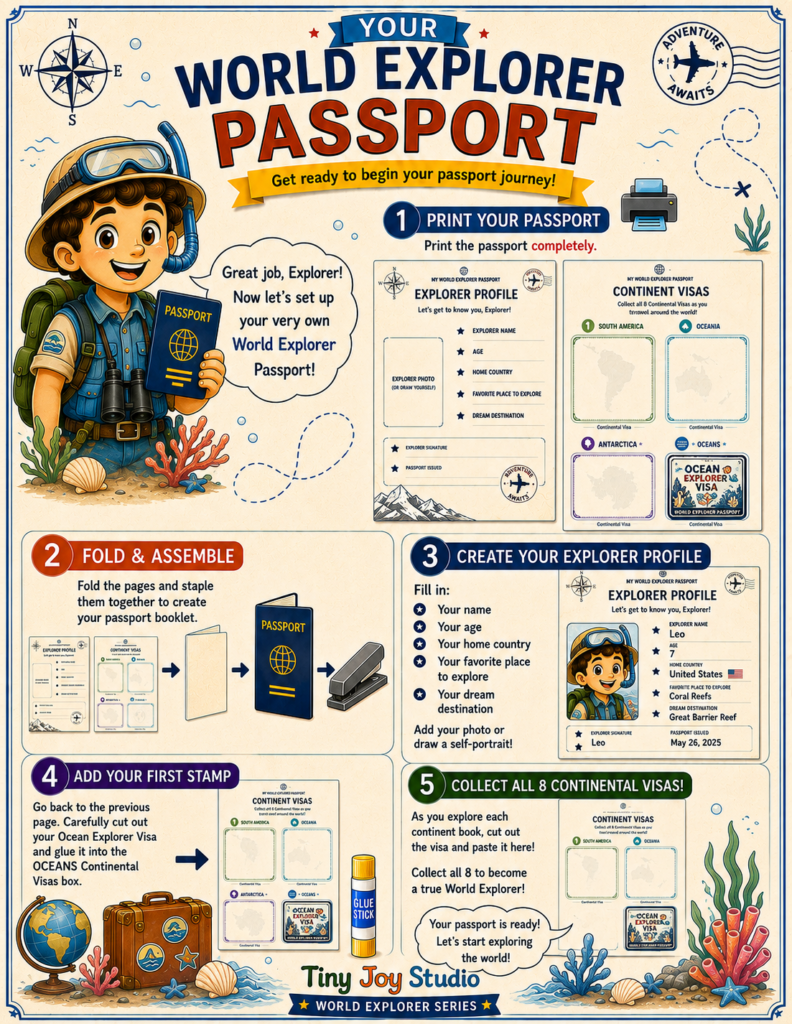
What makes Ocean Explorer completely unique is that it doesn’t feel like a standard workbook. It is structured as a World Explorer Passport project.
When children start the book, they get to set up their very own passport booklet, complete with an explorer profile where they can write their name, age, home country, and even draw a self-portrait.
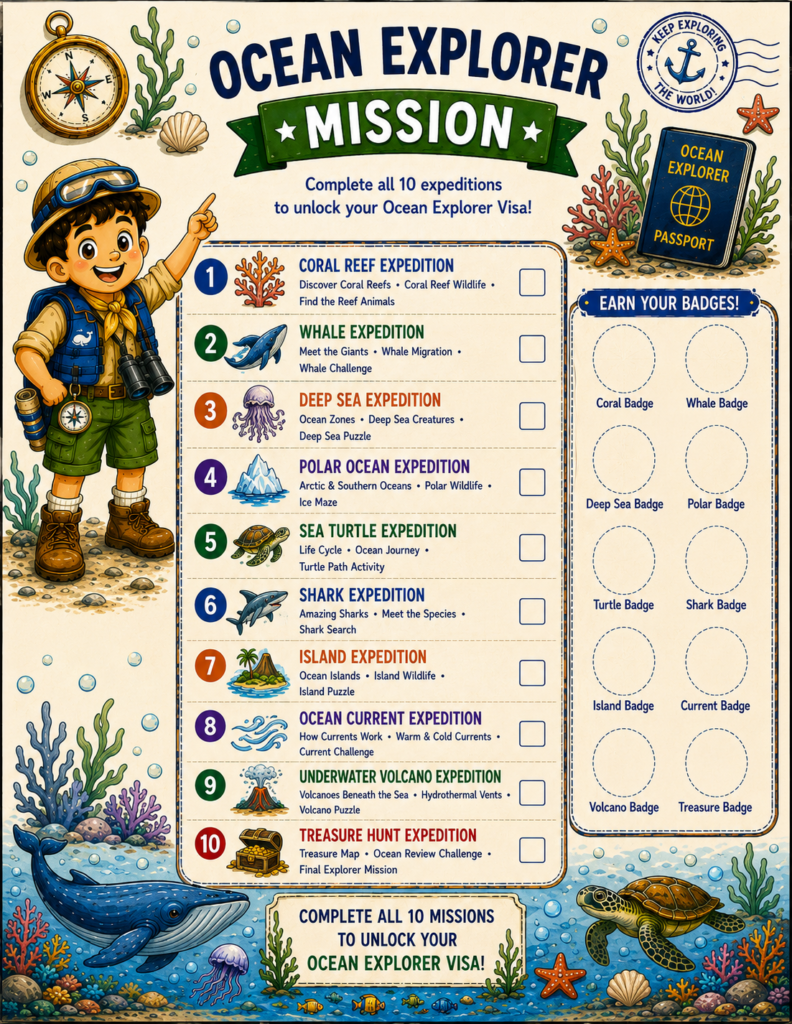
From there, their mission is clear: Complete all 10 Ocean Expeditions to unlock their official Ocean Explorer Visa Stamp!
The 10 structured expeditions take young learners on a comprehensive tour of the marine world:
- Coral Reef Expedition: Discovering why coral reefs are the vibrant «ocean cities» of our planet.
- Whale Expedition: Meeting the gentle giants, learning about baleen plates, and tracking magnificent migration paths.
- Deep Sea Expedition: Venturing down through the ocean zones to meet bioluminescent creatures.
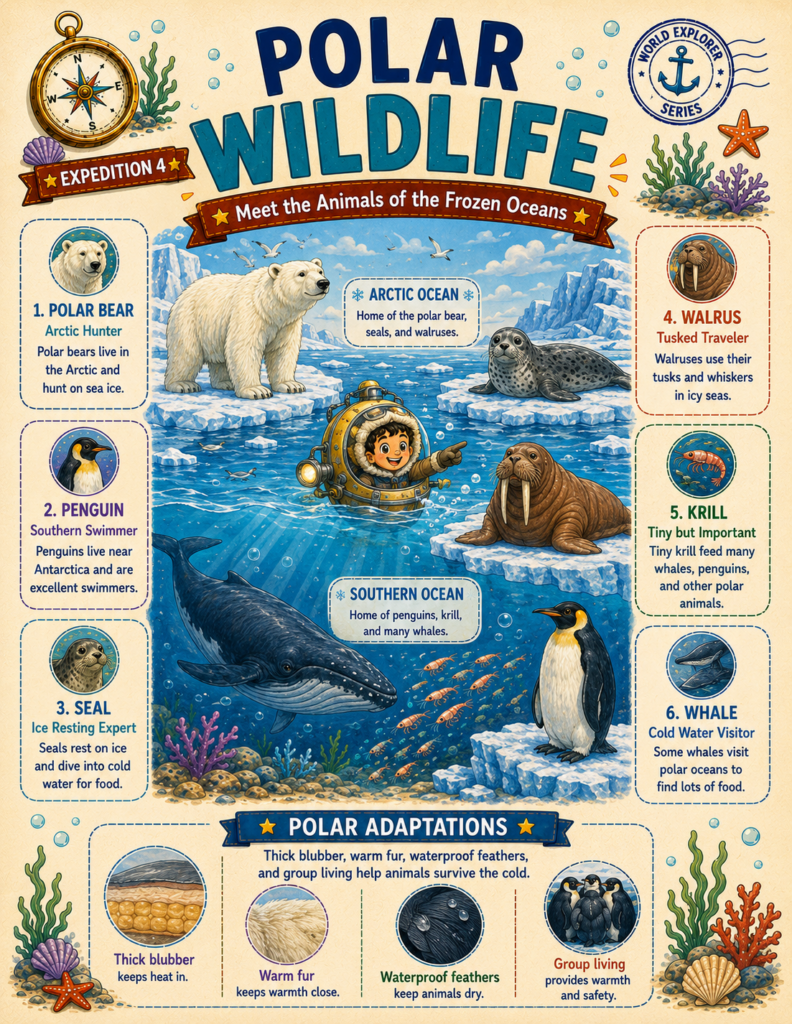
- Polar Ocean Expedition: Exploring the freezing, icy waters of the Arctic and Southern Oceans.
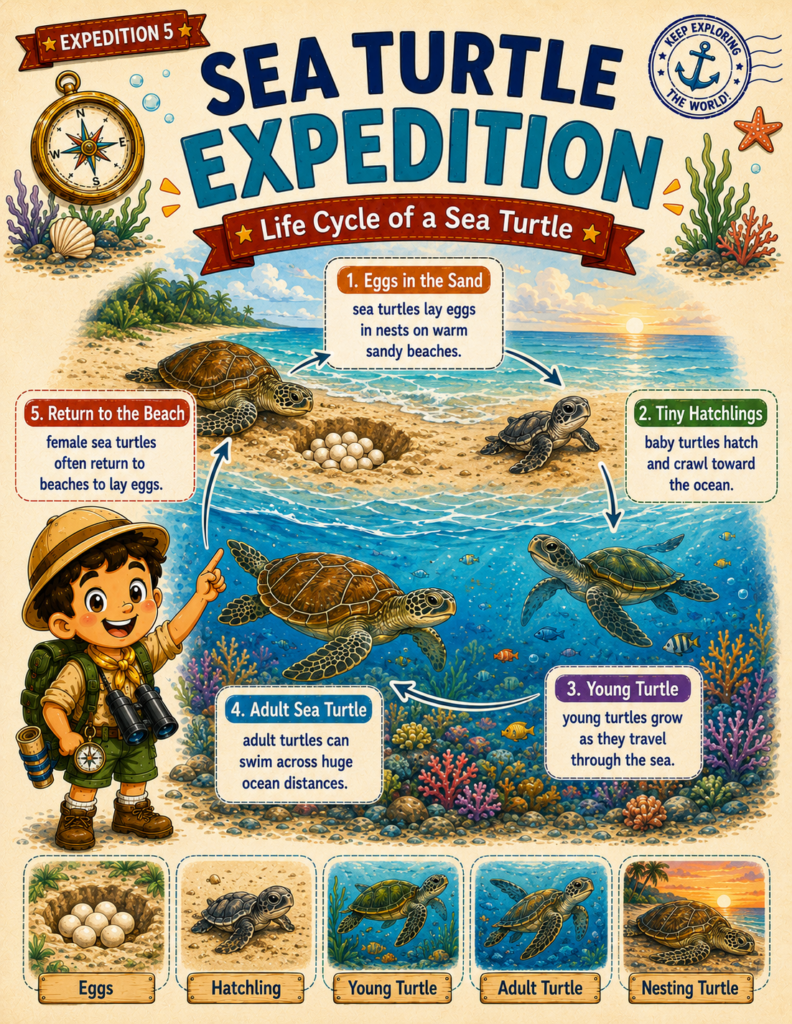
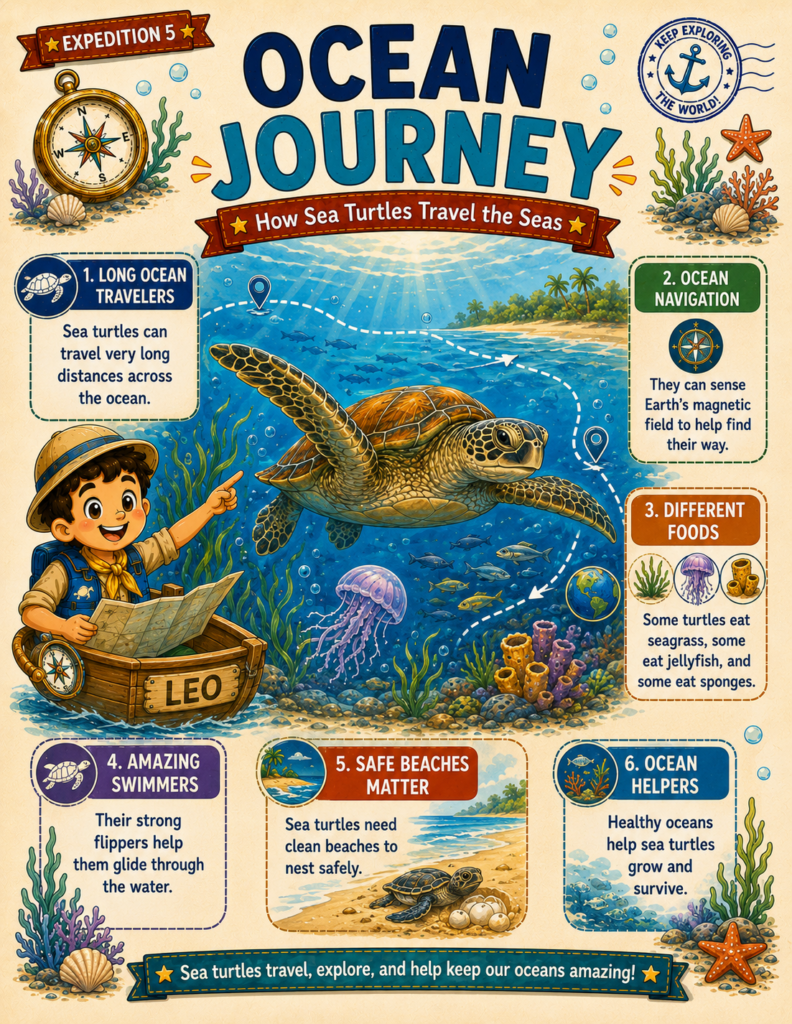
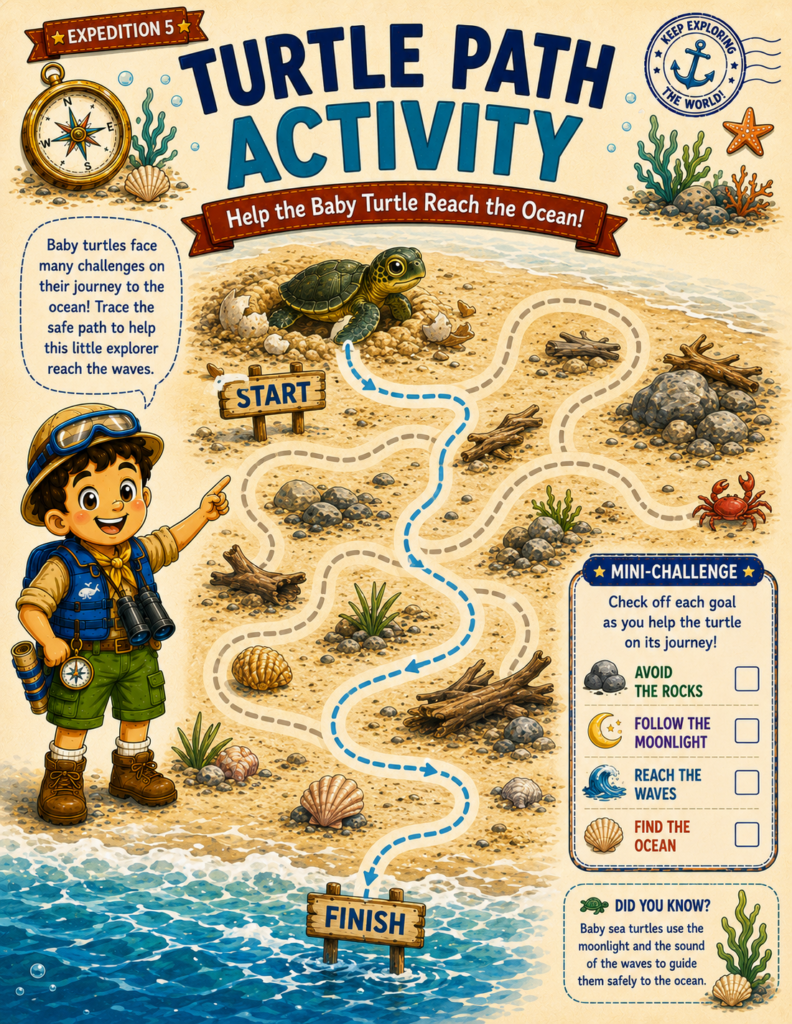
- Sea Turtle Expedition: Tracing the beautiful and perilous life cycle of a nesting turtle.
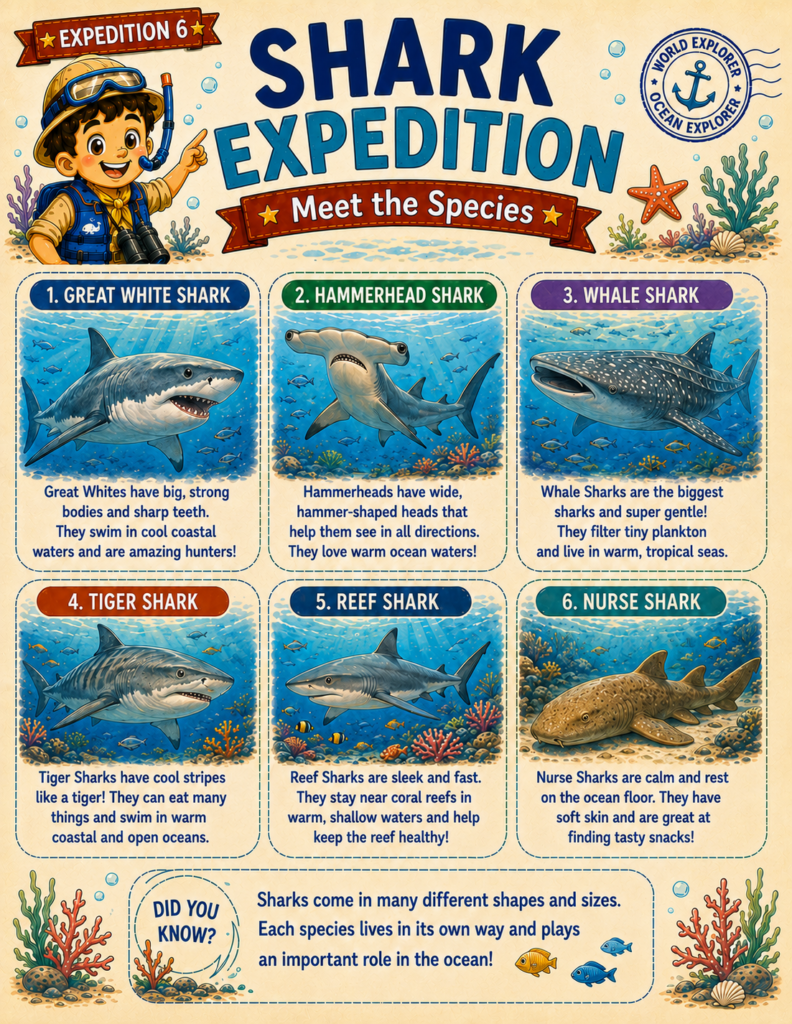
- Shark Expedition: Learning why sharks are fascinating cartilaginous fish—not mammalian monsters—that keep our ecosystems in balance.
- Island Expedition: Uncovering how volcanic eruptions and coral structures build new landmasses from the ocean floor.
- Ocean Current Expedition: Mapping the warm and cold «rivers» that connect our global ocean.
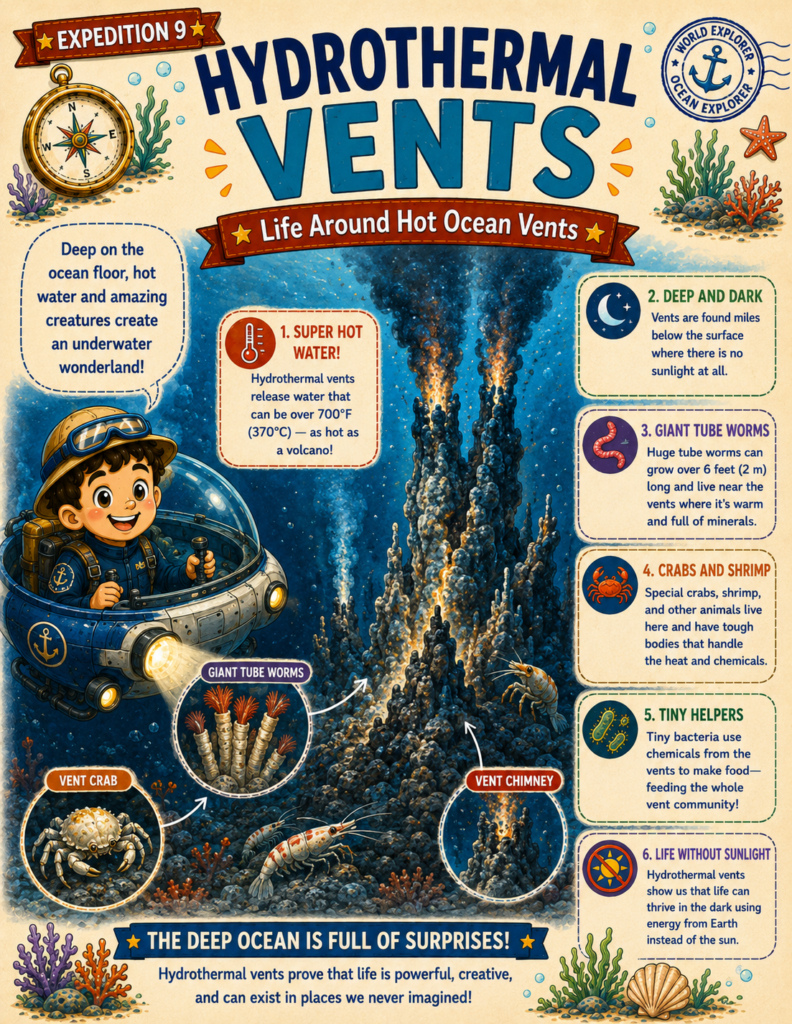
- Underwater Volcano Expedition: Daring to look at hydrothermal vents where life thrives completely without sunlight.
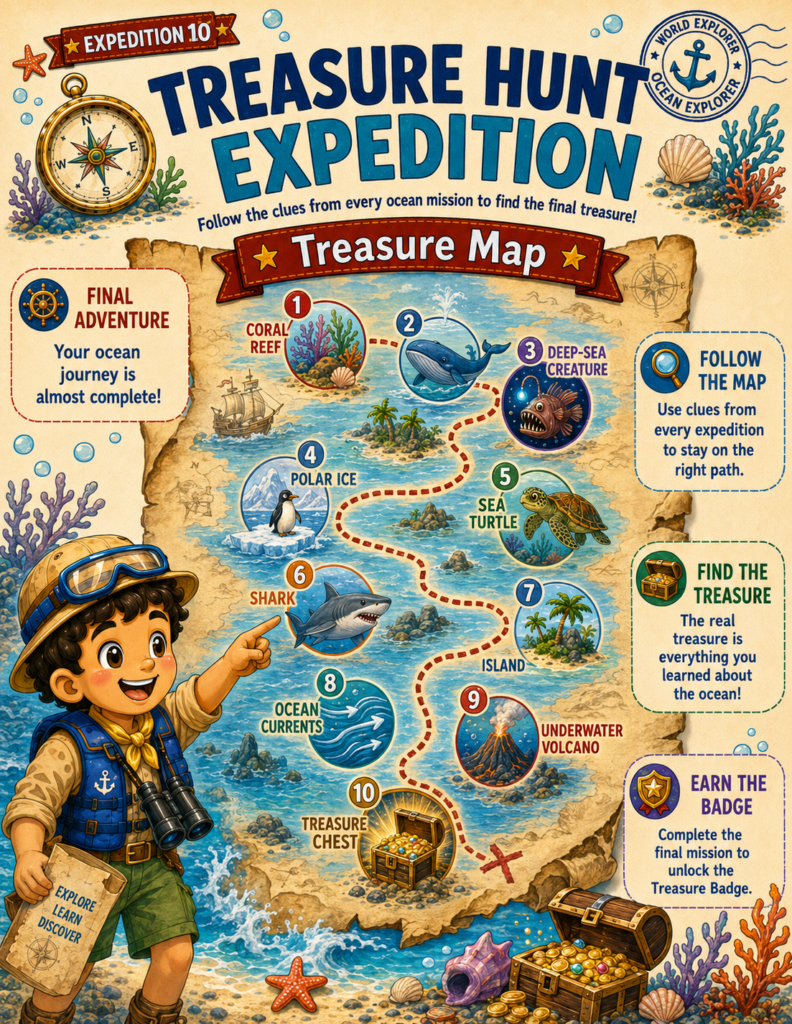
- Treasure Hunt Expedition: A grand final review challenge where kids use everything they’ve learned to locate the hidden treasure chest.
Engaging Activities on Every Page
Every single expedition is split into a multi-sensory learning experience:
- Learn: Bite-sized, engaging facts that focus on high-interest topics.
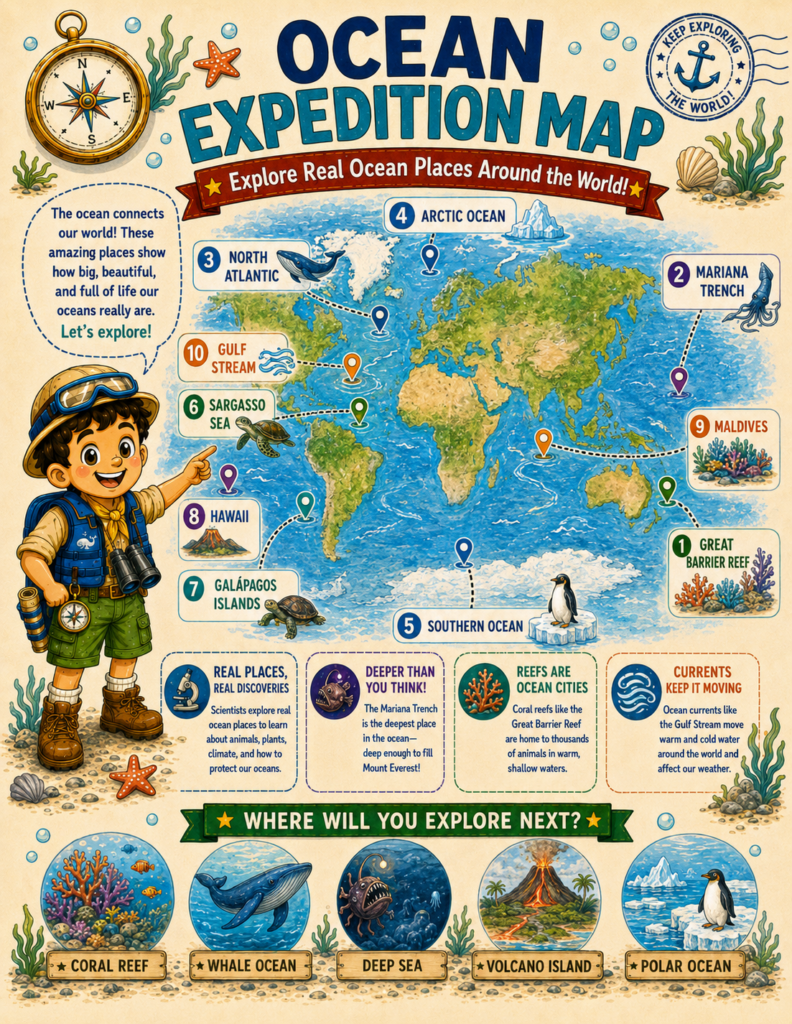
- Explore: Beautiful, clear maps that show real geographical places like the Great Barrier Reef, the Galapagos Islands, and the Sargasso Sea.
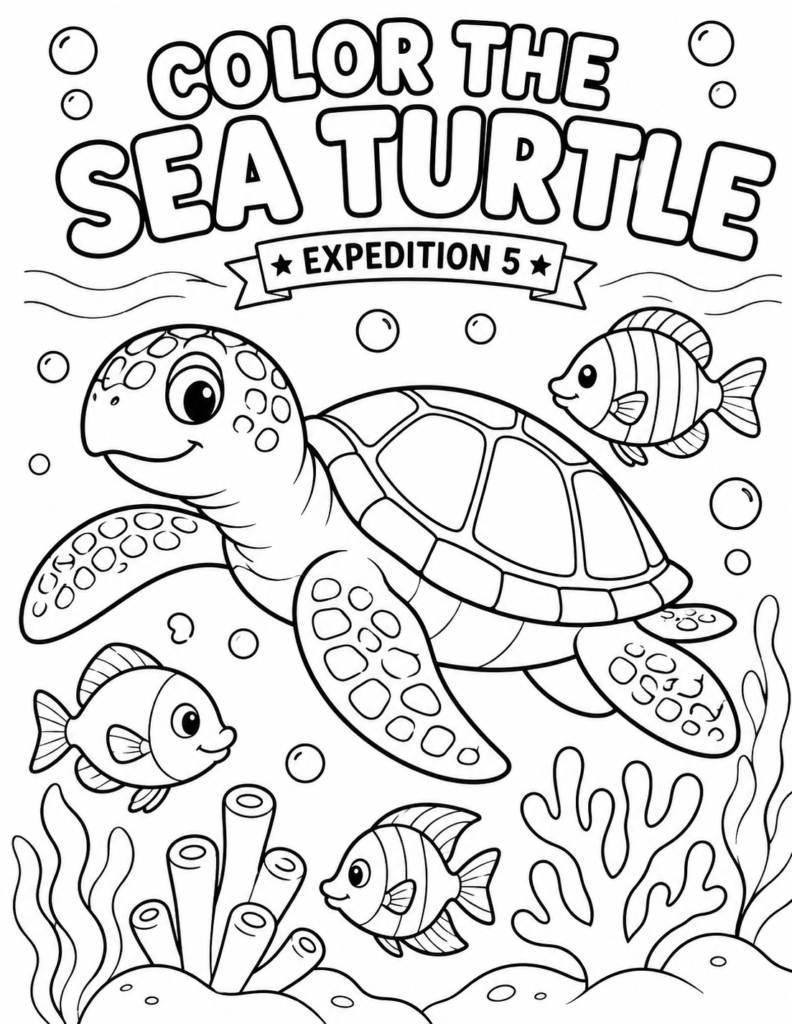
- Complete: Brain-boosting puzzles, word searches, coordinate sorting, ice mazes, and spot-the-difference challenges.
- Earn: Children get to visually track their progress, checking off checkboxes and collecting digital or cut-out badges—like the Coral Badge, Shark Badge, and Treasure Badge—as they complete each phase.
Practical Ways to Combine This Book with At-Home Activities
To get the absolute most out of your child’s ocean geography journey, you can pair the pages of the Ocean Explorer book with simple, real-world activities:
1. The Salty Water Experiment
On Page 5, Leo explains that ocean water is salty because rivers carry tiny bits of minerals to the sea over a very long period of time.
- Activity: Take two glasses of water. Leave one fresh, and stir two tablespoons of salt into the other. Let your child taste a drop of each. Then, look up a picture of the Dead Sea or explain how salt makes things float more easily! If your little scientist loves hands-on activities like this, explore our full collection of easy science experiments for rainy days to keep their curiosity buzzing all week long.
2. The Moonlight Turtle Walk
While working through the Sea Turtle Expedition, kids learn that tiny hatchlings use the bright moonlight reflecting on the water and the acoustic sound of crashing waves to guide themselves safely from the sand into the ocean.
- Activity: Turn off the lights in a room. Use a flashlight to project a «moonlight beam» on the floor or a wall. Have your child pretend to be a baby turtle crawling exclusively toward the light path while avoiding «obstacle rocks» (pillows thrown on the floor).
3. Kitchen Bioluminescence
When diving into the Midnight Zone pages, talk about bioluminescence—the ability of deep-sea animals to create their own chemical light in the dark.
- Activity: Take some glow sticks into a dark bathroom or closet. Crack them open to trigger the chemical reaction. Explain to your child that animals like the dummy octopus or the jellyfish are using a very similar magical superpower deep under the waves!
Raising the Next Generation of «Ocean Helpers»
Ultimately, geography and marine science education serve a larger purpose: conservation.
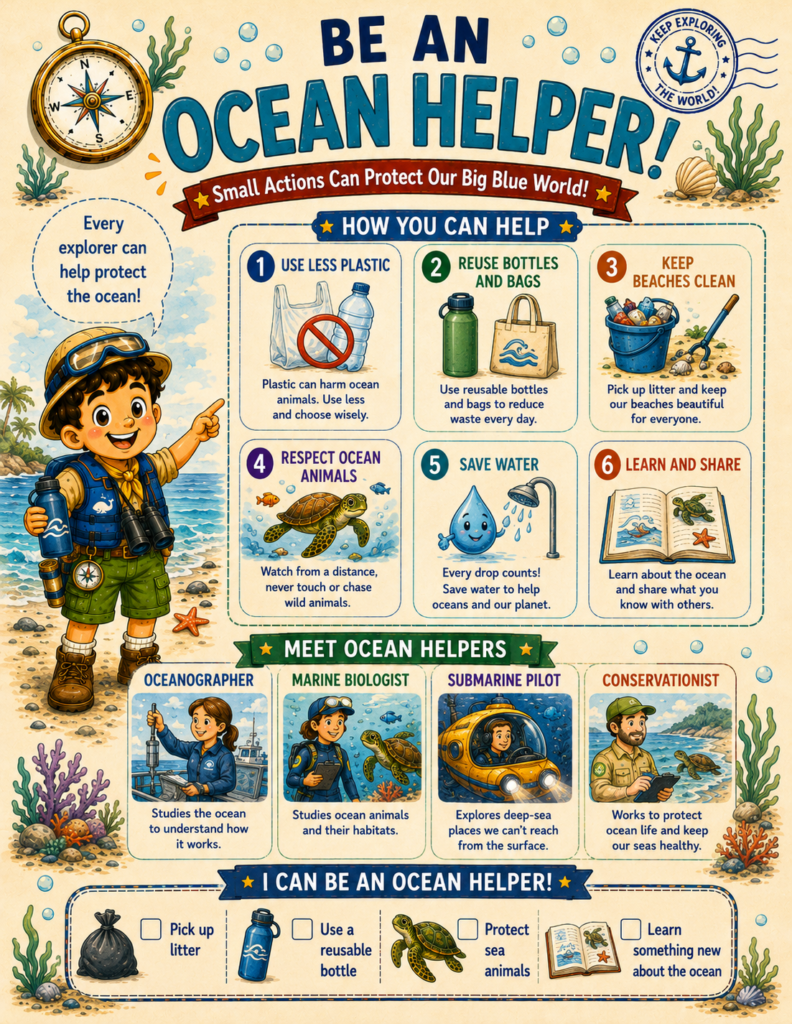
The final sections of the Ocean Explorer guide focus beautifully on how every single young explorer can become an official Ocean Helper. It introduces them to critical real-world careers—such as Marine Biologists who study marine habitats , Oceanographers who map the seas , and Submarine Pilots who venture into uncharted waters.
More importantly, it provides actionable, empowering steps that kids can take in their daily lives to protect our big blue world:
- Using less single-use plastic to prevent harm to vulnerable marine wildlife.
- Choosing reusable bottles and bags to cut down on daily community waste.
- Keeping local beaches and parks clean by proactively picking up litter.
- Respecting wild animals by observing them from a safe distance without chasing or touching them.
When children realize that their small, everyday actions directly protect the sea turtles, clownfish, and magnificent humpback whales they just read about, geography stops being an abstract subject in a book—it becomes a personal mission.
Final Thoughts: Start Your Explorer Journey Today
Teaching kids about the world doesn’t have to look like memorizing a list of capitals or staring blankly at a globe. By turning geography into an interactive, gamified quest, you can foster a deep, lifelong love for science, travel, and exploration.
If you are ready to kickstart this journey, grab a box of crayons, print out your passport pages, and join Leo on an unforgettable voyage across the global ocean.
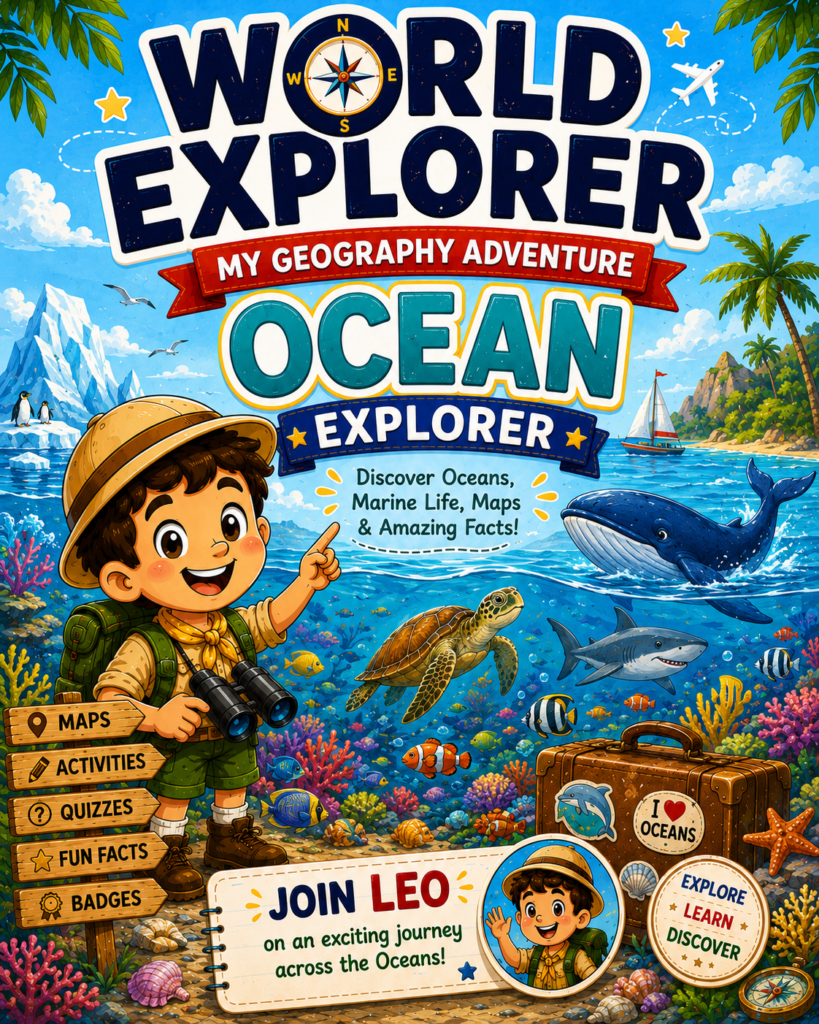
By turning geography into an interactive, gamified quest, you can foster a deep, lifelong love for science, travel, and exploration. To see how this book fits into a broader educational roadmap, check out the ultimate geography learning path for kids ages 6–9 to seamlessly guide your child from learning about global oceans to exploring specific continents and countries!
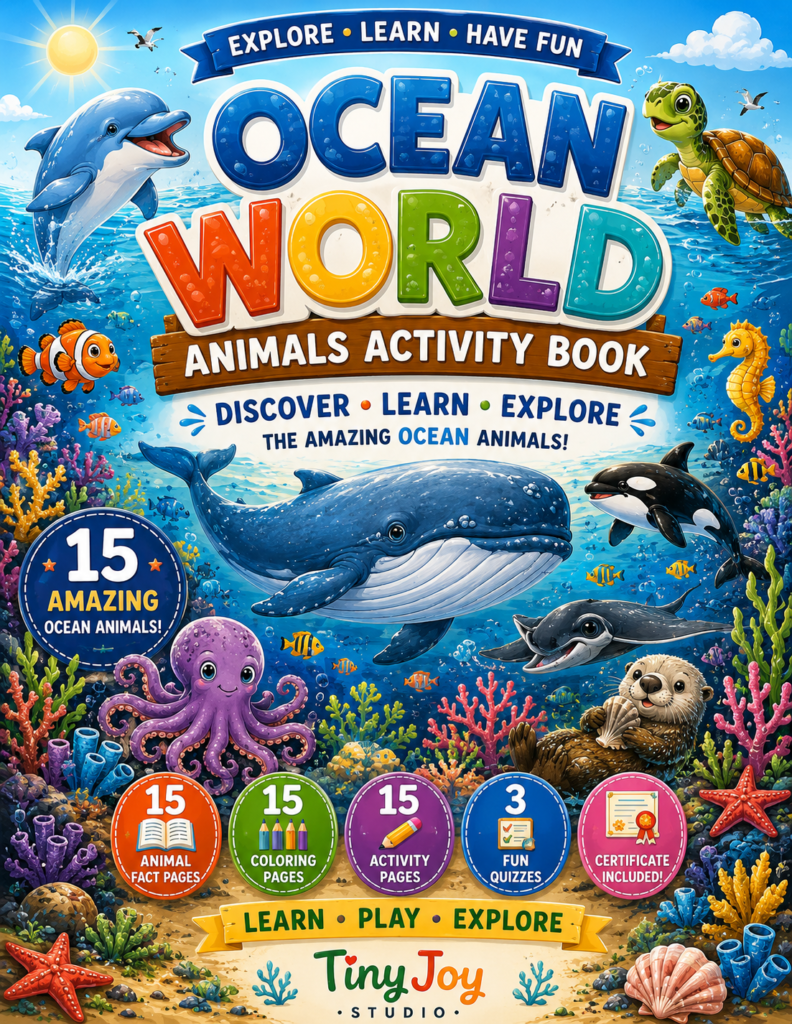
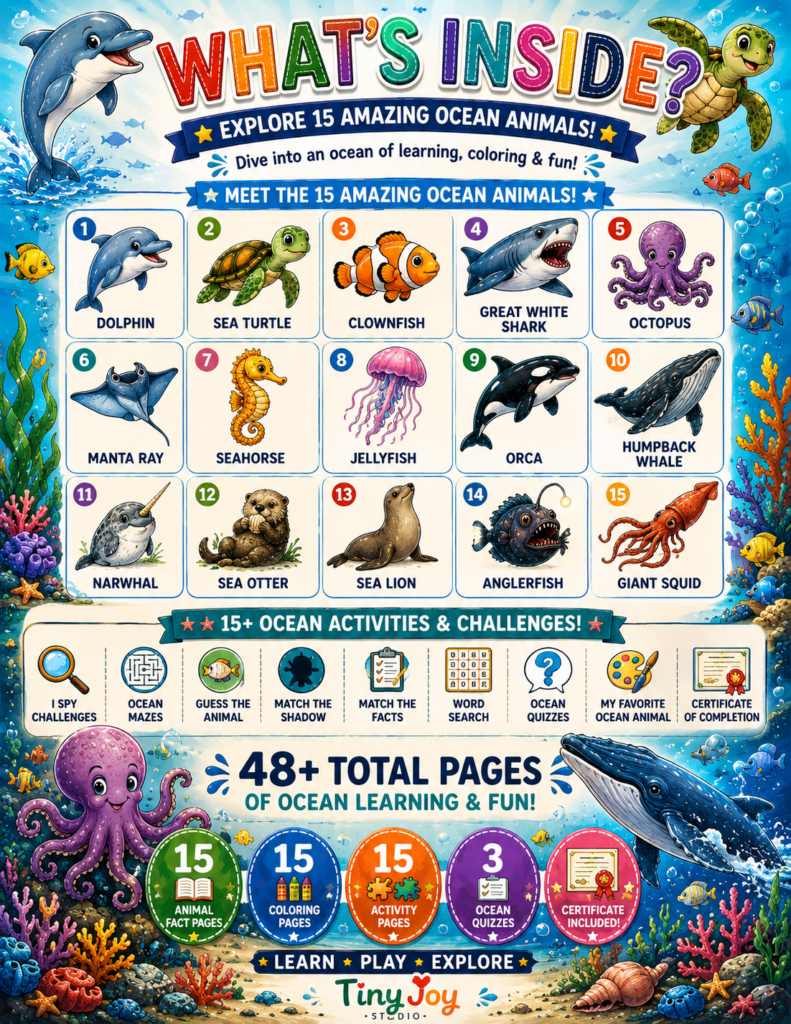
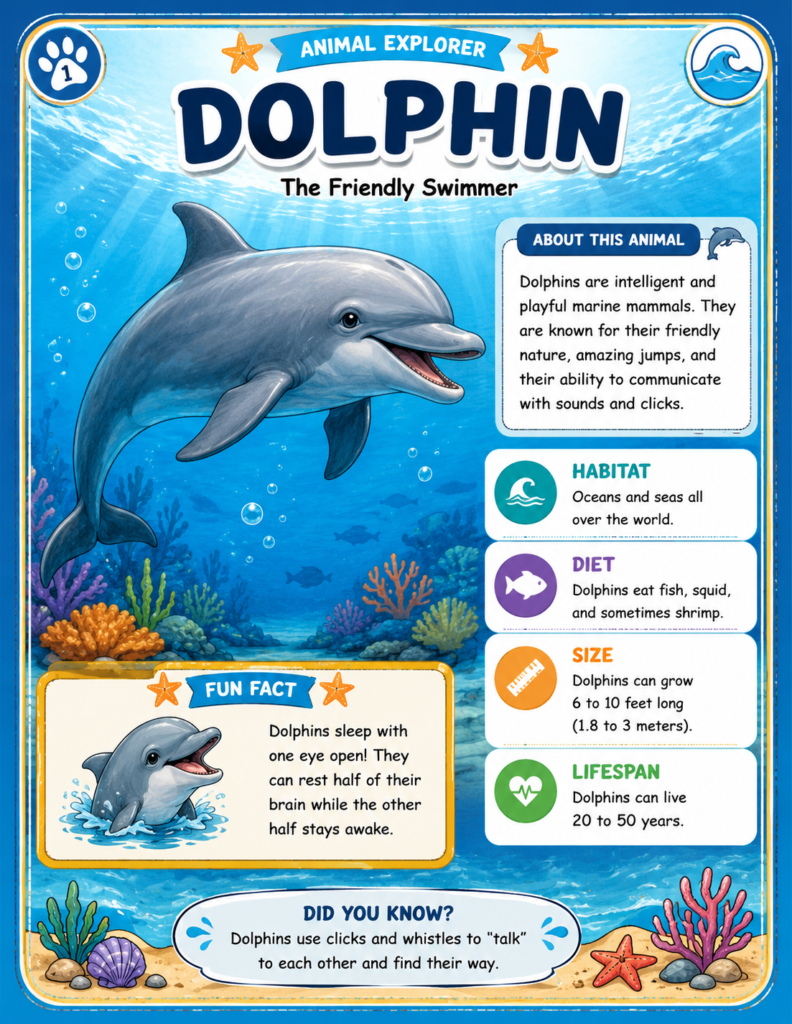
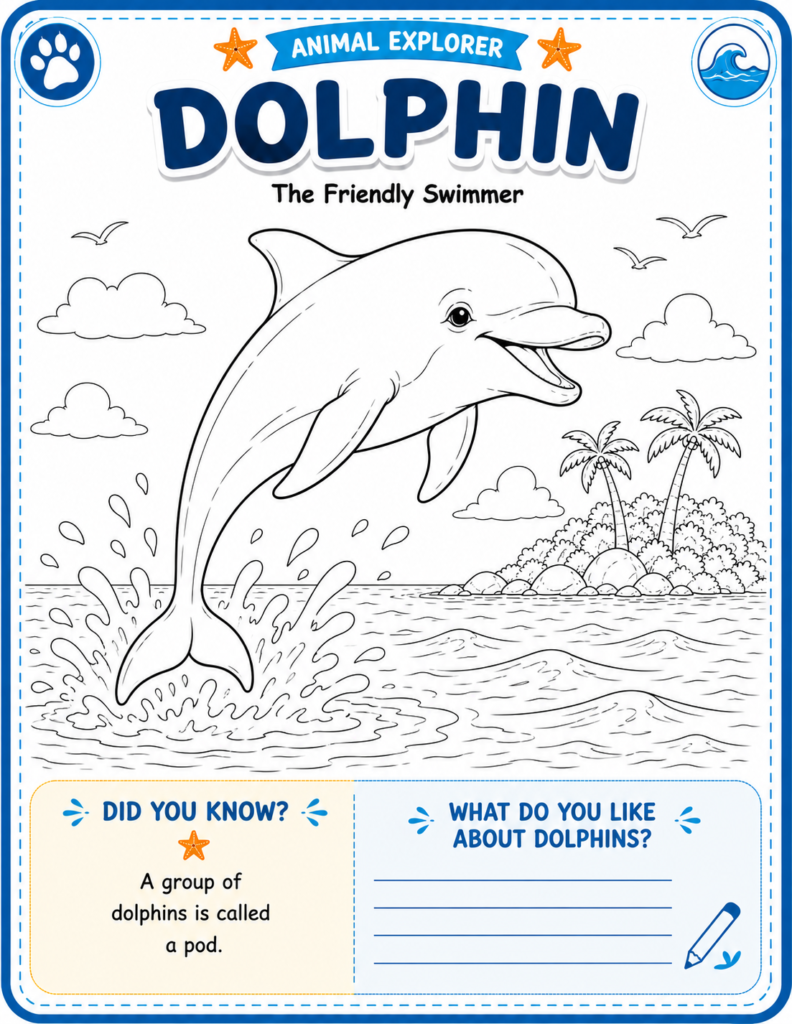
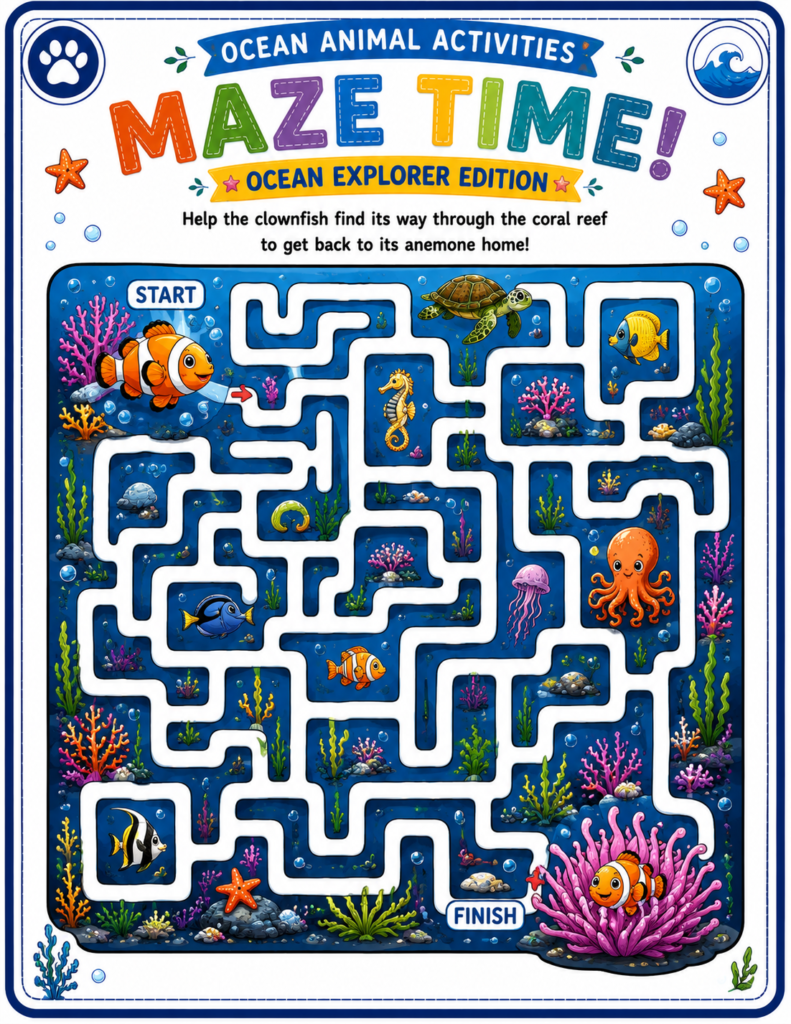
Ready to dive deeper? You can find the Ocean Explorer activity book, along with its wonderful companion, the Ocean World Animals Activity Book (featuring 15 detailed animal fact pages, coloring sections, and a graduation certificate) , directly via the Tiny Joy Studio collection.
Happy exploring, captains!