A Language Is Not a Flag: Teaching World Languages Through Evidence and Human Networks
Most elementary world culture units follow a rigid, predictable template: a national flag is pinned to a country, accompanied by a single greeting like “bonjour” or “hola” and an implied rule that each bordered nation speaks exactly one tongue.
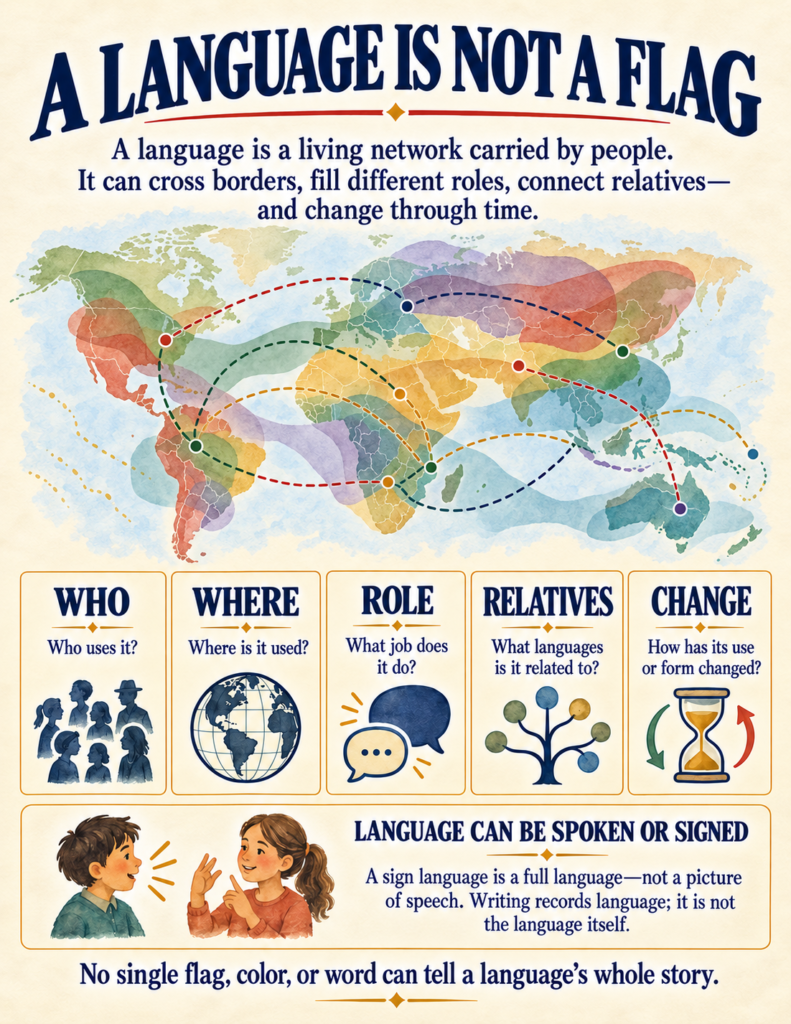
Yet real human geography refuses to fit inside tidy colored outlines. Cross a national border into Switzerland, and you encounter four official languages distributed across distinct regions. Visit Paraguay, and you will hear Guaraní spoken in backyards while Spanish dominates official government bulletins. Talk to a bilingual child, and you quickly learn that one person can effortlessly assign different languages to science class, video calls with grandparents, and neighborhood games.
When social studies lessons rely on oversimplified charts, children assume that countries and languages are identical units. Moving beyond this misconception requires tools that treat communication as an evolving, human network. A thoughtfully designed languages of the world workbook does not demand that children memorize dry phrase tables; it challenges them to examine border overlaps, investigate language families across oceans, and evaluate how speech changes over time.
Escaping the «One-Color Map Trap»
The central obstacle in teaching linguistic geography is the habit of assigning one uniform color to every country. While simplified political maps make borders easy to recognize, they inadvertently hide linguistic minorities, cross-border speech communities, and widespread multilingualism.
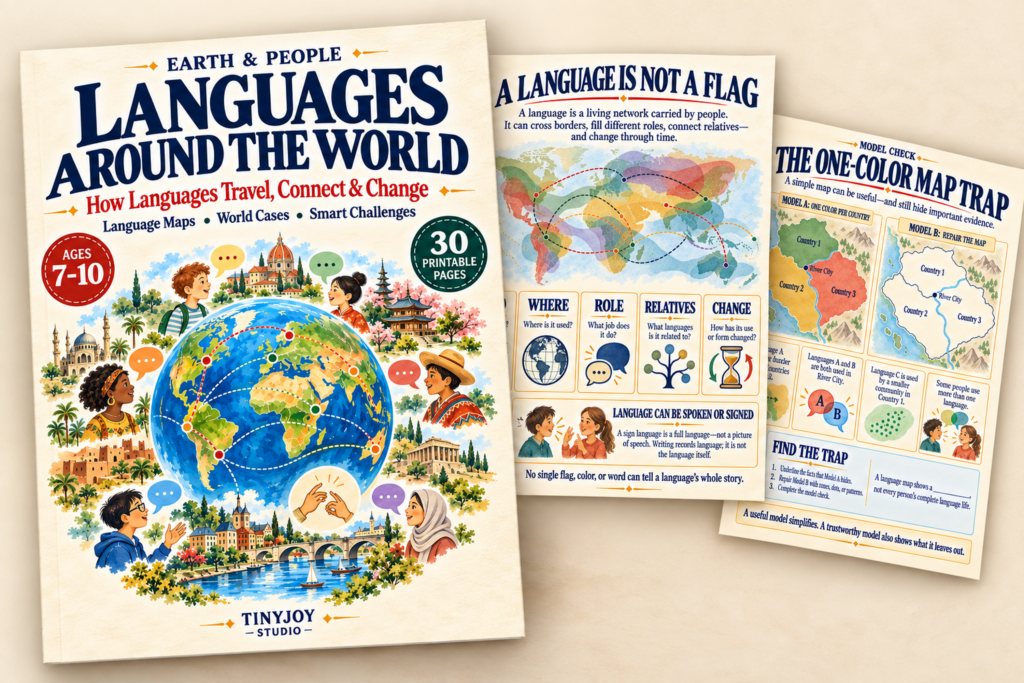
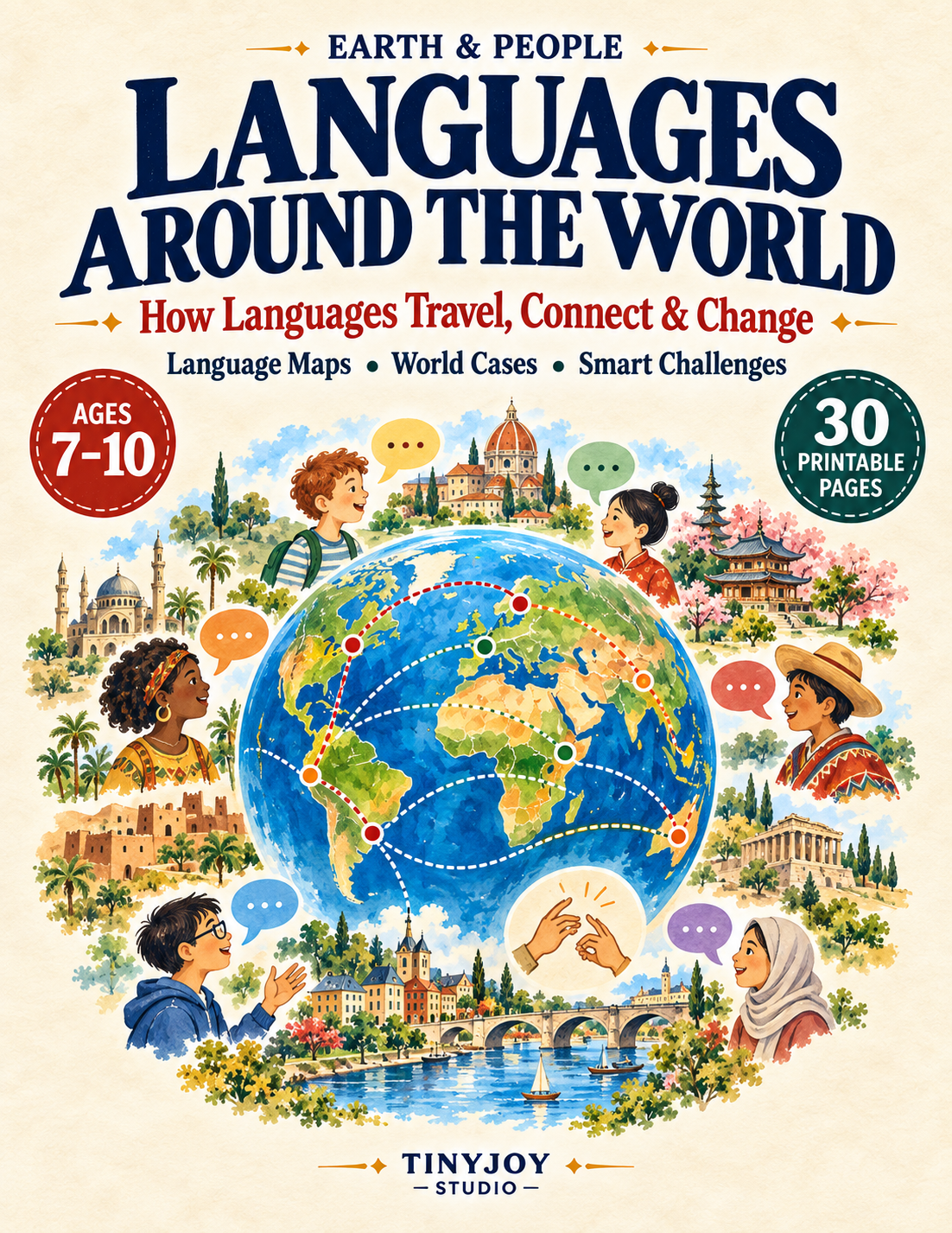
In Earth & People: Languages Around the World (a 30-page printable unit designed for ages 7–10), students directly deconstruct this habit in an exercise called «The One-Color Map Trap». Rather than accepting a pre-colored map as absolute truth, learners inspect a scenario where three nations share a bustling border city:
- Model A (The Trap): Assigns one solid shade to each nation, completely concealing minority communities and overlapping speech zones.
- Model B (The Repair): Challenges students to redraw the map using stripes, colored dots, and shared transit lines to reflect how people actually communicate across borders.
Understanding that scientific diagrams and maps make deliberate trade-offs is an invaluable analytical skill. Just as students discover that planetary posters distort cosmic scale and empty space—a concept explored in our review of the Solar System Explorer Workbook —young linguists learn that a trustworthy map must display both clear evidence and its own limitations.
Becoming a Language Family Detective
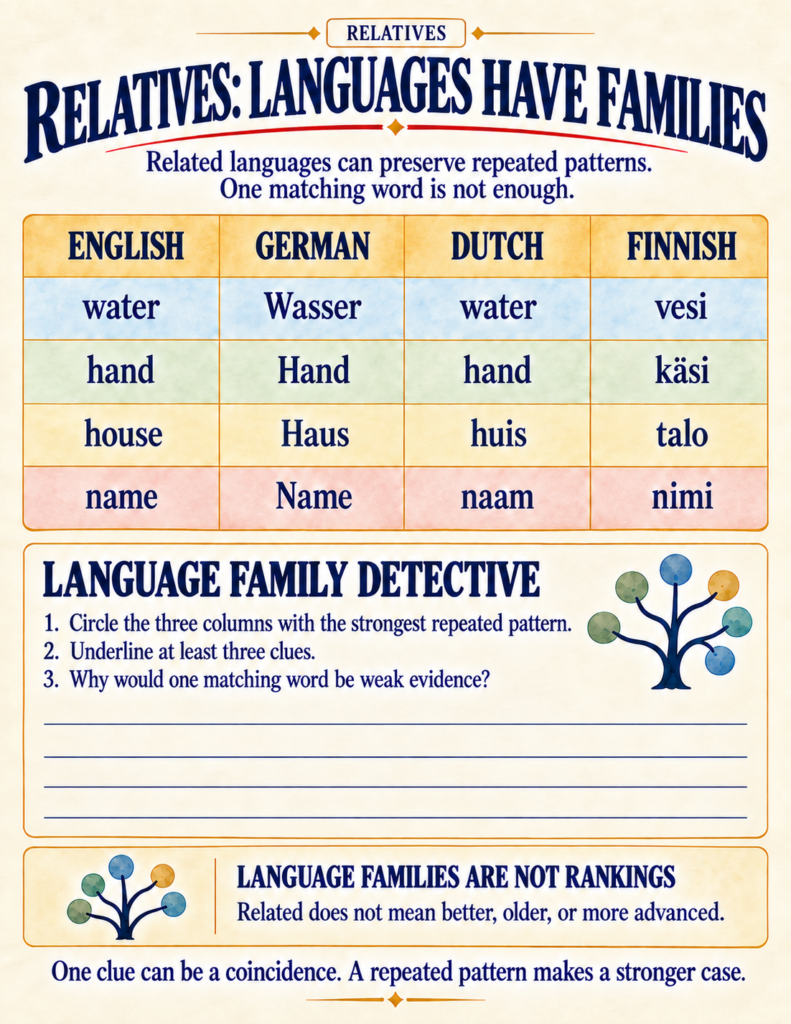
One of the most persistent misunderstandings among elementary learners is assuming that languages are related simply because they share a single familiar word. A child might spot a borrowed modern term like “radio” or “coffee” and conclude that two distant tongues belong to the same ancestral branch.
Languages Around the World turns vocabulary comparison into a rigorous forensic investigation:
- Pattern Hunting: Students inspect core basic words (such as water, hand, and house) across English, German, Dutch, and Finnish. They observe that while English (water), German (Wasser), and Dutch (water) exhibit systematic phonetic parallels, Finnish (vesi) stands completely apart.
- Ocean-Spanning Connections: In the Austronesian case file, children discover that Malagasy (spoken in Madagascar off the coast of Africa) shares ancestral number roots (lima/rima/dimy) with Tagalog in the Philippines and Māori in New Zealand, despite thousands of miles of open water.
This dynamic mirrors how living systems organize themselves in the natural world. Much like the interconnected nutrient cycles and canopy layers analyzed in our look at the Tropical Rainforest Workbook, human languages form rich evolutionary branches that carry history across generations.
Bridge Languages and Multilingual Roles
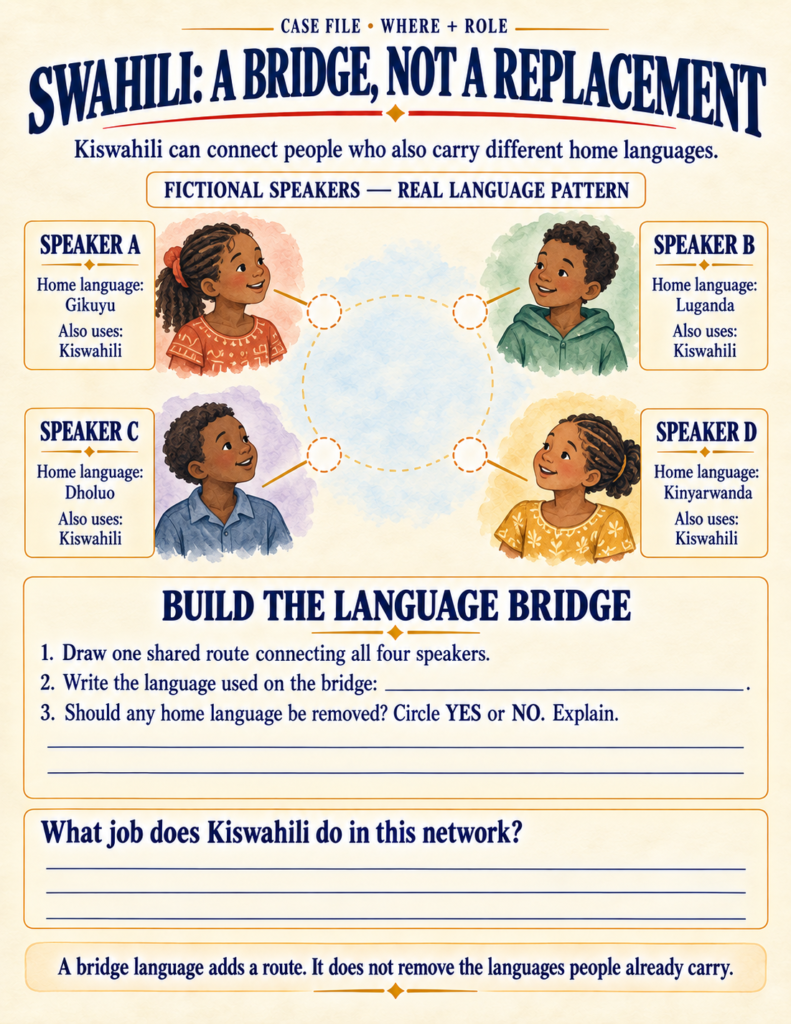
Elementary curriculum often frames language acquisition as a zero-sum replacement: if you learn a new tongue, the old one must fade. Languages Around the World explicitly dismantles this view by studying bridge languages.
Through a fictional yet realistic case study set in East Africa, students follow four individuals with distinct mother tongues (Gikuyu, Luganda, Dholuo, and Kinyarwanda) who all use Kiswahili to trade, travel, and converse. The core lesson is clear: “A bridge language adds a route. It does not remove the languages people already carry”.
Students examine how communication serves specialized functions in daily life:
- Code-Switching in Action: Following a case study of Arabic, learners explore how speakers smoothly navigate between Modern Standard Arabic (used in school textbooks, news broadcasts, and formal speeches) and local spoken dialects (used for relaxed family chats and humor) without ever leaving their language.
- Full Languages, Not Mime: The workbook tackles the widespread myth that sign languages are merely finger-spelled copies of local spoken speech. Students discover that American Sign Language (ASL) and British Sign Language (BSL) possess completely distinct grammars and origins—with ASL sharing a historical lineage with French Sign Language rather than spoken British English.
Understanding how living organisms develop specialized structures to serve specific survival roles is a fundamental principle of biology. As we detailed in our guide to the Plant Life Cycle Workbook , where xylem and phloem perform distinct transport jobs within a single plant, human societies naturally develop specialized linguistic registers for formal discourse, home life, and international trade.
Training Young Minds to «Shrink the Claim»
What sets this workbook apart from typical social studies workbooks is its explicit focus on scientific epistemology and careful reasoning.
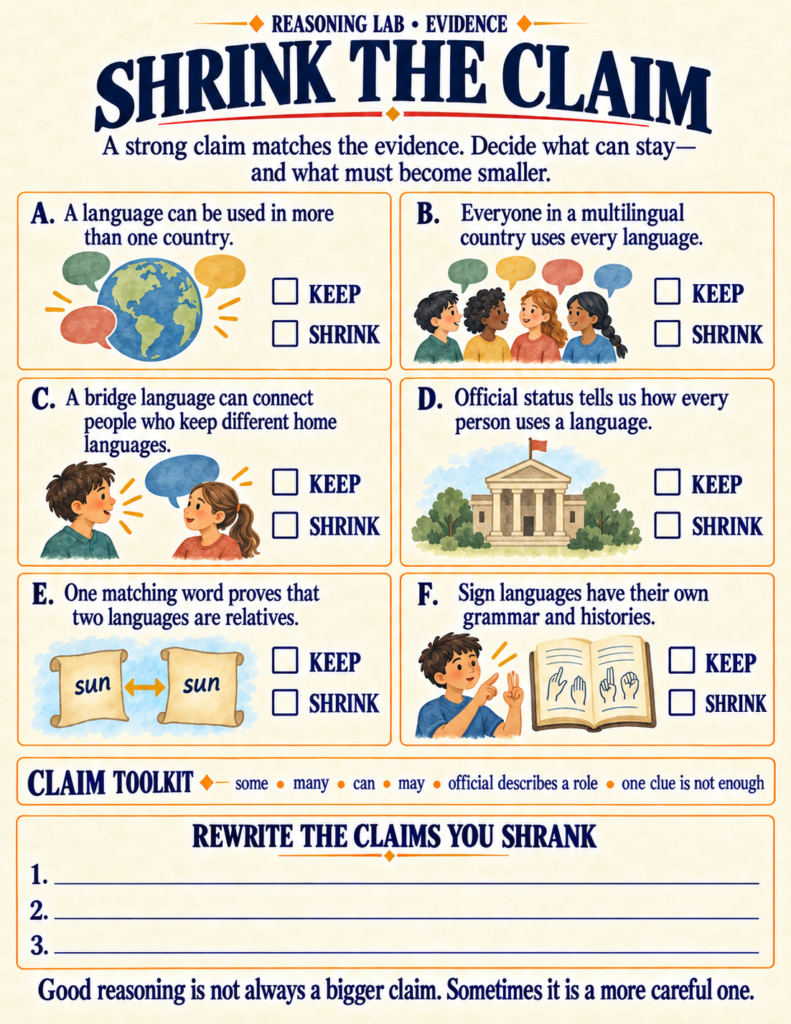
On the «Shrink the Claim» spreads, students are given a set of sweeping, exaggerated statements and a linguistic toolkit of qualifiers (some, many, can, may, role):
- The Oversized Claim: “Everyone in a multilingual country uses every language”.
- The Evidentiary Check: Switzerland has four national languages, yet individual citizens typically speak one or two regional tongues.
- The Shrunk, Defensible Claim: “Some people in a multilingual country use more than one language, and official status describes a governmental system rather than every resident’s personal habits”.
By learning that good thinking does not mean making the biggest claim, but the most defensible one, children gain critical reading habits that benefit every academic discipline.
Flexible Integration for Home and Classroom
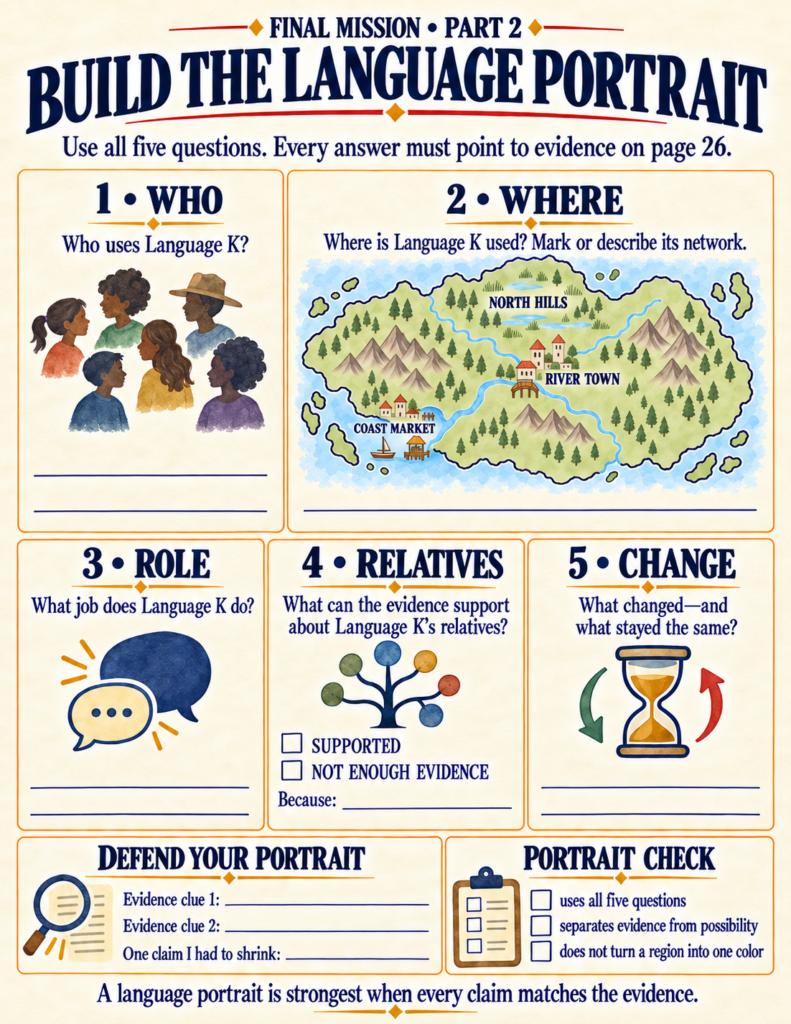
With complete answer keys, self-contained data briefs, and engaging watercolor illustrations, Languages Around the World requires zero specialized prep work:
- Homeschool Social Studies Block: Complete two pages daily over three weeks for a rich, screen-free world geography and linguistics unit.
- Classroom Inquiry Stations: Laminate the «Case Files» (such as Paraguay’s official bilingualism or Haitian Creole’s contact history) for collaborative small-group analysis.
- Cross-Curricular Detective Day: Use the «Word Journey» tracking spreads to trace the etymological paths of everyday words like tomato (Nahuatl), coffee (Arabic), and tea (Hokkien) on a world globe.
If you are looking for a printable social studies resource that replaces superficial flag-matching with authentic linguistic reasoning, model auditing, and cultural discovery, Languages Around the World gives your young explorer the tools to see how human communication truly unites our planet.