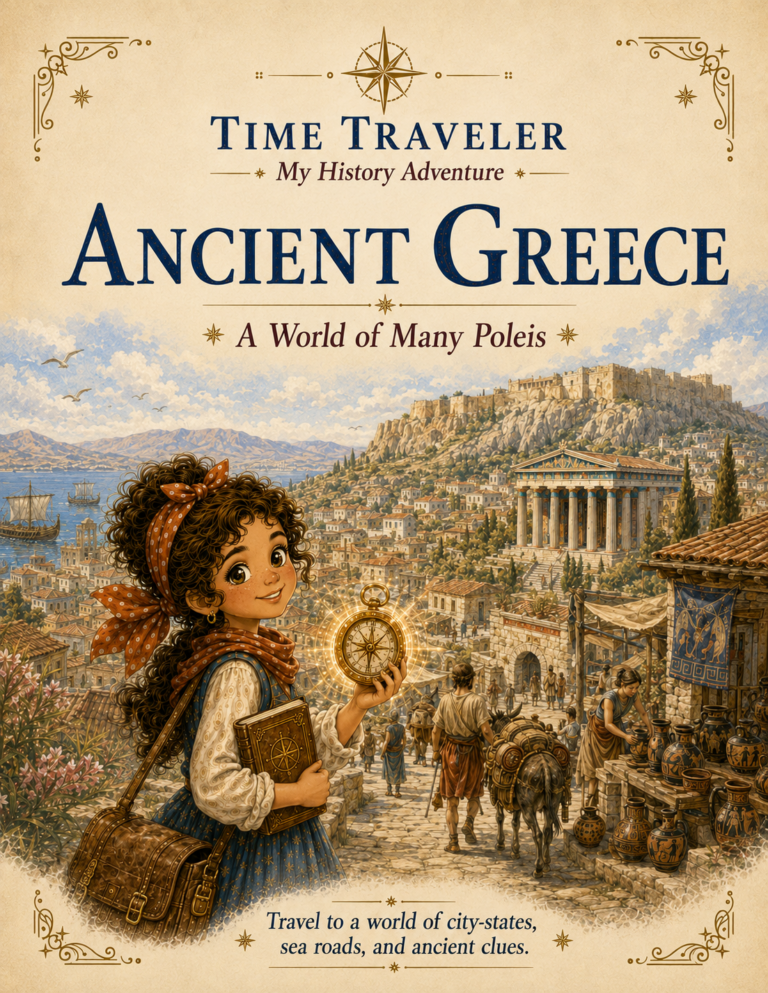
Ancient Greece Activities for Kids: Olympics, Theater & History
Ancient Greece Activities for Kids: Olympics, Theater & History
When children think of Ancient Greece, their minds often jump to champion sprinters crowned in olive leaves or dramatic actors wearing theatrical masks. Between the thunderous roar of the Olympic stadium and the crowded open-air theaters of Athens, it is an era built to captivate young imaginations. But how do we turn exciting tales of athletes and actors into genuine educational value? The secret lies in purposeful Ancient Greece activities for kids that prioritize active investigation over passive memorization.
By using thoughtfully structured materials, parents and educators can transform simple history lessons into engaging historical inquiries. Let’s look at how hands-on history workbooks exploring Olympic contests, Athenian theater, and ancient evidence develop critical thinking, spatial logic, and lifelong curiosity.
Why Interactive History for Kids Works
Children retain concepts far better when they analyze, sort, and deduce rather than simply read a list of dates. A standard textbook might say that the Greeks held athletic games and staged plays, but an interactive workbook asks children to examine the underlying system: How did a contest actually work, from training and judging to crowds and prizes? This shift from passive reading to active reasoning is the cornerstone of meaningful learning.
When you bring a structured interactive history for kids curriculum into your homeschool or study routine, you are not just presenting facts. You are teaching children how to read floor plans, examine material clues, and question historical claims like real historians.

Exploring Stadiums, Theaters, and the Contest System
One of the most effective ways to understand Greek society is to show children that different public events shared a common heartbeat. Athletics at Olympia honored Zeus, while drama contests at the City Dionysia honored Dionysus. Yet, underneath the surface, both required the exact same working parts: participants, intensive preparation, a dedicated space, strict rules and judges, an attentive audience, and a meaningful prize.
To see the broader picture of how religious sanctuaries and sacred spaces guided Greek life, you can explore our foundational Ancient Greece unit study. At the same time, this study connects naturally with our focused sister guide in the Ancient Greece unit study : Gods, Myths & Sacred
Places, which dives deep into Greek civic institutions and culture. Engaging Ancient Greece activities for kids challenge students to compare these worlds: Why did an Olympic victor take pride in a simple wild-olive wreath, while an Athenian festival winner took home valuable amphorae filled with olive oil? Material value, kids discover, was not the same thing as prestige.
Learning Through Doing: «When Athletes Broke the Rules»
To spark true curiosity, history should present real dilemmas. What happened when an athlete tried to cheat at Olympia?

In activities exploring the Zanes, children follow the story of a boxer named Eupolus who bribed competitors in 388 BCE. Fines collected from cheaters were used to erect bronze statues of Zeus warning future athletes that victory belonged to skill, not money. By comparing surviving stone bases visible in Olympia today with written accounts by the traveler Pausanias, young learners see how physical artifacts and texts work together to reveal the truth.
Thinking Like a Source Detective
The ultimate goal of historical education is to teach children how to evaluate evidence. This is where rich Ancient Greece activities for kids truly excel.
Did Greek theater masks look exactly like the stone and terracotta sculptures we find in museums today? Real performance masks were made of perishable materials like linen or leather and decomposed centuries ago. Historians have to reconstruct them by cross-referencing vase paintings, terracotta figurines, and ancient scripts.

By practicing the «Source Check» (asking who created a source, when, and why), students learn that ancient authors were not always neutral. Pindar wrote to flatter wealthy victors, Aristophanes exaggerated for comedic laughs, and Pausanias visited Olympia five centuries after its classical peak. Recognizing these nuances equips children with analytical and media literacy skills that serve them well beyond history class.
Spark Your Child’s Curiosity Today
Parents want educational resources that build genuine intellectual skills without feeling dry. High-quality workbooks filled with Ancient Greece activities for kids strike that ideal balance. They combine the thrilling world of Olympic footraces, chariot champions like Kyniska of Sparta, and masked stage performances with authentic archaeological detection.
By giving your children learning materials that treat them like young historians, you nurture their curiosity, hone their reasoning, and show them how the ancient world really worked.
Step into the past today and watch your young historian uncover the stories behind the stadium and the stage!