Why Communities Celebrate: Teaching Global Festivals as Living Traditions
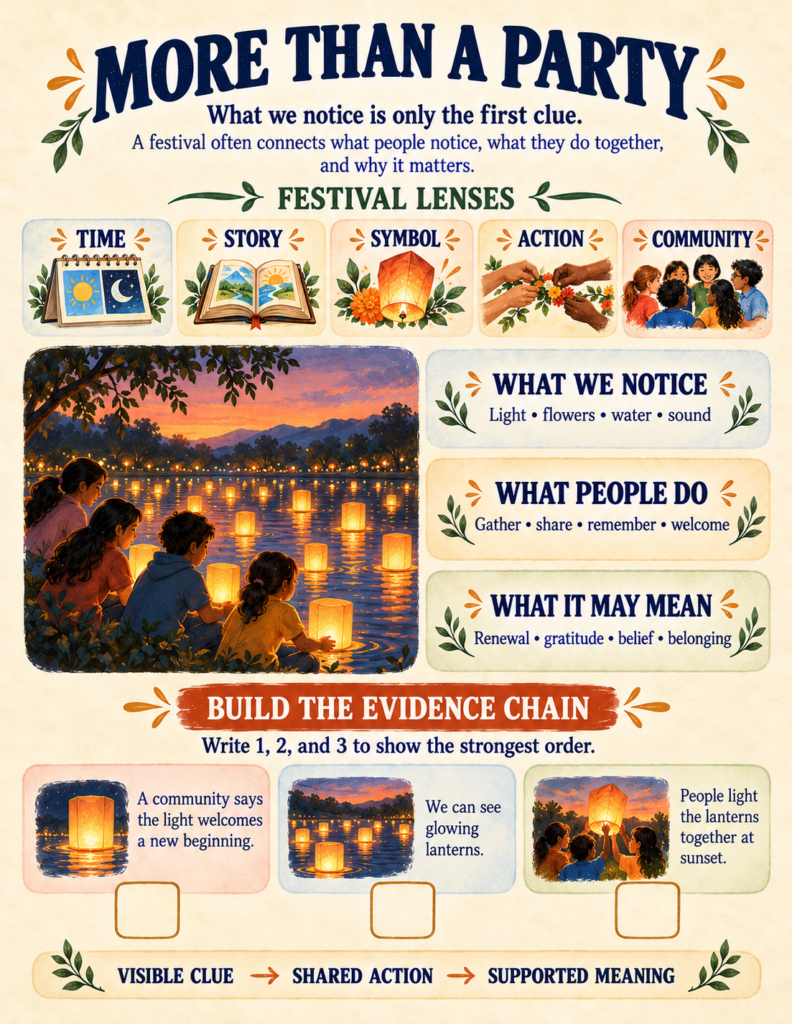
Ask an elementary student what happens during a festival, and the response usually centers on surface details: colorful costumes, delicious food, parades, or fireworks. When social studies units introduce world cultures exclusively through party snapshots, children walk away believing that celebrations are merely fun events on a calendar.
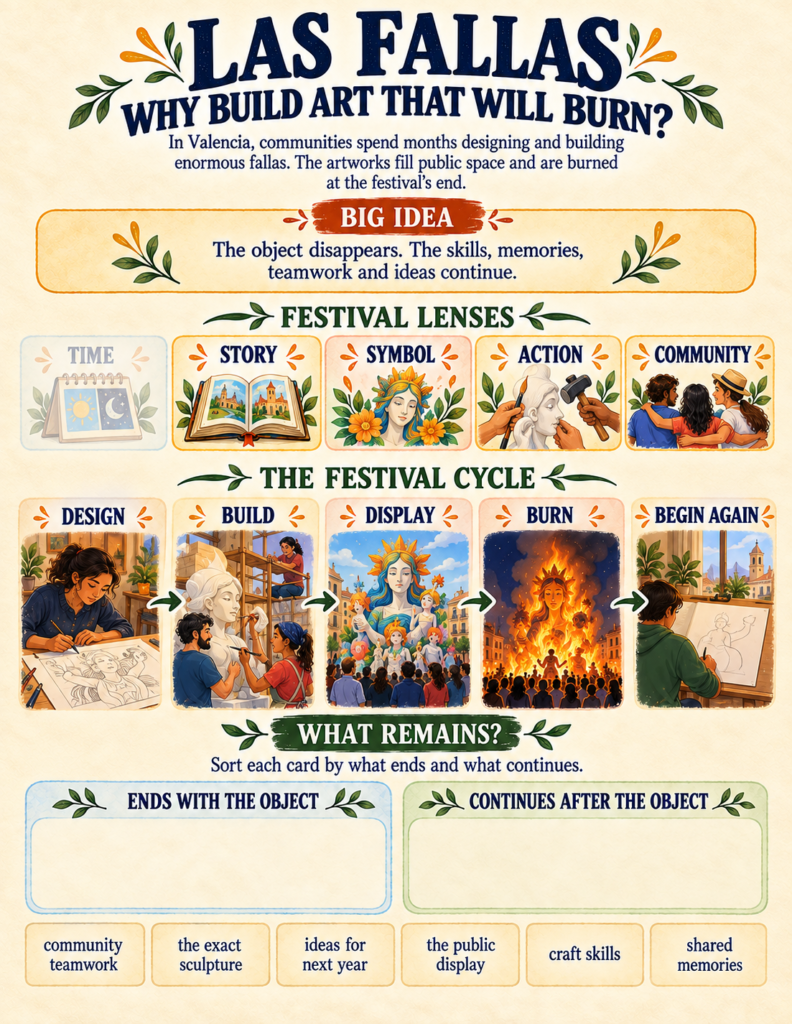
Yet a real celebration is never just a party. In Valencia, Spain, neighborhoods spend an entire year building massive wooden sculptures for Las Fallas, only to deliberately burn them to ashes in a single night of community renewal. In Thailand, Songkran fills streets with water, yet the splashing is rooted in quiet rituals of cleansing, showing respect to elders, and washing away hardship before the new year. In Ghana, Ga communities celebrate Homowo—a name that literally translates to «hooting at hunger»—by preparing ceremonial food that transforms memories of historical famine into shared resilience.
Moving past tourist cliches requires teaching children how human societies transform memory, time, and shared values into action. A thoughtfully crafted festivals around the world workbook does not present cultural holidays as disconnected spectacles; it equips young learners with analytical lenses to decipher how astronomical calendars work, why symbols shift across borders, and how living traditions evolve over generations.
Decoding the Astronomical Clocks of Human Culture
The most common misconception elementary students hold about world holidays is that every festival follows a static date on the wall calendar. When children see that dates for Eid al-Fitr, Diwali, or the Lunar New Year move every year on the civil calendar, they often assume the timing is random.
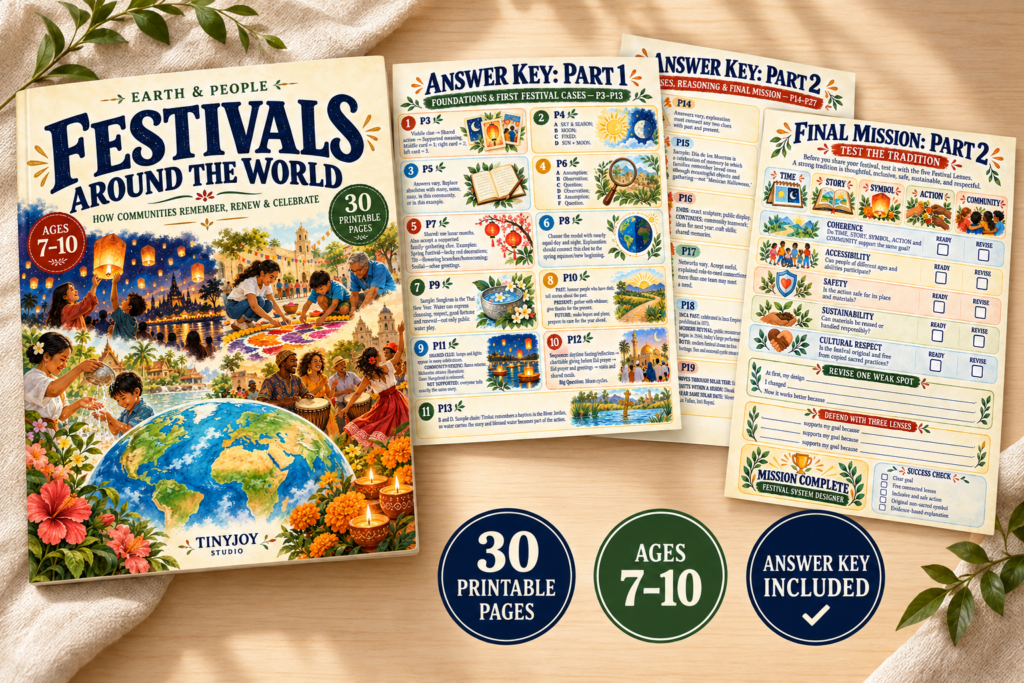
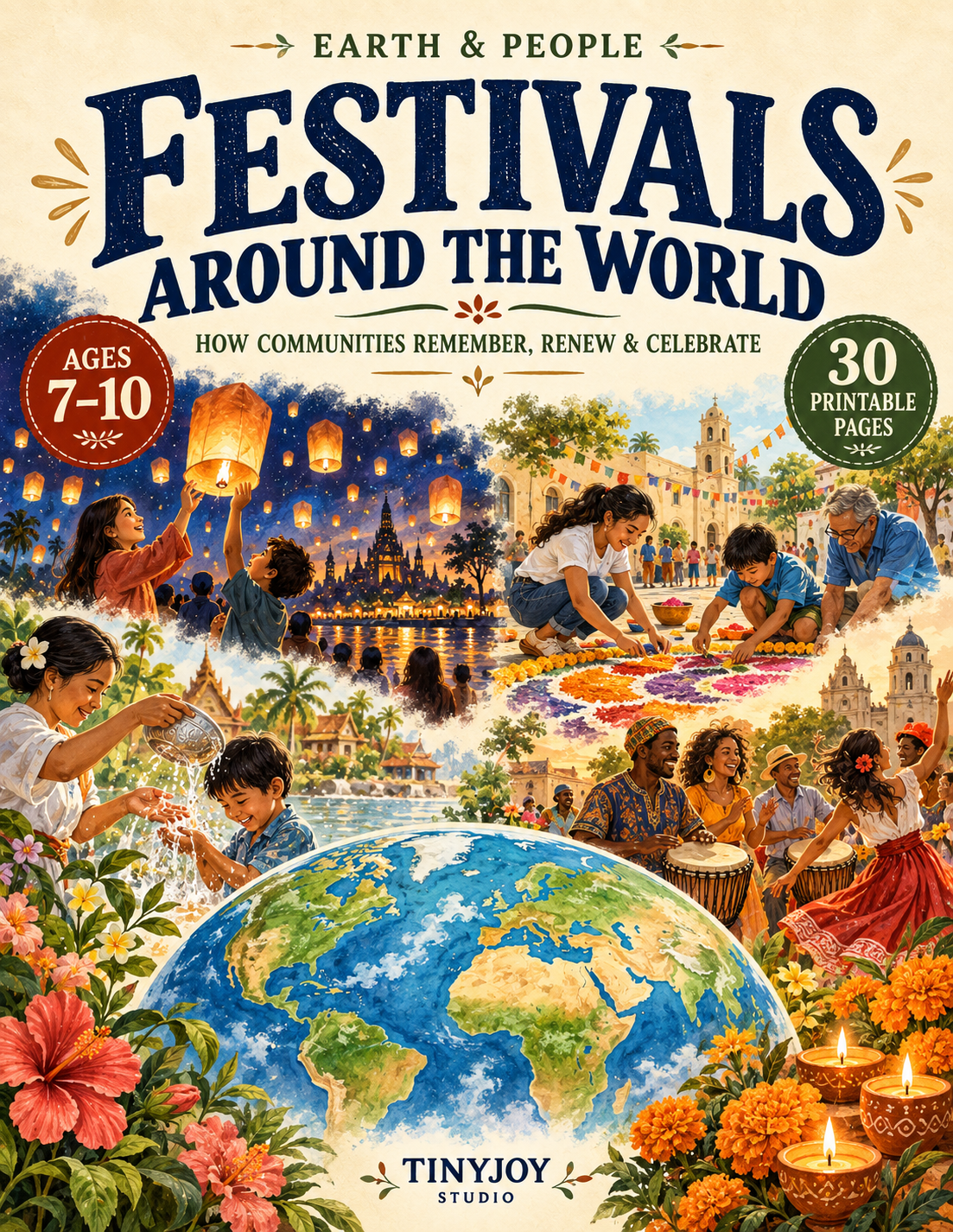
In Earth & People: Festivals Around the World (a 30-page printable unit designed for ages 7–10), learners discover that human cultures track time through distinct astronomical rules:
- Pure Moon Clocks: The Islamic calendar follows lunar cycles, causing holidays like Eid al-Fitr to migrate gradually through all four solar seasons across a 33-year cycle.
- Sun + Moon (Lunisolar) Clocks: Traditions like Spring Festival, Tết, Seollal, and Diwali track lunar months but periodically adjust them to ensure the celebrations stay anchored to a specific season.
- Sky & Season Clocks: Celebrations such as Nowruz begin precisely at the astronomical spring equinox, while the Māori New Year period of Matariki aligns with the winter rising of the Pleiades star cluster and the maramataka stellar-lunar calendar.
Understanding how celestial mechanics govern human cultural rhythms bridges social studies directly with physical science. Just as orbital geometry and axial tilts regulate planetary seasons, day lengths, and cosmic motion—a concept examined in our guide to the Solar System Explorer Workbook —the physical movement of the Sun, Moon, and stars establishes the baseline rhythms that unite human communities across our planet.
Context Dictates the Clue: The Myth of the Universal Symbol
Standard cultural worksheets often treat symbols like static emoji codes: green always means nature, water always means thirst, and fire always means destruction. Festivals Around the World directly deconstructs this oversimplification in an exercise titled «Same Symbol, Different Meaning».
Students compare identical physical elements across contrasting cultural settings:
- Water: During Thailand’s Songkran, water expresses reverence, cleansing, and wishing good fortune for the upcoming year; during Ethiopia’s Timkat, blessed water honors the baptism of Jesus in the River Jordan.
- Light: Clay lamps (diyas) during Diwali represent differing community stories—from Rama’s return to Mahavira’s liberation or Guru Hargobind’s release—while the candles on Mexican ofrendas during Día de los Muertos serve to guide and honor the memory of departed ancestors.
- Flowers: Bright orange cempasúchil marigolds decorate memorial altars in Mexico, whereas woven flower crowns and maypoles during Swedish Midsummer celebrate the warmth and vitality of the summer solstice.
This lesson reinforces that a symbol derives its power from community narrative and historical context rather than an arbitrary, universal rule.
This principle of functional context operates in the natural world as well. Much like the specialized tissues and fluid networks analyzed in our look at the Plant Life Cycle Workbook, where identical plant organs perform radically different survival functions depending on environmental pressures, human cultures select shared physical resources to communicate distinct, localized values.
Living Traditions Are Loops of Renewal
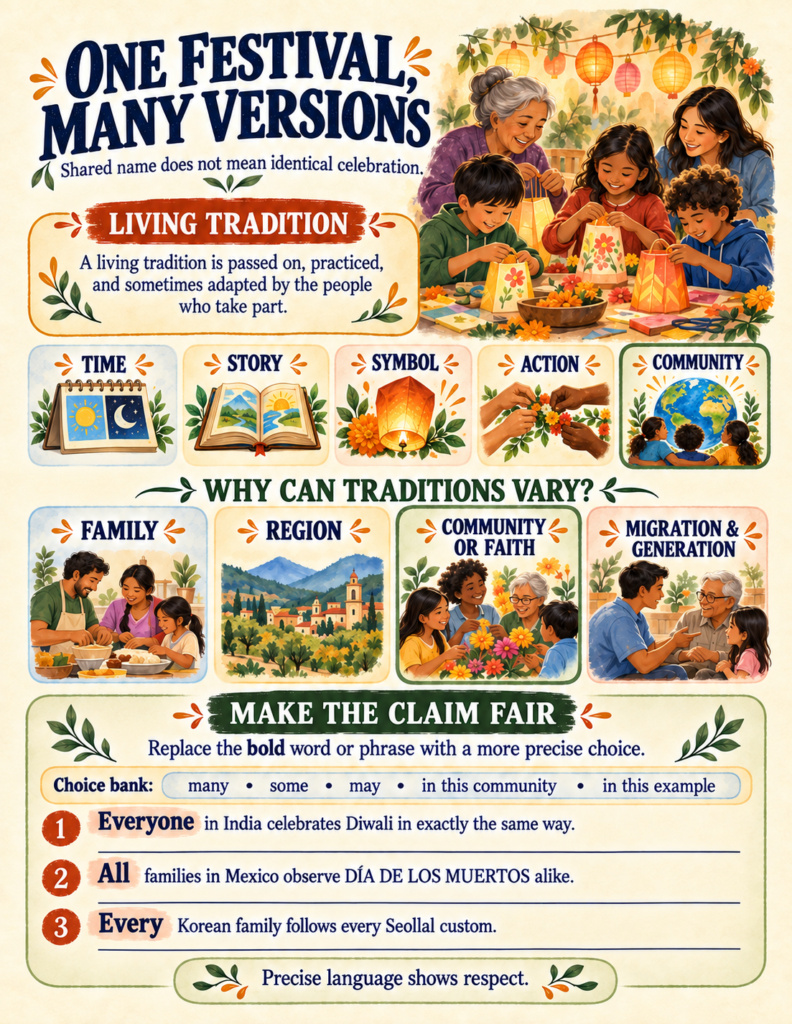
One of the deepest insights the workbook offers is that culture is not a museum relic frozen in time; it is an active, evolving process.
In the case study of Peru’s Inti Raymi, children analyze a historical timeline:
- The ancient Inca empire celebrated the Sun at the winter solstice.
- Spanish colonial authorities prohibited the celebration in 1572.
- In 1944, citizens in Cusco organized a public historical reconstruction.
- Today, Inti Raymi is a vibrant public celebration of Quechua heritage, theater, and cultural identity.
Students learn to distinguish an unchanged survival from an intentional cultural revival. They evaluate how communities protect core spiritual meanings while updating outward forms—such as replacing single-use plastics with compostable materials or connecting families separated by migration through video calls.
This regenerative continuity mirrors the closed-loop cycles of living ecosystems. Just as decomposing organic matter feeds ancient root networks—as explored in our review of the Tropical Rainforest Workbook —human festivals recycle community memory, allowing old traditions to nourish future generations without losing their essential identity.
Training Young Observers in the «Curator’s Craft»
What makes Festivals Around the World truly unique among elementary social studies resources is its rigorous emphasis on media literacy and respectful ethnography.
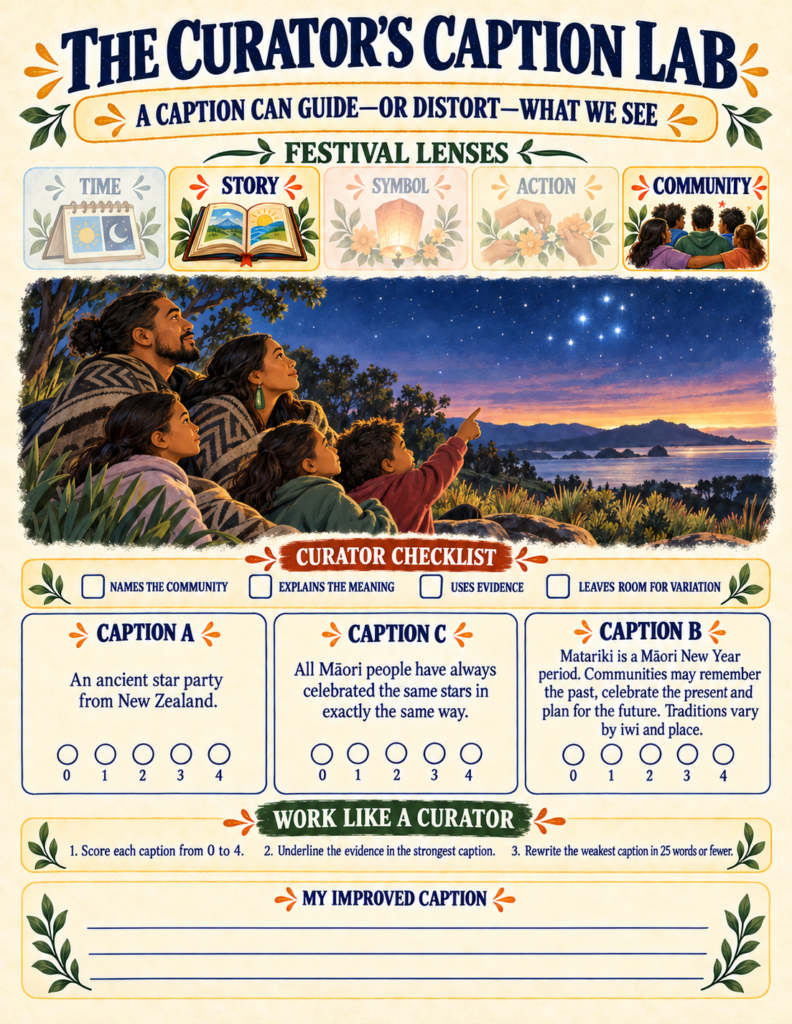
In the «Curator’s Caption Lab,» students audit three descriptions of the Māori New Year festival Matariki using a formal four-point checklist:
- Caption A (The Tourist Trap): «An ancient star party from New Zealand» (scored poorly for being vague, dismissive, and culturally superficial).
- Caption C (The Overgeneralization): «All Māori people have always celebrated the same stars in exactly the same way» (fails because it erases iwi variations and assumes static uniformity).
- Caption B (The Evidence-Based Standard): «Matariki is a Māori New Year period. Communities may remember the past, celebrate the present and plan for the future. Traditions vary by iwi and place.»
By learning how to spot unwarranted assumptions («Blue must mean sadness») and replacing them with careful questions («What do these ribbons mean to this community?»), children build empathy, critical inquiry, and genuine cultural respect.
From Critical Analysis to Community Design
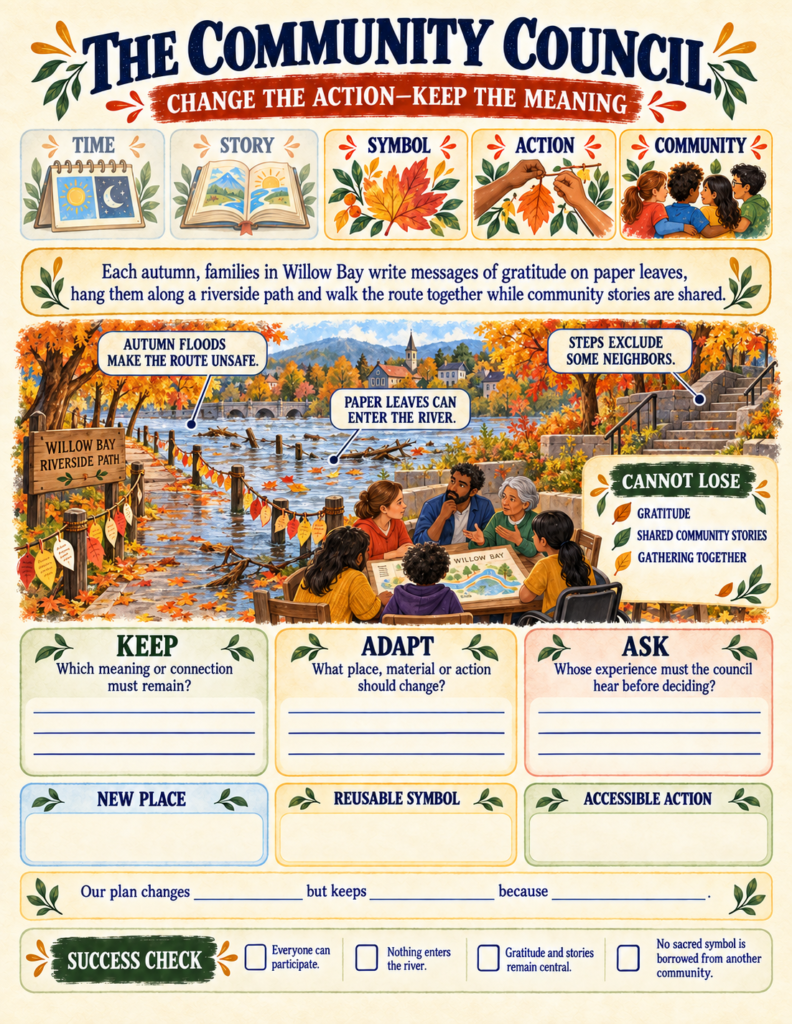
The workbook culminates in a creative two-part capstone: The Festival System Designer.
Rather than having children mimic sacred rituals from real cultures—an approach that often leads to cultural misappropriation—the workbook challenges students to design an original, non-sacred festival for their own neighborhood, school, or town:
- Define the Purpose: Choose a central goal: welcoming a season, honoring local history, expressing gratitude, strengthening community ties, or creating public art.
- Align the Five Lenses: Select a specific time rule, draft the community story, design an original symbol, outline shared actions, and plan who participates.
- The Five-Point Stress Test: Before finalizing the design, students audit their celebration against five ethical benchmarks: Coherence, Accessibility (can all ages and abilities take part?), Safety, Environmental Sustainability, and Cultural Respect (ensuring no sacred symbols were borrowed).
Practical Integration for Home and Classroom
Because Festivals Around the World features self-contained case briefs, clear graphic organizers, and a comprehensive answer key, it requires zero specialized teacher preparation:
- Homeschool Cultural Geography Block: Complete two pages daily over three weeks for a rich, screen-free social studies curriculum.
- Classroom Inquiry Stations: Print individual case files—such as Las Fallas, Timkat, or Rio Carnival—for collaborative small-group analysis and discussion.
- End-of-Year Civics & Community Project: Use the «Willow Bay Community Council» and the festival-builder spreads as an integrated civics and creative writing capstone.
If you are looking for an educational resource that replaces shallow holiday worksheets with authentic cultural inquiry, astronomical timekeeping, and critical thinking, Festivals Around the World gives your young explorer the tools to understand why human beings everywhere find reasons to gather, remember, and celebrate together.