A Dark Cloud Is Not a Promise: Teaching Meteorology Through Field Observation and Real Evidence
Most elementary meteorology lessons start and end with a daily morning calendar where a child sticks a smiling sun or a cartoon raindrop onto a Velcro board. Choosing an evidence-based weather workbook for kids is one of the sharpest ways to show young learners that real atmospheric science is about gathering physical clues rather than guessing tomorrow’s forecast. When structured as an outdoor field investigation, a weather workbook for kids trains students to observe cloud edges, read ground-level wind indicators, classify moisture on surfaces, and compare the exact same patch of sky over time.
Standard classroom worksheets frequently flatten meteorology into memorizing Latin cloud names or gluing cotton balls onto construction paper. Those activities rarely address the subtle distinctions that make field observation genuinely scientific: that a still photograph can show cloud layers but cannot prove movement; that high-altitude clouds often drift in a completely different direction than wind blowing across the grass; and that a single dark cloud overhead is merely one clue, never a guarantee of rain.
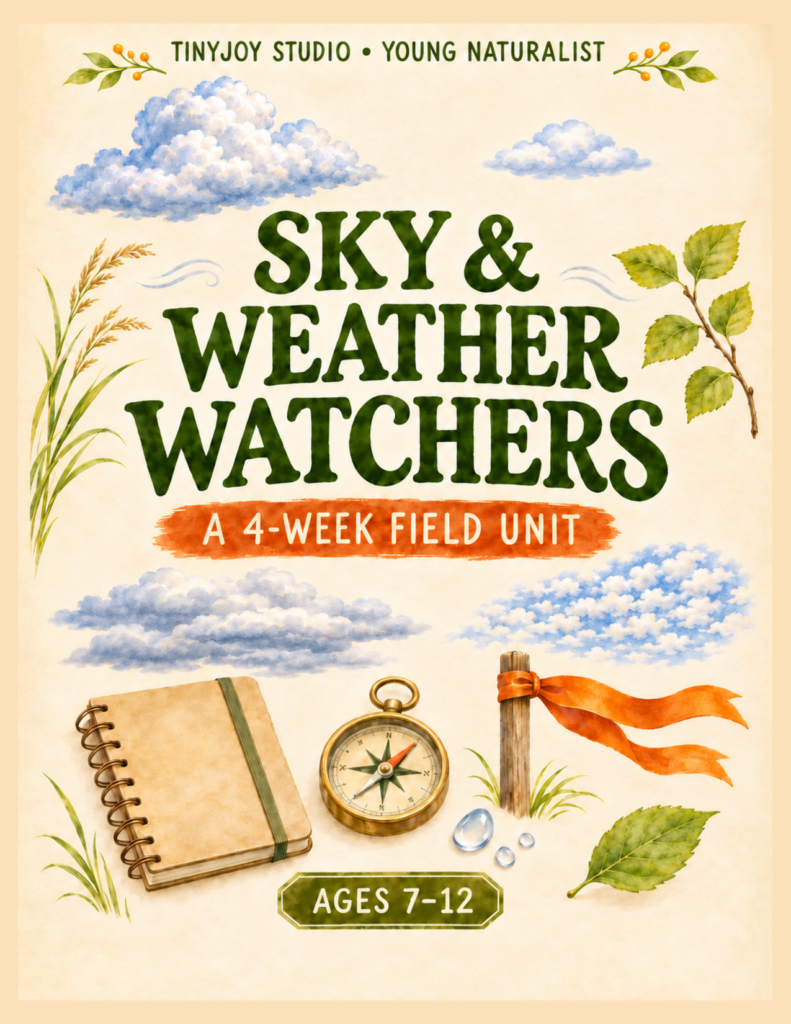
In Sky & Weather Watchers: A 4-Week Field Unit (a 32-page printable guide for ages 7–12 in the TinyJoy Studio Young Naturalist series), children become careful atmospheric observers. Built around a repeatable weekly cadence—Learn → Think → Go → Observe → Make → Check—the unit moves seamlessly between safe outdoor sky patches, window views, and built-in illustrated Home Field Scenes so weather tracking never stalls on stormy days.

Week 1: Reading Cloud Cover, Edges, and Layers
Instead of overwhelming beginners with dozens of Latin cloud classifications, Week 1 focuses on three concrete visual traits any child can verify in a single safe patch of sky: cloud cover (from no clouds to all covered), edges (crisp versus soft), and layers. To remove guesswork when estimating sky coverage, students cut out and assemble a handheld $2 \times 4$ Sky Patch Viewer—an eight-window paper grid held away from the face to count how many squares contain cloud.
By anchoring their gaze to three fixed landmarks—near, middle, and far—and watching one cloud edge against a roofline or branch for 30 to 60 seconds, learners practice separating raw visual facts from assumptions. That disciplined habit of recording only what is directly visible forms the backbone of the entire Young Naturalist series, whether children are inspecting bark habitats in our insects field unit for kids or comparing branching silhouettes in our tree identification for kids guide.

Week 2: Wind Clues Near the Ground vs. Aloft
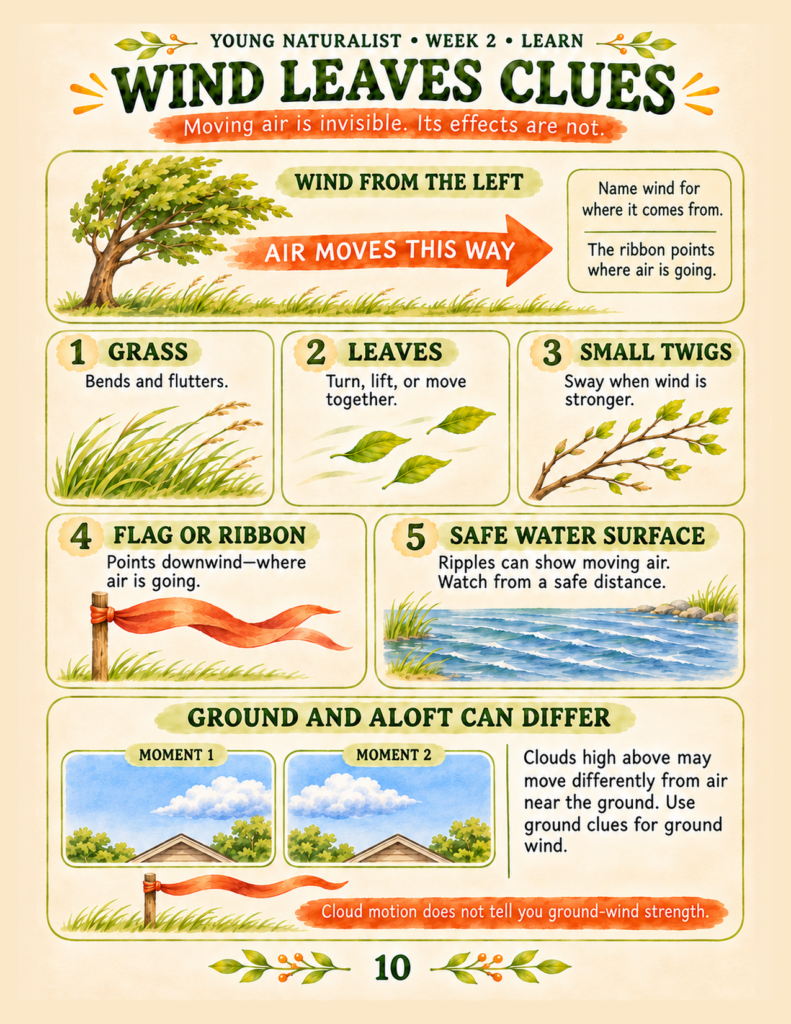
Because moving air is invisible, Week 2 teaches students to read its physical fingerprints across five ground-level indicators: bending grass, turning leaves, swaying twigs, ripples on a safe pond surface, and a DIY paper Wind Ribbon taped to an unsharpened pencil. Students master a classic meteorological convention that trips up many adults—naming wind by where it comes from, even though a ribbon points toward where the air is going.
Just as importantly, learners compare high cloud drift with ground-level ribbons to discover that air aloft and air near the soil can behave quite differently. Observing how wind bends meadow grasses and ripples leaf litter connects naturally with examining surface soil layers and decomposition in our forest floor science for kids unit.
Week 3: Moisture in the Air, on Surfaces, and Falling
In Week 3, investigations shift to the hydrological clues surrounding us every morning. Students classify water into three observable states—hanging in the air (clouds and ground-touching fog), on a surface (dew and frost), and falling (rain and snow)—while building a three-flap interactive lift-the-flap reference organizer.
Through a structured 10-Minute Moisture Watch, children learn crucial scientific nuances: that morning dew condenses directly onto cool blades of grass rather than falling as overnight rain, and that a hazy distant ridge requires additional evidence before claiming it is fog rather than smoke or dust. Tracking overnight dew on grass and mud puddles along a trail pairs effortlessly with reading fresh footprints and wildlife signs in our animal tracks and bird signs for kids unit.

Week 4: «Then and Now» Comparisons and the Discovery Mosaic
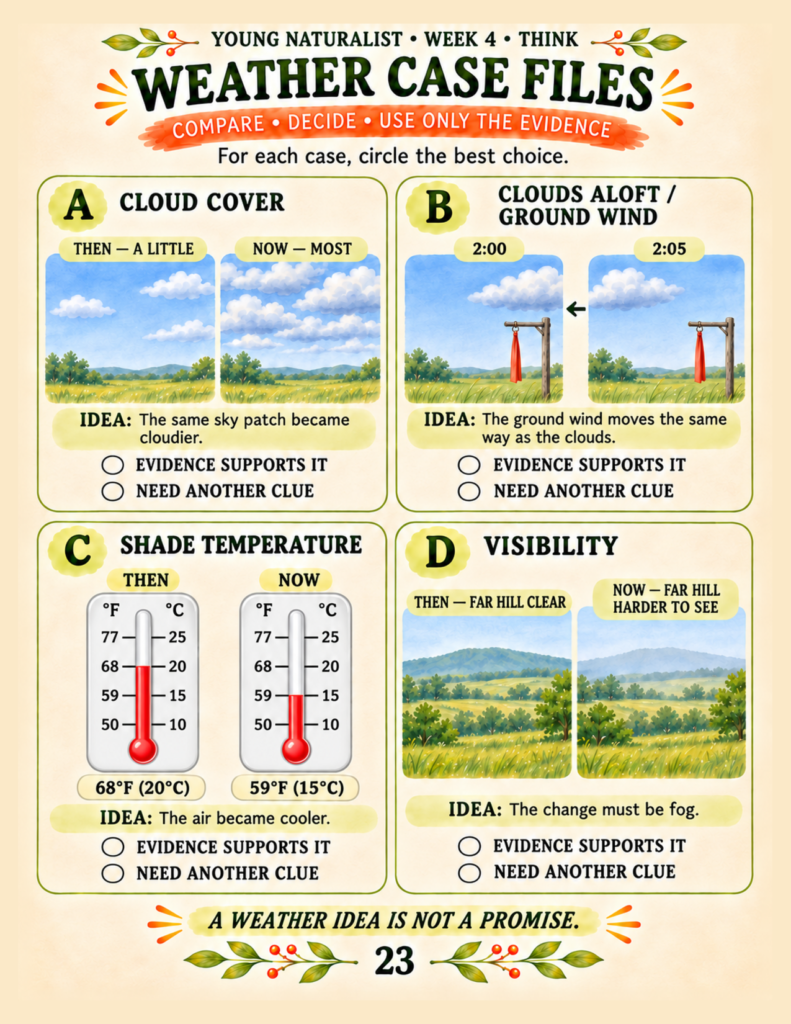
Week 4 brings all five weather clues—clouds, wind, water, temperature, and visibility—together through longitudinal comparison. Returning to the exact same observation spot and facing the same landmarks, students record Then and Now snapshots, assemble an accordion-folded Weather Story Strip, and audit four Weather Case Files to decide when evidence supports an idea versus when «need another clue» is the most honest answer. Even returning to find zero visible change is celebrated as valid scientific data.
Upon completing the final Weather Evidence Report on Page 30, learners unlock the Sky & Weather Discovery Piece—a full-color collectible tile designed to fit into the top-left slot of the 9-piece My Nature Discovery Mosaic poster featured on the back cover.

Practical Ways to Use This 4-Week Field Unit
Designed for ages 7–12 (grades 2–6), Sky & Weather Watchers requires only everyday household items—scissors, tape, a pencil, crayons, and an optional unbreakable outdoor thermometer or compass. When extreme heat, bitter cold, smoke, or thunder keeps learners indoors, two full-page illustrated Home Field Scenes (Pages 28–29) with matching Study Spots A–D allow students to complete every single observation log safely from the kitchen table.
If you want a ready-to-print, screen-free meteorology unit that replaces passive weather charts with real field observation and evidence-based reasoning, Sky & Weather Watchers gives young naturalists a structured, four-week path into reading the living sky.