Looking Beyond the Green: A Tree Identification for Kids Unit That Builds Real Field Habits
When elementary children look at a forest, park, or suburban street, they frequently perceive trees as an undifferentiated wall of green leaves on brown trunks. Introducing a structured framework for tree identification for kids transforms that vague background into a vivid gallery of distinct species, architectural branching strategies, and seasonal adaptations. Rather than forcing children to guess species names from a single leaf, an authentic approach to tree identification for kids teaches them to gather multiple lines of evidence: analyzing whole-tree crown silhouettes, inspecting leaf margins and attachment nodes, examining winter bud pairings, and tracking changes across the seasons.
Early botanical education frequently falls into the trap of hasty identification. Children download a digital phone app, snap a blurry photo of a leaf, and accept an automated guess without checking the trunk, looking at branch arrangement, or noticing whether the leaf is simple or compound. When the leaves drop in autumn, their ability to identify trees disappears entirely.

In Leaf & Tree Hunters: A 4-Week Field Unit (designed for ages 7–12 by TinyJoy Studio), children build the observational discipline of true field botanists. Serving as a core thematic component of our Young Naturalist collection—building upon the foundational outdoor habits established in our open-ended nature journal for kids and complementing the micro-ecosystem studies in our insects field unit for kids—this unit guides learners through a month-long, evidence-based investigation of living trees.

A Predictable 4-Week Learning Rhythm
Science understanding deepens when children follow a dependable rhythm. Leaf & Tree Hunters organizes thirty-two rich pages into four sequential investigations, designed for 3 to 4 short sessions of 15–20 minutes each week:
- Week 1: Which Tree Is Mine? (Tree Shape): Moving from whole-tree silhouettes (wide and rounded, narrow and tall, triangle-shaped) to landmark mapping and baseline portraits.
- Week 2: What Can a Leaf Tell Me? (Leaf Clues): Decoding shapes (oval, lobed, needle-like), edges (smooth vs. toothed), venation, and the vital structural difference between a single leaf blade and several leaflets.
- Week 3: What If There Are No Leaves? (Bark & Buds): Solving winter identification through twig anatomy, contrasting opposite bud pairs with alternate bud arrangements, and inspecting bark ridges.
- Week 4: How Does My Tree Change? (Change Over Time): Conducting longitudinal field comparisons, recording signs of wildlife, and separating observed physical facts from untested explanations.
Every week utilizes an active pedagogical sequence: Learn a structural concept, Think through an evidence puzzle, Go outside or to a window, Observe specific diagnostic clues, Make a physical model or pocket guide, and Check discoveries using an open-ended review.
This habit of connecting physical plant forms to localized climate conditions mirrors the broader geographical thinking taught in our geography learning path for kids. Just as regional geography examines how mountain barriers, soil moisture, and prevailing winds shape distinct global ecosystems, young tree hunters discover that a tree’s crown geometry and foliage density represent a finely tuned response to light availability, wind exposure, and water transport.

Diagnostic Rigor: The Leaf Suspect Lineup and Winter Twigs
One of the greatest challenges for young learners is recognizing that a single clue is rarely enough to name a plant. Leaf & Tree Hunters builds diagnostic skepticism through guided forensic activities:
- The Leaf Suspect Lineup (Page 11): Children are given a single clue (e.g., Smooth Edge) and asked if they can identify the tree. They quickly discover that a smooth edge leaves multiple candidates on the table. Only when paired with a second independent clue—such as an oval silhouette or lobed margins—does the suspect list narrow down to a single species.
- The Mystery Twig (Page 17): In winter, deciduous trees drop their foliage, leaving children to rely on twigs and buds. Students inspect four regional candidates (sugar maple, white oak, black walnut, white ash) using a two-step matrix:
- Step 1: Leaf scar history (simple leaf vs. compound leaf).
- Step 2: Bud alignment (buds in opposite pairs vs. buds taking alternate turns along the branch).

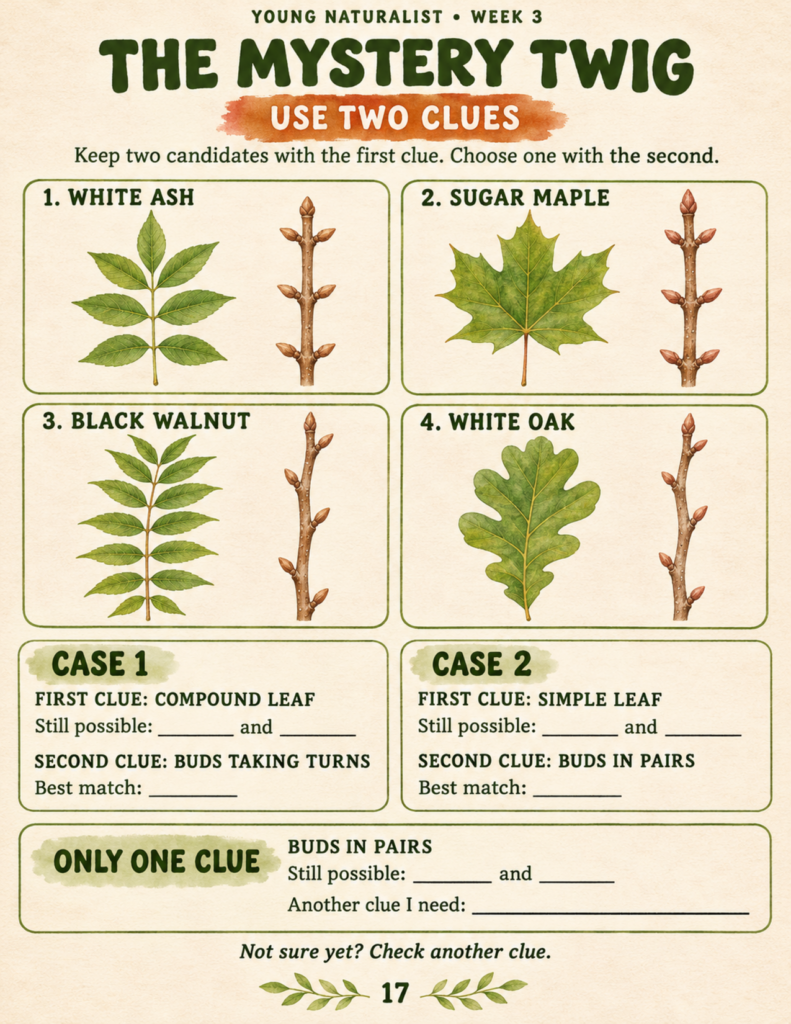
Through these deductive exercises, children learn that saying «I am not sure yet; I need to check another clue» is not a sign of failure, but the highest mark of a true scientist.
This analytical discipline of testing multiple independent markers directly reinforces the empirical mindset cultivated across our earth and space science bundle for kids. Just as young astronomers cross-reference celestial coordinates, apparent brightness, and light-year depth models before mapping constellations, young botanists learn that hasty conclusions must always yield to verifiable physical evidence.

Accessible Fieldwork: Four Observation Routes and Honest Data
Field science must be practical and inclusive. Whether families live in dense urban centers, manage severe outdoor pollen allergies, or encounter winter blizzards, Leaf & Tree Hunters ensures uninterrupted study through four flexible observation routes:
- Outdoors: Studying a living tree in a backyard, park, or quiet street.
- From a Window: Observing a neighborhood tree’s crown shape and seasonal shifts safely from indoors.
- From Photographs: Analyzing high-resolution images of local flora.
- Home Field Scenes (Pages 28–29): Utilizing composite teaching spreads that show the exact same lettered trees (sugar maple, white oak, white ash, black walnut) in early summer and the following winter.
Furthermore, the curriculum champions honest scientific recording. If a child looks out the window and cannot see small buds on a high branch, the correct scientific note is not to guess, but to record: «Can’t see it from here». Similarly, if a student revisits their study tree after four weeks and spots no visible transformation, recording «No obvious change noticed» is celebrated as valid, rigorous data.
This dedication to accurate historical recording and evaluating artifacts in place mirrors the methodology of our interactive history for kids curriculum. Just as young historians evaluate primary sources based strictly on preserved physical records without fabricating missing details, young naturalists learn that unvarnished truth is the foundation of genuine discovery.
Unlocking the Middle-Left: The Nature Discovery Mosaic
A standout feature of the Young Naturalist series is its engaging collectible architecture:
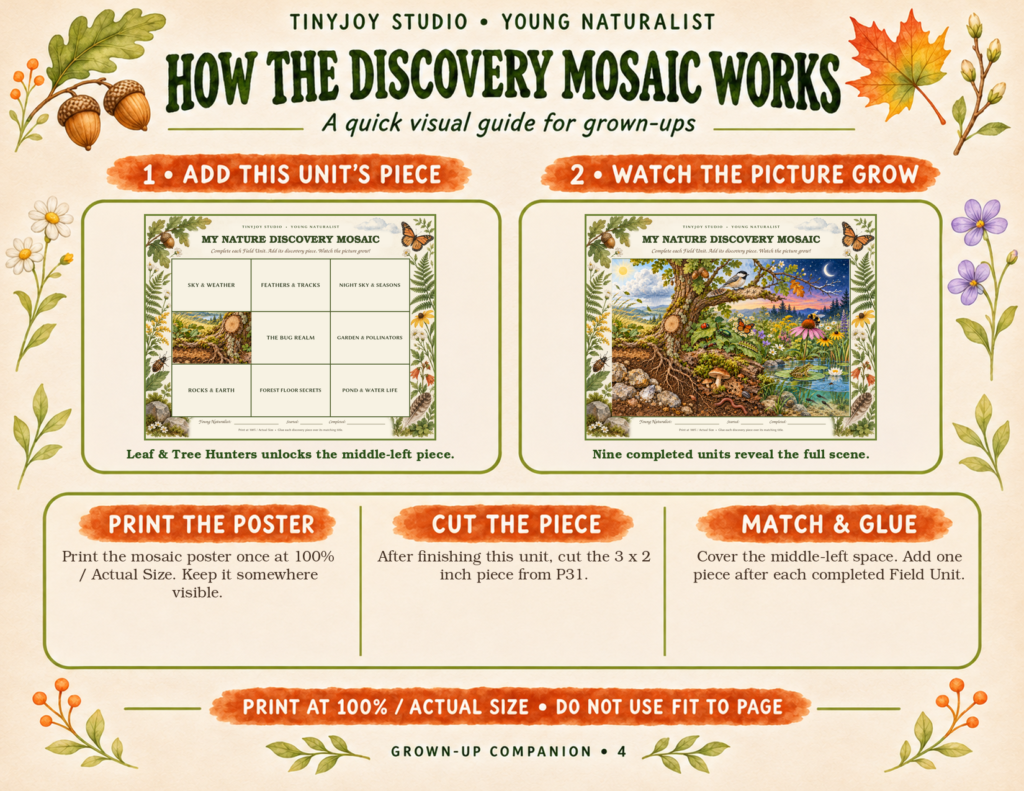
- The Completed Unit Reward: Upon finishing Week 4’s final mission («My Tree Evidence File»), the child earns the official $3 \times 2$-inch Leaf & Tree Hunters discovery piece found on page 31.
- The Nine-Part Poster Grid: Families print the bonus My Nature Discovery Mosaic poster at 100% / Actual Size. The poster features a $3 \times 3$ grid of nine thematic units:
- Top Row: Sky & Weather • Feathers & Tracks • Night Sky & Seasons
- Middle Row: Leaf & Tree Hunters • The Bug Realm • Garden & Pollinators
- Bottom Row: Rocks & Earth • Forest Floor Secrets • Pond & Water Life
- The Middle-Left Anchor: While The Bug Realm unlocks the central puzzle piece, Leaf & Tree Hunters officially unlocks the middle-left space.
When young naturalists paste this full-color tile over its matching title, they uncover the massive roots, weathered trunk bark, and ancient tree cross-section of the forest scene. Watching the large-scale woodland poster assemble piece by piece provides children with tangible momentum as they look forward to future field units.

Simple Materials, Lasting Scientific Habits
Leaf & Tree Hunters requires no expensive botanical laboratory equipment. With basic pencils, colored pencils, a ruler, child-safe scissors, a glue stick, and an optional magnifying glass or wax crayon, it fits naturally into any educational lifestyle:
- Homeschool Science Blocks: Dedicate fifteen minutes three days a week to work through one thematic week, pairing workbook pages with a single neighborhood study tree.
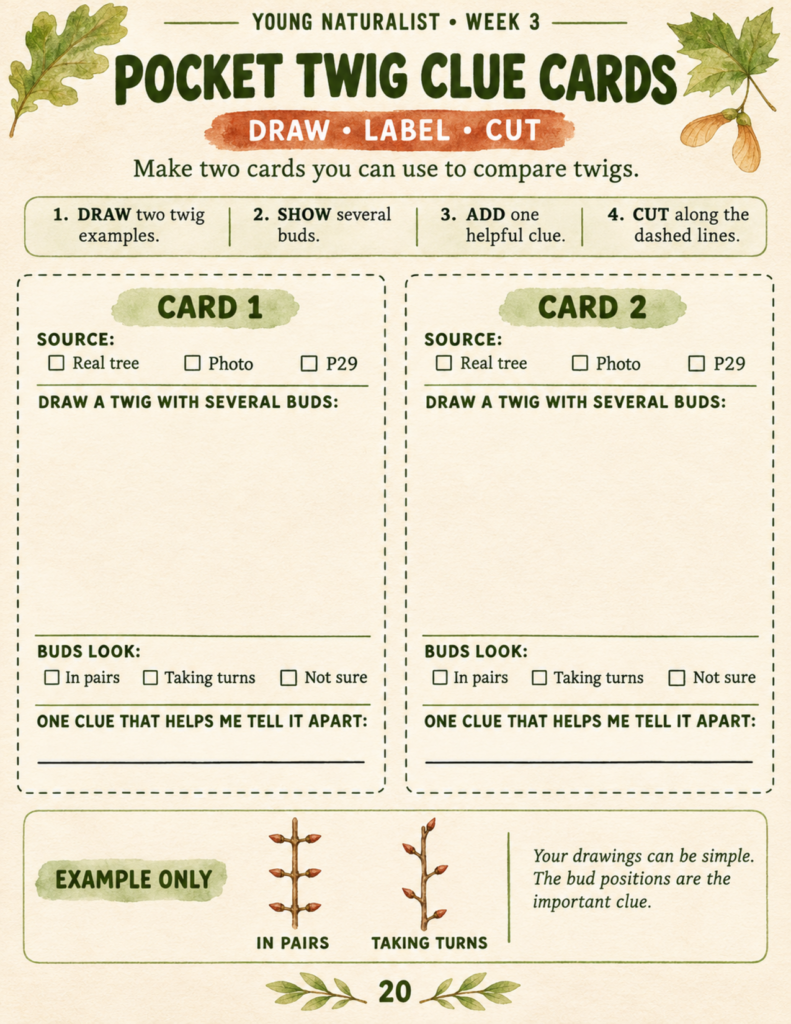
- Multi-Season Nature Walks: Keep the printable «Pocket Twig Clue Cards» and fold-out «Tree Clue Guide» in a field pack to investigate trees across spring, summer, fall, and winter.
- Window-Side Nature Study: For families in apartments or during harsh winter weather, complete the entire unit using window views and the detailed summer-and-winter teaching scenes.
If you are looking for an educational, screen-free resource that turns casual walks into genuine botanical inquiry, trains the eye to see subtle morphological clues, and rewards curiosity through a beautiful collector mosaic, Leaf & Tree Hunters provides the ultimate field companion to the towering living world around us.