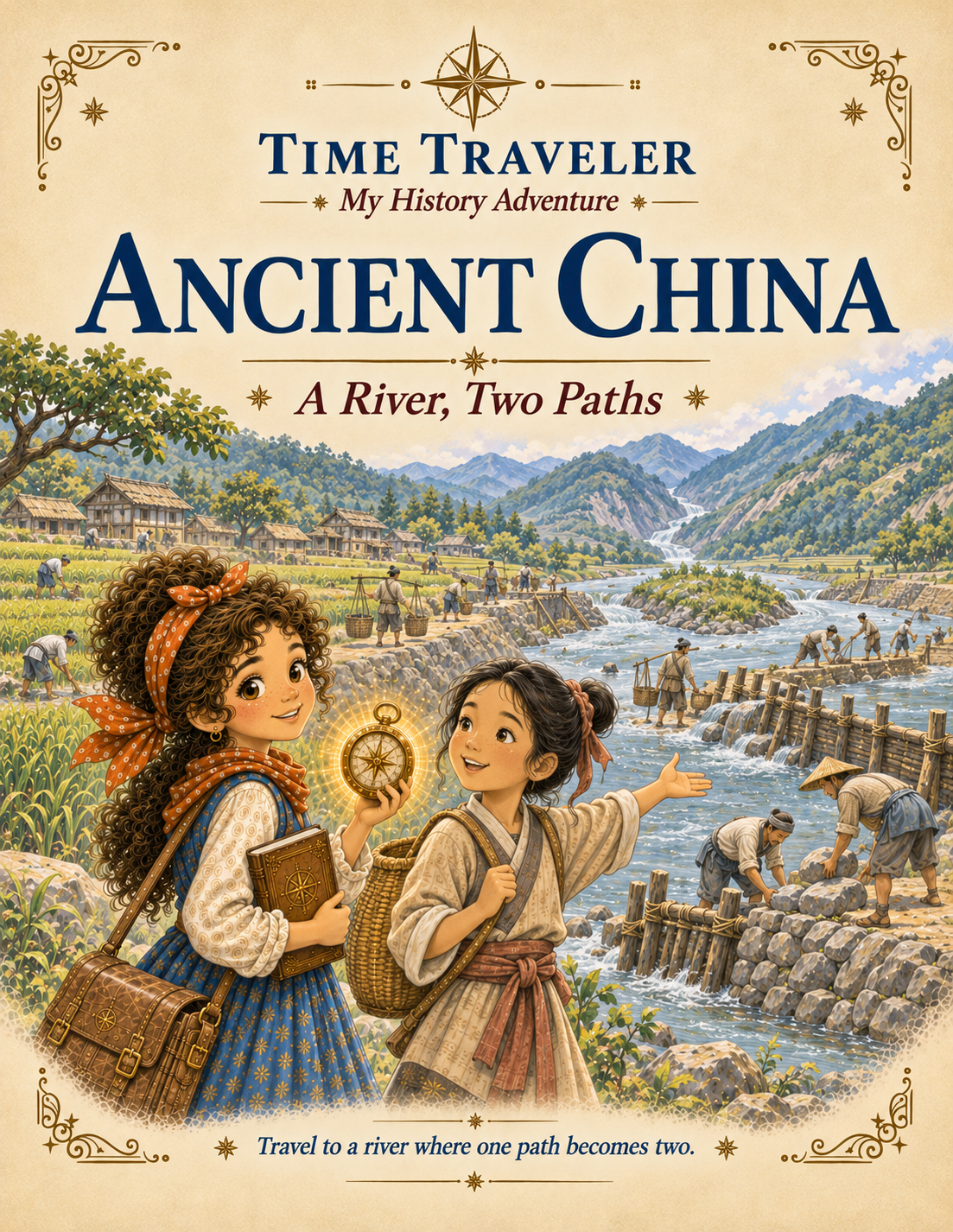
Ancient China Unit Study: Spark Curiosity with River Engineering
When children explore the history of early civilizations, lessons often emphasize emperors, legendary dynasties, and grand monuments. But behind ancient empires were pressing survival challenges: feeding expanding populations, preventing catastrophic seasonal floods, and routing water across stubborn landscapes. How can educators turn 3rd-century BCE public works into captivating, hands-on learning for young minds? The key lies in an immersive Ancient China unit study that prioritizes environmental physics, engineering problem-solving, and spatial reasoning over passive memorization.
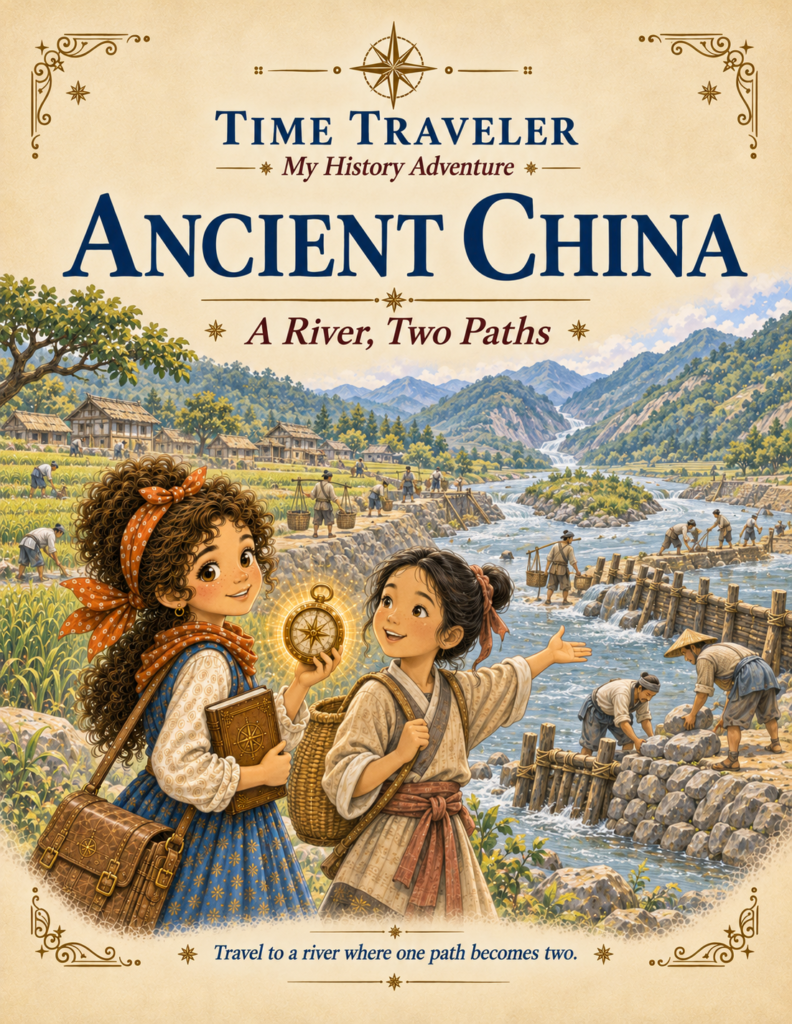
By joining time-traveling explorer Mia along the rushing Minjiang River in Shu around 256 BCE, interactive history guides transform standard social studies into a dynamic technological expedition. Let’s examine how an inquiry-driven investigation of the Dujiangyan water-management system cultivates genuine analytical reasoning, teamwork awareness, and active curiosity.
Why Interactive History for Kids Works
Children connect with historical events far more deeply when challenged to solve practical dilemmas rather than memorize dynasties and dates. A conventional textbook might mention that officials managed river floods, but an interactive workbook prompts students to ask fundamental physical questions: If thirsty farm fields lie beyond a ridge of solid rock, how can people guide life-giving water without building a barrier that completely blocks the main river flow?
When you integrate a structured interactive history for kids curriculum into your homeschool or classroom routine, you do far more than recount the distant past. You equip your child with the cognitive tools of a historical engineer: evaluating natural topography, observing sediment deposits, and designing solutions that work with nature rather than fighting against it.

Exploring River Ecosystems, Topography, and Community Effort
One of the most valuable insights hands-on history offers is showing that grand engineering triumphs were rooted in deep, patient observations of the natural world. Before official Li Bing and thousands of Qin workers carved channels or shifted boulders, they had to study river bends, changing seasonal levels, and where heavy sand naturally gathered along the banks.
Just as young historians evaluate civic infrastructure in our Ancient Rome unit study homeschool, trace interconnected logistical chains in our Knights and Castles unit study, and analyze the political dilemmas of our American Revolution unit study, an investigative Ancient China unit study reveals the living ecosystem behind technological breakthroughs. Children discover that taming the Minjiang took more than clever ideas; it required community cooperation utilizing woven bamboo baskets, wooden poles, quarried stones, and continuous manual labor.
Learning Through Doing: «A Road Through Stone»
To foster authentic STEM thinking, learning resources must present genuine geographic constraints where land refuses to compromise.

In activities exploring the Bottle-Neck Passage (Baopingkou), learners examine how water moves across variable terrain. Because water cannot naturally climb over high rocky bluffs to reach parched farmland, ancient builders painstakingly cut through solid stone to create an intake channel at just the right elevation. Children trace the low path from mountains to the Chengdu Plain, realizing that every successful aqueduct or canal depends on gravity, slope calculation, and persistence.
Thinking Like an Engineer: Balancing Low and High Water
The hallmark of exceptional historical education is teaching young learners how systems adapt to changing environmental conditions. This is where a comprehensive Ancient China unit study proves especially powerful.
Streams and rivers are never static. If an intake passage is cut too wide, heavy mountain floods will rush through and drown vulnerable crops; if the opening is carved too narrow, scorching dry seasons leave crops parched. Students test channel models across both lower-water and higher-water seasons to identify the balanced intake that keeps agricultural fields protected year-round.

Furthermore, young time travelers discover that engineering did not stop with the Qin Dynasty. Journeying forward nearly a thousand years into the Tang period, students see subsequent generations maintaining dikes, clearing silting sand, and expanding canals—proving that sustainable engineering is an enduring pact between people and the land.
Spark Your Child’s Curiosity Today
Parents and teachers seek social studies resources that build spatial logic, environmental appreciation, and critical reasoning without burying kids under dry chronologies. An interactive Ancient China unit study delivers that vital synthesis. By placing children in the role of ancient river engineers—analyzing currents, designing river dividers, and finding pathways through solid bedrock—you kindle an enduring passion for discovery.
Equip your young learners with materials that honor their intelligence and demonstrate how ancient innovators shaped civilizations. Step back in time to the banks of the Minjiang River today, unlock the Ancient China Time Seal, and watch your child’s love for history and problem-solving flourish!