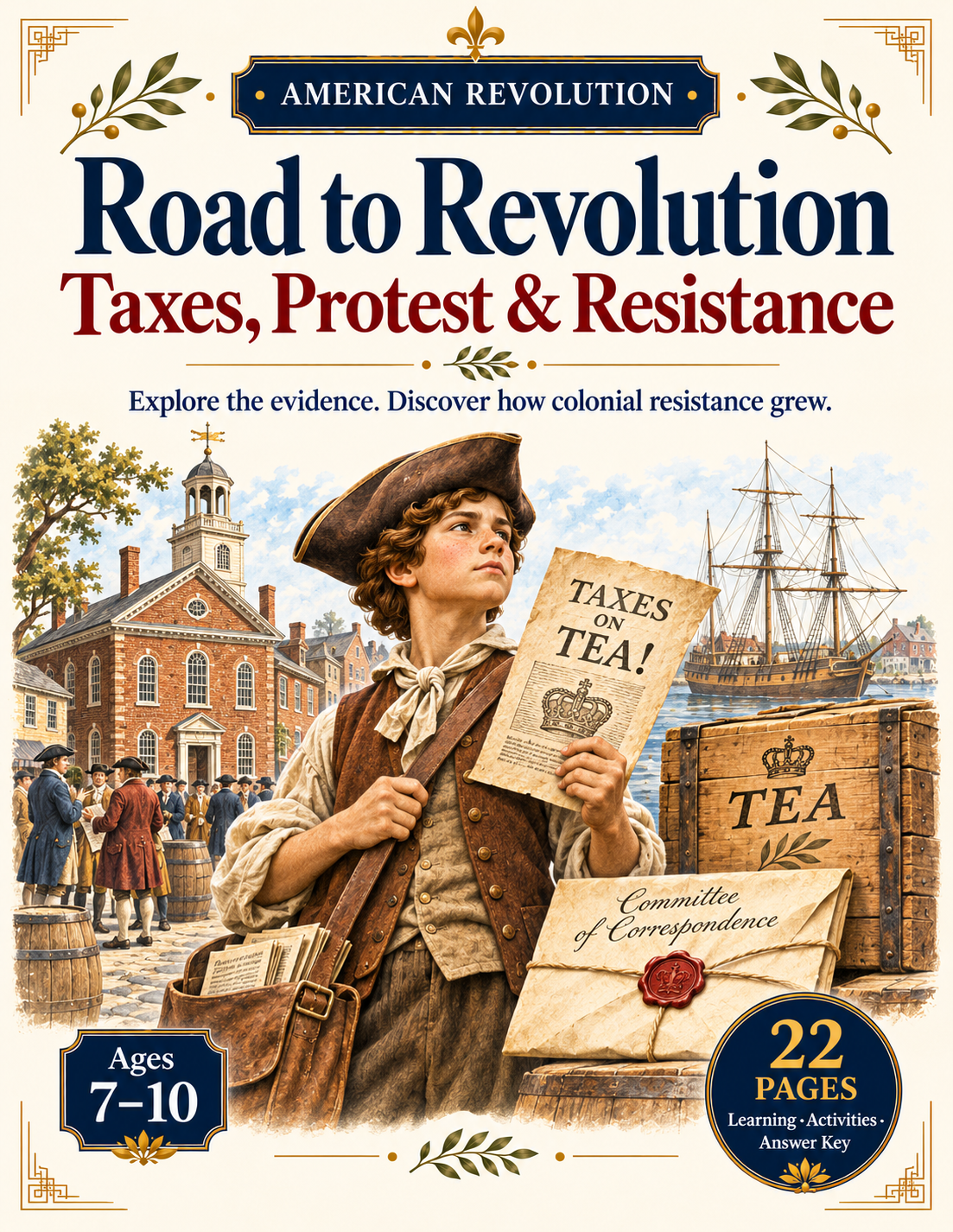
American Revolution Unit Study Homeschool: Taxes, Protest & Resistance
When children study the American Revolution, history lessons often jump straight from the Boston Tea Party to the battles of Lexington and Concord. But before any muskets were fired, colonies engaged in a prolonged, decade-long clash of ideas, trade agreements, and legal debates. How did separate towns and thirteen distinct colonial assemblies transform their localized complaints into a unified, coordinated resistance? The answer lies in an inquiry-driven American Revolution unit study homeschool curriculum that prioritizes financial analysis, media literacy, and primary source evaluation over passive memorization.
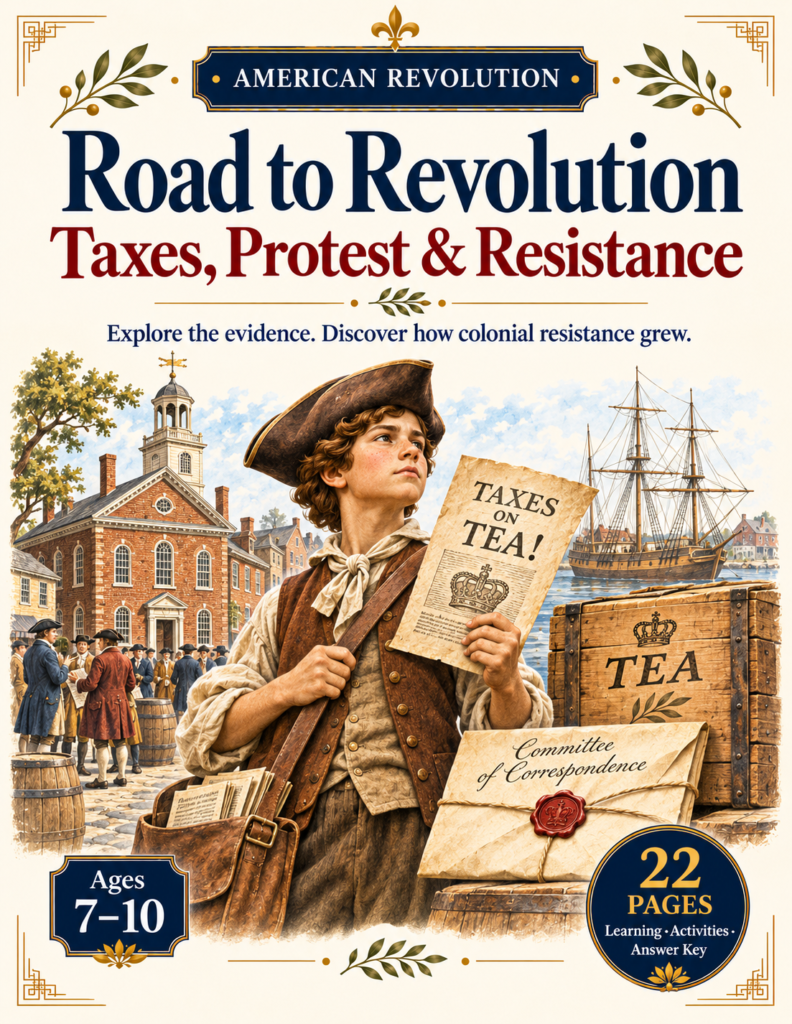
By investigating genuine colonial dilemmas—from customs duties to print propaganda—interactive history workbooks turn social studies into a hands-on historical investigation. Let’s explore how an evidence-based journey through the Road to Revolution cultivates practical logic, civic literacy, and critical reasoning in young learners.
Why Interactive History for Kids Works
Children connect with history on a much deeper level when challenged to solve authentic historical problems rather than memorize static dates. A conventional textbook might simply state that colonists chanted «no taxation without representation». But an interactive workbook prompts students to ask practical financial questions: Why would a colonial assembly worry if the royal governor started receiving his salary directly from Crown-controlled customs revenue instead of local tax votes?
When you integrate a structured interactive history for kids curriculum into your homeschool routine, you give children the mental tools of a historical detective. They discover that changing who paid an official’s salary dramatically shifted who held influence over that official.

Exploring Trade Networks, Boycotts, and Civic Cooperation
One of the most valuable insights of hands-on history is demonstrating that political movements rely on delicate economic systems. When Parliament imposed the 1767 Townshend Acts on imported glass, lead, paint, paper, and tea, colonists had to differentiate between routine trade regulations and taxes explicitly designed to raise government revenue without assembly consent.
Just as young historians decode civic infrastructure in our Ancient Rome unit study homeschool and trace logistical supply chains in our Knights and Castles unit study, an enriching American Revolution unit study homeschool module exposes the interconnected webs of colonial life. Learners analyze the tough trade-offs faced by merchants: Should a shopkeeper sign a Non-Importation Agreement to support colonial rights even if it severely damages his family business? When Parliament repealed most Townshend duties in 1770 but kept the tax on tea, merchants had to decide whether to resume partial trade or maintain total economic pressure.
Learning Through Doing: «What Can the Sources Prove?»
To foster sharp critical thinking, educational materials must challenge students to examine bias, perspective, and media influence.

In activities exploring the Boston Massacre of 1770, students step into the role of evidence evaluators. They compare Paul Revere’s sensationalized engraving—designed to stir public outrage across the colonies—with Captain Thomas Preston’s written testimony stating he never ordered his men to fire. By sorting historical claims into Supported, Possible, or Too Big a Claim, children learn the essential «Historian’s Rule»: comparing multiple, conflicting accounts is necessary to determine what is verifiable, what is debated, and what remains uncertain.
Thinking Like an Organizer: The Power of Connected Committees
The hallmark of exceptional historical education is showing how individual sparks grow into structured cooperation. This is where a focused American Revolution unit study homeschool guide truly excels.
Resistance did not succeed through spontaneous mob protests alone. When British authorities threatened to send Rhode Island suspects across the sea to Britain for trial following the 1772 Gaspee incident, Virginia’s House of Burgesses proposed a formal network of correspondence. Students examine how horseback couriers and printed circular letters linked town meetings from Boston to Williamsburg, transforming isolated local complaints into an organized, unified voice.
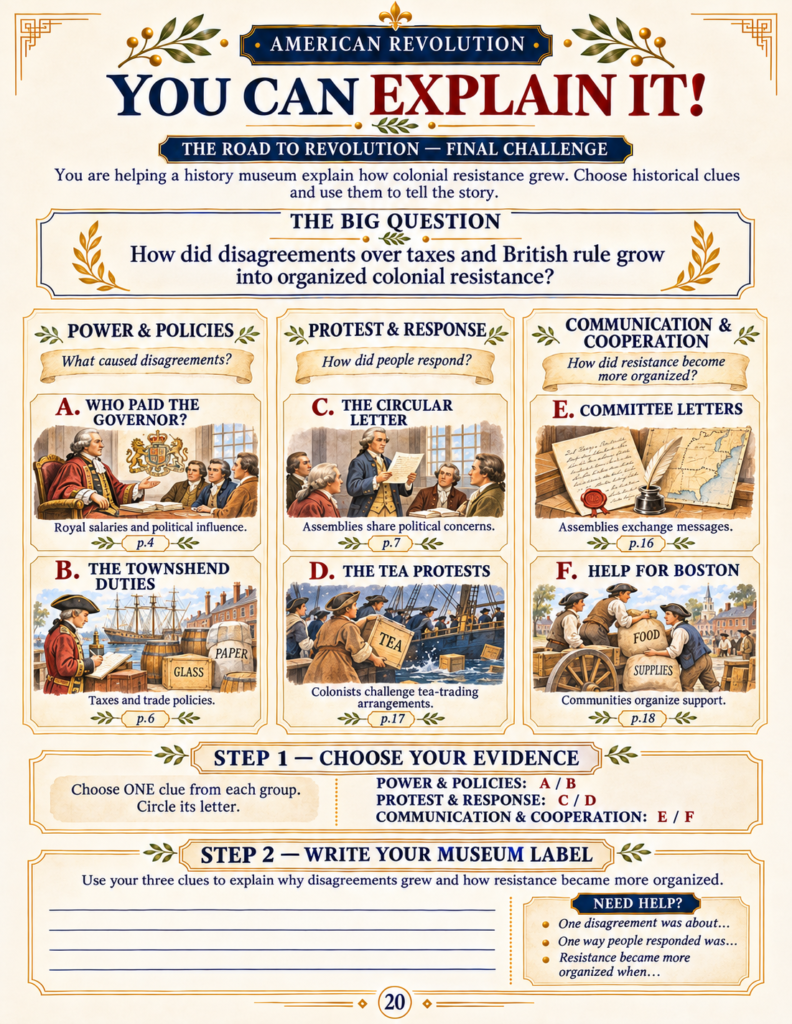
For families who want to expand their exploration into an immersive narrative adventure, this workbook connects directly with our broader American Revolution unit study, where time-traveling guide Mia navigates the risky personal choices of everyday colonists, Loyalists, enslaved people, and Indigenous nations.
Spark Your Child’s Curiosity Today
Parents and educators want history materials that build media literacy, analytical reasoning, and empathetic perspective-taking without relying on boring memorization lists. An interactive American Revolution unit study homeschool guide delivers that vital balance. By inviting young learners to trace money flows, audit political propaganda, and balance economic compromises, you nurture habits of mind that will benefit them across all academic disciplines.
Provide your children with resources that honor their intellect and reveal the complex human choices behind historical milestones. Step into colonial print shops and assembly halls today, tackle the Road to Revolution challenge, and watch your child’s critical thinking soar!