Teaching Astronomy as One Connected Machine: An Earth and Space Science Bundle for Kids
When elementary children study astronomy, they often encounter the cosmos as five completely unrelated subjects. Choosing an integrated earth and space science bundle for kids is the most effective way to help young learners connect these scattered concepts into a single coherent physical system. This comprehensive earth and space science bundle for kids bridges the gap between everyday backyard observations and large-scale cosmic physics, taking students across 151 printable pages of hands-on investigations, spatial models, and real scientific inquiry.
Standard classroom units tend to fracture space science into isolated trivia packets. One week, children memorize planetary distances; the next, they scrape cream off cookies to model lunar phases, and later, they connect arbitrary dots on a flat constellation chart. Because these phenomena are rarely taught as interdependent parts of a dynamic universe, fundamental misconceptions take root. Children grow up believing that summer occurs because Earth moves physically closer to the Sun, that the Moon changes shape because Earth casts a daily shadow across it, and that the stars in Orion are close physical neighbors clustered together in the dark.
The Earth & Space Explorer Bundle (a 5-workbook printable collection for ages 7–10) completely rethinks this approach. Instead of asking students to passively color pre-drawn graphics, it equips them with evidence cards, diagnostic model audits, and real data logs across five dedicated field guides.

1. Earth in Motion: Decoding Spin, Tilt, and Seasons
The journey begins on the ground where young observers stand. Before children can understand distant galaxies, they must grasp the physical mechanics governing their own backyard.
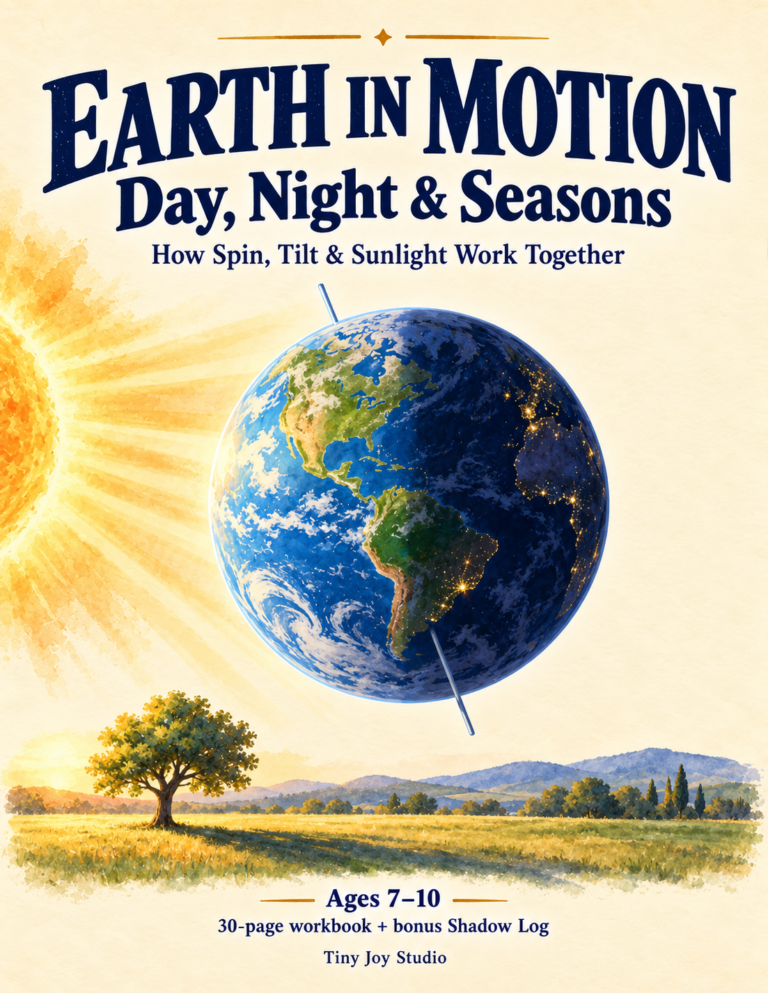
In Earth in Motion: Day, Night & Seasons, students tackle the classic misconception that Earth moves closer to the Sun during warmer months. By comparing perihelion data in early January (147 million km) against aphelion in July (152 million km), learners discover an undeniable contradiction: Northern Hemisphere winter occurs exactly when our planet is closest to solar heat.

The curriculum transitions from distance to the geometry of light concentration, using grid squares to demonstrate how a 90° direct solar angle packs intense thermal energy into fewer grid cells than a dispersed 30° winter ray. As detailed in our deep-dive review of the Earth in Motion Workbook, children pair these spatial insights with hands-on stick-and-shadow logs, learning how axial tilt and 24-hour rotation produce the predictable rhythms of life on Earth.
2. Sun Explorer: Light, Energy, and Space Weather
Once students understand how sunlight strikes Earth’s surface, the next logical question arises: what powers this celestial engine?
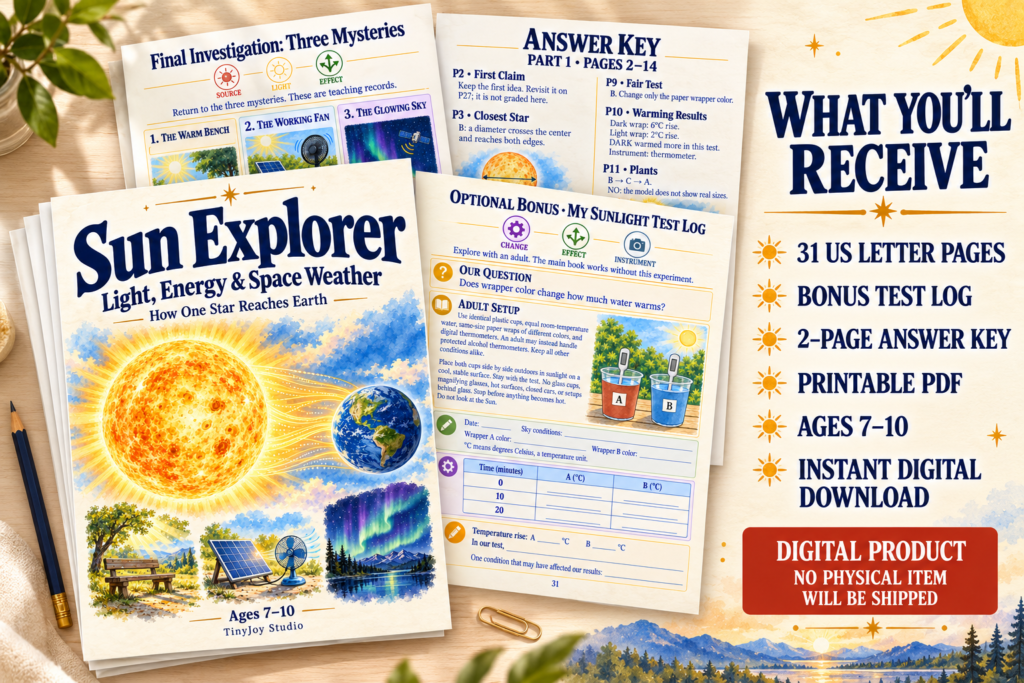
Sun Explorer: Light, Energy & Space Weather shifts the spotlight to our nearest star. Standard elementary printables depict the Sun as a friendly yellow ball, ignoring that it is a turbulent, magnetically active ball of plasma driving our entire interplanetary environment.
In this workbook, children investigate how core nuclear fusion creates energy that slowly travels through the radiative and convective zones before bursting outward as solar wind, flares, and coronal mass ejections. Learners analyze how Earth’s protective magnetosphere deflects charged particles, channeling them toward the poles to ignite auroral displays. To see how these solar mechanics and atmospheric radiation balance interact, explore our complete guide to the Sun Workbook.
3. Solar System Explorer: Orbital Mechanics and Planetary Systems
With the central powerhouse understood, learners expand their scope to the worlds caught in its gravitational grip. Rather than treating the eight planets as a decorative row of marble-like spheres, Solar System Explorer: A System of Worlds in Motion challenges students to analyze scale trade-offs and physical forces.
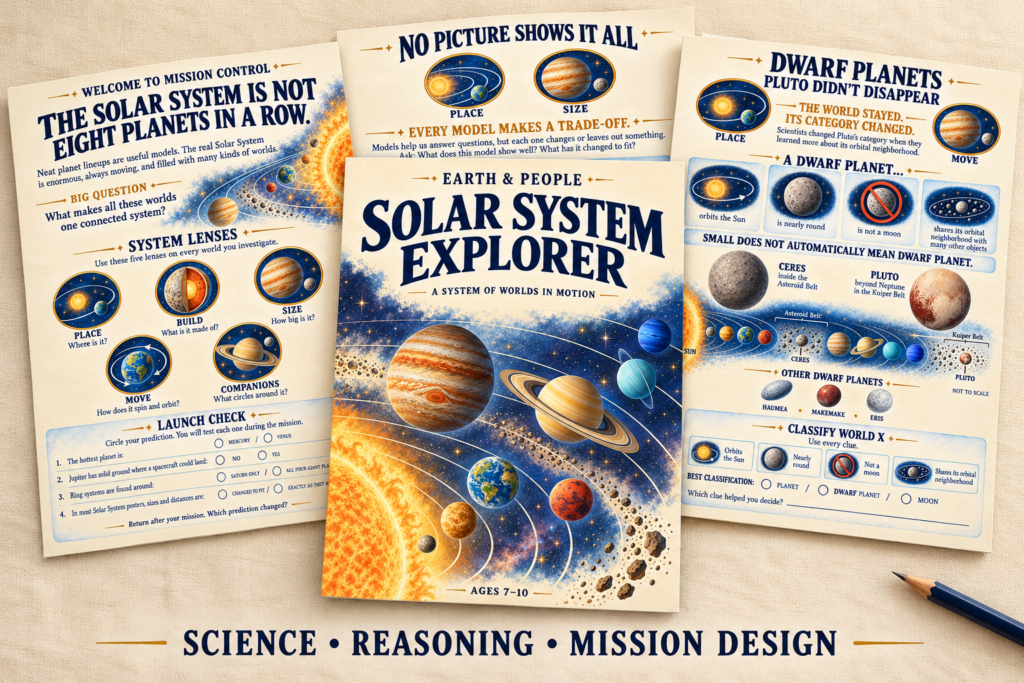
Children critique classic classroom posters, evaluating why a diagram that shows correct orbital order usually completely distorts proportional planetary distances and physical diameters. They resolve thermal paradoxes—discovering why Venus out-heats Mercury despite orbiting twice as far from the Sun—by studying runaway greenhouse atmospheres.
As explored in our walkthrough of the Solar System Workbook, students culminate their planetary investigation by acting as aerospace engineers, selecting scientific instruments, antennas, and power systems tailored to surviving extreme planetary terrains.
4. Moon Explorer: Three-Dimensional Perspective, Eclipses, and Tides
Moving closer back to Earth, students turn their focus to our nearest celestial companion. The study of lunar phases is notoriously difficult for children when taught through flat circular diagrams on paper.
Moon Explorer: Phases, Eclipses & Tides remedies this by breaking lunar cycles into five core analytical lenses: Position, Light, View, Alignment, and Pull. Children learn that outside of a rare eclipse, half of the Moon is always bathed in direct sunlight. The phases observed from Earth reflect nothing more than our shifting vantage point as the Moon orbits our world.
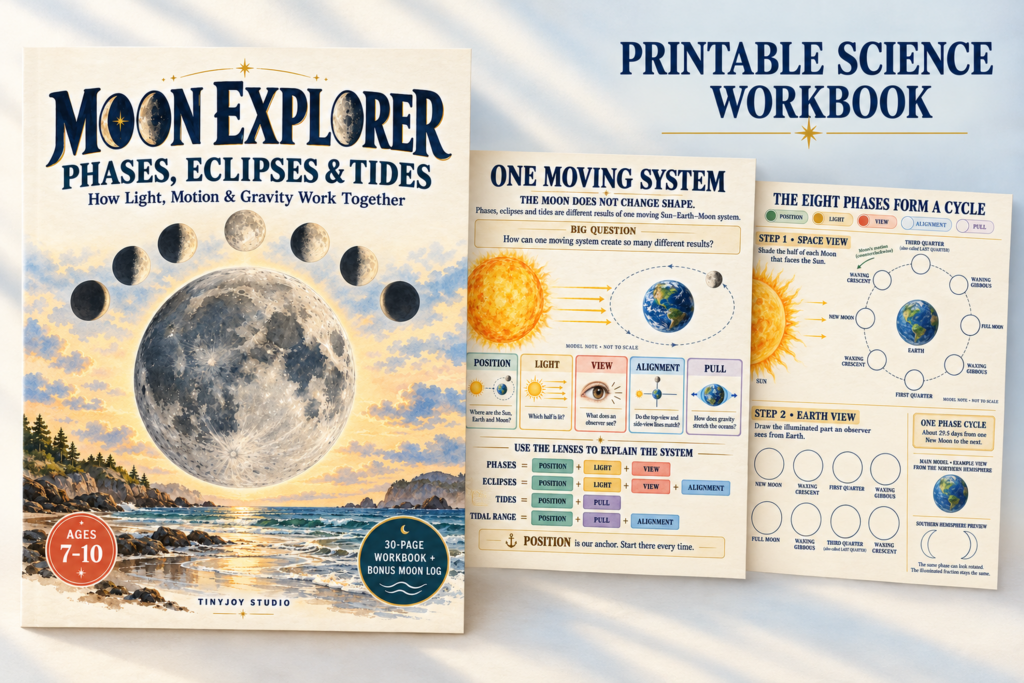
Furthermore, the workbook untangles the classic eclipse confusion: because the Moon’s orbit is tilted approximately 5° relative to the Earth-Sun orbital plane, the Moon usually passes above or below Earth’s shadow cone. Connecting celestial motion with Earth’s oceans, learners discover how differential gravity stretches water into two simultaneous bulges. For a full pedagogical breakdown of this lunar system, review our article on the Moon Phases and Eclipses Workbook.
5. Star Explorer: Constellations, Depth, and the Moving Night Sky
Finally, the bundle turns its gaze beyond the solar neighborhood toward deep interstellar space. When children look up at the night sky, their eyes naturally perceive a flat celestial dome where connected stars look like close companions.

Star Explorer: Constellations & the Night Sky dismantles this 2D illusion. Through physical light-year depth models of familiar asterisms like Orion, children discover that stars appearing side-by-side from Earth are actually separated by hundreds of light-years along our line of sight. They learn why Sirius appears exceptionally brilliant in the winter sky compared to Rigel—not because it produces more raw light, but because it is nearly a hundred times closer to our planet.
As outlined in our feature on the Constellations Workbook, students track Polaris as a rotational celestial anchor, calculate the 4-minute daily sidereal time shift, and complete backyard observation logs.
A Ready-to-Print Homeschool and Classroom Solution
Because every workbook in the bundle features embedded diagnostic checks, model audits, clear data banks, and full solution keys, the collection integrates seamlessly into diverse teaching rhythms:

- A Full-Year Astronomy Block: Complete one workbook every 4–6 weeks for an exhaustive, screen-free elementary space curriculum.
- Targeted Thematic Science Units: Pull individual modules—such as Earth in Motion during the equinox or Moon Explorer during a lunar cycle—to align directly with seasonal sky events.
- Collaborative Science Labs: Laminate model repair challenges (such as fixing flawed solar system charts or audit broken observatory posters) for small-group STEM problem-solving.
If you are looking for an educational resource that replaces superficial coloring drills with authentic spatial reasoning, real data interpretation, and genuine physics, the Earth & Space Explorer Bundle gives elementary learners a comprehensive, structured launchpad into the living universe.