Why Summer Isn’t About Distance: Teaching Day, Night, and Seasons Through Evidence
Ask an elementary student why summer is hot and winter is cold, and you will almost certainly hear the single most persistent misconception in astronomy: «Earth moves closer to the Sun during the summer.» Finding an authentic earth in motion workbook for kids that dismantles this intuitive error is essential for early scientific literacy. A well-structured earth in motion workbook for kids guides learners to look past solar distance, demonstrating how our planet’s axial tilt, continuous orbital motion, and 24-hour spin work in unison to produce day, night, changing shadows, and opposing seasonal cycles across the globe.
Standard classroom worksheets often treat planetary motion as static vocabulary drills. Students memorize definitions of rotation and revolution, color a two-dimensional globe, and complete matching tests, yet they remain unable to explain why sunrise occurs on the eastern horizon, why shadows shrink toward solar noon, or why July brings winter snow to South America while North America bakes under summer sun.

In Earth in Motion: Day, Night & Seasons — How Spin, Tilt & Sunlight Work Together (a 30-page printable workbook plus bonus Shadow Log designed for ages 7–10 by Tiny Joy Studio), children do not merely memorize astronomical terms. Instead, they act as scientific detectives investigating two everyday mysteries using five dedicated lenses: Spin, Orbit, Tilt, Light, and Observer.

Dissecting the Distance Myth with Real Planetary Clues
The fundamental pedagogical turning point in elementary astronomy occurs when children confront empirical contradictions. On page 2, students record their initial reaction to the classic claim: «Summer happens because Earth moves closer to the Sun». Rather than correcting them immediately, the workbook leads them to gather evidence and re-evaluate this claim on page 27.
On page 14, learners examine two irrefutable solar clues:
- The Distance Clue: In early January, Earth sits roughly 147 million kilometers from the Sun; in early July, it is approximately 152 million kilometers away. Earth is physically closer to the Sun during the northern hemisphere’s winter.
- The Opposing Season Clue: On the exact same January date, Sam at 45°N experiences winter while Ana at 35°S enjoys summer.
Children realize that if distance dictated seasonal heat, the entire planet would experience summer simultaneously. This deduction teaches young learners to demand physical mechanisms rather than relying on surface assumptions.
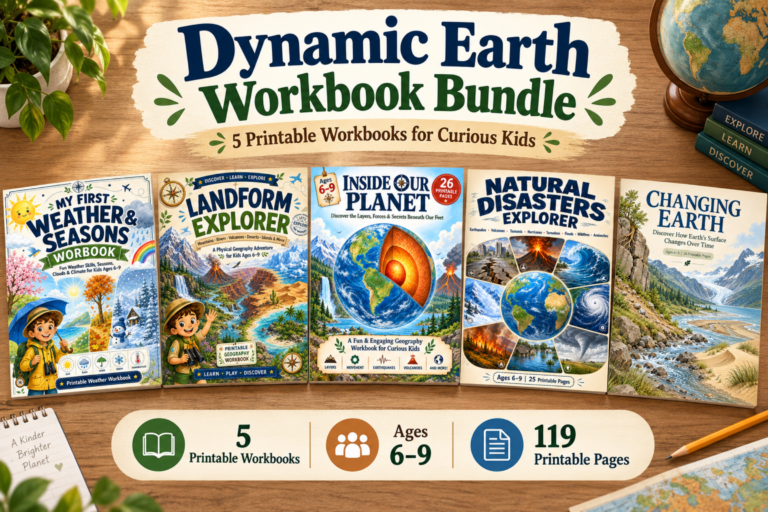
Understanding how planetary forces dictate surface environments forms the cornerstone of earth sciences. For families exploring how deep crustal dynamics, plate motions, and surface erosion continuously reshape our planet’s exterior, our Dynamic Earth Workbook Bundle provides a natural, hands-on extension into physical geology and active landforms.

Light Concentration: Why Angle Governs Temperature
If distance does not create seasons, what does? The workbook introduces the physics of solar insolation on page 16 through «Same Light, Different Spread».
Using equal-energy bundles of sunlight projected onto a grid, students count illuminated squares:
- Direct sunlight arriving at a 90° overhead angle concentrates all its heat energy into just 4 grid cells.
- Slanted sunlight arriving at a 30° angle spreads the identical energy across 8 grid cells.
Children immediately grasp the core physical concept: slanted rays spread solar energy thinly over a larger surface area, providing far less warmth per square meter than concentrated overhead rays.
To see how living organisms adapt to these shifting sunlight intensities, seasonal temperature swings, and light availability across biomes, exploring our Nature Workbooks for Kids shows how native plants and animals adjust their survival strategies across forests, wetlands, and open plains.

The Fixed Axis: 23.5 Degrees of Unchanging Direction
The true engine behind seasonal variation is Earth’s axial tilt. On page 15, students learn that Earth’s axis leans roughly 23.5° from perpendicular relative to its orbital plane. Crucially, as our planet travels along its yearly path, the axis maintains nearly the identical direction in space; it does not pivot back and forth to face the Sun.
This steady geometric tilt creates two simultaneous effects for an observer at mid-latitudes:
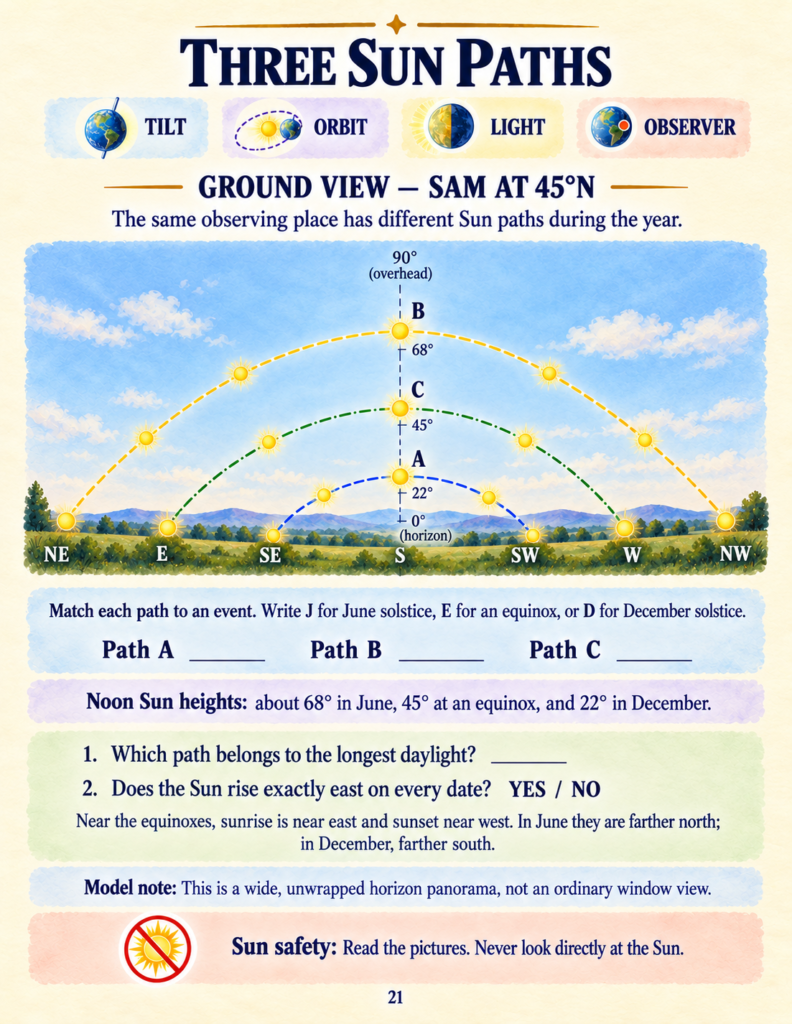
- Solar Altitude: Near the June solstice, the midday Sun climbs high in the sky (about 68° above the horizon at 45°N), delivering highly concentrated direct energy. Near the December solstice, it peaks low (about 22°), delivering slanted, diffuse rays.
- Daylight Length: Because the Northern Hemisphere leans toward the Sun in June, an observer’s daily path spends roughly 64% of each 24-hour turn in sunlight (about 15½ hours of daylight). In December, the path spends only 36% in sunlight (about 8½ hours).
By synthesizing these clues, children deduce that summer is the product of two working factors: higher noon Sun and longer daylight hours.
Connecting planetary geometry to extreme regional landscapes is a thrilling next step for curious minds. In our Amazing Earth Adventures Workbook Bundle, young explorers journey to polar ice caps with 24-hour midnight sun and equatorial trenches to discover how global geometry manifests in Earth’s most dramatic natural environments.
Shadows as Living Clocks: The Observer’s Field Craft
Astronomy becomes tangible when children observe the physics taking place in their own backyards. Throughout Earth in Motion, shadows serve as primary scientific instruments:
- A low Sun near sunrise or sunset produces long, stretched shadows pointing away from the light.
- A high Sun near solar noon casts the shortest shadow of the day.
- On page 9, children interpret a sample Shadow Log, predicting how afternoon shadows lengthen as the Sun descends.
- In «Final Mission 1» on page 26, students solve a geographic puzzle using only stick measurements: at 45°N, a 20 cm stick casts a 51 cm noon shadow pointing north, while at 35°S, the same stick casts a tiny 4 cm shadow pointing south, proving the date is the December solstice.
Understanding how human communities historically used shadows, seasonal markers, and solar calendars to schedule agriculture, design settlements, and organize public festivals bridges science directly with human society. In our People and Places Workbook Bundle, students examine how diverse cultures across continents adapt their daily routines, architecture, and calendars to regional sun angles and seasonal rhythms.

Practical Implementation for Home and Classroom
Because Earth in Motion includes self-contained diagrammatic models, scaffolded evidence cards, and complete solution guides for all 27 pages, it adapts seamlessly into various teaching settings:
- Homeschool Astronomy Unit: Complete two pages daily across a focused three-week block, combining book activities with the included bonus «My Shadow Log» to track a backyard stick over four consecutive weeks.
- Classroom Science Stations: Laminate the «Ball & Lamp Lab» (page 10), «Three Sun Paths» (page 21), and «Repair the Observatory Poster» (page 25) for collaborative peer review and model auditing.
- Screen-Free Morning STEM: Use the model-matching spreads (page 12) and solstice-equinox daylight charts (page 22) as deductive reasoning warm-ups.
To further strengthen your child’s ability to read horizon lines, record cardinal shadow directions, track compass bearings, and interpret geographic coordinates, exploring our Explorer Skills Workbook Bundle equips young naturalists with practical navigation and mapping skills for outdoor field science.
If you are ready to replace passive solar coloring sheets with genuine astronomical modeling, seasonal data interpretation, and empirical shadow observation, Earth in Motion provides your young astronomer with an engaging, structured launchpad into real planetary science.