Why the Arctic Is Not Just an Empty Snowfield: Teaching Tundra Ecology Through Systems Thinking
When children picture the far north, they almost always imagine an unchanging, empty desert of pure white snow and towering glaciers. Finding an authentic arctic and tundra workbook for kids that dismantles this barren wasteland myth is essential for teaching genuine polar science. A well-structured arctic and tundra workbook for kids shows young naturalists that beneath the winter freeze lies a dynamic living system—one where a shallow active layer of soil, insulating snow blankets, and an explosive six-week summer burst sustain intricate food webs and complex nutrient loops.
Standard classroom printables often treat polar habitats as decorative background art. Children color cartoon seals, complete word searches with words like blubber and igloo, and categorize every cold region into a single generic freeze. As a result, students fail to understand why trees cannot take root in permafrost, how a blanket of sub-zero snow actually protects small mammals from lethal wind chill, or why climate warming causes frozen tundra ground to collapse into new ponds and wetlands.

In Arctic & Tundra Life Explorer: Slow Ground – Fast Summer (a 30-page printable workbook designed for ages 7–10 by Tiny Joy Studio), students do not passively memorize polar trivia. Instead, they act as ecological field investigators using five interconnected system lenses: Structure (how the ground and layers are arranged), Resource (what nutrients and sunlight are available), Flow (how meltwater and heat move), Connection (what depends on what), and Change (what happens through the seasons and across decades).
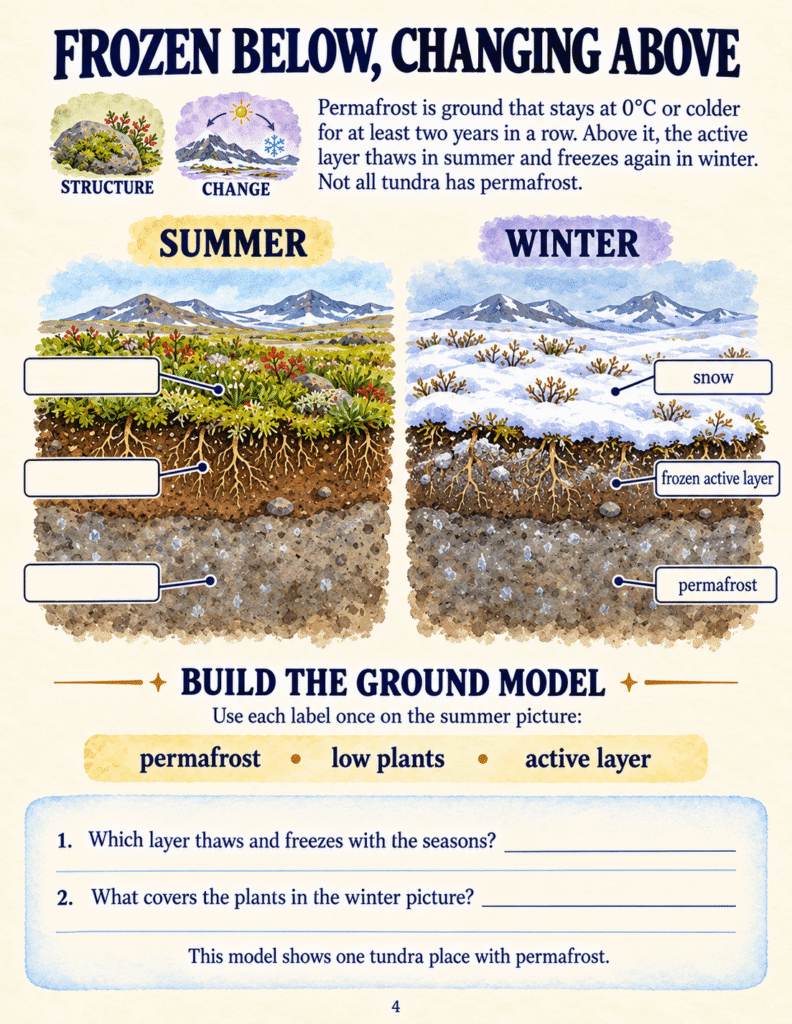
The Two-Tier Ground: Active Layer Versus Permafrost
The foundational geological concept in tundra ecology is understanding why trees are absent. On page 4, students build the core ground model, distinguishing the permanently frozen ground from the seasonal surface:
- Permafrost: Ground that remains at or below 0°C for at least two consecutive years. It forms a hard, impenetrable floor that deep tree taproots cannot penetrate.
- The Active Layer: The top slice of soil that thaws during the brief summer warmth and freezes solid again in winter.
- The Low-Profile Strategy: Because roots can only exploit the shallow thawed dirt above the ice barrier, tundra vegetation survives by growing as dwarf shrubs, spreading mat carpets, and tight cushion mounds that hug the ground to escape howling polar winds.
Understanding how solid ground structures interact with temperature extremes forms a critical bridge into physical geology. For families exploring how deep crustal dynamics, volcanic forces, and weathering shape our dynamic globe, our Dynamic Earth Workbook Bundle provides a rich, hands-on extension into planetary geology and changing landforms.

Micro-Habitats: Why Tundra Is Not a Flat Plain
Classroom worksheets often depict the tundra as a flat, uniform tabletop. Arctic & Tundra Life Explorer immediately challenges this oversimplification on pages 5 and 6 by introducing the «Tundra Patch Detective».
Students evaluate field data across four distinct terrain patches:
- The Exposed Ridge (K): Scoured by intense winter winds, holding only 5 cm of snow that melts out early in Week 1, leaving dry, rocky soil behind.
- The Sheltered Hollow (R): Catches deep windblown snow drifts up to 50 cm; snow lingers until Week 4, providing protected, damp conditions.
- The Meadow (M): Moderate snow depth (20 cm) melting in Week 2, resulting in rich, wet organic soil.
- The Pond Edge (T): Retains standing water throughout the summer season because impermeable permafrost below blocks deep vertical drainage.
Children deduce that a few inches of topographic relief completely transform microclimates, winter survival zones, and plant moisture access.
To see how living organisms adapt to structural environments and shifting light cycles across varied global biomes, exploring our curated Nature Workbooks for Kids allows learners to compare fragile arctic ecosystems directly with temperate forests, wetlands, and coastal habitats.

The Subnivean World: Snow as a Heat Trap
One of the most counterintuitive discoveries in cold-climate ecology is that snow functions as an insulator. On page 9, students examine the subnivean space—the sheltered zone between the soil and the base of the snowpack.
Children analyze a winter thermal profile:
- Air above the snow: -20°C with severe, freezing winds.
- Middle of the snowpack: -12°C.
- Ground beneath the snow: -4°C.
Through the companion fair-test investigation on page 10 (comparing bare jars with thinly and thickly wrapped cotton insulation), learners prove that snow does not generate heat; rather, trapped air pockets dramatically slow heat loss to the sky. Beneath this insulating shield, lemmings stay active all winter, feeding on buried mosses and roots without freezing.
Connecting regional polar adaptations to planetary extremes gives young scientists an expansive perspective. In our Amazing Earth Adventures Workbook Bundle, children journey from midnight-sun polar plains to deep oceanic trenches and scorching thermal vents to see how life thrives in Earth’s most severe environments.

The Fast Summer: Ecological Synchronization and the Phenological Trap
Summer in the high Arctic is a frantic sprint. Because the sun remains above the horizon around the clock near the summer solstice, plants and insects compress their entire reproductive season into six brief weeks.
On page 14, students construct a multi-track ecological calendar:
- Migratory shorebirds arrive from southern continents in Weeks 2–3.
- Insect emergence peaks dramatically during Weeks 3–5.
- Bird chicks hatch in Week 4, creating an intense surge in food demand that overlaps with peak insect availability for only two critical weeks (Weeks 4 and 5).
On page 22 and page 26, the workbook introduces the critical concept of phenological mismatch. If an unusually warm spring triggers early insect emergence by two weeks, but migratory birds arrive on their fixed calendar schedule, the chicks hatch after the insect peak has already collapsed. Children discover that in ecology, food timing can matter as much as food amount.
Understanding how humans historically tracked these seasonal wildlife migrations, sea-ice hunting seasons, and seasonal shifts connects science directly to human culture. In our People and Places Workbook Bundle, students examine how Indigenous peoples of the Arctic and communities worldwide adapt their shelters, seasonal movements, and daily routines to challenging regional climates.

Beyond Food Chains: Dens, Droppings, and Biological Links
Elementary science often reduces ecological connection to simple predator-prey food chains (fox eats lemming). Arctic & Tundra Life Explorer expands this perspective on pages 19 and 21 by showing how organisms physically alter their habitats:
- The Fox Den Oasis: Arctic fox dens, inhabited by generations of kits, accumulate prey remains and nutrient-rich droppings, creating lush, vibrant islands of tall wildflowers and grasses in an otherwise nutrient-starved landscape.
- Marine-to-Terrestrial Bridges: Arctic terns catch small fish in offshore waters and carry marine nitrogen and phosphorus directly to inland nesting rocks, fertilizing tundra soils miles from the shore.
- Lichen Symbiosis: Photosynthetic algae produce sugars from light while their fungal partners provide physical structure, moisture retention, and shelter against desiccating winds on bare rock surfaces.

Practical Integration for Home and Classroom
Because Arctic & Tundra Life Explorer is completely self-contained with embedded model checks, evidence stamp checklists, and full answer keys, it integrates smoothly into various learning environments:
- Homeschool Science Block: Complete two pages daily over a focused three-week biome unit, using the five Field Evidence stamps (FE1 through FE5) to verify comprehension.
- Classroom Inquiry Stations: Laminate the «Snow Blanket Investigation» (page 10) and the «Repair a Broken Tundra System» spread (page 25) for collaborative group model critique.
- Screen-Free Ecology Capstone: Have students complete the comprehensive final mission (pages 26–27), labeling permafrost layers, tracing meltwater run-off arrows, and defending claims about climate trends versus short-term weather.
To strengthen your child’s ability to navigate polar coordinates, read topographic elevation contours, and log systematic field survey data, our Explorer Skills Workbook Bundle equips young researchers with essential cartographic, grid-mapping, and field-recording tools.
If you are looking for an educational printable that replaces generic polar coloring pages with authentic permafrost modeling, thermal physics experiments, and real ecological reasoning, Arctic & Tundra Life Explorer offers your young naturalist a structured, inspiring journey across Earth’s northern living systems.