Why Outdoor Observation Begins with Questions: A Nature Journal for Kids That Builds Real Habits
Stepping into a backyard, park, or trail is one of the most enriching experiences for a young child, yet standard outdoor learning materials often turn the natural world into a frantic checklist race. Finding a thoughtful nature journal for kids that prioritizes quiet attentiveness over superficial collection is the secret to nurturing lifelong curiosity. Rather than urging children to gather armfuls of wild specimens or check off species in a hurry, an inquiry-based nature journal for kids teaches them to slow down, look closely, listen to shifting outdoor cues, and leave the landscape exactly as they found it.
For homeschool families and early elementary educators, outdoor education often swings between two extremes: unstructured free play with no scientific reflection, or rigid adult-led worksheets that feel like indoor seatwork dragged into the grass. When outdoor study feels like busywork, children lose the spontaneous joy of genuine discovery.
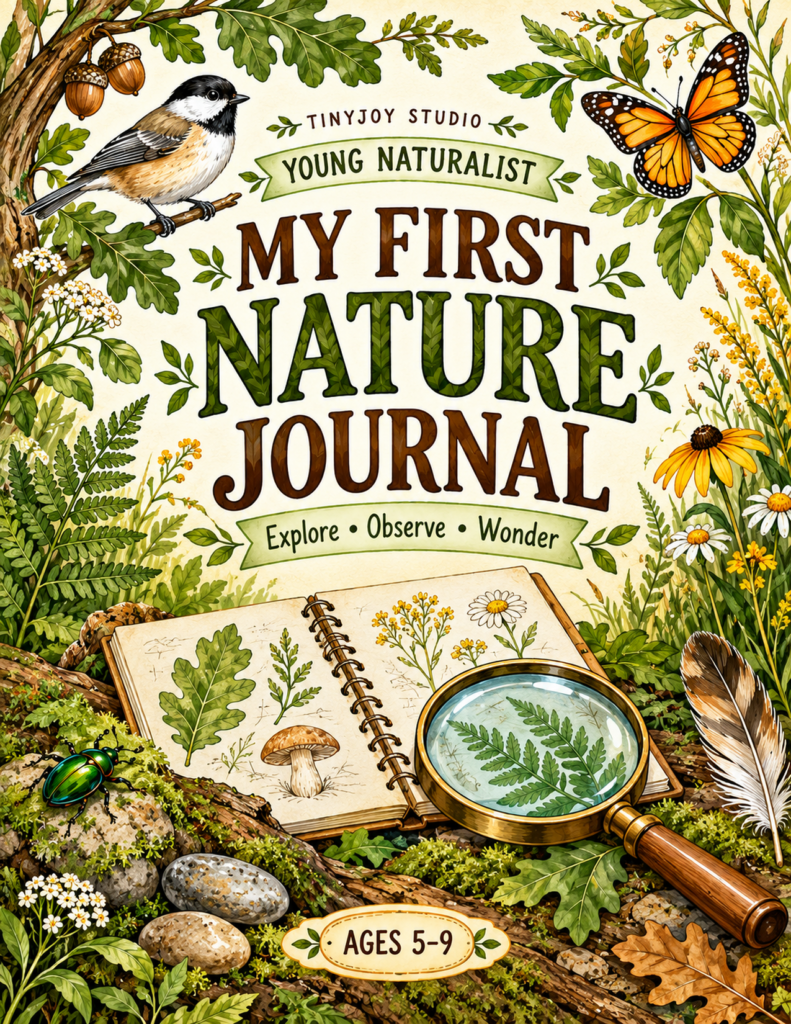
In My First Nature Journal (designed for ages 5–9 by TinyJoy Studio), young explorers are introduced to the core philosophy of our new Young Naturalist line. Acting as the foundational anchor of this entire nature branch, this field journal is deliberately designed to stand on its own. It equips children with essential habits of mind: observing with multiple senses, sketching textures, asking open-ended questions, and practicing respectful stewardship.

Three Core Movements: Choose, Observe, and Wonder
Real field science is not about knowing the taxonomic Latin name of every beetle on day one. It is about building a disciplined routine of attention. My First Nature Journal structures every outing around a simple, repeatable three-part inquiry cycle:
- Choose: Children pick any page that matches the adventure right in front of them—whether they are watching ants on a sidewalk crack, tracking drifting clouds from a front stoop, or sitting quietly beside a woodland creek.
- Observe: Instead of writing lengthy paragraphs, young naturalists use sensory checkboxes, guided clue frames, and field sketches to document colors, patterns, and movement.
- Wonder: Every field mission finishes by prompting the child to articulate one question they want to investigate next.
This habit of following observation with an unanswered wonder question mirrors the intellectual curiosity children develop when exploring our broader interdisciplinary curriculum. When students learn to connect physical terrain to human culture through a structured geography learning path for kids, they realize that geography is not just static borders, but a living dialogue between landscapes, water resources, and living communities.

Multi-Sensory Field Investigation: From Sound Maps to Texture Rubbings
One of the greatest pedagogical strengths of My First Nature Journal is that it engages every sensory pathway:
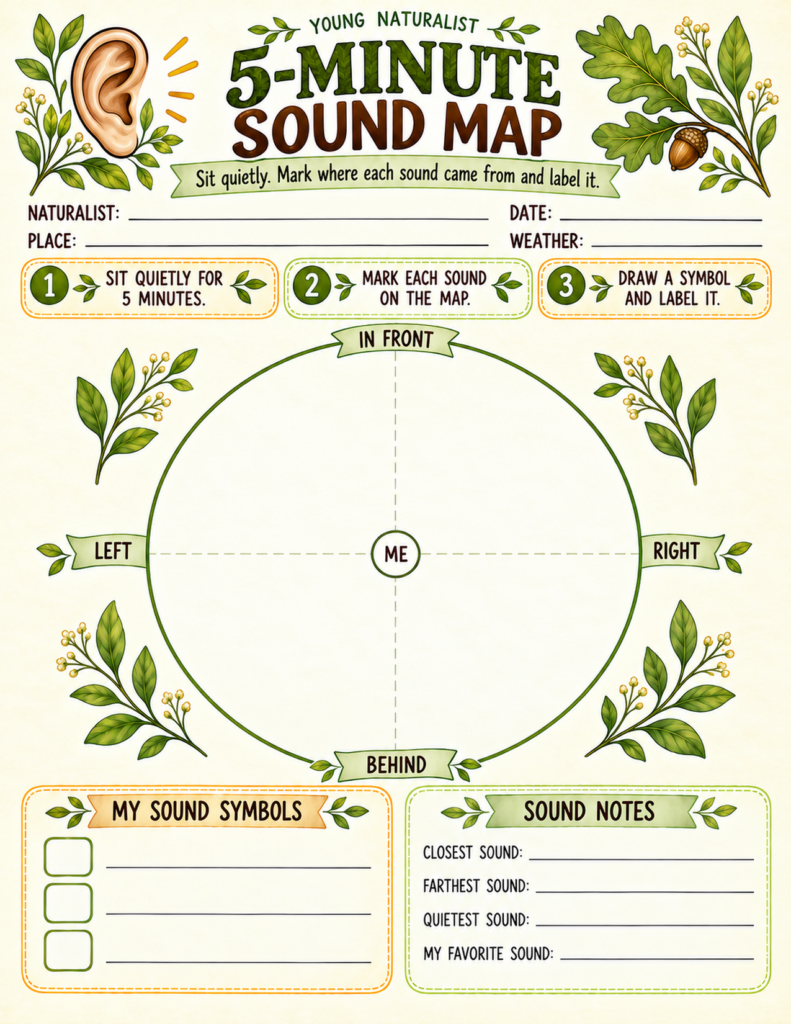
- The 5-Minute Sound Map: On page 10, children sit in silence for five minutes, marking the origin, distance, and volume of sounds on a spatial grid (in front, behind, left, and right) using invented symbols. This exercise builds acoustic awareness and spatial orientation without requiring fluent handwriting.
- Tactile Texture Comparisons: On page 8, young explorers place fallen leaves beneath the page to capture vein patterns with a crayon rubbing, or hold the paper against tree bark to compare ridge roughness against smooth stems.
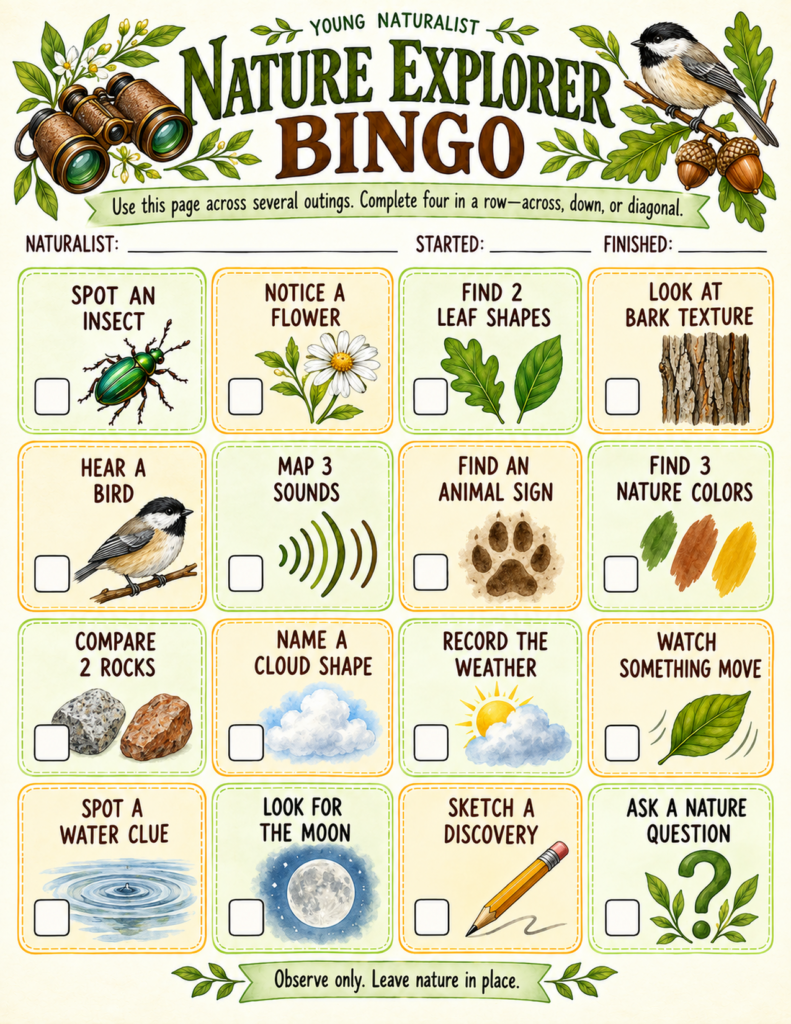
- Color and Scavenger Hunts: Pages 6 and 12 turn outdoor walks into mindful scavenger hunts. Children search for subtle natural hues (gray, brown, yellow) or elusive physical properties (something round, something casting a shadow, something moving) without stripping plants or collecting delicate items.
- Organism Clue Sheets: Specialized spreads for bugs, flowers, and birds guide children to look closely at functional anatomy. Instead of guessing a bird’s exact species, they record clue categories: size, social behavior (alone or in a flock), location, and voice.


Connecting local sensory tracking to sky phenomena forms a natural bridge to our physical science collection. When children track cloud shapes and record seven-day weather patterns in this journal, they take their very first steps toward the celestial mechanics and planetary systems taught across our comprehensive earth and space science bundle for kids.
Stewardship First: The «Look, Don’t Take» Rule
Many traditional nature craft books encourage children to pull living wildflowers, dig deep holes, or trap insects in jars. My First Nature Journal actively counters this destructive habit by embedding ethical fieldwork on every page:
- Leave Every Discovery in Place: Checklists explicitly remind children to study fallen leaves and leave attached plants untouched.
- Paper-Based Collecting: The «My Nature Collection» spread invites children to collect sketches and glued photos rather than taking delicate moss, nests, or living organisms out of their natural habitats.
- Safe and Respectful Boundaries: Field safety guidelines remind kids to explore with an adult, watch wildlife from a respectful distance, and check for ticks after each expedition.
This habit of handling evidence with care and analyzing artifacts in their original context reflects the disciplined methods of our interactive history for kids curriculum. Just as young historians evaluate primary sources without removing them from their historical context, young naturalists learn that a bird’s nest, an animal track, or a lichen patch loses its true scientific meaning once detached from its natural ecosystem.
The Young Naturalist Ecosystem: How This Journal Fits the Broader Series
It is vital to understand the unique architectural role My First Nature Journal plays within TinyJoy Studio’s broader curriculum:
- A Self-Contained, Foundational Anchor: This standalone journal serves as the entry gate to outdoor science. Completing its observational challenges earns the young explorer the printable «Certified Nature Detective» certificate. It does not require any other book to be complete, rewarding, and educationally rich.
- The Expanding Field Units: For learners who complete this book and want to dig deeper into specific subjects, the Young Naturalist line expands into nine specialized four-week units: Leaf & Tree Hunters, The Bug Realm, Forest Floor Secrets, Feathers & Tracks, Sky & Weather, Rocks & Earth, Pond & Water Life, Garden & Pollinators, and Night Sky & Seasons. Each unit is a comprehensive, multi-week scientific investigation of a single ecological topic.
- The Mosaic Collector Mechanic: To celebrate completing these future deep dives, the nine separate units feature an exclusive collectible reward system. At the end of each four-week unit, children earn a collectible discovery tile. Together, the tiles from those nine distinct books assemble into a magnificent, full-color nature discovery poster.
A Note on the Puzzle Poster: Please note that the nine-piece Nature Discovery Mosaic belongs exclusively to the upcoming four-week thematic field units. Because My First Nature Journal is designed as an independent, foundational field companion, it is completely self-contained and does not include the mosaic puzzle piece.

Practical Ways to Use the Journal at Home and School
Because My First Nature Journal requires no specialized lab gear beyond a pencil, a hand lens, and a water bottle, it fits naturally into any family routine:
- Homeschool Nature Walks: Keep the journal in a daypack for weekly trail visits, dedicating 15–20 minutes to a single observation spread.
- Longitudinal Seasonal Studies: Use the «One Tree, Four Seasons» log and the bean germination spread to teach cyclical change over months rather than hours.
- Screen-Free Morning Warm-Ups: Spend ten minutes on the porch completing the cloud watcher or weather log before beginning indoor lessons.
If you are looking for an open-and-go field companion that replaces passive screen time with authentic sensory awareness, mindful stewardship, and lifelong scientific questioning, My First Nature Journal offers the perfect, gentle launchpad for your young naturalist.