Why the Sun Is Not a Campfire: Teaching Solar Physics and Space Weather Through Evidence
When elementary children look at the daytime sky, they see a bright yellow disc and assume it burns like wood in an open fire. Finding a thoughtful sun workbook for kids that dismantles this intuitive campfire myth is the key to helping young learners grasp real astrophysics and energy science. A structured sun workbook for kids shows that the Sun does not consume fuel with oxygen; instead, it is a massive sphere of extremely hot plasma where deep nuclear fusion generates radiant energy that travels through space to warm our soil, power our electrical circuits, and trigger glowing auroras in the night sky.
Standard classroom worksheets frequently reduce solar science to isolated trivia. Children color a cartoon sun with sunglasses, memorize that sunlight takes roughly eight minutes to reach Earth, and match simple vocabulary without examining the underlying physics. As a result, students miss the crucial mechanical differences between visible light, invisible infrared, and ultraviolet radiation. They rarely investigate how surface color influences thermal absorption, nor do they see why solar flares and coronal mass ejections do not always produce visible Northern Lights.

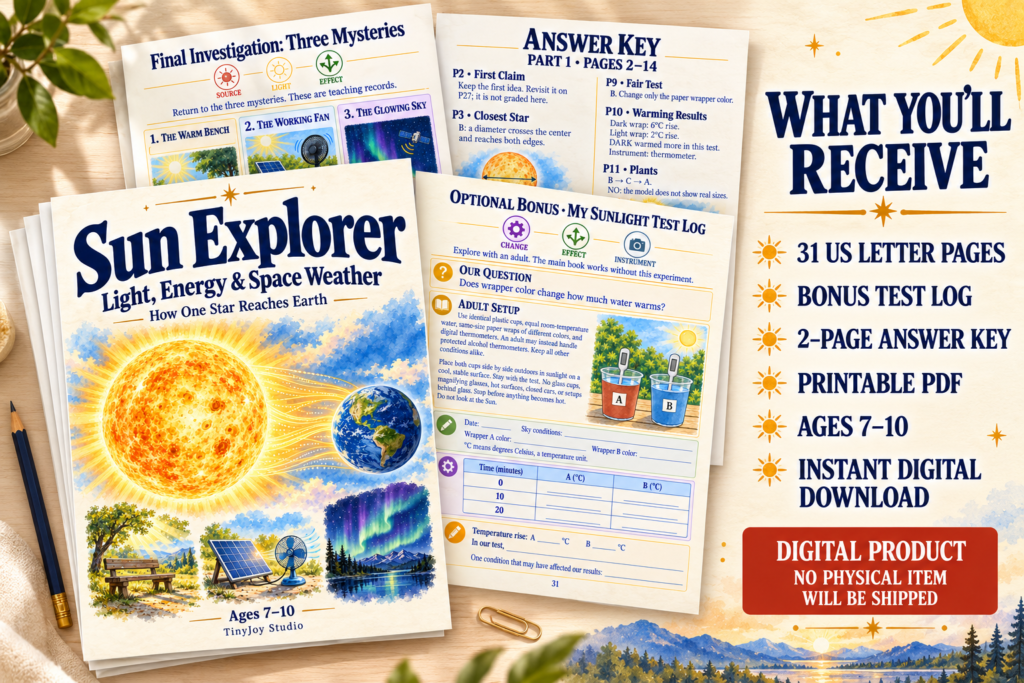
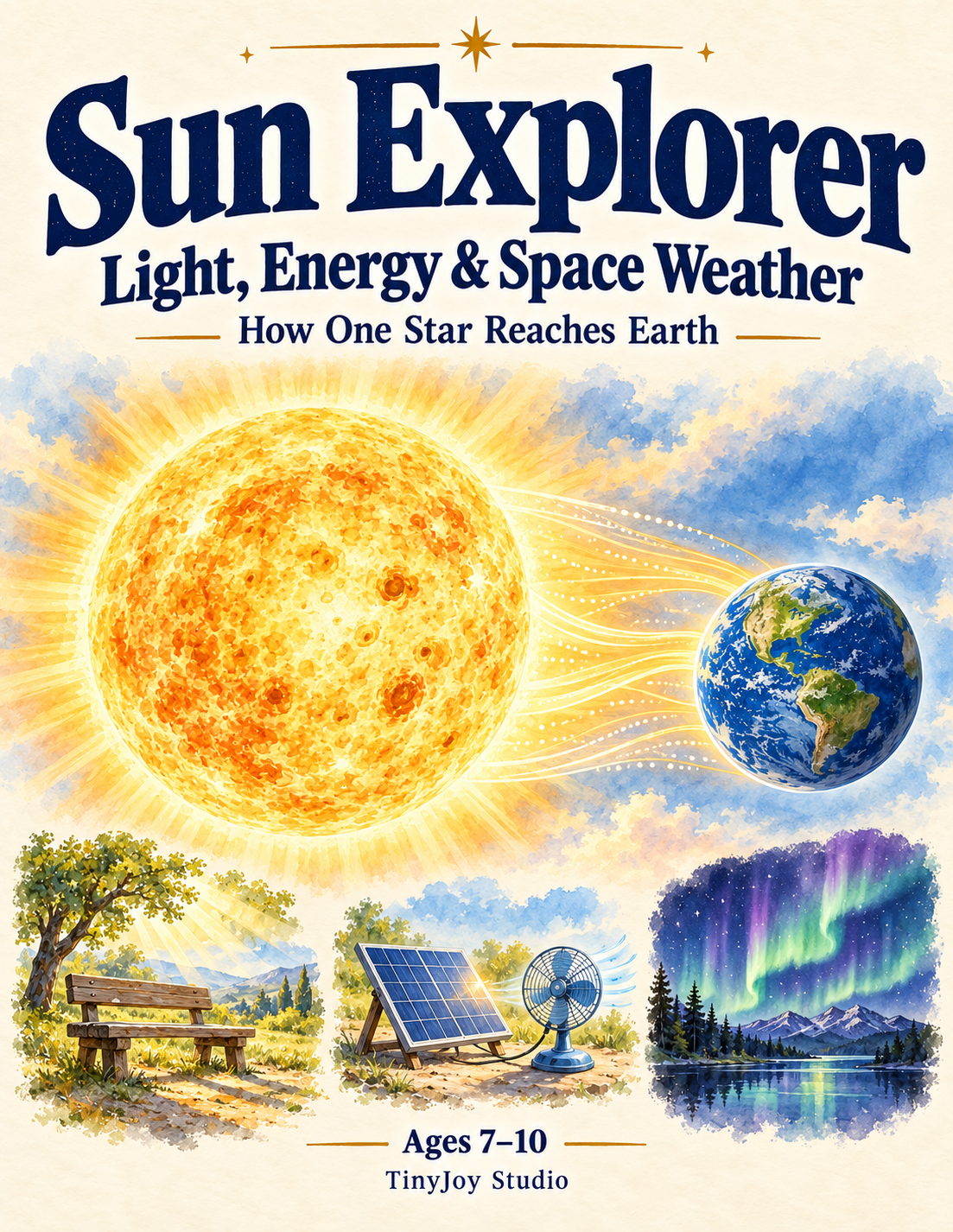
In Sun Explorer: Light, Energy & Space Weather — How One Star Reaches Earth (a 30-page printable science unit designed for ages 7–10 by TinyJoy Studio), children do not passively absorb facts. Instead, they act as solar physicists using five interconnected inquiry lenses: Source (what the Sun is like and what begins there), Light (what carries energy across space), Change (what shifts over hours, days, or an 11-year cycle), Effect (what transformation happens when energy arrives), and Instrument (what specialized tools reveal what human eyes cannot see).

Escaping the Campfire Myth: Core Fusion and Extreme Temperatures
The journey begins by examining the internal engine of our nearest star. On page 4, children explore a cutaway model of the Sun. Rather than encountering a solid surface, they discover a dramatic thermal gradient: while the visible layer registers at approximately 5,800 Kelvin, the core reaches a staggering 15 million Kelvin. By comparing these figures with familiar benchmarks—such as a comfortable living room (~293 K) and boiling water (~373 K)—students begin to quantify stellar heat using scientific units.
On page 5, the workbook confronts the opening myth head-on. While a campfire requires wood and atmospheric oxygen to burn chemically, the Sun does not need air to shine. Deep within the core, immense pressure and heat force the tiny centers of atoms to fuse together in nuclear fusion, releasing enormous amounts of raw energy.
Understanding how solar energy drives dynamic systems on nearby rocky planets provides a natural bridge to broader planetary sciences. Exploring our Dynamic Earth Workbook Bundle helps children see how internal geological heat and external solar radiation together sculpt landscapes, drive tectonic forces, and reshape planetary crusts.

The Eight-Minute Journey: Waves, Instruments, and Absorption
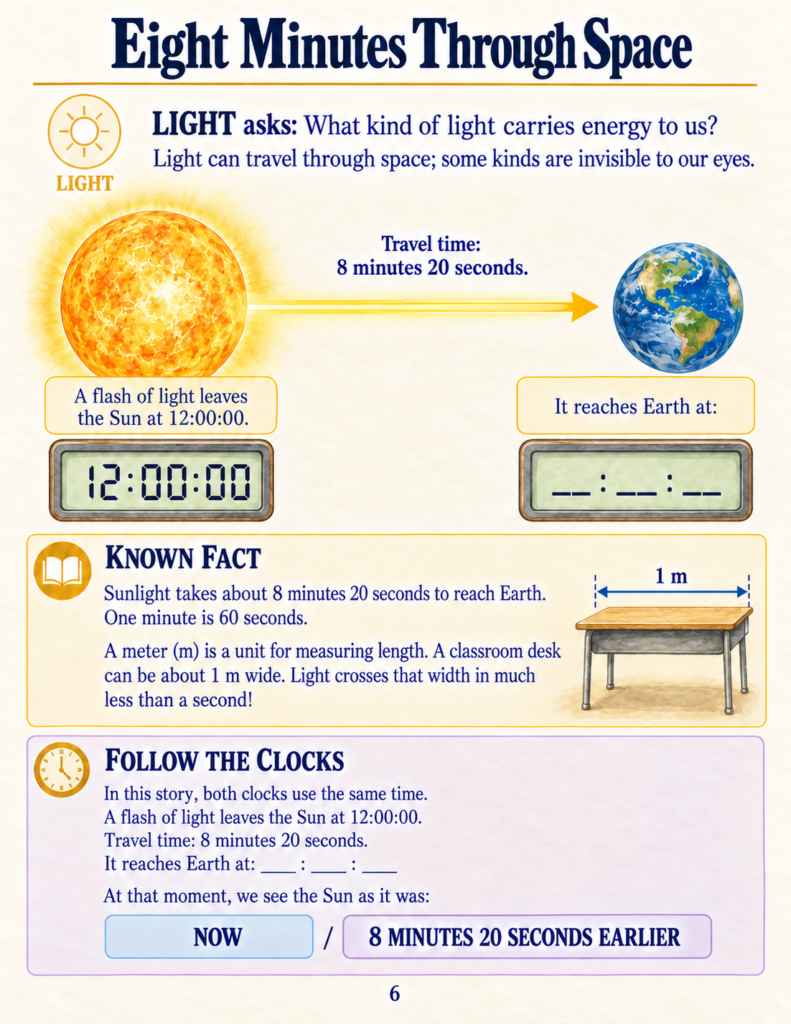
Once light leaves the Sun, it embarks on an eight-minute, twenty-second sprint across 150 million kilometers of vacuum. On page 6, students calculate arrival times using synchronized clocks, discovering that whenever we look up safely at daylight, we see the Sun as it appeared more than eight minutes earlier.
Yet visible sunlight is only part of the story. On pages 7 and 8, the curriculum introduces the invisible spectrum:
- Infrared Radiation: Wavelengths undetectable to the human eye that carry radiant thermal energy, recorded by specialized spacecraft cameras.
- Ultraviolet (UV) Waves: Energetic wavelengths that the atmosphere largely filters out before reaching living tissue.
- Surface Interactions: Tracing how incoming light either reflects off shiny surfaces, passes through transparent materials, or gets absorbed by dark matter, converting light directly into thermal heat.
To make this concrete, students analyze a controlled fair test on pages 9 and 10. Comparing two identical cups filled with equal amounts of water under identical sunlight, learners examine how a dark paper wrap causes water to rise from 22°C to 28°C over twenty minutes, while a light wrap rises only to 24°C.
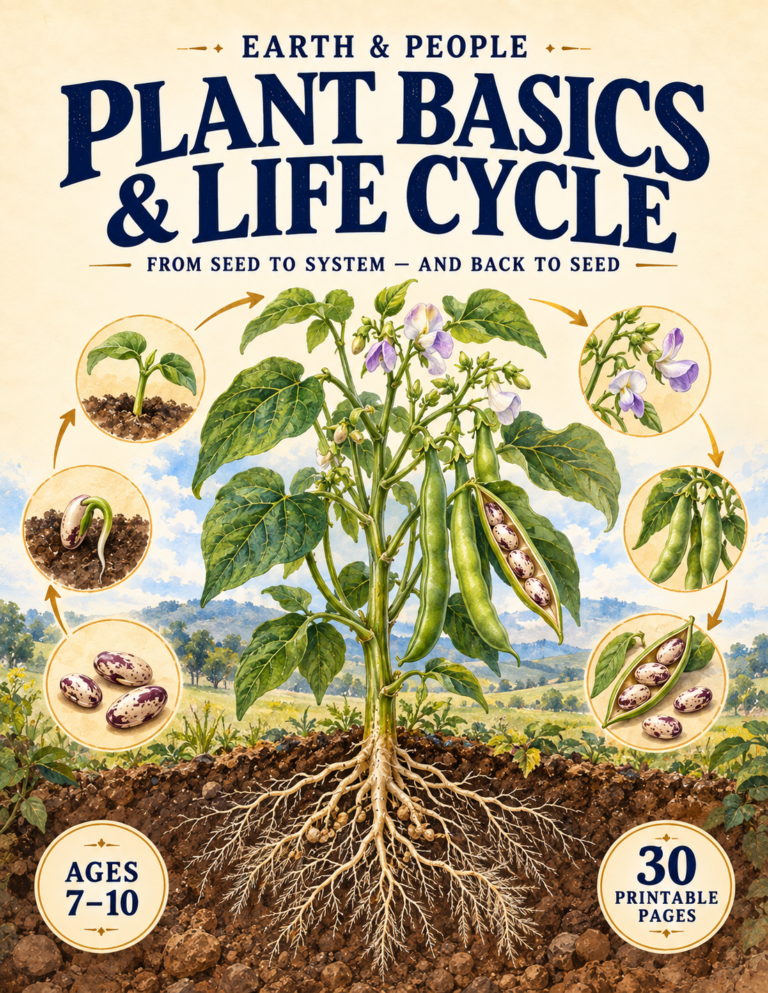
Investigating how sunlight powers living systems builds an essential foundation for biology. In our Nature Workbooks for Kids, students expand on the photosynthesis models introduced on page 11, discovering how green plants capture incoming solar photons to nourish global biomes and wildlife webs.
Space Weather: Solar Wind, Magnetic Shields, and Auroras
What makes Sun Explorer truly distinctive is its thorough treatment of space weather. Elementary materials often present the Sun as a steady, static lamp. In reality, it is a turbulent magnetic furnace.
Children track dark sunspots across a 13-day solar rotation sequence, analyze the 11-year solar activity cycle using camera sample data, and distinguish between steady particle flows and violent outbursts:
- The Solar Wind: A continuous stream of high-energy charged particles flowing outward into the solar system. Unlike light, these massive particles travel far more slowly, taking two to three days to reach Earth’s orbit.
- Solar Flares vs. Coronal Mass Ejections (CMEs): Students learn that a solar flare is an intense burst of light, while a CME is a colossal cloud of expelled plasma. Crucially, they discover that not every flare includes a CME, and not every plasma cloud is aimed toward Earth.
- Earth’s Double Shield: On page 19, learners evaluate how Earth protects itself. Earth’s magnetic field deflects charged particles toward the magnetic poles, while our atmosphere absorbs lethal UV rays.
- The Anatomy of an Aurora: When redirected charged particles collide with atmospheric gases high above polar regions, the energized gases release vivid dancing curtains of green, violet, and blue light.
Connecting planetary magnetospheres with cosmic phenomena opens doors to extreme earth science. In our Amazing Earth Adventures Workbook Bundle, students follow these geomagnetic interactions from high-latitude polar skies down to volcanic calderas, ocean trenches, and geothermal springs.

Scientific Thinking: Calibrating Claims and Planning Spaces
Rather than ending with a multiple-choice quiz, the workbook cultivates scientific epistemology. On page 21 («How Far Can the Claim Go?»), students review space weather reports and practice categorizing claims into Supported (backed directly by evidence), Possible (plausible, but requiring local data), or Too Big (stating more than the evidence allows). When a news report asserts that «everyone will see a bright aurora tomorrow,» students recognize the error: local cloud cover, city light pollution, and geomagnetic alignment determine whether an aurora is actually visible.
This critical thinking progresses through hands-on design and forensic problem-solving:
- The Discovery Corner: On page 24, students apply physical sunlight principles to design an outdoor garden nook. They position a solar panel in all-day sun, an ornamental shade-loving plant in partial morning light, and a resting bench in continuous afternoon shade.
- Repairing the Museum: On page 25, learners audit four incorrect museum placards, rewriting misconceptions about cold sunspot holes, magnetic barriers, and runaway flares using verified facts.
Examining how human societies organize their architecture around daily sunlight, shadows, and seasonal warmth bridges physics directly into human geography. In our People and Places Workbook Bundle, children explore how traditional homes, agricultural terraces, and civic gathering spaces across the globe are built in response to regional climate and solar angles.

Practical Implementation for Home and Classroom
Because Sun Explorer includes self-contained observation records, structured teaching datasets, and a full two-page answer key, it requires zero expensive lab gear or hazardous solar viewing:
- Homeschool Astronomy Unit: Complete two pages daily over three weeks for a comprehensive, screen-free solar physics study.
- Elementary STEM Stations: Print the solar circuit data lab (page 12) and the «Repair the Sun Museum» spread (page 25) for collaborative small-group analysis.
- Optional Backyard Science: Utilize the bonus «My Sunlight Test Log» (page 31) for a supervised, safe water-warming experiment comparing black and white wrappers under real sunshine.
To support young scientists in recording outdoor sun tracks, taking compass bearings, and plotting shadows without looking directly at the star, exploring our Explorer Skills Workbook Bundle equips learners with practical grid-reading, navigation, and field-recording techniques.
If you are looking for an educational resource that replaces superficial coloring sheets with genuine solar mechanics, space weather deduction, and energy models, Sun Explorer provides your young astronomer with an inspiring, structured launchpad into authentic stellar science.