
Ancient Egypt Religion Unit Study: Pharaohs, Gods & Temples
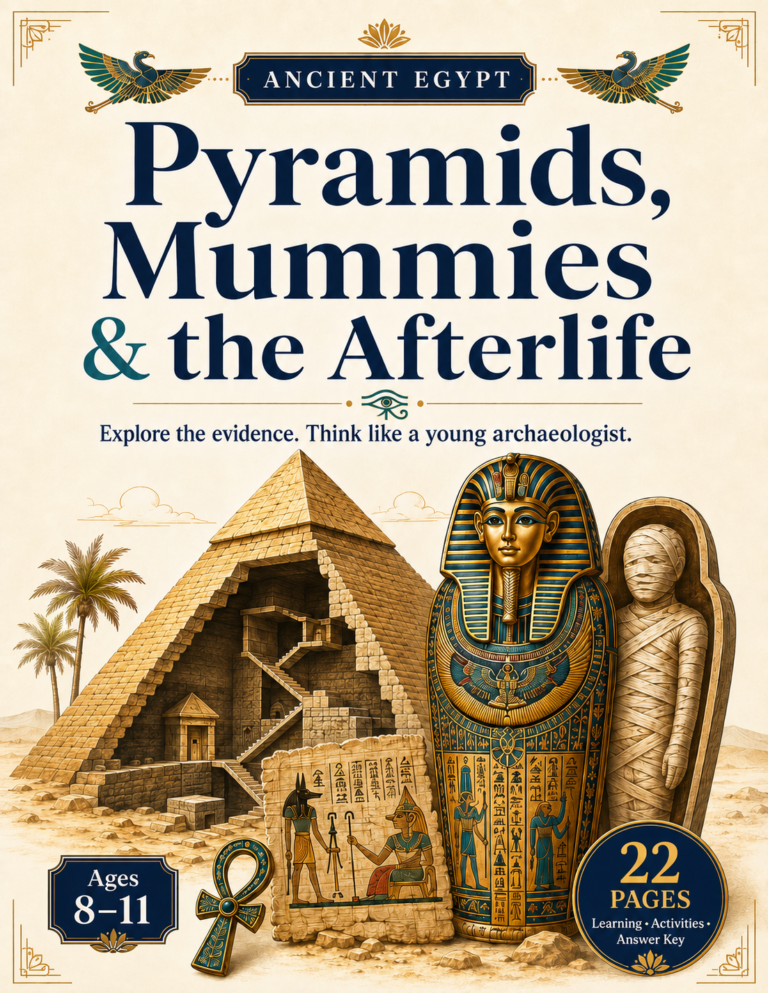
When children study ancient civilizations, mythology is often reduced to a static list of animal-headed deities or glamorous golden treasures. But to the people who walked along the banks of the Nile, religious belief was a living, working machine designed to preserve the balance of the universe—a concept they called Ma’at. How can parents turn these complex spiritual traditions into vibrant, practical learning? The secret is a thoughtfully structured ancient Egypt religion unit study that prioritizes systems thinking, architectural navigation, and source evaluation over passive memorization.

By investigating how rulers, priests, artisans, and everyday workers collaborated to keep their world in cosmic order, hands-on history guides transform standard social studies into exciting historical detective work. Let’s explore how an evidence-based approach to Egyptian temples and royal roles builds spatial reasoning, critical deduction, and lasting curiosity.
Why Interactive History for Kids Works
Children understand the ancient world far better when they are invited to solve authentic historical puzzles rather than memorize isolated names and dates. A conventional textbook might simply state that Egyptians worshipped many gods, but an interactive workbook asks young learners: If Hathor and Isis both appear with cow horns and a sun disk, how can an archaeologist tell them apart from appearance alone? Recognizing that physical traits shared between deities require inscribed names as confirmatory evidence helps children grasp the foundations of historical proof.
When you integrate a structured interactive history for kids curriculum into your homeschool or study routine, you equip your children with real analytical tools. Instead of reading about ancient rites from afar, they analyze temple floor plans, evaluate logistical food chains, and examine royal iconography like real historians.

Exploring the Temple Ecosystem: Beyond Priests and Statues
One of the most eye-opening lessons interactive history provides is demonstrating that grand monuments were practical, bustling centers of community life. An Egyptian temple was known as a «house for a god,» but maintaining daily service required an entire ecosystem of supporting professions.
While children explore mummification and afterlife preparation in our foundational Ancient Egypt activities for kids and decode hieroglyphic communication in our sister guide in the Ancient Egypt unit study, this dedicated ancient Egypt religion unit study reveals how economics and religion intertwined. Bakers, brewers, scribes, porters, and boat crews all managed supplies to ensure daily offerings were delivered on time. Furthermore, young historians discover the economic cycle of the reversion of offerings: food presented before the deity’s shrine was not wasted, but redistributed to feed the temple staff and administrators.
Learning Through Doing: «The King on the Wall, the Priest in the Room»
To nurture genuine critical thinking, learning materials must challenge students to distinguish between symbolic ideals and practical daily life.

On temple walls, the pharaoh is universally carved presenting incense and offerings to the gods. But did the pharaoh personally conduct thousands of ceremonies across Egypt every morning? By sorting statements into Visible on the Wall, Known from Other Evidence, and Too Big a Claim, children uncover royal messaging. The carvings celebrated the king’s sacred duty to uphold Ma’at, while appointed high priests actually carried out the day-to-day rituals inside dim sanctuaries.
Thinking Like an Archaeologist: The Amarna Artifact Study
The crowning achievement of high-quality history education is teaching young minds to evaluate original artifacts with academic discipline. This is where an investigative ancient Egypt religion unit study truly shines.
When studying the Amarna Period under Pharaoh Akhenaten, students examine a detailed facsimile of a limestone house altar (Berlin ÄM 14145). Instead of simply accepting blanket claims that the entire country instantly adopted the sun disk Aten, children evaluate specific claims using the Supported (S), Possible (P), and Too Big (T) framework:
- The sun’s rays end in hands holding signs of life: Supported (directly visible).
- The artist highlighted the royal family’s unique divine bond: Possible (a reasonable historical interpretation).
- Every Egyptian family worshipped Aten in their own home: Too Big a Claim (a single palace altar cannot prove universal private devotion).
To broaden their historical horizons, students can set sail down the river with Mia in our narrative adventure Ancient Egypt unit study or complete their museum curator project right in this guide.
Spark Your Child’s Curiosity Today
Parents and educators want social studies materials that foster deep intellectual curiosity, respectful cultural inquiry, and analytical reasoning without feeling tedious. An interactive ancient Egypt religion unit study provides that essential balance. By transforming students into young curators and historical detectives—decoding divine crowns, tracing sacred processional routes, and testing historical claims against physical artifacts—you give them skills that extend far beyond the classroom.
Provide your children with curriculum resources that respect their intelligence and bring the wonders of ancient Nile worship to life. Step into the sacred courts of Egypt today, uncover how pharaohs, gods, and communities worked as one, and watch your child’s love for history flourish!


Thanks for putting this together—concise, practical, and a pleasure to read.