Why T. Rex Never Met Stegosaurus: A Hands-On Dinosaur Workbook for Kids
Dump a plastic bin of toy dinosaurs onto a living room rug, and you will almost certainly witness a cinematic showdown: Tyrannosaurus rex lunging at a Stegosaurus, while a Pteranodon swoops down from a nearby bookshelf. Pop culture has spent decades convincing children that all prehistoric creatures shared the same prehistoric jungle.
Chronologically, Tyrannosaurus rex lived closer in time to human beings walking on the Moon than it did to Stegosaurus grazing during the Late Jurassic.
When early science curriculum reduces paleontology to roaring carnivores and memorized jaw lengths, young learners miss the core organizing principles of life science: deep time, anatomical adaptation, and ecological balance. A thoughtfully sequenced dinosaur workbook for kids rescues these ancient reptiles from the realm of fantasy monsters, transforming enthusiasm into authentic scientific reasoning.

Deep Time: Rescuing Dinosaurs from the «Prehistoric Soup»
The greatest barrier to scientific literacy in early elementary grades is the concept of geological time. To a seven-year-old, «millions of years ago» is an abstract fog where cavemen, woolly mammoths, and trilobites blend together.
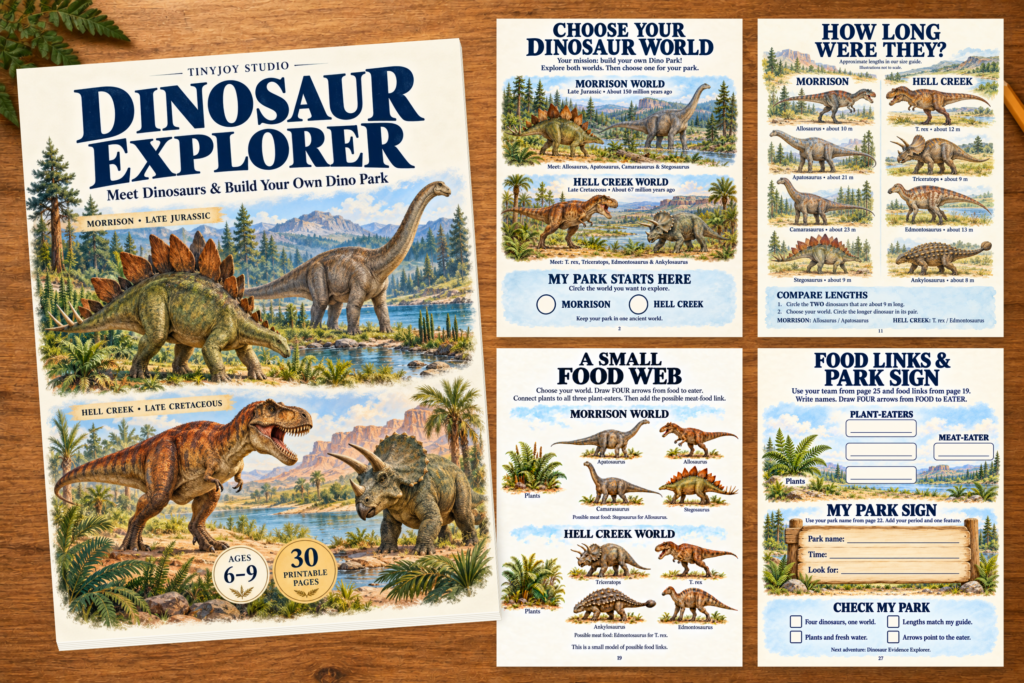
In Dinosaur Explorer: Meet Dinosaurs & Build Your Own Dino Park (a 30-page printable unit designed for ages 6–9), that misconception is dismantled on page two. Before children begin sketching their dream park, they must make an explicit choice between two real ancient ecosystems:
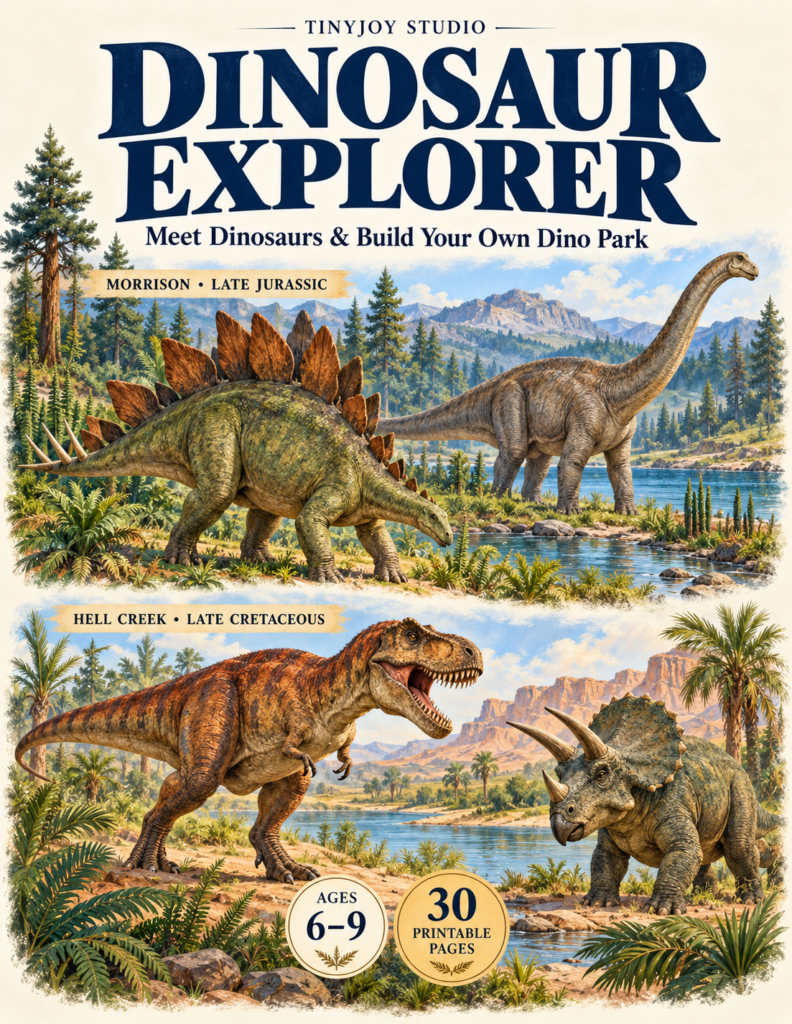
- Morrison World (Late Jurassic, ~150 Million Years Ago): Home to giant long-necked sauropods (Apatosaurus, Camarasaurus), plated Stegosaurus, and the apex predator Allosaurus.
- Hell Creek World (Late Cretaceous, ~67 Million Years Ago): Home to horned Triceratops, duck-billed Edmontosaurus, armored Ankylosaurus, and Tyrannosaurus rex.
By requiring young park designers to commit to a single world, the workbook instills chronological discipline. Developing this sense of historical sequence early prepares children for all future humanities and social studies work. For families seeking to build timeline reasoning across human civilizations, exploring our Interactive History Curriculum provides the same inquiry-driven framework to help young minds trace how eras, artifacts, and societies unfold in chronological order.
Biological Classification: Not Every Ancient Reptile Was a Dinosaur
Ask an elementary child to name their favorite dinosaur, and they will frequently answer with Pterodactyl or Mosasaurus.
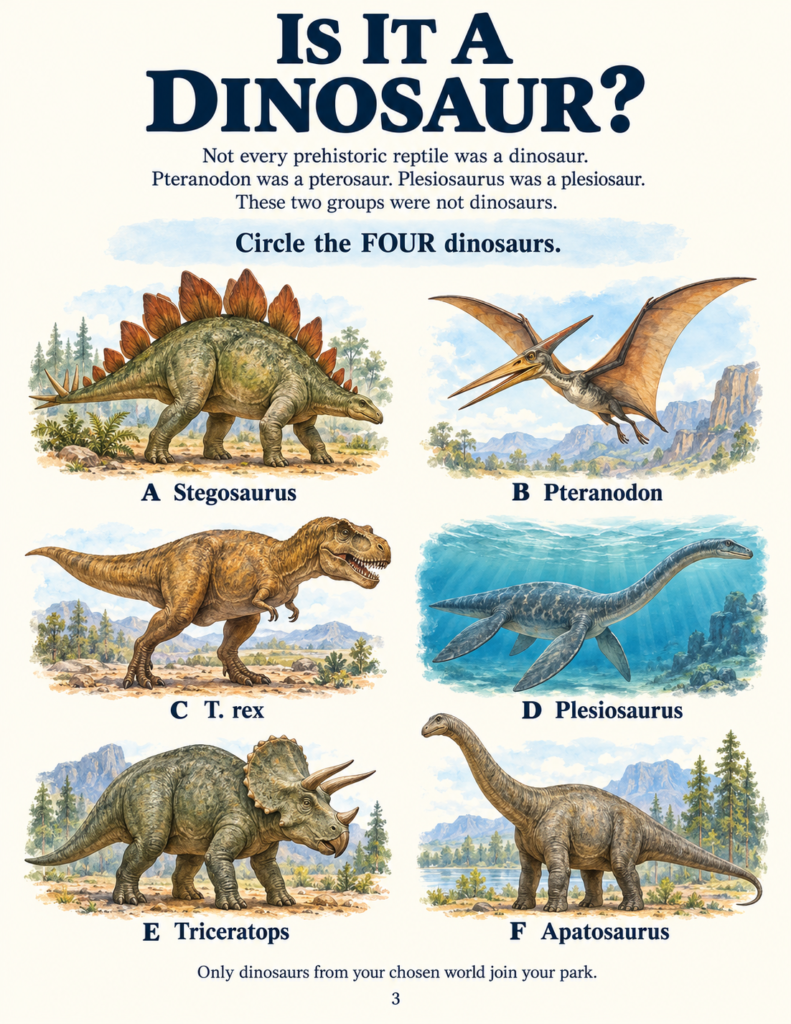
Dinosaur Explorer uses the «Is It a Dinosaur?» challenge to introduce formal biological classification. Rather than grouping animals by their scaly skin or ancient status, students investigate anatomical criteria:
- Pteranodon was an airborne reptile belonging to the pterosaurs.
- Plesiosaurus was a marine reptile swimming in ancient oceans.
- True dinosaurs were terrestrial reptiles with upright limb postures tucked directly beneath their bodies.
Children learn to cross out the flying and swimming impostors before populating their park pens.
Understanding that visual representations require critical observation parallels how young learners approach physical science. Much like auditing space illustrations to determine whether planet distances and orbital sizes are drawn to true scale—an approach detailed in our Solar System Explorer Workbook —identifying true dinosaurs trains young eyes to look past superficial artistic tropes and verify anatomical evidence.

Form Follows Function: Teeth, Beaks, and Skeletons
Elementary science often treats herbivory and carnivory as simple vocabulary labels. Dinosaur Explorer grounds feeding habits in functional morphology:
- Grab and Bite: T. rex used strong, conical, serrated teeth to seize moving animal food.
- Snip and Slice: Triceratops possessed a sharp, parrot-like beak specialized for shearing tough, fibrous prehistoric cycads and palms.
- Grind and Crush: Edmontosaurus packed hundreds of tightly packed cheek teeth into dental batteries that acted like millstones to grind coarse plant matter.
Students connect these dental adaptations to full-body skeletal systems. On the Apatosaurus skeletal anatomy spread, learners trace how a heavy backbone, columnar weight-bearing legs, and a counterbalancing tail worked in unison to support a 20-meter terrestrial giant.
Spatial Scale and Ecosystem Food Webs
Before constructing their park, children must tackle a practical engineering challenge: scale mapping.
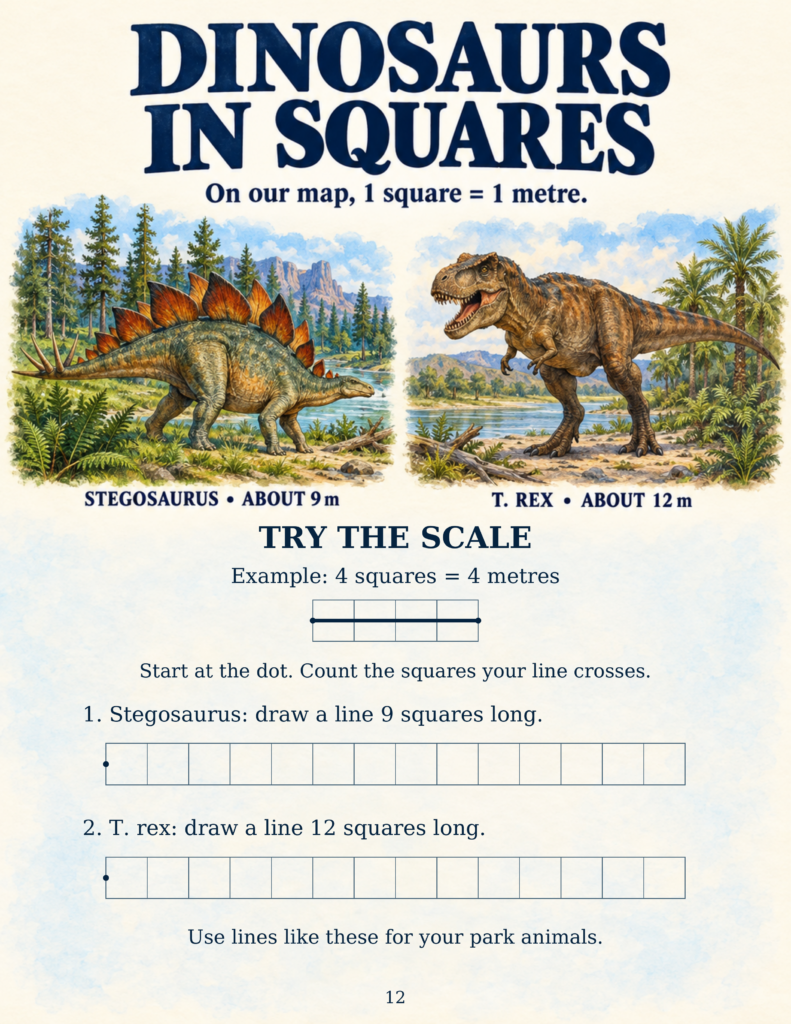
Using an intuitive cartographic grid where 1 square = 1 meter, children translate raw size guide numbers into spatial measurements:
- A 9-meter Stegosaurus requires a 9-square enclosure line.
- A 12-meter T. rex claims 12 grid squares.
- A colossal 23-meter Camarasaurus demands more than twice the perimeter of an 8-meter Ankylosaurus.
This direct spatial reasoning connects mathematical scale with real-world map planning. When children learn how regional boundaries, water access, and urban footprints balance against terrain constraints—a skill featured in our guide to Countries & Capitals Workbook —they realize that whether you are planning a national capital or an ancient wildlife habitat, scale dictates survival.
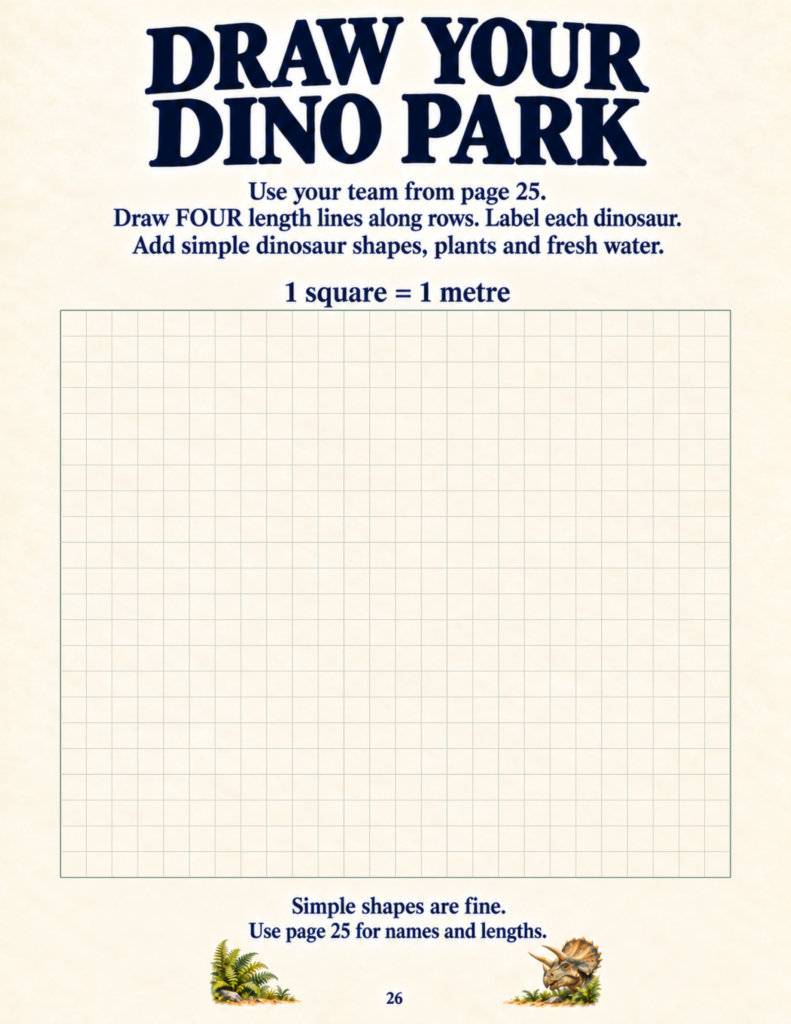
Furthermore, the park cannot exist without a functioning ecosystem. Children must supply fresh water (river, stream, or pond) and match their park’s flora to the correct era: conifers, horsetails, and ferns for the Jurassic Morrison; or flowering palm trees and ferns for the Cretaceous Hell Creek.
They trace ecological arrows from primary producers (plants) to primary consumers (herbivores), and finally to apex theropods. This delicate food loop echoes the environmental feedback loops analyzed in our review of the Tropical Rainforest Workbook, reinforcing that no animal can survive outside its supporting biological community.
Practical Implementation for Home and Classroom
Because Dinosaur Explorer is completely self-contained with full answer guides, size charts, and scaffolding, it fits seamlessly into a range of teaching settings:
- Homeschool Science Block: Spread the 30 pages across a focused two-week unit study, completing two to three pages per day.
- Independent STEM Enrichment: The self-checking anatomy and scale-drawing pages make excellent screen-free morning work.
- Classroom Park Planning Project: Have students work in pairs—one team managing the Jurassic Morrison Valley, the other building the Cretaceous Hell Creek Reserve—culminating in an oral park tour presentation.
If you are looking for an educational printable that channels your child’s passion for prehistoric reptiles into genuine anatomical inquiry, scale mapping, and ecosystem planning, Dinosaur Explorer provides a structured, thrilling pathway back into deep time.