Why a Coast Is Not Just a Sandy Beach: Teaching Coastal Geomorphology Through Evidence and Systems Thinking
When elementary children picture a coastline, they almost always imagine a sunny strip of golden sand lined with beach towels and rolling surf. Finding an authentic coasts workbook for kids that shatters this narrow stereotype is vital for genuine earth science literacy. A well-structured coasts workbook for kids demonstrates that a coast is anywhere land meets a sea or ocean—spanning sheer rocky cliffs battered by surging swells, broad mud flats uncovered by retreating tides, and tangled mangrove forests anchoring tropical shorelines.
Standard elementary geography units frequently reduce marine boundaries to static vocabulary lists. Children memorize isolated definitions of «cove» or «dune,» yet they struggle to explain how moving water carves bays out of soft rock while leaving hard stone headlands projecting into the sea. Furthermore, young students easily conflate the rapid, seconds-long crash of breaking waves with the multi-hour gravitational rise and fall of oceanic tides, or assume that sand washed away by winter storm surges has vanished from the planet completely.
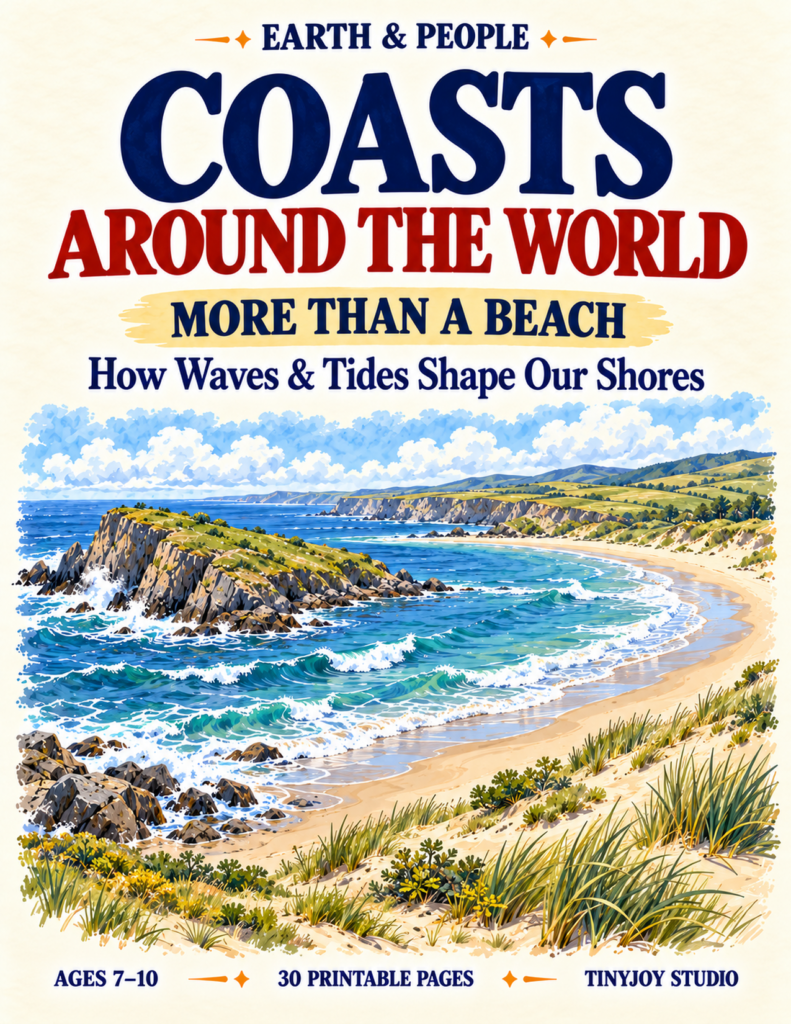
In Coasts Around the World: More Than a Beach (a 30-page printable earth science unit designed for ages 7–10 by TinyJoy Studio), children step into the boots of coastal researchers. Guided by five fundamental investigative lenses—Material, Water, Shape, Life, and Change—students explore nine real-world locations across six continents to investigate how hydrodynamics shape global landforms.

[IMAGE INSERT] Book: Coasts Around the World Page: 2 Use: Introduces the foundational inquiry pedagogy, confronting the «One Look vs. Many Looks» reality of global coasts and establishing the five Core Lenses (Material, Water, Shape, Life, Change). Alt text: Coasts workbook for kids introductory page illustrating four diverse shores and presenting five analytical inquiry lenses. Optional caption: Reframing the shoreline: moving from a generic beach picture to an inquiry framework analyzing material, water movement, landforms, ecosystems, and ongoing change. [/IMAGE INSERT]
Waves, Tides, and Currents: Reading the Clues of Water in Motion
Water moves across shorelines in distinctly different ways, leaving behind specific geological fingerprints. Standard worksheets often present waves and tides as interchangeable water motions, creating deep conceptual confusion.
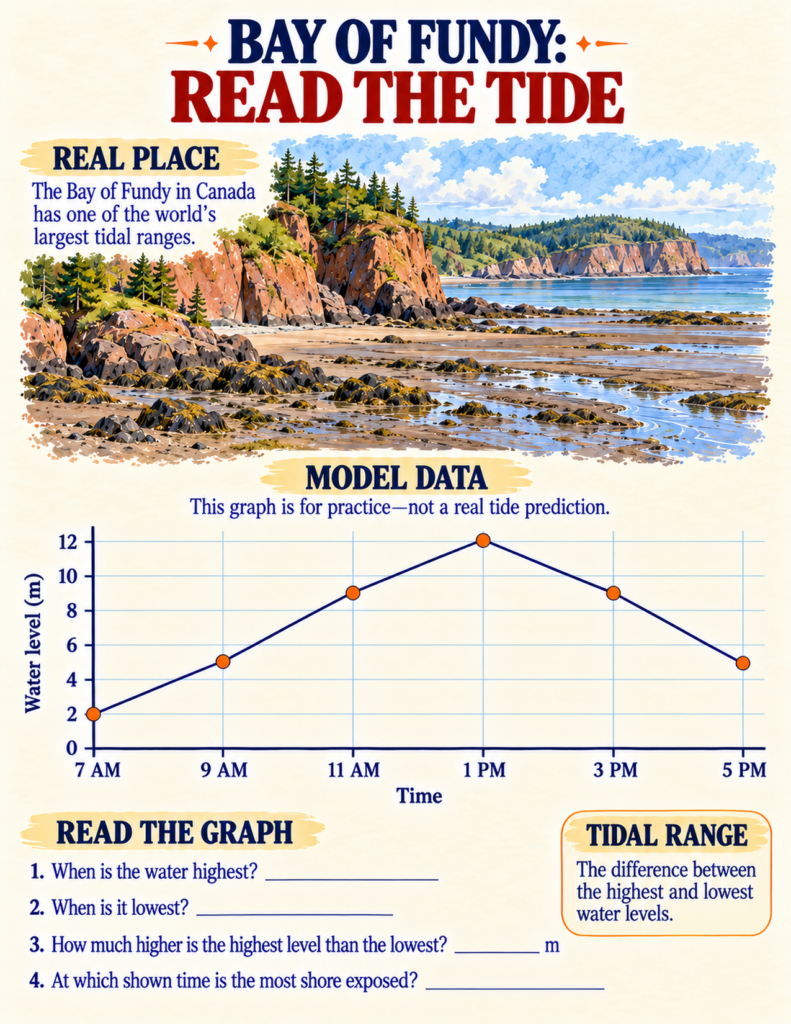
To build authentic scientific literacy, young learners must distinguish between high-frequency mechanical forces and slow gravitational cycles. Breaking waves rush forward and draw back within seconds, slamming physical energy against rock faces. Tides raise and lower the entire sea level gradually across six-hour cycles, completely transforming the exposed surface area of the intertidal zone without creating permanent new land. Meanwhile, longshore currents steadily push loose materials sideways along the coastline.
For homeschool families seeking to understand the deep geological forces that create these massive rock basins and continental plates, pairing marine studies with the Dynamic Earth Workbook Bundle provides a comprehensive foundation in planetary dynamics, crustal movement, and structural geology.
Differential Erosion: How Waves Sculpt Bays, Arches, and Sea Stacks
Children often imagine that shorelines are permanent barriers fixed in place. In reality, coastal rock faces are continuous battlegrounds of erosion, transport, and deposition.
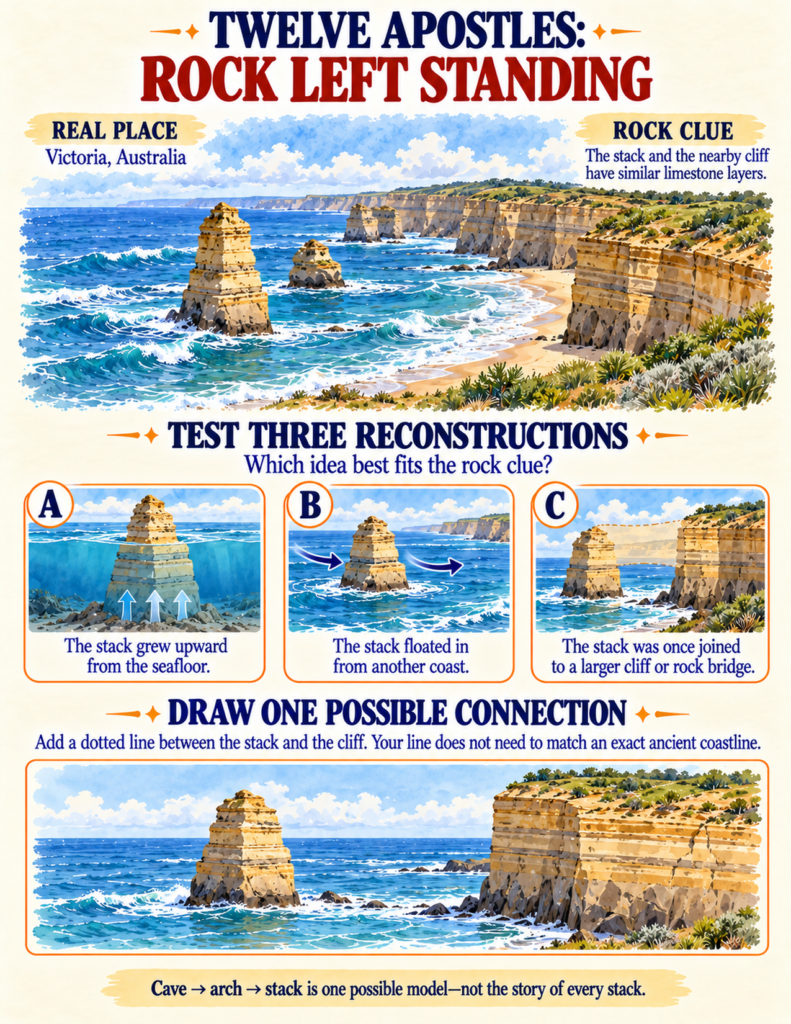
When waves strike alternating bands of hard and soft rock along the Jurassic Coast of Dorset, England, the softer rock wears away rapidly to form sheltered bays, while the more resistant strata stand firm as protruding headlands. Over thousands of years, wave energy concentrates against these headlands, cutting hollow sea caves, punching through rock arches, and eventually leaving isolated limestone pillars, such as the famous Twelve Apostles of Victoria, Australia.
Understanding that an isolated sea stack was once physically connected to the mainland cliff equips children to think in deep time—reconstructing ancient shorelines from physical field evidence rather than guessing.
The Sediment Budget: Where Does the Sand Go?
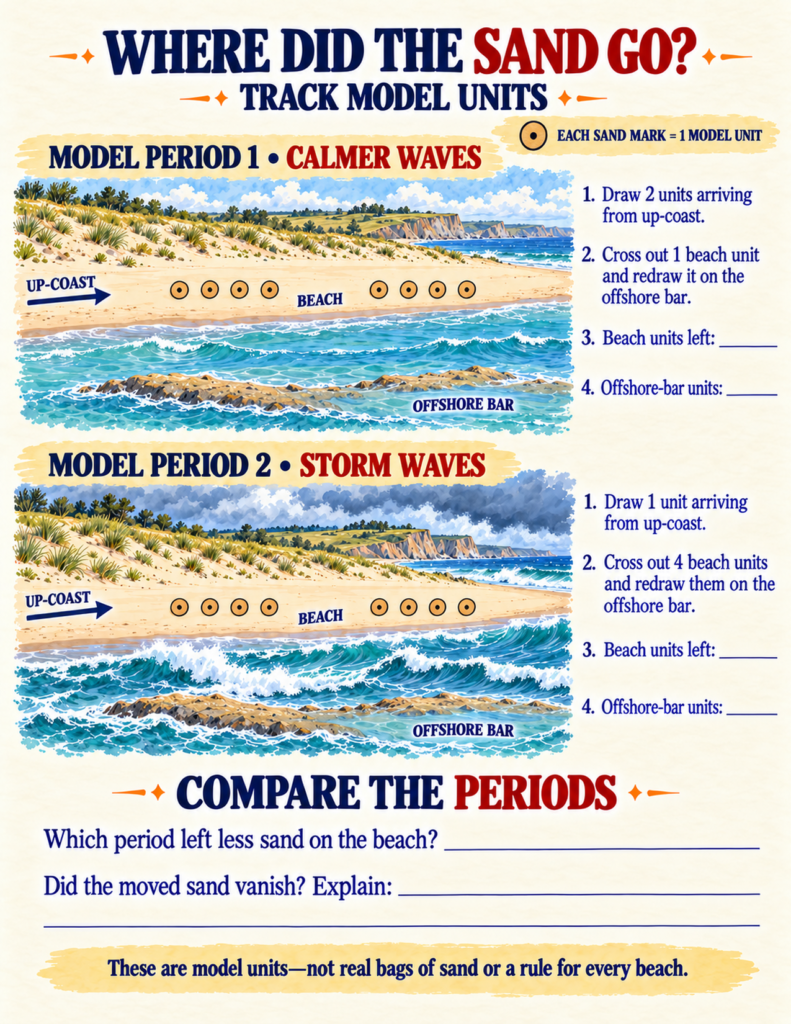
One of the most persistent misconceptions in elementary earth science is that eroded beach sand simply «disappears» when storm waves strip a shoreline bare.
By tracking simplified units of sediment before and after stormy seasons, children observe that high-energy storm waves drag sand grains offshore, depositing them into submerged offshore sandbars. When gentler, low-energy waves return during calmer seasons, water slowly pushes that sand back up the beach slope, illustrating a continuous cyclical sediment budget. Furthermore, students explore biological defenses, such as how deep-rooted marram grass binds sand dunes together and how tangled mangrove root networks in the Sundarbans slow tidal waters to trap vital coastal mud.
Connecting botanical adaptations to habitat preservation is an enriching cross-disciplinary step. Families expanding this inquiry can explore our Nature Workbooks for Kids to see how flora and fauna adapt to rigorous physical conditions across global wilderness biomes.

Field Stations, Forensic Clues, and Capstone Modeling
What elevates this workbook above standard classroom printables is its relentless insistence on scientific modeling, data auditing, and student decision-making.
Children do not simply read about coasts; they act as field scientists. In the «Coast Clue Detective» lab, learners analyze material, water movement, and shape clues to eliminate mismatched environments and identify mystery habitats. In the «Field Station Planning Puzzle,» they calculate tidal timing and walking speeds to conduct safe field observations before pathways flood. In the «Repair a Broken Coast Model» challenge, students audit a flawed landscape diagram, correcting mislabeled tides, displaced organisms, and false erosion assumptions.
To help students contextualize these wild environments alongside the extreme landscapes of our planet, the Amazing Earth Adventures Workbook Bundle takes young explorers across dramatic canyons, frozen peaks, and subterranean wonders. Similarly, connecting shoreline communities and maritime ports to wider human settlements is naturally enriched by the People and Places Workbook Bundle, which investigates how human culture and urban infrastructure adapt to local geography.
A Rigorous, Ready-to-Print Coastal Study
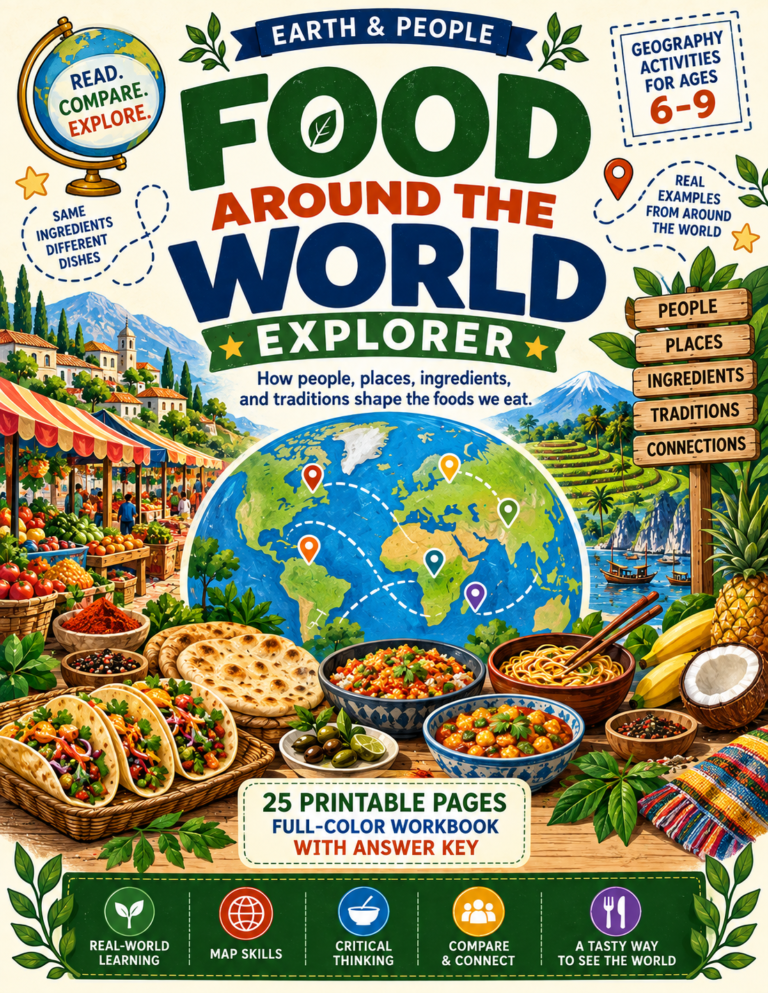
Whether implemented as a focused one-week homeschool unit study, an ocean science supplement, or an independent enrichment binder, Coasts Around the World provides an engaging, screen-free learning experience.
The curriculum concludes with a cumulative capstone challenge where students synthesize their knowledge: drawing and labeling a comprehensive coastal field map, plotting low- and high-water lines, mapping sediment transport paths, and defending their scientific models against incoming storm data.
To strengthen these essential cartographic and fieldwork capabilities, exploring the Explorer Skills Workbook Bundle equips young naturalists with practical compass navigation, coordinate mapping, and field notebook logging skills.
If you are looking for an evidence-based, screen-free resource that transforms a familiar vacation spot into an exciting laboratory of physical earth science, Coasts Around the World provides young explorers with the tools to observe, deduce, and understand how water shapes our dynamic planet.