Why Rockets Don’t Push on Air: Teaching Space Exploration Through Engineering and Evidence
When children imagine launching into space, they often picture brave astronauts piloting sleek rockets to alien worlds. Finding a comprehensive space exploration workbook for kids that channels this fascination into authentic scientific problem-solving is essential for elementary STEM education. A well-structured space exploration workbook for kids shows young learners that space exploration is fundamentally an engineering endeavor—one where teams on Earth use physics, energy budgets, radio links, and sensor data to answer questions about distant planetary environments.
Traditional classroom printables often treat space exploration as decorative fiction. Children color cartoon rockets, memorize mission dates, and connect constellations like dot-to-dot games. Yet when asked why a rocket motor still works in the airless void of space, why a satellite in orbit doesn’t plummet directly to Earth, or why a rover operator on Earth cannot steer a Martian vehicle with a live joystick, standard worksheets fall short.

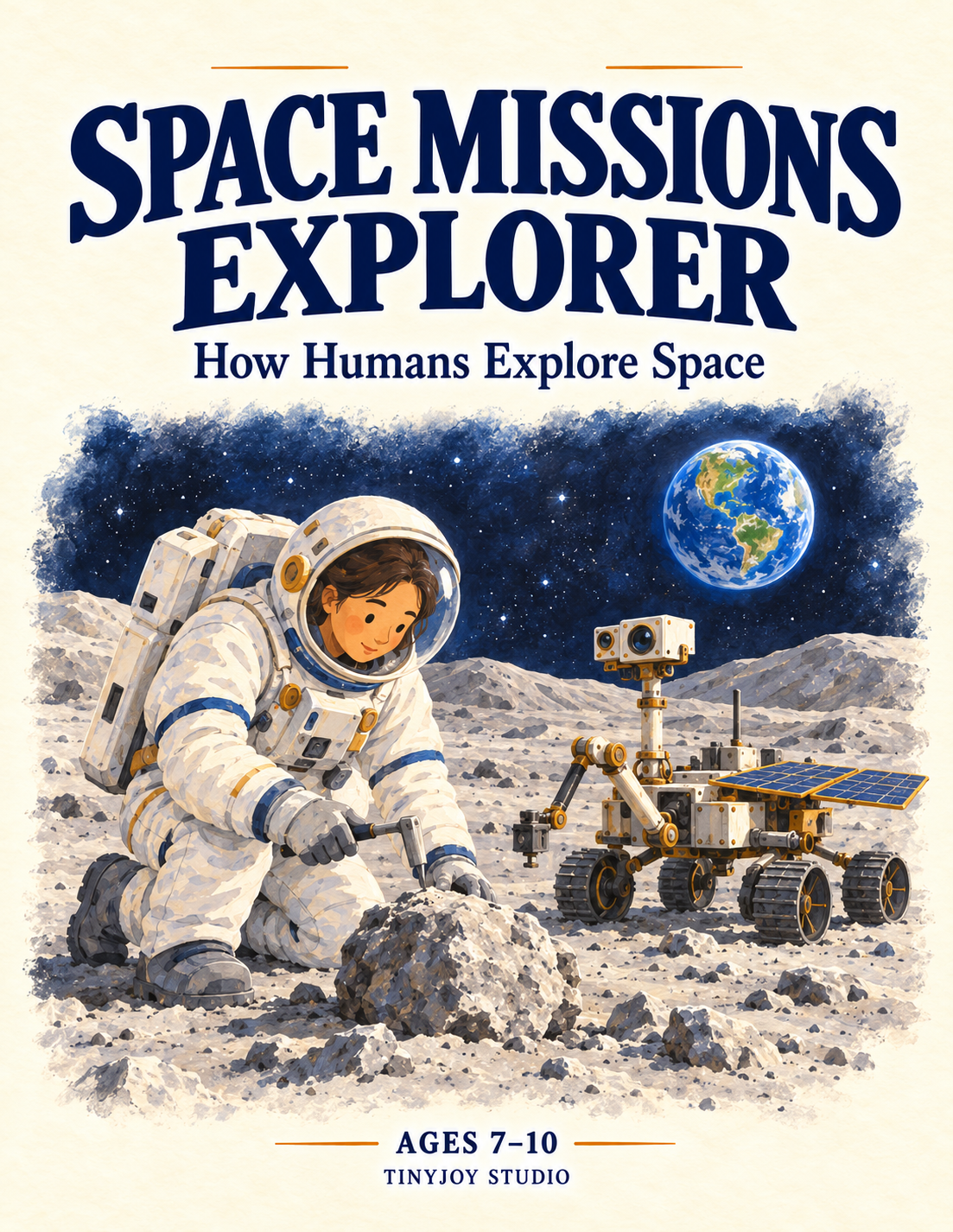
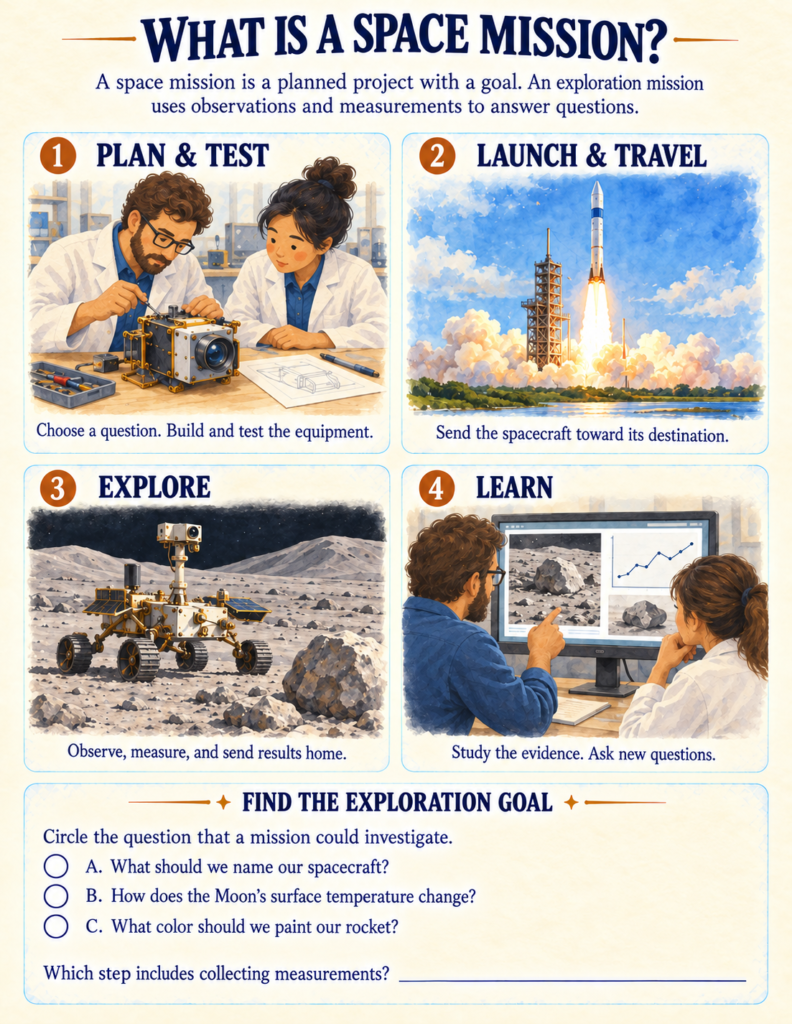
In Space Missions Explorer: How Humans Explore Space (a 30-page printable unit designed for ages 7–10 by TinyJoy Studio), learners step out of the role of passive spectators and into the seats of Mission Control. Through hands-on challenges, they discover that every expedition follows a rigorous four-phase cycle: planning and testing, launching and traveling, exploring and measuring, and learning from evidence.
Physics of the Journey: Thrust and Orbital Mechanics
The first major obstacle in teaching aerospace science is unlearning everyday assumptions. Many young learners intuitively believe that a rocket engine moves forward by pushing against atmospheric air. Space Missions Explorer tackles this head-on by demonstrating Newton’s third law of motion: rocket engines generate thrust by rapidly expelling exhaust gases backward through a nozzle, producing a forward pushing force that operates flawlessly in a vacuum.
Similarly, the workbook demystifies the phenomenon of weightlessness. Far from being a zone where gravity simply «turns off,» an orbit is revealed as a continuous state of falling around a planet. As Earth’s gravitational pull continually draws a spacecraft inward, sufficient forward horizontal speed ensures the craft curves around the planet at the exact rate the ground falls away.
Just as terrestrial geological processes depend on underlying physics and energy flows—a topic you can explore further with our Dynamic Earth Workbook Bundle—orbital spaceflight requires carefully balancing kinetic motion against gravitational pull.

Robotic Architecture: Flybys, Orbiters, Landers, and Rovers
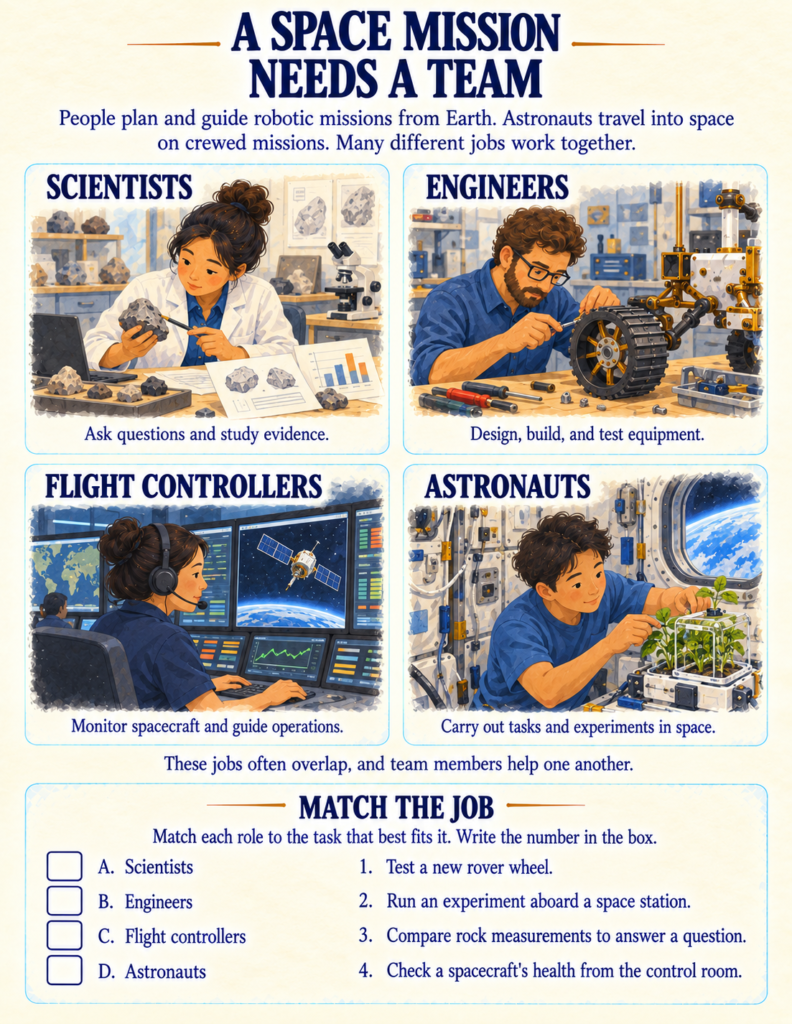
Human spaceflight captures headlines, but robotic spacecraft conduct the vast majority of extraterrestrial exploration. Space Missions Explorer categorizes spacecraft by their observational trade-offs:
- Flybys: High-speed probes that gather brief, valuable snapshots as they pass an astronomical body before continuing deeper into space.
- Orbiters: Craft that enter permanent orbit to systematically map terrain, monitor weather patterns, and record seasonal changes over months or years.
- Landers: Stationary surface platforms designed for in-depth, long-duration atmospheric and soil analysis at a single site.
- Rovers: Mobile robotic laboratories capable of traveling between diverse rock outcrops to sample soil and investigate different geological sites.
Understanding how specific robotic tools survive in harsh planetary conditions encourages students to compare alien landscapes with Earth’s own natural biomes. To see how organisms adapt to physical habitats across our own globe, explore our collection of Nature Workbooks for Kids.
Engineering Trade-Offs: Energy, Heat, and Signal Delays
Real space engineering is a discipline of limits. Rather than offering limitless imaginary capabilities, Space Missions Explorer engages children in genuine systems engineering:
- The Energy Budget: Learners must navigate a rover from point A to point B, take ground measurements, and transmit data back to Earth within a 12-unit battery allowance—while maintaining a mandatory 2-unit reserve. Adding an extra photograph sounds simple, but students quickly discover the mathematics of energy trade-offs.
- Thermal Regulation: Spacecraft endure extreme thermal environments. Children analyze onboard readings against an operating temperature range ($10^\circ\text{C}$ to $30^\circ\text{C}$), determining when to activate internal electrical heaters, adjust multilayer insulation, or open radiant heat-dump panels.
- The Speed-of-Light Delay: When commands travel across interplanetary distances via radio waves, latency is inevitable. If a signal takes 8 minutes to reach Mars and 8 minutes to return, a lack of response at the 5-minute mark is not evidence of a hardware malfunction—the command is still in transit.
Investigating these planetary extremes provides a powerful contrast to Earth’s most severe natural environments. For an immersive look at extreme landscapes, geothermal vents, and natural wonders right here on our home world, check out the Amazing Earth Adventures Workbook Bundle.

Life Support, Crewed Habitats, and Safe Return
When humans venture into the vacuum of space, the spacecraft must become a fully functional, closed-loop ecosystem. In the orbital habitat and spacesuit modules, students evaluate the physical systems required to keep astronauts alive:
- Atmospheric Scrubbing: Oxygen supply is only half the battle; without active chemical canisters to scrub exhaled carbon dioxide ($CO_2$), toxic gas rapidly accumulates in microgravity.
- Musculoskeletal Maintenance: In free-fall orbit, muscles and bones deteriorate without resistance; daily cardiovascular workouts on stationary cycles are mandatory.
- Atmospheric Re-entry: Slowing down from orbital velocity generates intense frictional heat. Students sequence the re-entry process, discovering that parachutes are completely useless in the vacuum of space and can only deploy once dense atmosphere provides aerodynamic resistance.
Comparing the closed-loop engineering of a space station with human settlements on Earth provides a fascinating bridge between technology and geography. To see how communities adapt their habitats and infrastructure to diverse environments around the globe, explore the People and Places Workbook Bundle.

Troubleshooting in Mission Control and Capstone Lunar Simulation
One of the most distinctive features of Space Missions Explorer is its focus on deductive problem-solving. In the «Mission Control: A Camera Problem» investigation, a newly landed rover transmits a completely black frame. Rather than jumping to wild guesses, students review a telemetry checklist: radio links are active, power is online, but the mechanical protective lens cover is logged as closed. Children formulate the fix, write the corrective command, and plan a confirmation test image.
This problem-solving progression culminates in a multi-page Lunar Rover Simulation:
- Students equip their chassis with a camera, temperature probe, battery, and radio antenna.
- They chart an initial 360-meter route between sunlit and shaded craters within a 500-meter driving limit.
- When updated orbital photography reveals an unexpected boulder field blocking the original path, students recalculate their route, choosing a safe 420-meter detour over an impassable 620-meter path.
- Upon returning to base, they analyze the collected surface data, convert temperature readings into bar charts, and form evidence-based scientific conclusions.
To further develop your young explorer’s field-mapping, route-plotting, and compass-reading abilities, consider pairing these space navigation exercises with the Explorer Skills Workbook Bundle.
If you are looking for an educational, ready-to-print resource that replaces passive space trivia with authentic physics, engineering logic, and data analysis, Space Missions Explorer provides children with an inspiring, structured launchpad into genuine aerospace exploration.