Why a Country Is More Than Its Flag: Teaching Global Emblems Through Evidence and Culture
When elementary students think of a nation’s identity, they almost always imagine a flag waving in the breeze. Finding a thoughtful national symbols workbook for kids that expands their understanding beyond colored stripes is essential for elementary social studies. A well-structured national symbols workbook for kids demonstrates that countries express their history, natural landscape, and values through a rich tapestry of animals, plants, instruments, architectural figures, and songs.
Standard classroom printables often treat national emblems as isolated trivia. Children fill in pre-drawn flags with markers, match a bird to a country name, or memorize a national anthem line without exploring the historical or ecological reasons behind those choices. As a result, students miss the crucial distinction between an officially designated emblem and a beloved cultural tradition, or why a single emblem often brings multiple regional stories together.
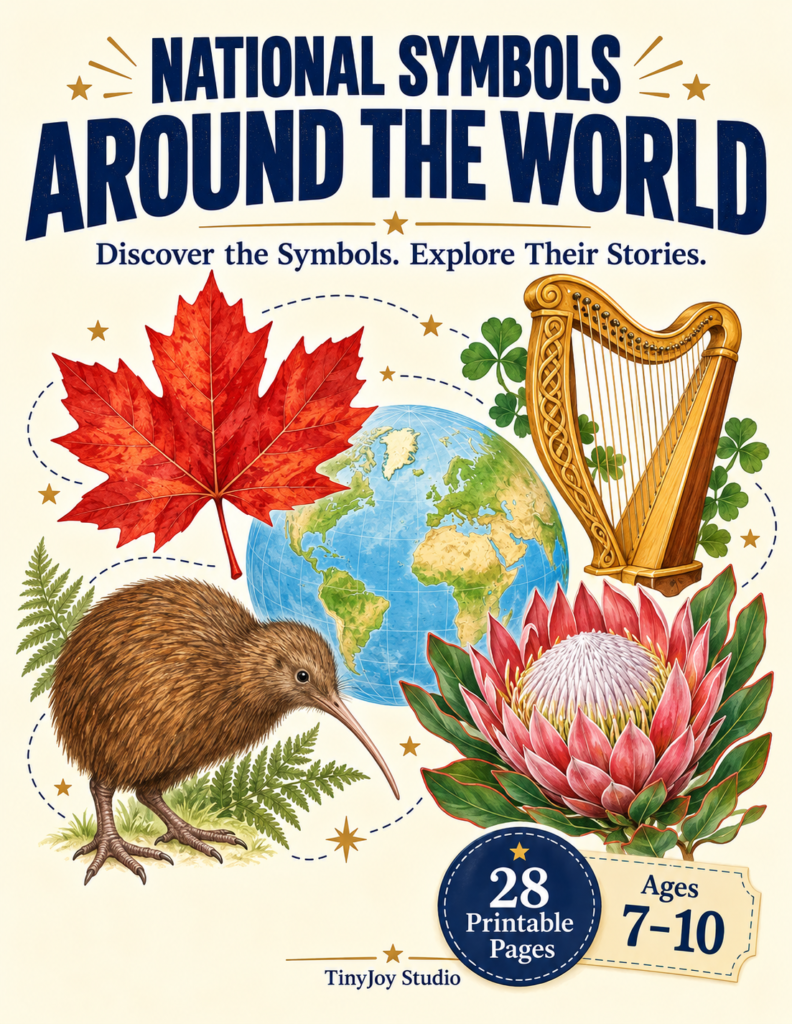
In National Symbols Around the World: Discover the Symbols. Explore Their Stories (a 28-page printable resource designed for ages 7–10 by TinyJoy Studio), children step into the shoes of museum curators. Moving through an inquiry framework—Notice, Learn, and Explain—they analyze evidence from ten countries across six continents to understand how emblems carry meaning.
Dissecting the Evidence: Official Status vs. Cultural Tradition
One of the most valuable lessons in early civics and geography is understanding that not all symbols carry the same legal weight. Children often assume that if an image appears on a postcard or a rugby jersey, it must be an official government decree.
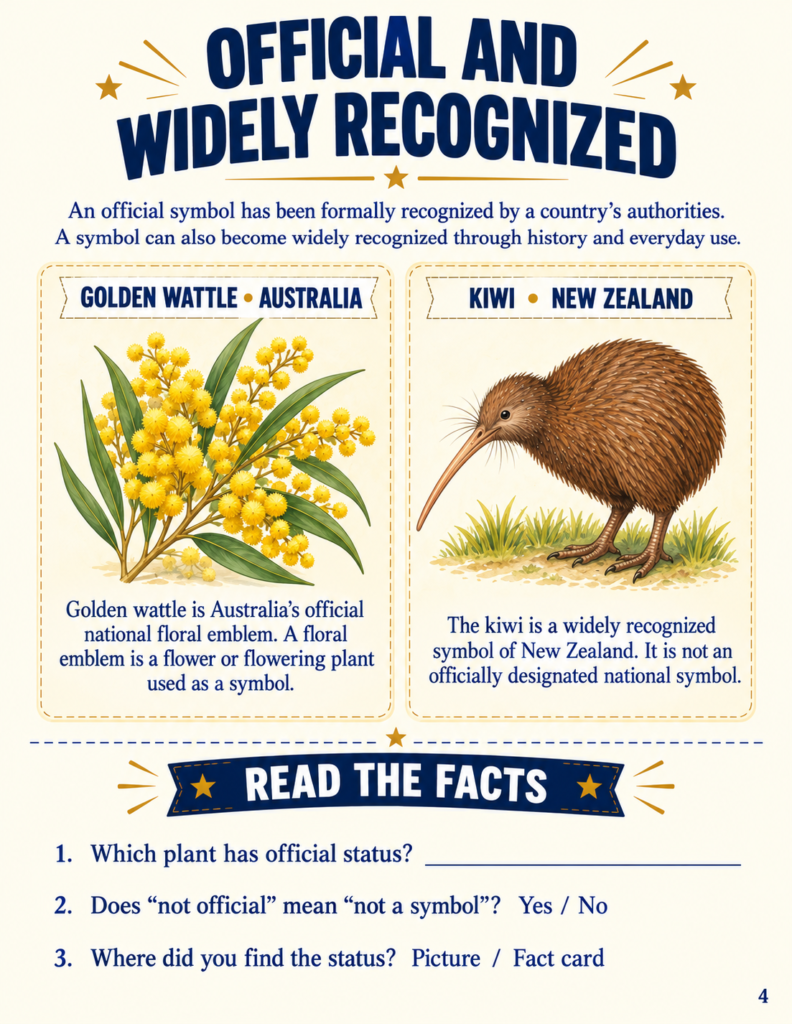
The workbook immediately tackles this distinction by comparing two southern hemisphere emblems:
- Australia’s Golden Wattle: Formally designated as the official national floral emblem by government authorities.
- New Zealand’s Kiwi: A flightless bird that is world-renowned and deeply cherished, yet serves as a widely recognized cultural symbol rather than an officially declared national emblem.
Students examine fact cards alongside detailed botanical and zoological illustrations, learning to cite textual evidence rather than making assumptions based on visual familiarity alone.
Understanding how indigenous flora and fauna become intertwined with a country’s identity parallels the study of natural ecosystems. To explore how diverse plants adapt to their environments across our planet, take a look at our collection of Nature Workbooks for Kids.
Botanical and Zoological Precision: When an Eagle Is Not Enough
Generic worksheets often rely on superficial labels: an eagle represents freedom, a flower represents beauty. National Symbols Around the World demands closer observation and species-level precision.
When studying national birds, learners discover that the bald eagle is the national bird of the United States, distinguished by its white head and dark brown body. However, seeing an eagle does not automatically point to America. On Mexico’s national coat of arms, the featured bird is a golden eagle—depicted perched upon a prickly pear cactus while grasping a serpent. Children realize that visual context, accompanying elements, and biological species tell completely different historical stories.
The same detailed scrutiny applies to national flowers:
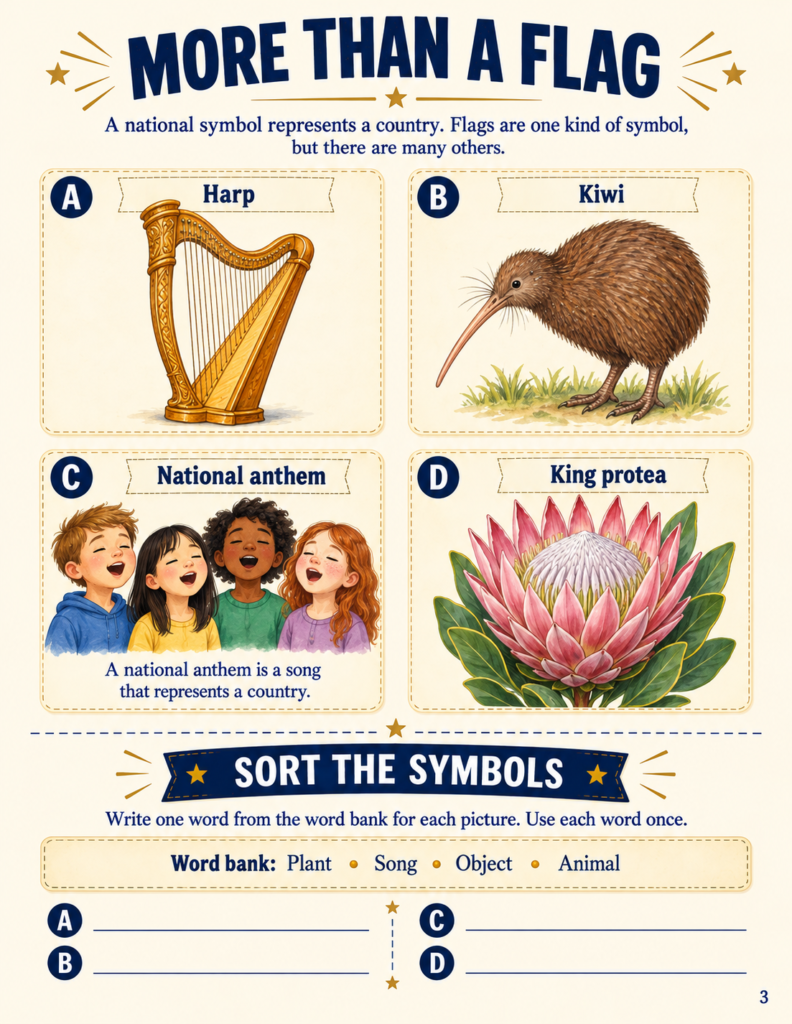
- South Africa’s King Protea: Children examine its large flower head surrounded by stiff, pointed floral bracts.
- Australia’s Golden Wattle: Students observe how hundreds of tiny individual flowers gather into dense, round yellow clusters along leafy branches.
Just as physical geography and geological forces shape the unique landscapes where these plants thrive—concepts detailed in our Dynamic Earth Workbook Bundle—the natural environment directly provides nations with their most striking visual emblems.

Complex Emblems: Mineral Riches, Living Resources, and Ideals
National emblems frequently combine multiple layers of history, geography, and civic philosophy within a single frame:
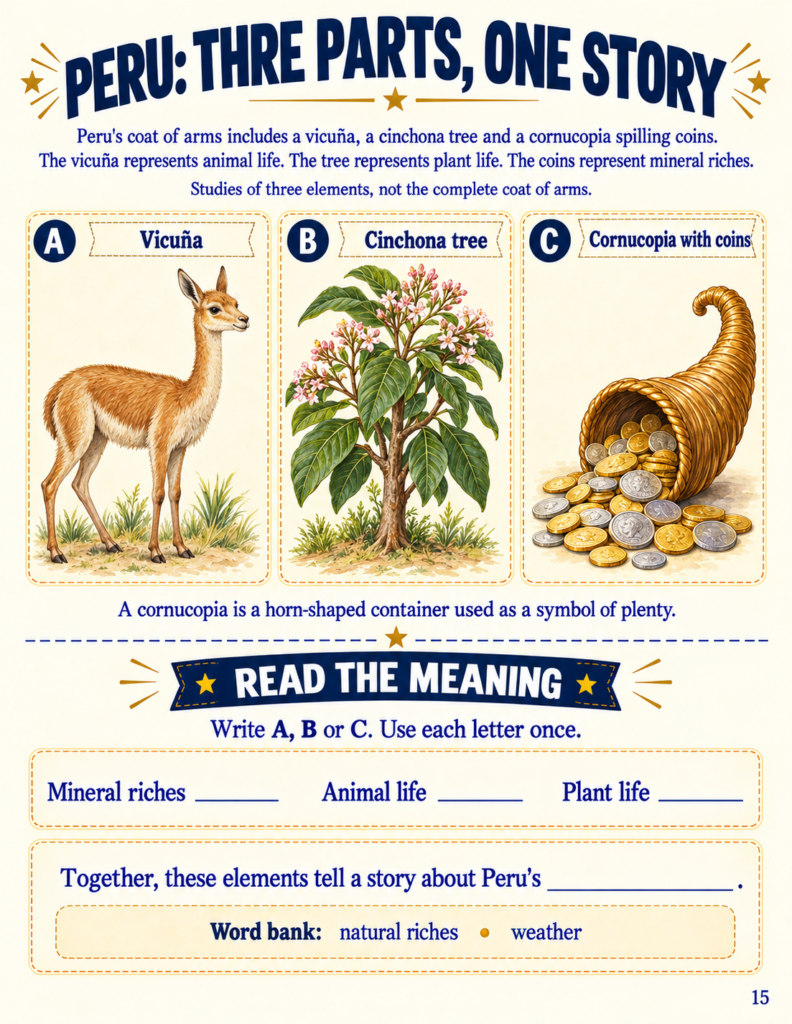
- Peru’s Coat of Arms: Rather than a single icon, Peru divides its shield into three distinct realms: the vicuña representing native animal life, the cinchona tree representing botanical resources and medicine, and a horn of plenty (cornucopia) spilling gold and silver coins representing mineral wealth.
- Australia’s Coat of Arms: A kangaroo and an emu flank a central shield that unites the individual symbols of all six Australian states, illustrating political federation.
- France’s Marianne: Learners discover that a symbol does not have to be an animal or a plant; Marianne is an allegorical figure wearing a Phrygian cap who embodies the abstract values of the French Republic rather than depicting a specific historic queen or president.
- Auditory and Functional Symbols: Emblems are not confined to paper coats of arms. They resonate through music as national anthems (O Canada, La Marseillaise) and circulate daily on euro coins, postage stamps, and civic municipal buildings.
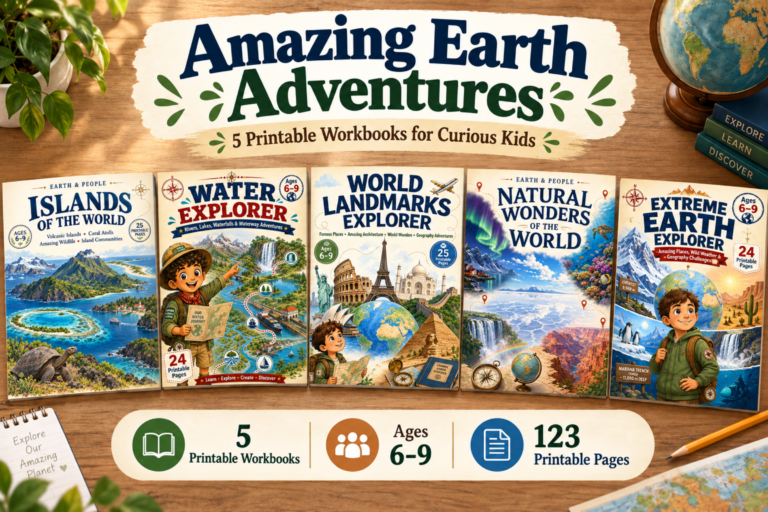
Tracing these extreme geographic origins across mountain ranges, coastal plains, and remote plateaus connects deeply with our Amazing Earth Adventures Workbook Bundle, which guides students through Earth’s most breathtaking physical environments.
Curating a Mini Museum: From Recall to Curation
The final section of the workbook shifts from guided analysis to independent synthesis. Children take on the role of head museum curator:
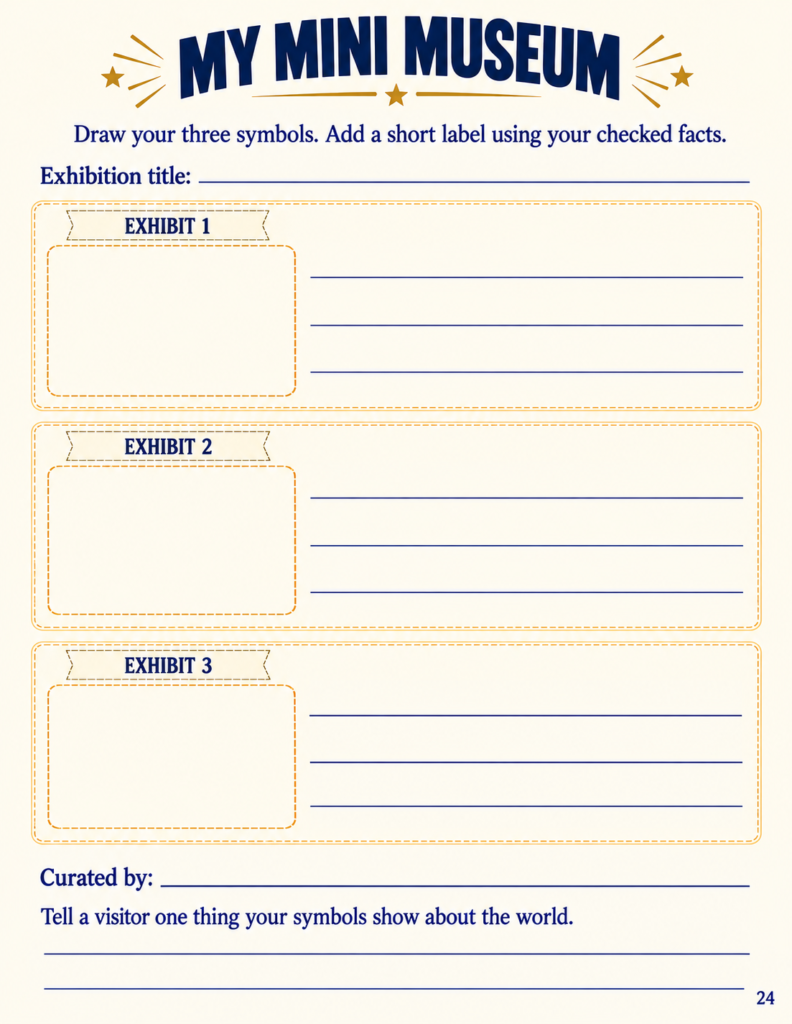
- Exhibit Selection: Students choose three diverse symbols that span at least two different countries and two distinct categories (an animal, a plant, a song, or an object).
- Label Writing: Curators draft informational placards that state the symbol, its home nation, and a verified historical or cultural fact gathered directly from their workbook research.
- Gallery Design: On the «My Mini Museum» exhibition spread, learners illustrate their three chosen artifacts, finalize their checked labels, and write a summary explaining what their collection reveals about our interconnected world.
- Metacognitive Reflection: On page 25, students revisit their very first opening guesses from page 2, actively correcting their prior knowledge and describing how their understanding has evolved.
To complement this cultural study with broader explorations of human settlements, community life, and cultural traditions around the globe, explore the People and Places Workbook Bundle.
Practical Application for Homeschool and Classrooms
Because National Symbols Around the World includes a world map reference, structured fact cards, and a complete answer key, it integrates seamlessly into various learning routines:
- Homeschool Geography & Civics Unit: Complete two pages daily over two weeks, utilizing the 10-country world map on page 6 as an ongoing geographic reference anchor.
- Cross-Curricular Art and Research: Have students practice botanical and heraldic sketching using the guided detail boxes (such as drawing the pointed lobes of the maple leaf or the bracts of the protea).
- Passport-Linked Exploration: Seamlessly link this unit with TinyJoy Studio’s World Explorer Passport system, awarding country visa stamps as students master each region’s heritage.
To reinforce the cartographic foundations of this global tour, you can also pair this study with our Explorer Skills Workbook Bundle to build essential map-reading, scale, and navigation skills.
If you are looking for an educational printable that replaces superficial coloring sheets with authentic historical reasoning, visual literacy, and cultural appreciation, National Symbols Around the World offers young learners an enriching, hands-on expedition through world heritage.