Why Play Is Human Engineering: Teaching Culture and Systems Through Global Games
When elementary children think about games, modern minds immediately picture digital video screens, shrink-wrapped plastic board games, or battery-operated electronic gadgets. Exploring an authentic toys and games around the world workbook is the most effective way to help young learners discover that play is actually universal human design. This hands-on toys and games around the world workbook demonstrates that every game ever invented—from spinning wooden tops on Mexican cobblestones to calculating seed distribution in West African wooden pits—is simply an ingenious human solution to a shared play problem.
Typical classroom social studies packs reduce childhood games to decorative cultural trivia. Worksheets ask children to color a cartoon spinning top, label a generic toy, or complete a word search of foreign words without ever analyzing how the game operates. As a result, children assume that games require expensive gear, factory dice, plastic pawns, and points to function. They fail to recognize that the core of any game is not the manufactured item, but the interaction between player actions, shared constraints, and agreed-upon goals.
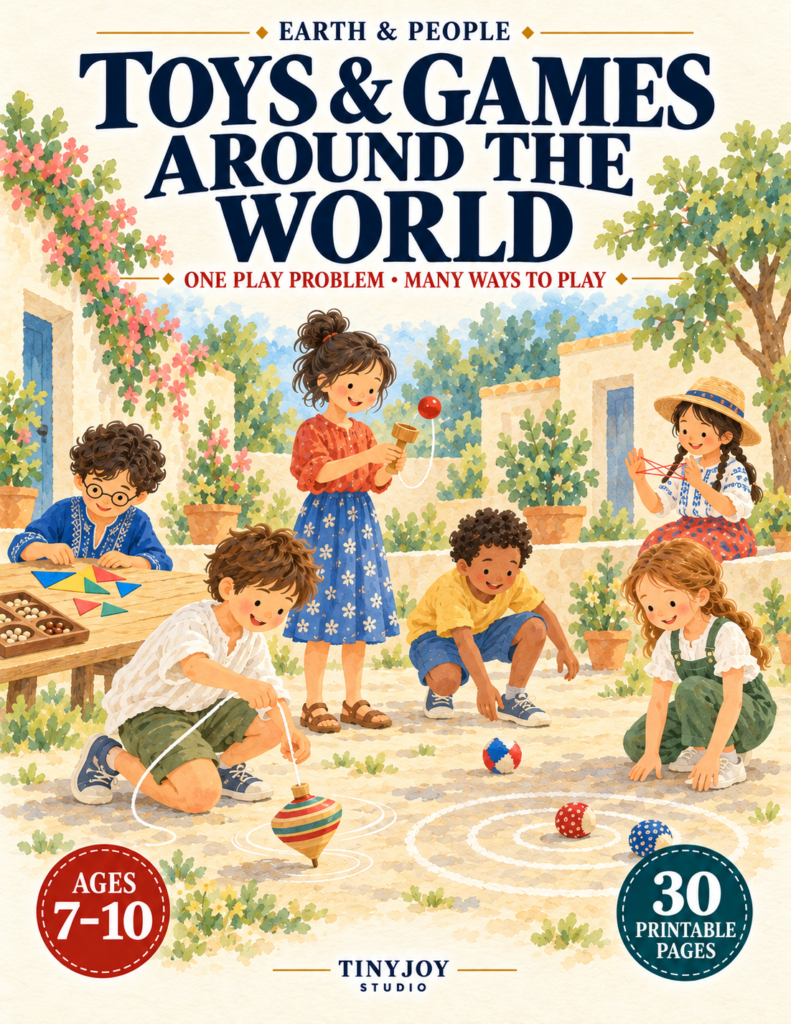
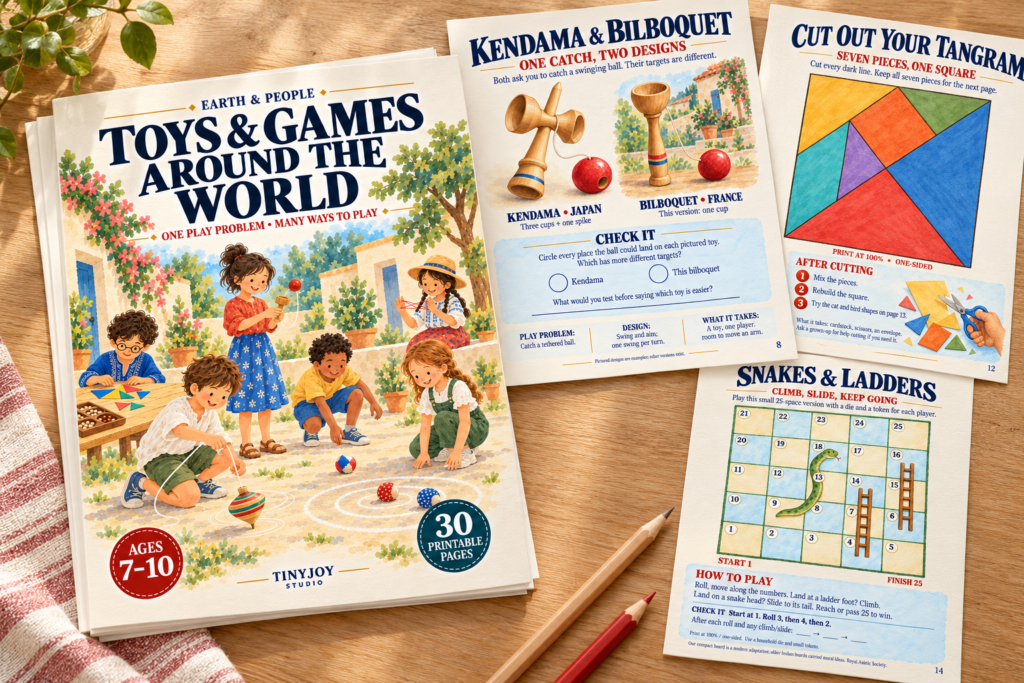
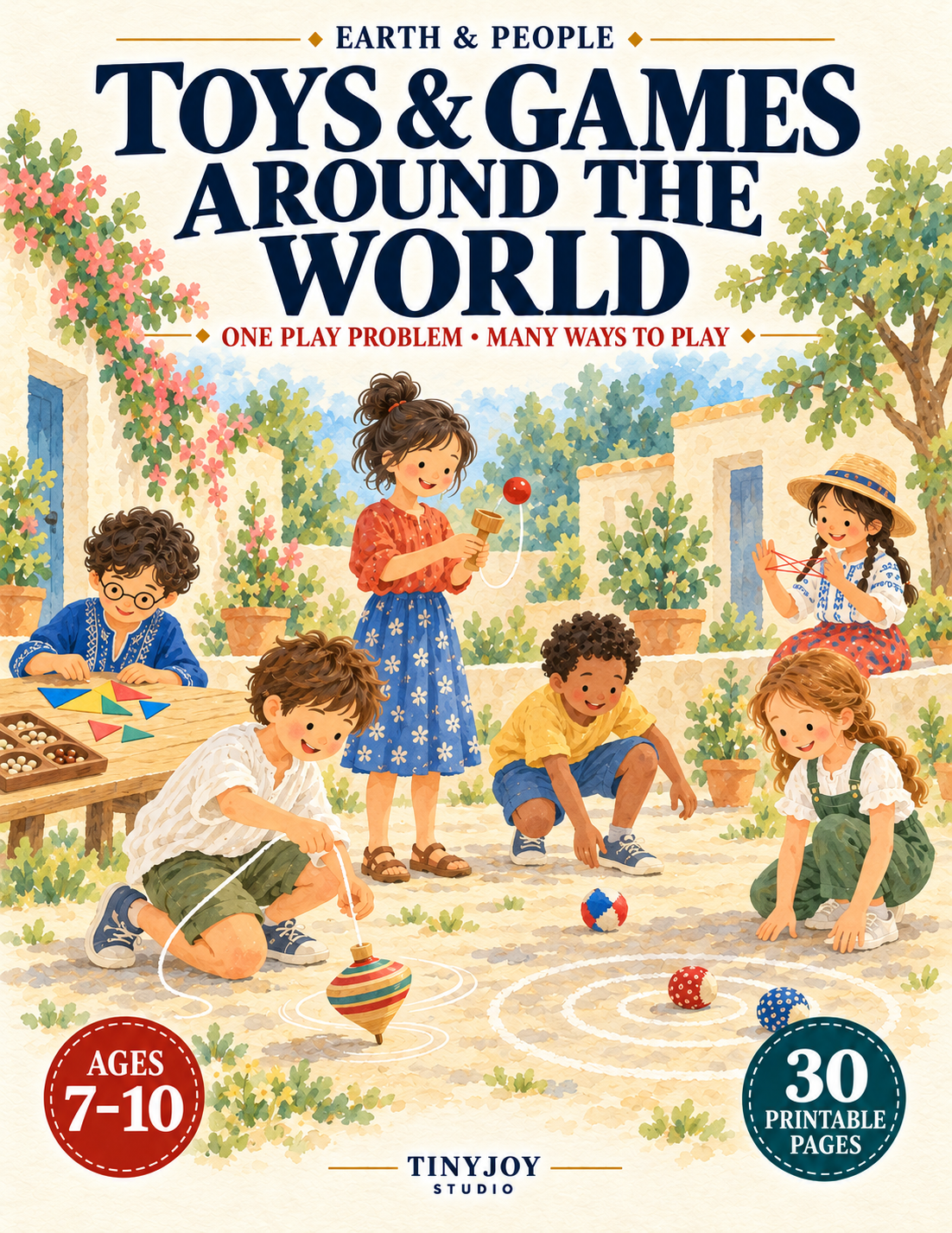
In Toys & Games Around the World: One Play Problem, Many Ways to Play (a 30-page printable unit designed for ages 7–10 by TinyJoy Studio), children step into the shoes of play architects and cultural ethnographers. Across an expedition featuring eight distinct stops and two cross-continental connections, students dissect games using five foundational questions: Players (who joins in?), Action (what do they do?), Rules (what is allowed?), Goal (what counts as success?), and Place (where is there room?).

What Does a Game Really Need? Separating Toys from Systems
The foundational breakthrough in elementary game study occurs when students distinguish between essential game mechanics and optional accessories. On page 3, students examine what every game in the world truly requires:
- The Non-Negotiable Core: Players, Actions, Rules, Goal, and Place.
- The Optional Extras: Dice, boards, plastic pawns, points, prizes, and even manufactured toys themselves.
Children explore this truth across movement games: in Ghanaian Ampe, two players clap, jump, and thrust one foot forward simultaneously, with turn order decided purely by whether their forward feet match or differ. The game requires zero physical objects, proving that an exciting, competitive system can thrive on human rhythm, observation, and quick decisions alone.
Examining how simple everyday objects or basic movements can unlock rich, multi-layered problem-solving mirrors the open-ended inquiry we champion across our curiosity books for kids in the Curious 25 series, where curious minds investigate everyday phenomena through structured, critical observation.

Primary Evidence and Cultural Humility
One of the most remarkable educational features of Toys & Games Around the World is its deliberate rejection of cultural stereotypes. On page 5, students inspect a real museum record from the National Museum of the American Indian describing an ajagaq made in 2003 in Igloolik, Nunavut, Canada, carved from caribou bone, wood, and string.
Rather than jumping to broad generalizations, students audit what the evidence actually proves:
- The Record Directly Supports: This specific object was made in 2003; it was constructed using caribou bone, wood, and string.
- Unsupported Generalizations: «Every Inuit child plays ajagaq» or «All ajagaq toys have always looked identical across history».
Children learn the vital ethnographic habit of asking: What does this artifact tell us, and what questions must we ask a real maker or player before assuming we know everything?
Connecting material artifacts to real human evidence bridges cultural geography directly with historical thinking. Much like young historians who evaluate manuscripts, monument inscriptions, and excavation layers to piece together ancient civilizations—a disciplined method built into our interactive history curriculum for elementary learners—students discover that an ancient game piece is a primary source that must be read with care and respect.

Mechanical Physics: Launching, Catching, and Aerodynamics
Play is applied physics in action. Across the workbook’s world tour, students explore how physical shapes determine motion:
- The Spin Problem (Mexican Trompo): Students trace the mechanical transfer of force: wrapping cord around a grooved wooden body, releasing the top with an outward pull, and transferring linear uncoiling tension into rapid rotational spin balanced on a tiny metal tip.
- The Catch Problem (Japanese Kendama vs. French Bilboquet): On page 8, learners compare two tethered-ball catch toys. While a French bilboquet offers a single cup target, the Japanese kendama provides four distinct targets: big cup, small cup, base cup, and a pointed wooden spike matching the ball’s drilled hollow. Children investigate fair testing: before declaring which toy is easier, you must test equal attempts with the exact same player.
- The Flight Problem (Brazilian Peteca): Children examine the aerodynamic balance of Brazil’s peteca—a weighted leather base fitted with upright colored feathers that creates drag, keeping the weighted end falling downward so players can continuously palm it skyward in open rallies.
To understand how internal structure and physical form govern movement, children build their own paper-and-foil catch toy on page 9, testing whether a string of three cup-heights or two cup-heights yields more catches. This emphasis on structural function mirrors the botanical systems we study in nature. Just as living leaves and stems develop precise vascular networks to transport fluids and anchor against physical forces—mechanisms detailed in our Plant Life Cycle Workbook—the geometry of a toy determines how it responds to gravity, inertia, and human touch.
Strategic Systems: Mathematical Sowing and Geometric Blocking
Moving from physical coordination to abstract thought, the workbook introduces classic mathematical board games:
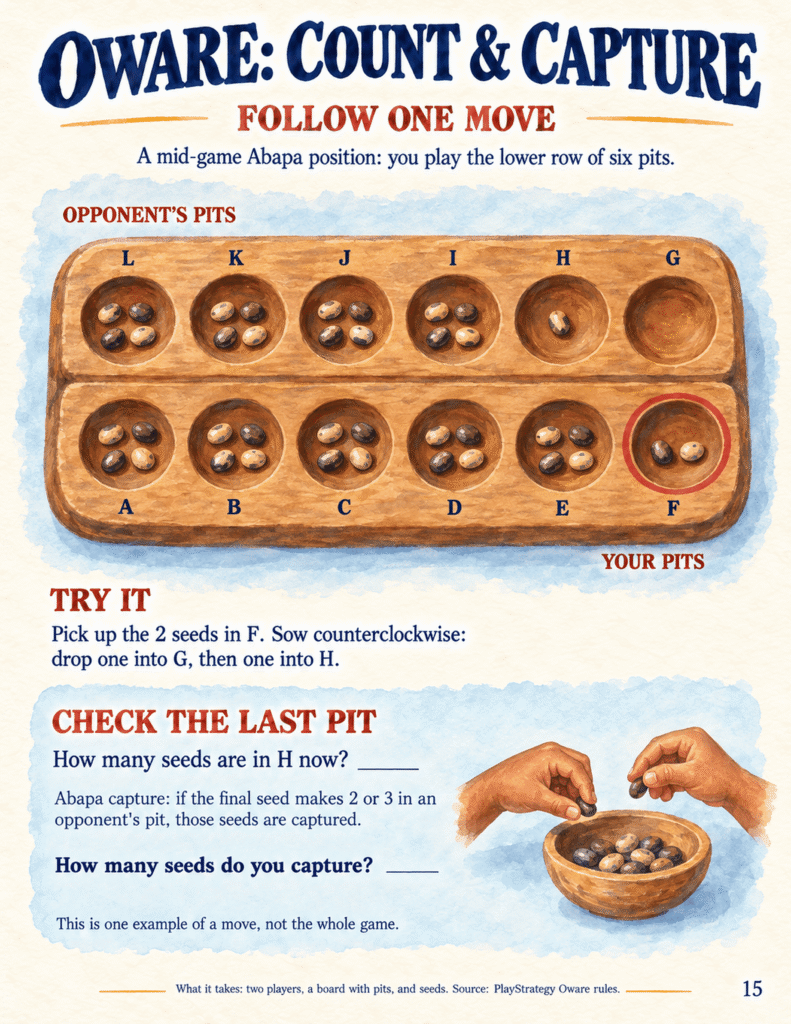
- Oware (Ghana): On pages 15–16, students follow the traditional Abapa rules of the mancala family. Children practice distributive arithmetic: picking up seeds from a pit, sowing them counterclockwise one by one into consecutive pits, and executing a capture when the final seed brings an opponent’s pit to exactly two or three seeds.
- Mū Tōrere (Aotearoa New Zealand): On pages 17–18, learners cut out eight counters and play on an eight-pointed star board (kāwai) radiating from a central hub (pūtahi). The rule requires deep spatial reasoning: a piece can enter the central hub only if it sits directly adjacent to an opponent’s piece on the outer circle, forcing players to anticipate and block their opponent’s legal movements.
Students categorize whether success in a game stems from Luck (dice rolls in Snakes & Ladders), Skill (palming a peteca or aiming a kendama), or Strategy (setting up captures in Oware or traps in Mū Tōrere).
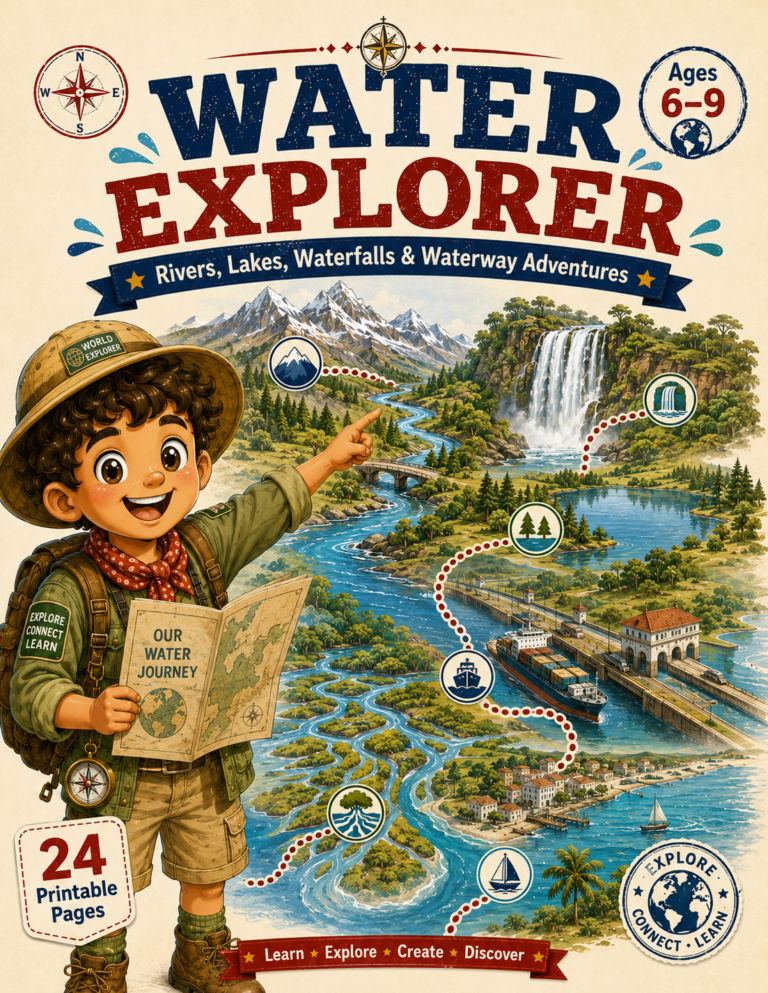
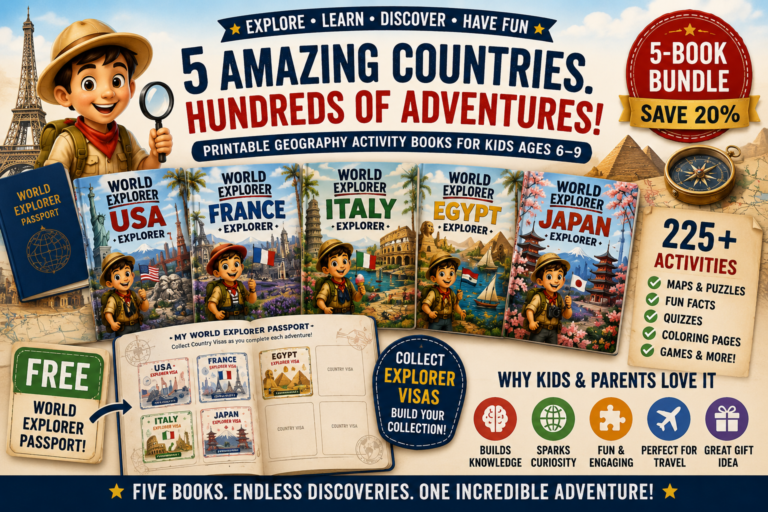
Connecting regional game boards to hands-on cartography and interactive projects forms the heart of our broader geography curriculum. If your family loves exploring how cultures adapt their daily lives to their environments, discovering how we structure project-based learning in homeschooling through our World Explorer series will give you a comprehensive roadmap for integrating international passports, country visa badges, and hands-on regional portfolios into your homeschool year.
Applied Game Design and Inclusive Rulemaking
The final section of Toys & Games Around the World shifts from analysis to active creation and civic empathy:
- Same Toy, New Conditions: On page 22, students take a single jump rope and adapt its rules when moving from three friends outside into a crowded indoor room with eight children, shifting from high-flying rope swings to orderly turn-based path-following.
- Make Room for Everyone: On page 23, children encounter a scenario where one child plays while seated. Rather than excluding the child, students rewrite the rule: allowing players to trace the rope path using either a hand or a foot, proving that a truly fair rule welcomes every participant.
- Fix the Rulebook: On page 24, learners edit muddled rules (such as «players take a turn whenever they feel like it»), introducing clear turn order and equal tries to prevent playground arguments.
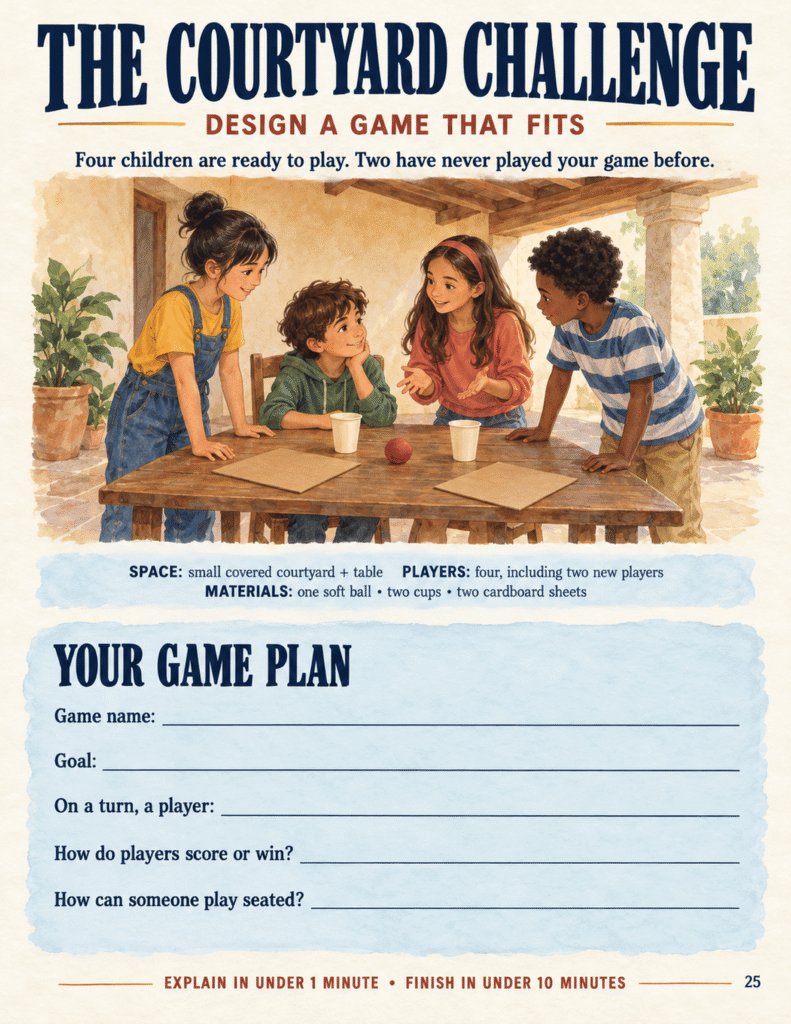
- The Courtyard Challenge Capstone: In the final engineering mission, students design an original game using two paper cups, two cardboard sheets, and one soft ball for four children—with rules that can be explained in under one minute, finished in under ten minutes, and adapted for seated play. They then complete an honest test record, changing one feature at a time to improve playability.
Practical Implementation for Home and Classroom
Because Toys & Games Around the World includes cut-out tangram templates, printable Mū Tōrere boards, hands-on craft guides, and full answer keys, it requires minimal prep:
- Homeschool Cultural Geography Unit: Work through two pages daily across a three-week block, combining history, mathematics, physics, and world culture.
- Co-op Play Lab Stations: Set up physical stations for the paper peteca rally, Oware seed counting, and Mū Tōrere board play for small-group collaborative challenges.
- Screen-Free Game Design Workshop: Have students complete their personal «My Game Card» (page 27) and give it to a peer to verify whether a brand-new player can understand the rules without adult intervention.
If you are looking for an educational printable that trades commercial screen games for authentic cultural inquiry, hands-on physics prototyping, and compassionate game architecture, Toys & Games Around the World equips young thinkers to understand how humanity connects through play.