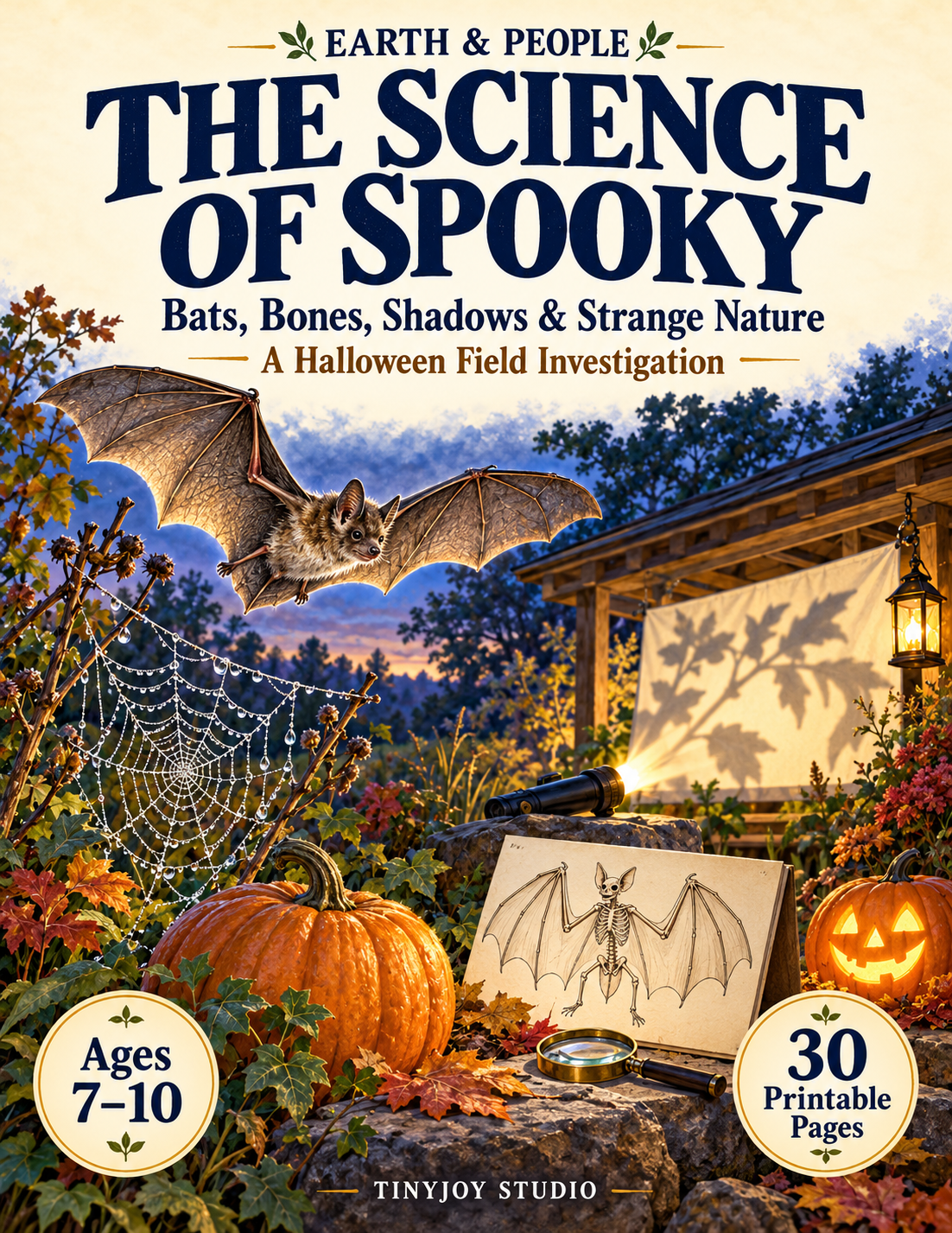
The Science Behind the Spooky: Turning Halloween Curiosity into Scientific Evidence
Halloween naturally brings an atmosphere of eerie mysteries, lurking silhouettes, and spooky decorations. But introducing an authentic halloween science workbook for kids allows parents and educators to channel that seasonal excitement into rigorous STEM thinking. A thoughtfully designed halloween science workbook for kids shows young learners that the world’s most famous spooky tropes—giant looming shadows, bats navigating pitch darkness, vibrating spider webs, hidden skeletons, and rotting pumpkins—are actually governed by predictable physical and biological laws.
Typical holiday activity packs reduce autumn learning to matching games, cartoon bat mazes, or word searches. While festive, these surface-level exercises leave curious minds wondering what is physically happening behind the scenes. Children miss the opportunity to learn that bats are not blind creatures of myth, that skeletons are dynamic living frameworks, and that a decaying pumpkin is driving an essential soil ecosystem.
In Science of Spooky: Bats, Bones, Shadows & Strange Nature (a 30-page printable field investigation designed for ages 7–10), students tackle five distinct case files:
- The Giant Shadow: How light paths and spatial distance alter shadow size.
- The Bat in the Dark: How reflected sound echoes help insect-hunting mammals navigate without sight.
- The Trembling Web: How mechanical vibrations travel along silk strands to deliver sensory data.
- The Skeleton Clue: How shared bone structures adapt across humans, bats, and cats.
- The Changing Pumpkin: How decomposers, fungi, and bacteria break down plant tissues into soil nutrients.

Optics and Light: Why Shadows Loom Large
When children see a massive, distorted silhouette cast across a wall, it can easily feel eerie. Rather than treating shadows as spooky illusions, the workbook breaks down the three essential elements of optical projection: the light source, the opaque object, and the viewing surface.
Students run physical tests using a flashlight and a toy—or evaluate illustrated comparative diagrams—to discover the mechanics of scale:
- As an object moves closer to the light source while the screen remains fixed, it intercepts more light rays, casting an enlarged shadow.
- Moving the light source sideways changes the shadow’s position on the wall, even when the object stands completely still.
This simple exploration in perspective and spatial relationships helps children recognize that observation always depends on positioning.

Sound Waves and Sensors: Navigation Through Echoes
One of the most persistent wildlife myths is that bats fly blindly through the night. The workbook immediately reframes this concept: insect-eating bats have functional eyesight, but they use echolocation to pinpoint flying moths in total darkness.
Learners examine a clear mechanical sound model:
- The bat emits a directed outgoing call.
- The sound wave travels through the air until it strikes an object and reflects backward.
- The returning echo reaches the bat’s sensitive ears.
- Closer objects return echoes sooner, allowing the animal to map distances using time intervals.
Students read step-by-step linear models marked with time increments to calculate which target is nearer and which is farther away. Investigating how living things process sensory inputs is a foundational theme across our curiosity books for kids in the Curious 25 series, where curious learners examine everyday wonders through bite-sized, inquiry-driven challenges.

Comparative Anatomy: One Skeletal Pattern, Different Jobs
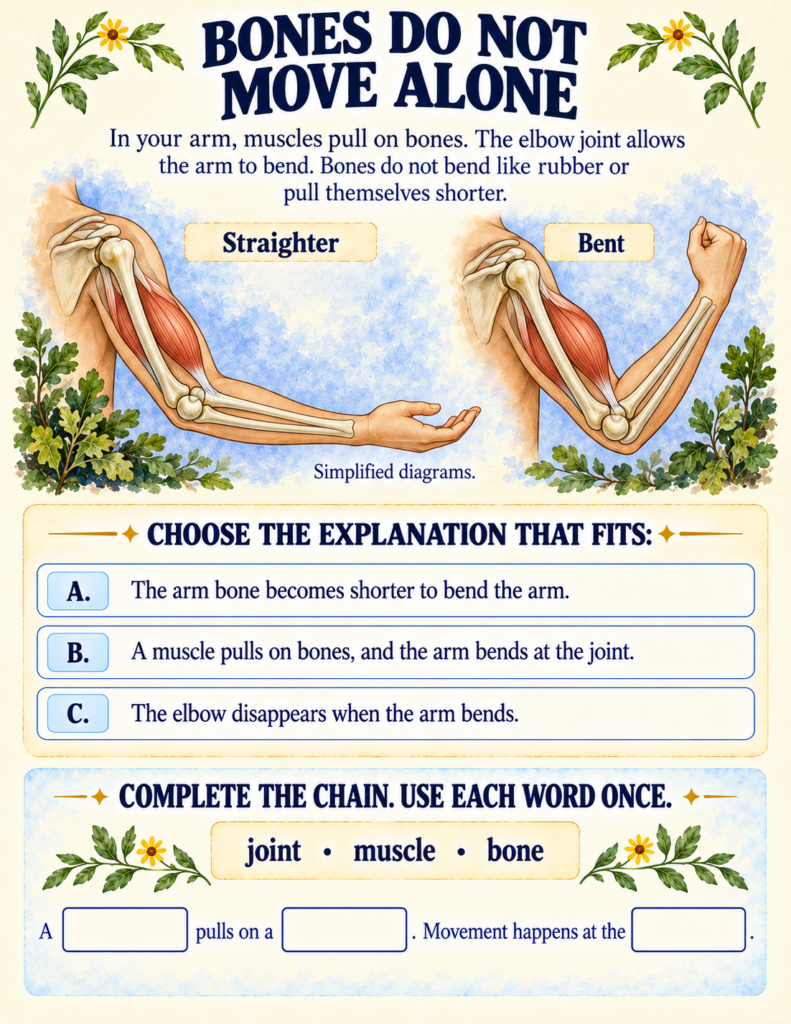
Plastic skeletons dangling from porch ceilings often look like isolated, scary objects. Science of Spooky brings anatomy back to life by showing that bones are dynamic living tissues that protect vital organs, support posture, and coordinate with muscles and joints to create movement.
The lesson expands into comparative morphology:
- Human Arm: Adapted with flexible digits for grasping tools and writing.
- Bat Wing: Features extremely elongated finger bones that stretch and support a thin flight membrane.
- Cat Foreleg: Built for structural stability, balance, and quiet walking on cushioned paws.
By identifying wrists, elongated digits, and joints across distinct mammalian species, children see that seemingly different creatures share an underlying anatomical blueprint.
The Decomposition Cycle: Why Nothing Disappears
Before a pumpkin is carved into a seasonal jack-o’-lantern, it is a living botanical fruit developed from a flower. But what happens when the celebrations end and the carved pumpkin begins to collapse, soften, and darken?
Rather than calling it “gross” or ruined, the workbook introduces children to nature’s breakdown team:
- Fungi and Bacteria: Microscopic decomposers that release enzymes to break down tough plant cellulose.
- Worms and Invertebrates: Soil organisms that chew, fragment, and recycle decaying matter.
- Plant Roots: Beneficiaries that absorb the restored soil nutrients to nourish the next spring generation.
Children learn that organic matter does not simply vanish into thin air; it is transformed and recycled back into Earth’s living soil.

Broadening the Field of Exploration
When seasonal science sparks a child’s curiosity, that momentum can naturally branch out into broader educational adventures.
If your young detective enjoys understanding physical habitats, terrain boundaries, and natural environments, stepping into our comprehensive geography learning path for kids provides an engaging roadmap for mapping the world’s biomes and landscapes.
Similarly, understanding why societies developed traditions around autumn harvests, ancient calendar shifts, and spooky folklore connects seamlessly with our interactive history curriculum for elementary learners, where students examine historical artifacts and primary evidence to discover how ancient civilizations made sense of the world.
Practical Use for Home and Classroom
Because Science of Spooky provides clear evidence checklists, diagnostic case files, hands-on options, and complete answer keys, it adapts effortlessly to various autumn schedules:
- Homeschool Seasonal Science Unit: Complete one case file every two days during October for a fun, screen-free autumn curriculum.
- Halloween STEM Stations: Set up self-guided stations for shadows, bat echo number lines, and web vibration models for cooperative classroom work.
- Pumpkin Change Journal Capstone: Use the included bonus field tracker to document real-life pumpkin decomposition photos over 7–10 days.
If you want an autumn printable that trades superficial holiday crafts for authentic physics, biological structures, and evidence-based field inquiry, Science of Spooky provides young detectives with an exciting, reliable framework to demystify nature’s strange phenomena.