Medieval Castle Activities: Spark Curiosity with Siege Engineering
Medieval Castle Activities: Spark Curiosity with Siege Engineering
When children picture medieval castles, they often imagine invincible stone fortresses standing tall against the horizon. Between dramatic drawbridges, deep moats, and towering battlements, castles naturally capture young imaginations. But how do we turn this fascination into deep educational value? The secret lies in purposeful medieval castle activities that challenge children to think not just like tourists, but like medieval builders, defenders, and engineers.
By exploring the science and strategy behind medieval defenses, parents and educators can transform simple history lessons into thrilling STEM-infused problem-solving adventures. Let’s look at how interactive history resources exploring sieges, defensive trade-offs, and historical evidence develop critical thinking and spatial reasoning.
Why Interactive History for Kids Works
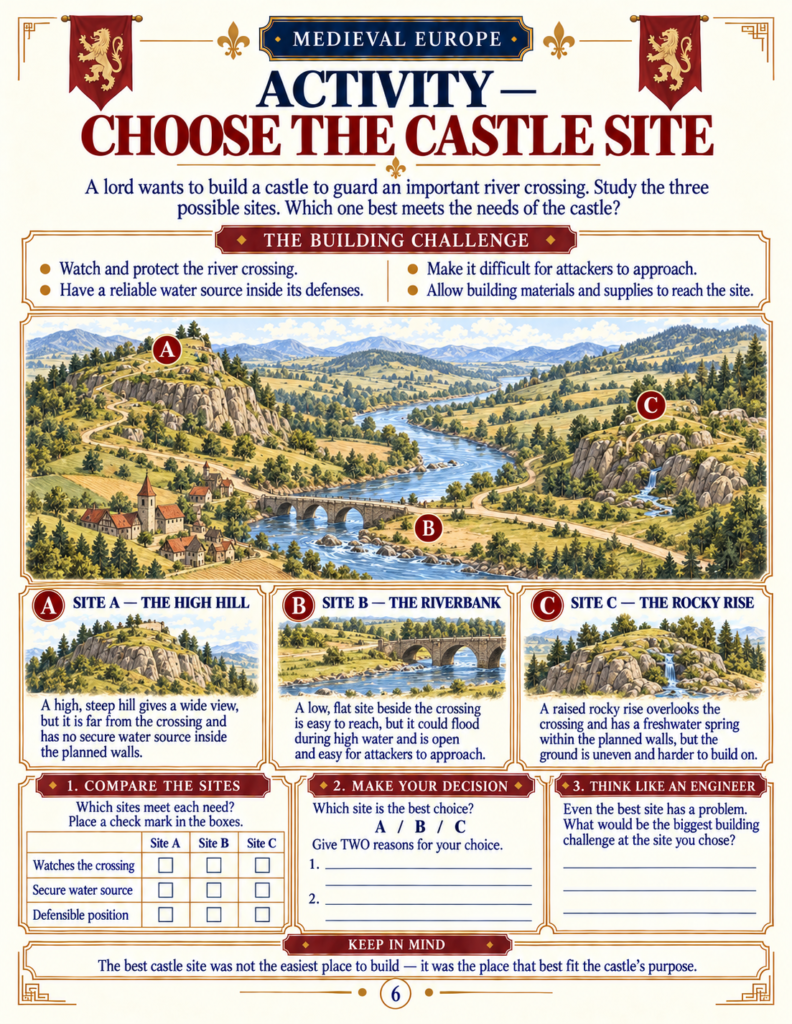
Children learn best when they are designing, calculating, and problem-solving rather than memorizing dry architectural terms. A standard textbook might simply state that castles had thick stone walls, but an interactive workbook asks children: If a site has very thick walls, does that automatically make it ready for a long siege? The answer is no—walls alone were never enough without secure water, food supplies, and functioning teams of defenders and builders.
When you integrate a structured interactive history for kids curriculum into your homeschool or study routine, you teach children to evaluate whole systems. Castle defense was a living machine where location, gatehouses, curtain walls, and supplies worked together.
Exploring Defensive Systems and Strategic Trade-offs
A powerful way to teach history is to reveal that every engineering choice involved a trade-off. A fortress perched high atop a rocky cliff was nearly impossible for attackers to climb, but carrying heavy building timber, stones, and daily food up those steep slopes took immense time and labor. Similarly, building on solid rock prevented enemy miners from tunneling under the walls, but made digging a deep well inside the stronghold extraordinarily difficult.
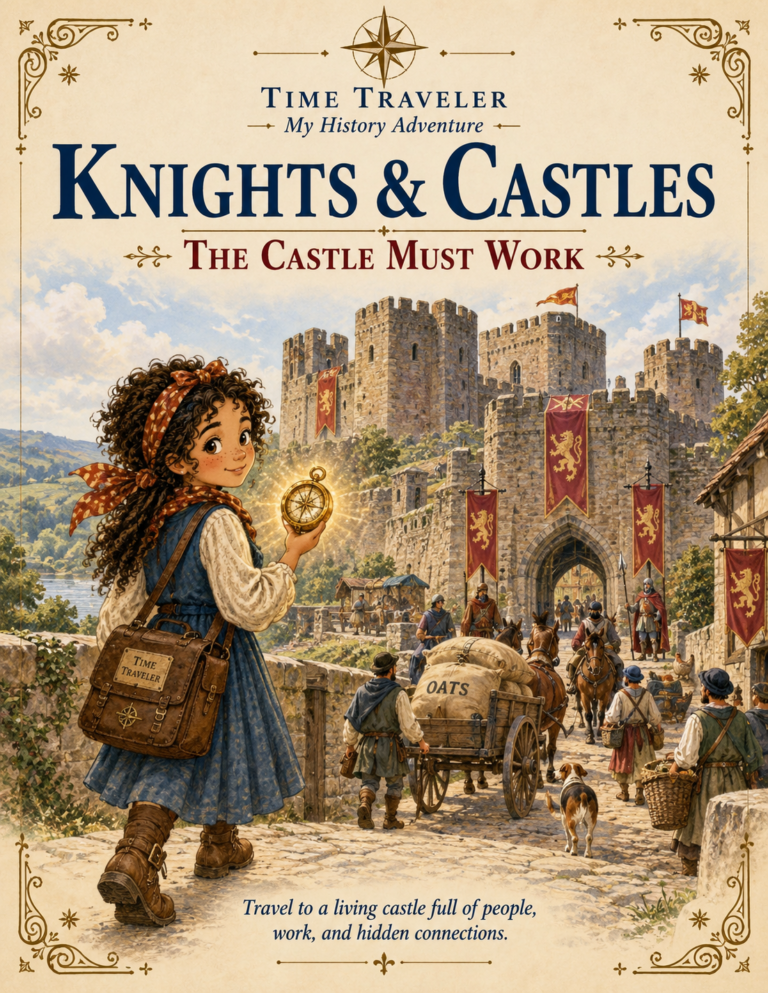
In our foundational knights and castles unit study, children learn how everyday life buzzed inside these great stone enclosures. When paired with our companion medieval knights unit study, learners discover the vital human side of defense—from armor upkeep to garrison duties. Engaging medieval castle activities build upon this knowledge by putting children in charge of structural decisions: Why did projecting towers give archers a far better angle of fire than towers built flush with the wall? Why was the gatehouse defended with multiple barriers like heavy timber doors and an iron portcullis? Defenses were never isolated structures; they were mutually supporting obstacles.
Learning Through Doing: «Can the Castle Hold Out?»
To spark true curiosity, historical education should present tangible dilemmas. What happens when an invading army cuts off all supply roads?
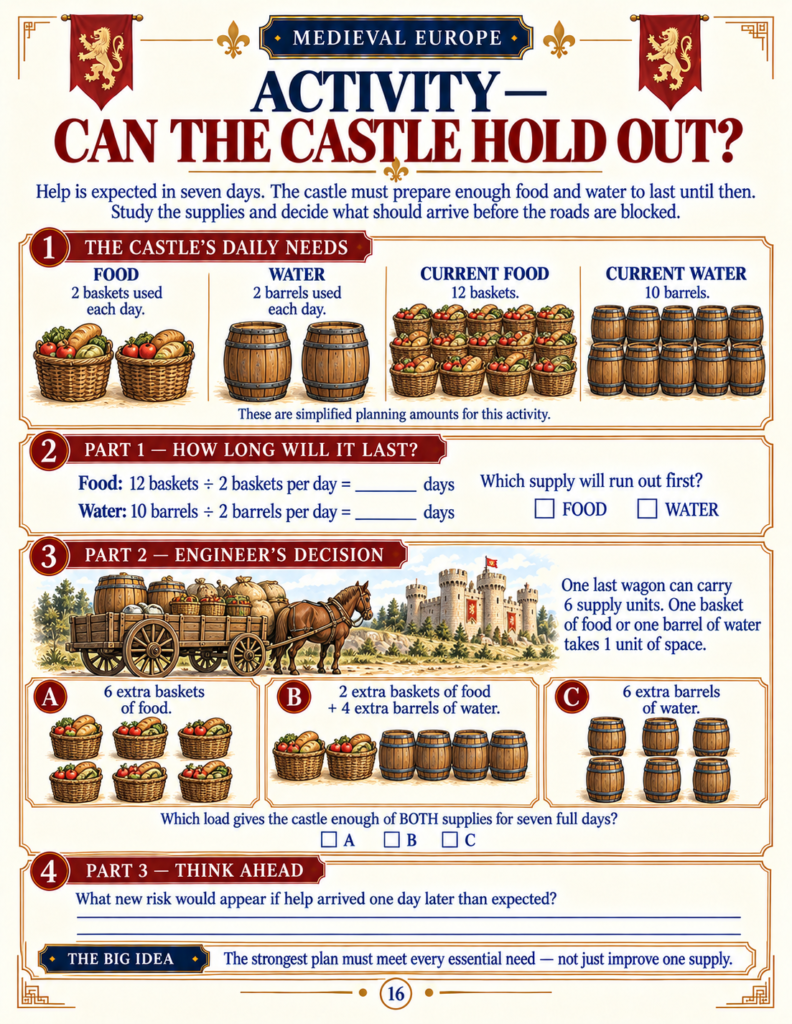
In activities exploring siege logistics, children calculate daily consumption rates of barrels of water and baskets of food. They quickly discover a harsh historical reality: a castle with enough bread to last a month could still fall in seven days if its internal well ran dry. Managing scarce supplies and reinforcing battered stone under pressure teaches children the crucial link between engineering, geography, and human survival.
Thinking Like a Historical Detective: The Siege of Kenilworth
The ultimate goal of historical inquiry is to teach children how to evaluate real-world evidence. This is where investigative medieval castle activities truly excel.
Did medieval trebuchets instantly smash every stone fortress into dust? By exploring the physics of counterweights and slings, students see how mechanical leverage worked—and why many sieges still dragged on for months. During the famous 1266 siege of Kenilworth Castle, King Henry III’s forces bombarded the walls for nearly half a year. Yet archaeological digs and written chronicles show that Kenilworth surrendered not because its stone walls collapsed, but because the defenders ran out of food and succumbed to illness.

By testing historical claims against surviving gatehouses, medieval manuscript illustrations, and excavated stone cannonballs, kids learn the «Historian’s Rule»: strong conclusions require comparing multiple clues rather than trusting a single image or biased chronicle.
Spark Your Child’s Curiosity Today
Parents and teachers are constantly seeking educational materials that develop genuine problem-solving skills without feeling tedious. High-quality workbooks featuring medieval castle activities strike the perfect balance. They combine the thrilling world of catapults, moats, and stone bastions with hands-on physics, resource management, and historical detective work.
By providing children with resources that treat them like young engineers and historians, you do far more than teach them about medieval wars. You nurture their analytical thinking, develop their understanding of how connected systems function, and ignite a lifelong curiosity about how civilizations built and defended their worlds.
Step into the past today and watch your young learner uncover the strategic genius of medieval engineering!