A Clue Is Not a Promise: Teaching Animal Tracks and Bird Signs for Kids Through Real Field Evidence
When children spot an indentation in muddy trail soil or a loose feather resting beside a park bench, their immediate impulse is to shout out a single species name—«A wolf!» or «An eagle!»—and pocket the feather as a souvenir. Introducing an inquiry-led approach to animal tracks and bird signs for kids replaces hasty guessing with the patient, methodical discipline of real wildlife biologists. Rather than treating every mark on the ground as a guaranteed answer, a thoughtful curriculum on animal tracks and bird signs for kids teaches young naturalists to measure scale, classify shape groups, read repeating trackways, analyze feather structures, and separate direct observations from untested guesses.
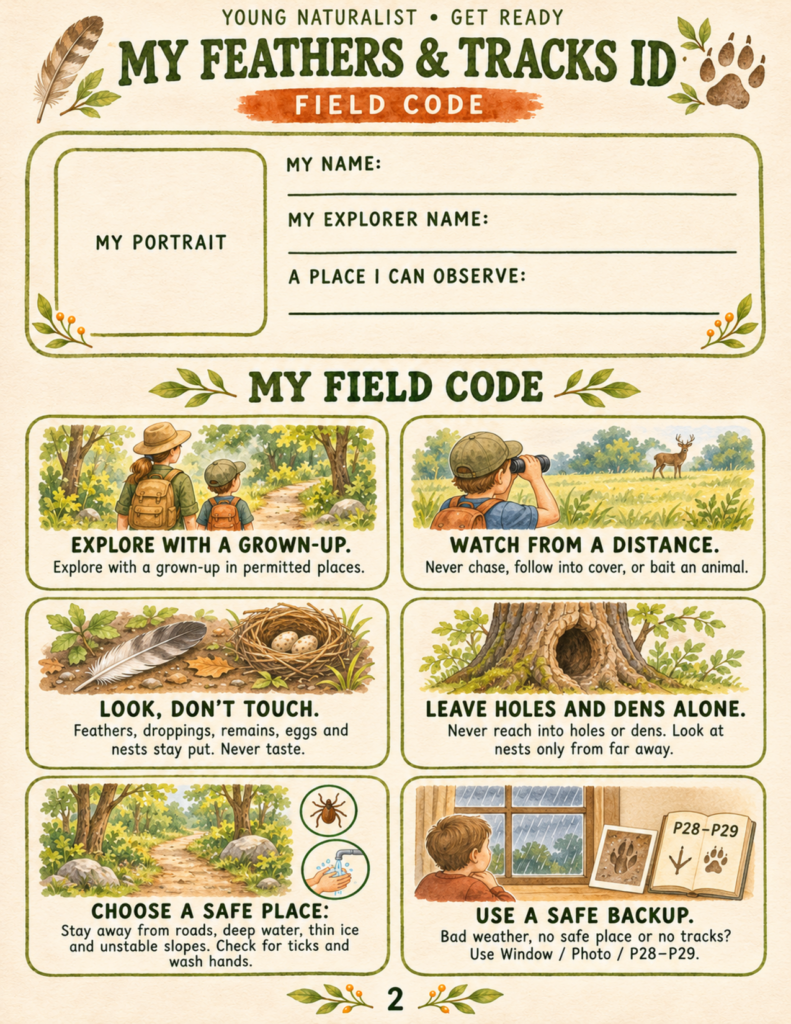
Traditional elementary tracking worksheets often create false confidence by pairing clean, isolated ink stamps with a single animal label. In real outdoor settings, mud squishes, snow melts, claws fail to register, and a feather lying beside a paw print might have drifted there on the wind hours earlier. Without a disciplined framework for evaluating evidence, children either disturb wildlife habitats by chasing animals into cover or jump to conclusions that the physical clues simply do not support.

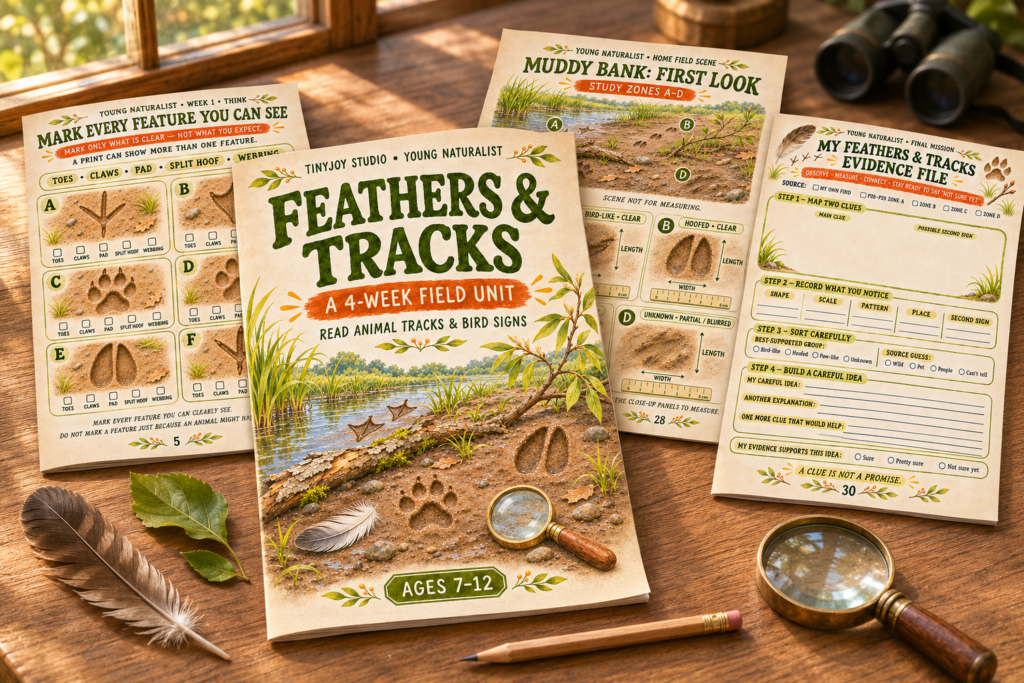
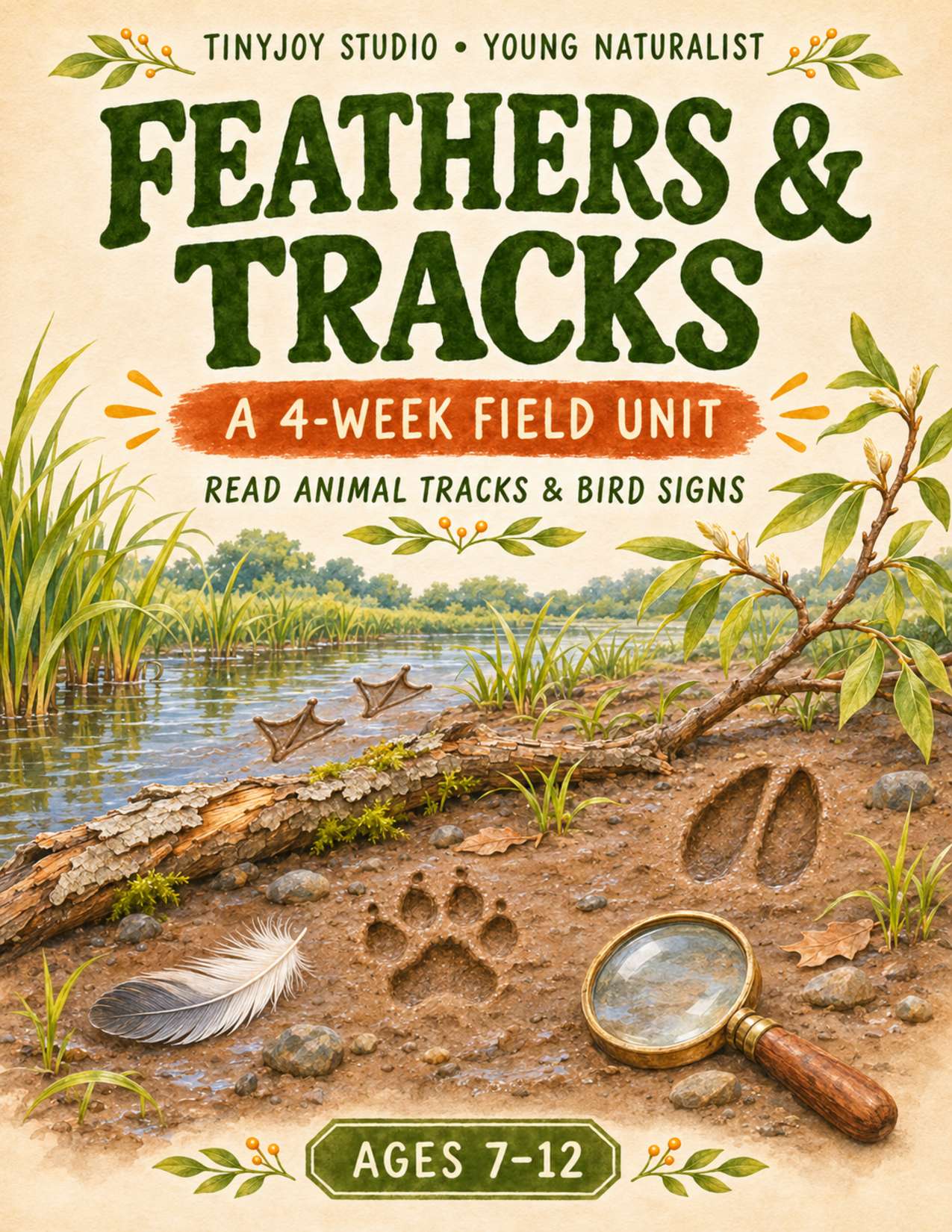
In Feathers & Tracks: A 4-Week Field Unit (designed for ages 7–12 by TinyJoy Studio), students adopt a clear guiding principle: «A clue is not a promise». Expanding our Young Naturalist series—building on the foundational mindfulness of our nature journal for kids while linking directly to the ground-level investigations in our forest floor science for kids unit, the canopy studies in our tree identification for kids unit, and the microhabitat watches in our insects field unit for kids—this 32-page curriculum transforms everyday walks into structured forensic investigations.
A Repeatable 4-Week Rhythm: Learn, Think, Go, Observe, Make, Check
Young investigators build lasting analytical skills when fieldwork follows a steady weekly pulse. Feathers & Tracks organizes thirty-two pages into four progressive modules, built around five core clues (Shape, Scale, Pattern, Place, and Second Sign):
- Week 1: Read One Print: Sorting single tracks into four observable shape groups—Bird-like, Hoofed, Paw-like, and Unknown—while learning to measure length and width without covering the print.
- Week 2: Read a Trackway: Moving from a single impression to a repeating sequence of at least three prints, identifying alternating lines, two staggered rows, side-by-side pairs, and repeating groups of four.
- Week 3: Read Feathers & Bird Signs: Distinguishing flight, contour, and down feathers by shaft, vane, and downy base, while observing distant nests and peck marks without touching.
- Week 4: Connect Clues Carefully: Testing whether nearby signs—such as a hoof-like print and a low browsed twig, or a paw-like print beside a boot sole—actually belong to the same visitor.
Every single week moves through the exact same six-part inquiry loop: Learn a structural concept, Think through a visual puzzle, Go on a timed 5- to 10-minute field scan, Observe and sketch evidence, Make a hands-on scale card, pattern strip, paper feather model, or detective board, and Check understanding.
Evaluating how soil moisture, terrain corridors, and shoreline mud preserve animal movement connects directly to physical geography. When students explore how rivers, coastlines, and regional climates shape movement across landscapes in our geography learning path for kids, they apply this identical spatial awareness—reading the physical surface to understand how living creatures travel through a place.
Observation Versus Guess: Feather Anatomy and Forensic Skepticism
One of the defining pedagogical strengths of Feathers & Tracks is how rigorously it trains children to separate direct physical facts from interpretations:
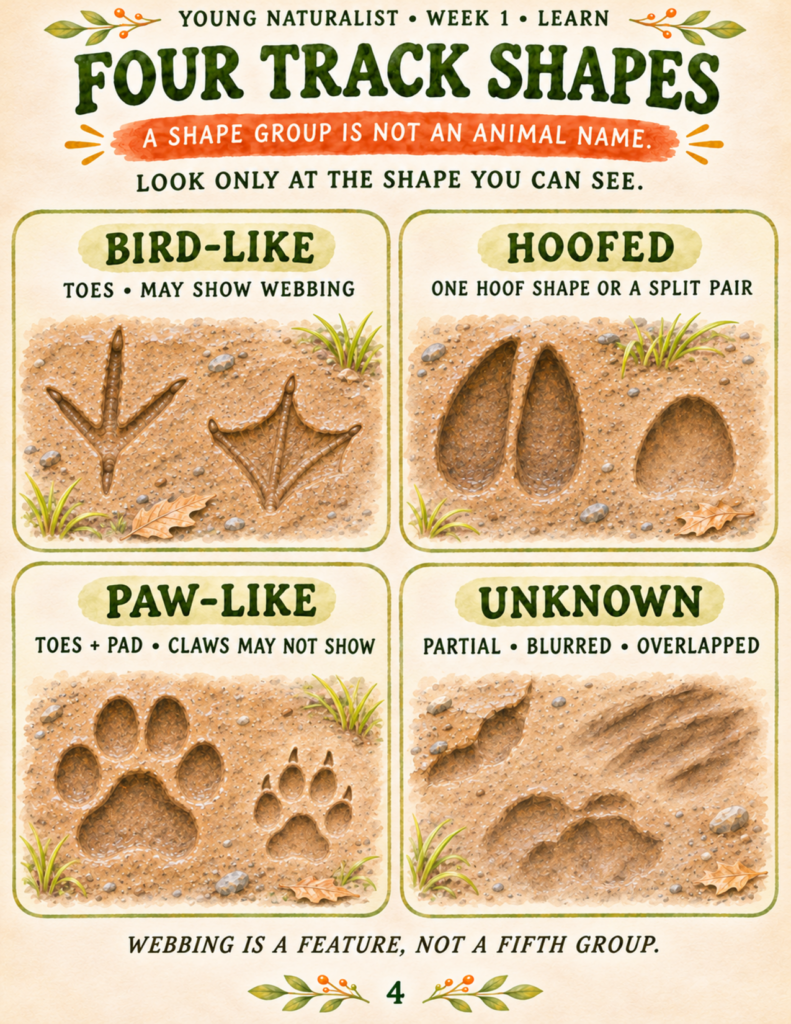
- Shape Group Is Not an Animal Name (Pages 4–5): Children learn that webbing is a feature rather than a separate shape group, that paw-like prints may not always show claws, and that marking a feature only when clearly visible prevents false assumptions. If a print is partial or blurred, recording «Blurred and Unknown» is celebrated as accurate science.
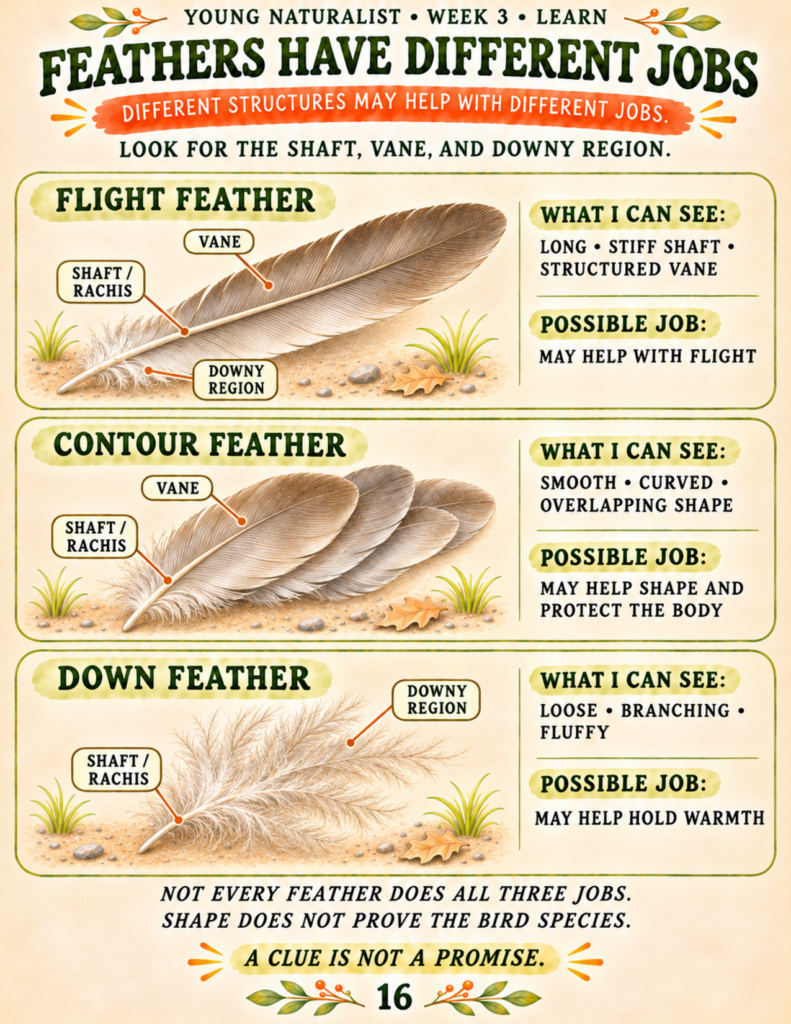
- Feathers Have Different Jobs (Pages 16–20): In Week 3, students examine the anatomy of Flight Feathers (long stiff shaft/rachis and structured vane), Contour Feathers (smooth, curved, overlapping shape), and Down Feathers (loose, branching, fluffy structure). On page 17 («Observation or Guess?»), children classify statements—recognizing that «The first feather has a long, stiff shaft» is an Observation, whereas «It came from a hawk» or «It kept a bird warm» is a Guess or functional idea. On page 20, students cut, fringe, and assemble a four-piece Paper Feather Model to see how microscopic hooklets on barbules interlock like a zipper.
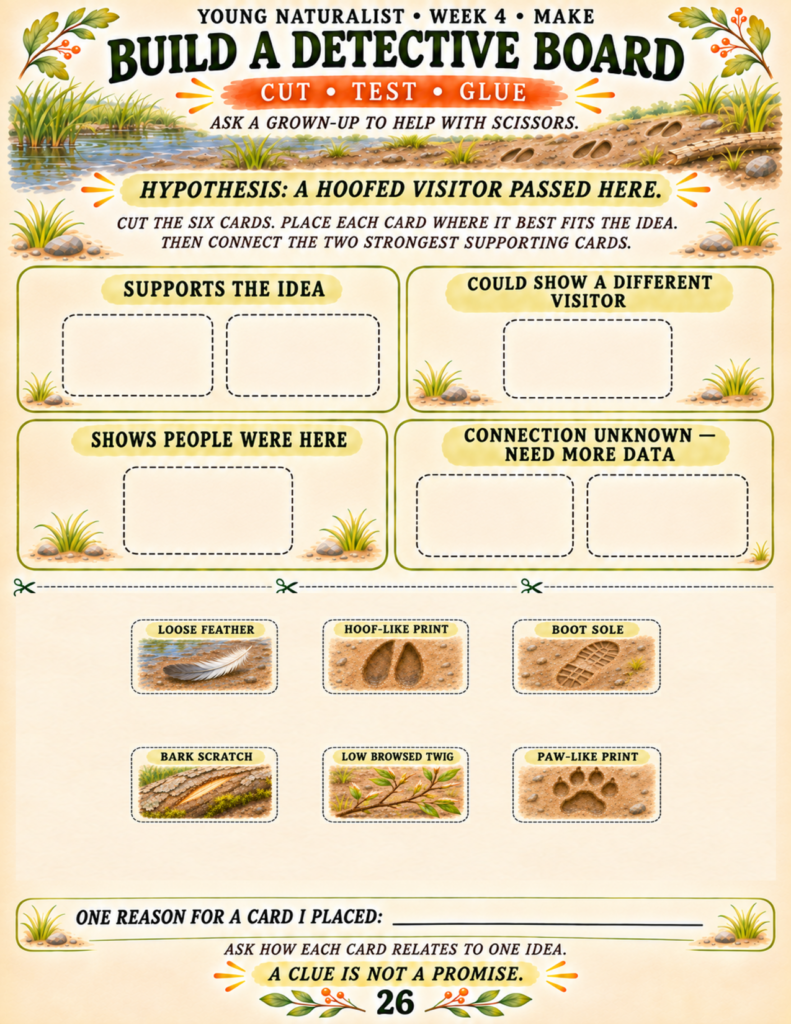
- Nearby Does Not Always Mean Connected (Pages 22–26): In Week 4, students build a cut-and-sort Detective Board testing the hypothesis «A hoofed visitor passed here». They sort six evidence cards into four logical categories: Supports the Idea (hoof-like print + low browsed twig), Could Show a Different Visitor (paw-like print), Shows People Were Here (boot sole), and Connection Unknown — Need More Data (loose feather and bark scratch).
This commitment to testing multi-variable hypotheses and keeping unverified claims open mirrors the empirical discipline cultivated across our earth and space science bundle for kids, where young investigators learn to separate what an instrument directly measures from what a model infers.
All-Weather Access: Scale Cards, Practice Prints, and Muddy Bank Scenes
Outdoor tracking rarely happens under textbook conditions—dry summer soil holds few prints, winter ice can be unsafe, and busy trails often erase tracks. Feathers & Tracks solves every practical barrier with built-in tools and teaching scenes:
- The Printable Track Scale Card (Page 8): Printed at 100%, this dual-unit ruler card (inches and centimeters) is placed flat beside—never over—a print so children can sketch or photograph accurate measurements without damaging the impression.
- Indoor Practice Prints & Zero-Result Validation (Pages 6 & 12): When outdoor mud or snow is unavailable, children press a hand, toy wheel, or shoe sole into damp sand or an indoor flour tray (never leaving powder outdoors) to practice reading outlines. Just as importantly, recording «Found none» or «No trackway found» after a 10-minute scan is explicitly validated as real scientific data.
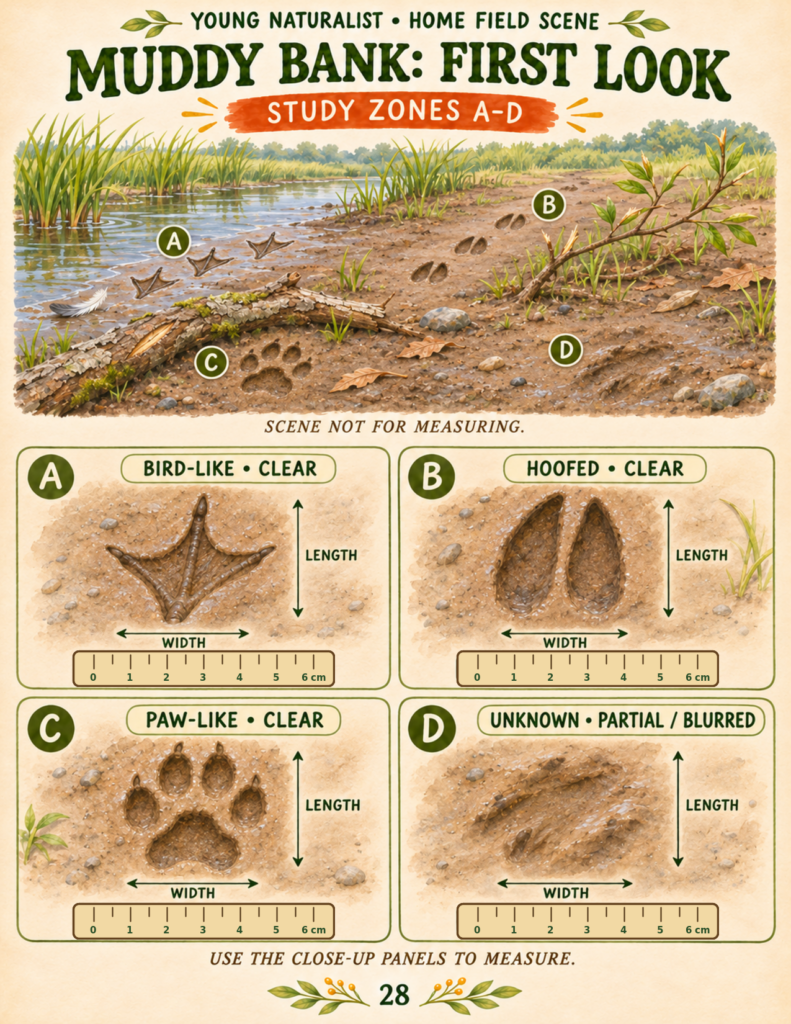
- Paired Home Field Scenes (Pages 28–29): Pages 28 and 29 provide high-detail composite shoreline scenes (Muddy Bank: First Look and Muddy Bank: Second Look) featuring four study zones (A–D) complete with built-in millimeter/centimeter scale bars. Students measure clear bird-like, hoofed, and paw-like prints alongside a blurred unknown track on page 28, then return on page 29 to evaluate newly spotted second signs—a loose feather, a browsed twig, a bark scratch, and a zone with no second sign.
Unlocking the Top-Center: The Nature Discovery Mosaic
Completing Feathers & Tracks rewards young naturalists with an essential piece of the nine-unit collector poster:
- The Final Mission Evidence File (Page 30): Students synthesize all five clues—mapping a main clue and possible second sign, selecting a best-supported group, proposing an alternative explanation, and rating their certainty on the evidence meter.
- The Discovery Piece (Page 31): Finishing the unit unlocks the official full-color Feathers & Tracks discovery piece, depicting a barred feather, oak acorns, two tiny bird prints on a mossy branch, and a perched black-capped chickadee.
- Completing the Top-Center Slot (Page 32): When children cut out and paste this tile over the top-center space of their My Nature Discovery Mosaic poster, they crown the upper canopy right between Sky & Weather and Night Sky & Seasons, directly above the central Bug Realm tile.

Practical Ways to Use This Unit at Home and School
Requiring only a pencil, clipboard, ruler, child-safe scissors, glue, and an optional magnifier or camera, Feathers & Tracks adapts smoothly to any learning environment:
- A 4-Week Homeschool Nature Study: Spend 15–20 minutes three times a week moving through one module, pairing trail or park scans with the weekly «Make» models.
- Rainy-Day & Apartment Science: Use the paired Muddy Bank scenes (pages 28–29) and indoor damp-sand practice trays to master measurement, trackway patterns, and multi-clue deduction without needing rural wilderness access.
- Multi-Age Sibling Fieldwork: Have younger learners (ages 7–9) focus on shape-group sorting, scale-card placement, and pattern strips, while older students (ages 10–12) defend multi-clue hypotheses and propose alternative explanations in the Final Mission file.
If you are looking for a screen-free science unit that teaches children to observe wildlife signs respectfully, distinguish direct evidence from speculation, and read the subtle stories left in mud, snow, and fallen feathers, Feathers & Tracks offers an engaging, rigorous field guide for ages 7–12.