The Ultimate Costa Rica Unit Study for Homeschoolers (No Prep!)
When teaching early elementary geography, finding a country that naturally captivates a child’s imagination is the ultimate jackpot. If you ask any 6- to 9-year-old what they find exciting about the planet, they will almost always answer with towering volcanoes, lush tropical jungles, sloths hanging upside down, and colorful toucans flying across misty waterfalls.
Costa Rica checks every single one of these boxes—and then some. Tucked neatly into Central America between the Pacific Ocean and the Caribbean Sea, this small yet ecologically vibrant country is an open-air classroom for physical geography, biodiversity, Earth science, and Latin American culture.
However, translating all this beauty into a cohesive homeschool week often feels overwhelming for parents. You spend hours hunting down printable maps, searching for kid-friendly volcano diagrams, and piecing together random craft sheets. If you want a comprehensive, engaging costa rica unit study for homeschoolers that is completely open-and-go with zero weekend prep, you are in the right place!
Let’s take a guided tour through Costa Rica alongside our favorite young traveler, Leo the Explorer, and see how you can transform your social studies lessons into an unforgettable expedition.
Meet Leo the Explorer: Learning Through Action, Not Rote Memorization
Traditional social studies programs often fail young learners because they rely on dense reading passages followed by dry comprehension questions. Elementary kids do not want to read an encyclopedia article about geography—they want to be explorers.
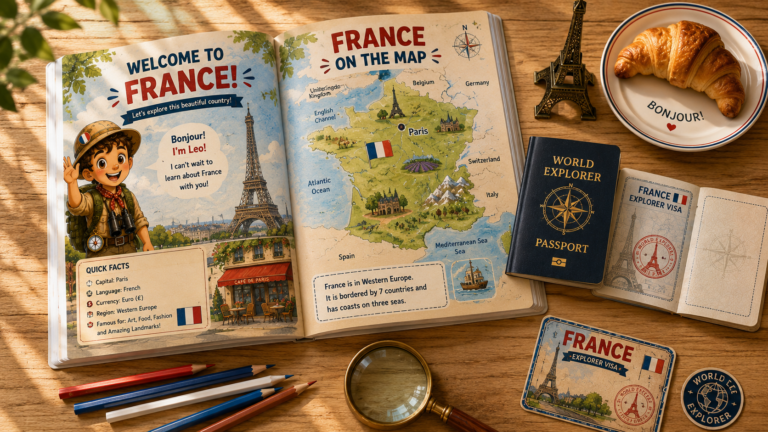
In the Costa Rica Explorer: My Geography Adventure activity book (Level 3 of the World Explorer Series), your child is guided every step of the way by Leo, an intrepid explorer who introduces them to landscapes, culture, wildlife, and hands-on challenges.

The learning cycle is structured around clear milestones:
- Learn: Discover bite-sized facts about the land, wildlife, and people.
- Explore: Navigate real maps, mountain passes, and coastal routes.
- Complete Activities: Solve puzzles, classify habitats, and trace trade journeys.
- Earn Achievements: Collect stamps, complete the master quiz, and earn official rewards!
1. Mapping a Land Between Two Oceans
Before diving into wildlife and rainforests, children need a strong mental map of where things belong. Costa Rica offers an extraordinary lesson in physical geography because of its compact shape and extreme topography. Despite its modest size, it features sandy Pacific surf beaches, rugged volcanic cordilleras, and humid Caribbean lowlands—all within a day’s drive!

- What’s Inside the Book: Kids examine Costa Rica’s borders with Nicaragua to the north and Panama to the south. They identify the Pacific Ocean to the west, the Caribbean Sea to the east, and locate the bustling capital city of San José nestled in the Central Valley. Through visual map challenges, children match key settlements like Liberia, Puntarenas, Cartago, and Limón with their distinctive terrain.
- Hands-On Homeschool Tip: Pair this mapping exercise with your physical globe or a world map. Have your child trace the narrow Isthmus of Central America that connects North and South America. Understanding spatial relationships early builds rock-solid spatial awareness, which is why a hands-on geography curriculum for kids is so vital during the early elementary years.
2. Volcano Country: Plate Tectonics and Clean Energy
Why does Costa Rica have so many active volcanoes? Kids are naturally curious about molten rock and explosive craters, making this unit a seamless bridge between social studies and Earth science.
Costa Rica sits directly atop active tectonic plate boundaries, where oceanic crust slowly pushes beneath the continental plate, melting rock into rising magma.

- What’s Inside the Book: Children explore the science behind iconic peaks such as Arenal (famous for its perfect symmetrical cone), Poás (renowned for its massive steaming crater), and Irazú (the country’s highest active volcano). But rather than focusing solely on volcanic danger, the book teaches how volcanic ash weathers over centuries into nutrient-rich soil that feeds lush highland agriculture. Even better, it explains how steam beneath the ground generates renewable geothermal energy to power communities and schools!
- Bringing It to Life at Home: Use baking soda, vinegar, and a spoonful of dish soap to create an active crater model in your kitchen sink, or explore hot springs on Google Earth. Connecting visual puzzles with physical play is one of the most effective ways to prevent summer slide during school breaks.
3. Biodiversity in Action: Rainforests, Cloud Forests, and Turtle Coasts
Did you know that Costa Rica is home to roughly 5% of the entire world’s biodiversity, despite covering only 0.03% of the planet’s landmass? For young animal lovers, studying this country is pure joy.
Costa Rica is packed with distinct ecological worlds:
- The Tropical Rainforest: Warm and dense, divided into stratified layers from the dark forest floor to the high emergent canopy. Kids meet three-toed sloths, scarlet macaws, red-eyed tree frogs, and howler monkeys.
- The Mysterious Cloud Forest: Cool, high-elevation mountain slopes where mist blankets the trees. Plants like orchids, bromeliads, and mosses grow directly on branches as epiphytes without touching the forest floor.
- Mangroves and Turtle Beaches: Coastal wetland habitats where green sea turtles crawl onto sandy shores to lay eggs, and tangled mangrove roots provide safe nursery waters for fish and caimans.

- Conservation & Wildlife Corridors: The activity book goes far beyond simple animal identification. It introduces children to national parks and wildlife corridors—connected strips of forest that allow animals to migrate safely between habitats without crossing busy roads. This hands-on approach reinforces why animal habitat activity books make learning meaningful, teaching environmental stewardship alongside biology[cite: 40].
4. Culture, Spanish Language & Life Today
A well-rounded country study must look at daily community life, tradition, and communication. Costa Rica offers an inspiring culture centered on community, hospitality, and a respect for nature captured in the national motto: “Pura Vida” (Pure Life).
- Language Practice: Young explorers learn everyday Spanish greetings and numbers—¡Hola!, Buenos días, Gracias, Por favor, and ¿Cómo estás?—through fun match-up challenges and speech bubbles.
- Traditional Arts & Crafts: Children discover the vibrant craft tradition of Sarchí, where wooden oxcarts (carretas) and giant wooden wheels are painted with intricate floral and geometric star mandalas. Kids even get to design their own colorful oxcart wheel pattern!
- Food & Agriculture: Kids trace the journey of four world-famous Costa Rican crops—highland coffee beans, coastal bananas, sweet pineapples, and cacao pods crafted into chocolate. They also discover staple culinary dishes like gallo pinto (savory rice and beans) and casado.
5. Gamification: Earning the Official Costa Rica Visa Stamp
The biggest challenge with independent workbooks is keeping children excited all the way to the end. That is where our structured reward system comes into play!
Throughout the 58 pages, children test their memory through interactive mazes, word searches, secret code breakers, coordinate grids, and spot-the-difference games.
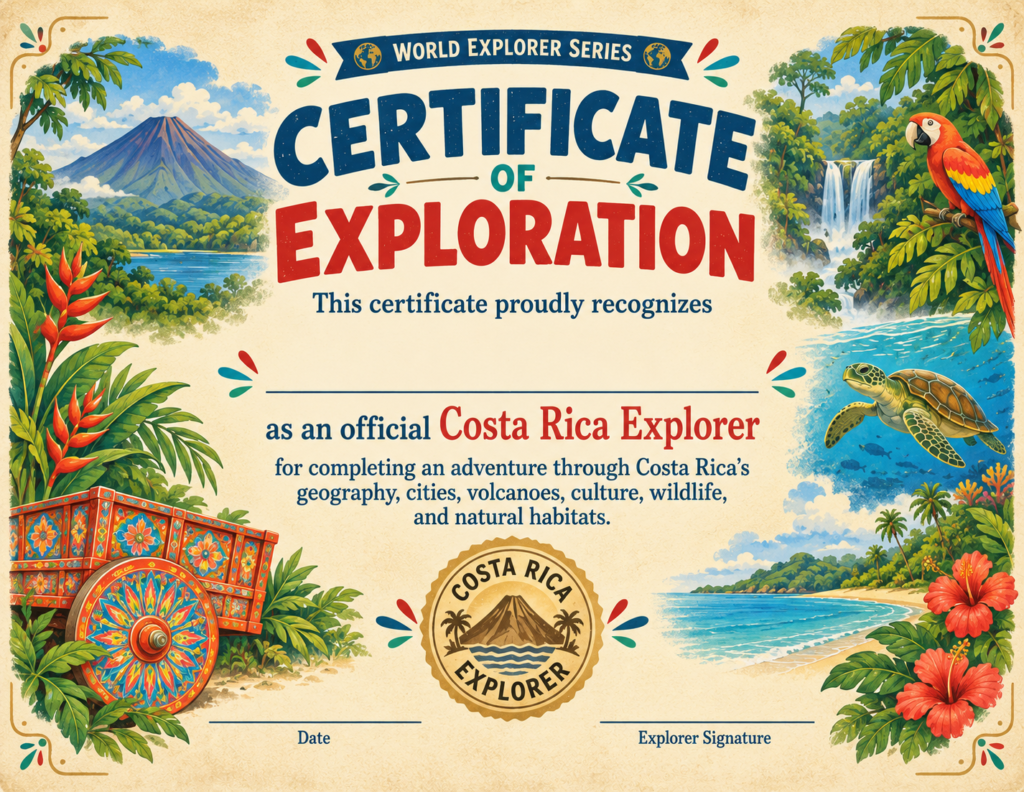

When your child completes their journey, they unlock:
- An official, fill-in Certificate of Exploration recognizing them as an authorized Costa Rica Explorer.
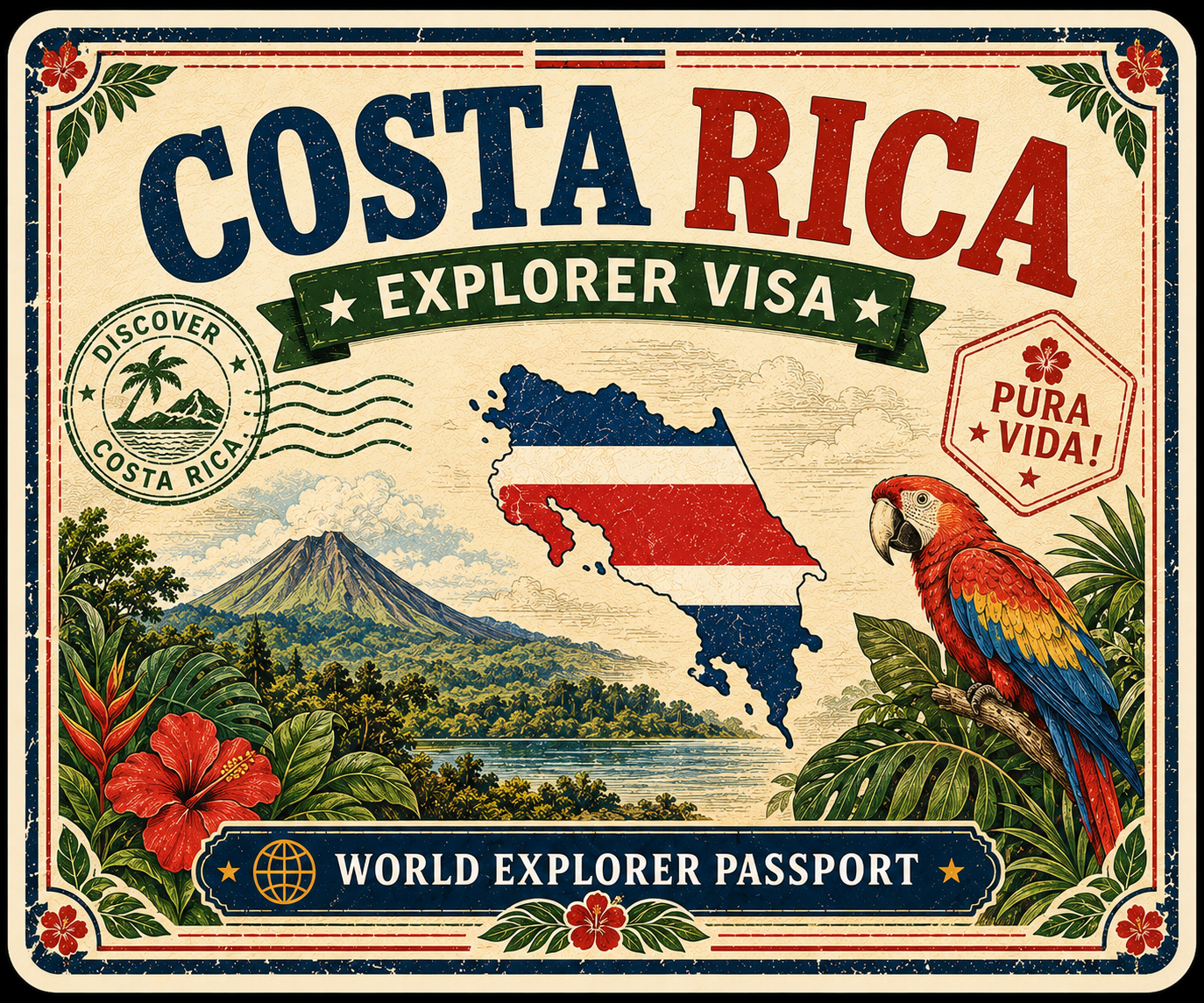
- The full-color Costa Rica Visa Stamp featuring the national flag and tropical heliconia flower, ready to be cut out and glued into their Universal World Explorer Passport!
This tangible sense of progression transforms schoolwork from a daily chore into an addictive global quest. By turning each country into an expedition with a collectible reward at the finish line, you tap into the natural power of gamification in education for kids.
Start Your Costa Rica Adventure Today!
You don’t need a plane ticket or a weekend spent cutting out flashcards to explore the wonders of Central America. With 58 printable, beautifully illustrated pages packed with maps, science diagrams, wildlife mazes, and language activities, this workbook is the ultimate open-and-go solution for your homeschool table.
Grab your colored pencils, print your workbook, and let Leo guide your child on an unforgettable journey through volcanoes and rainforests!

👉 Get the Costa Rica Explorer Activity Book in the Tiny Joy Studio Etsy Shop Today!