Why a Tadpole Is Not a Different Species: Teaching Life Cycles Through Evidence
Place a photograph of a legless bullfrog tadpole next to an adult frog perched on a lily pad, and young children will often state that they are looking at two completely unrelated animals. To an early elementary student, an organism that swims with gills, grazes on underwater pond algae, and propels itself with a finned tail cannot intuitively be the same creature that later breathes air and catches flying dragonflies on land.
Most school worksheets sidestep that cognitive hurdle. They hand children a circular diagram with four arrows, ask them to glue cartoon pictures in a ring, and call the lesson finished. The result is a persistent conceptual error: children often believe an adult frog or butterfly literally turns back into its own egg, confusing generational reproduction with continuous individual growth.
Bridging the gap between memorizing vocabulary and understanding genuine developmental biology requires an investigative approach. A thoughtfully designed animal life cycles workbook does not present stages as isolated vocabulary words; it turns children into biological field researchers who evaluate step-by-step observational records, track changes in body proportions, and follow evidence from an embryo to the next generation.
Developmental Needs Are Not Static
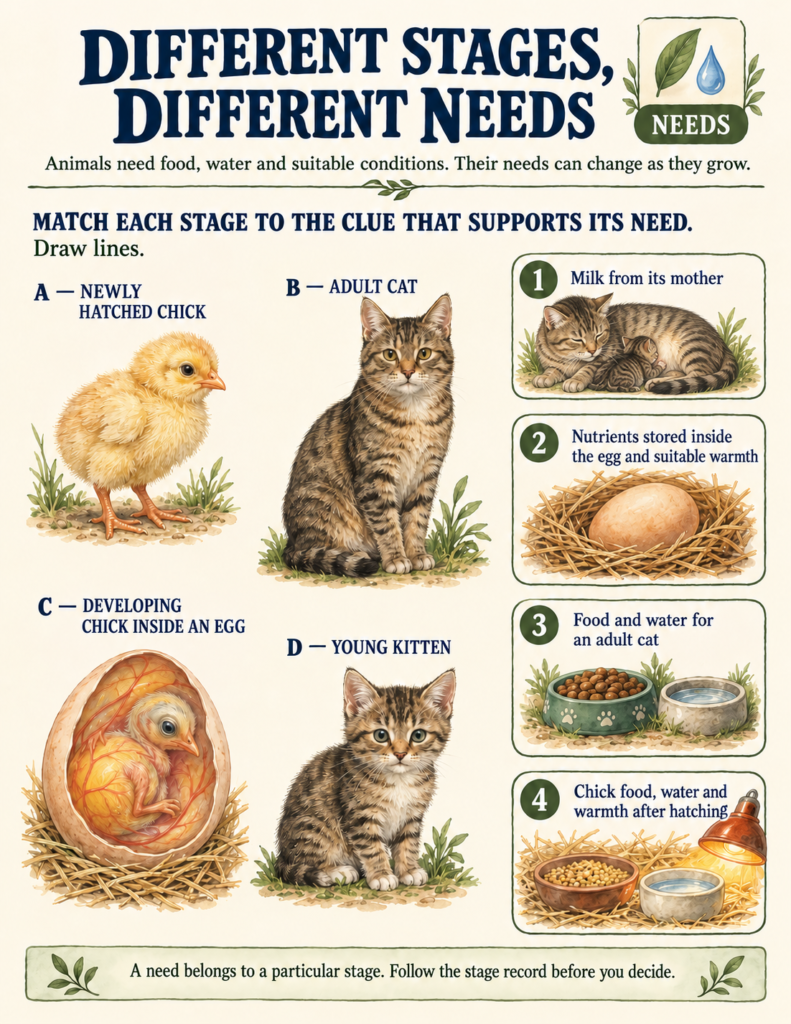
A central flaw in basic animal worksheets is treating survival needs as a fixed checklist. Children are taught that an animal requires food, water, shelter, and air, but they rarely investigate how those needs transform throughout an individual organism’s life.

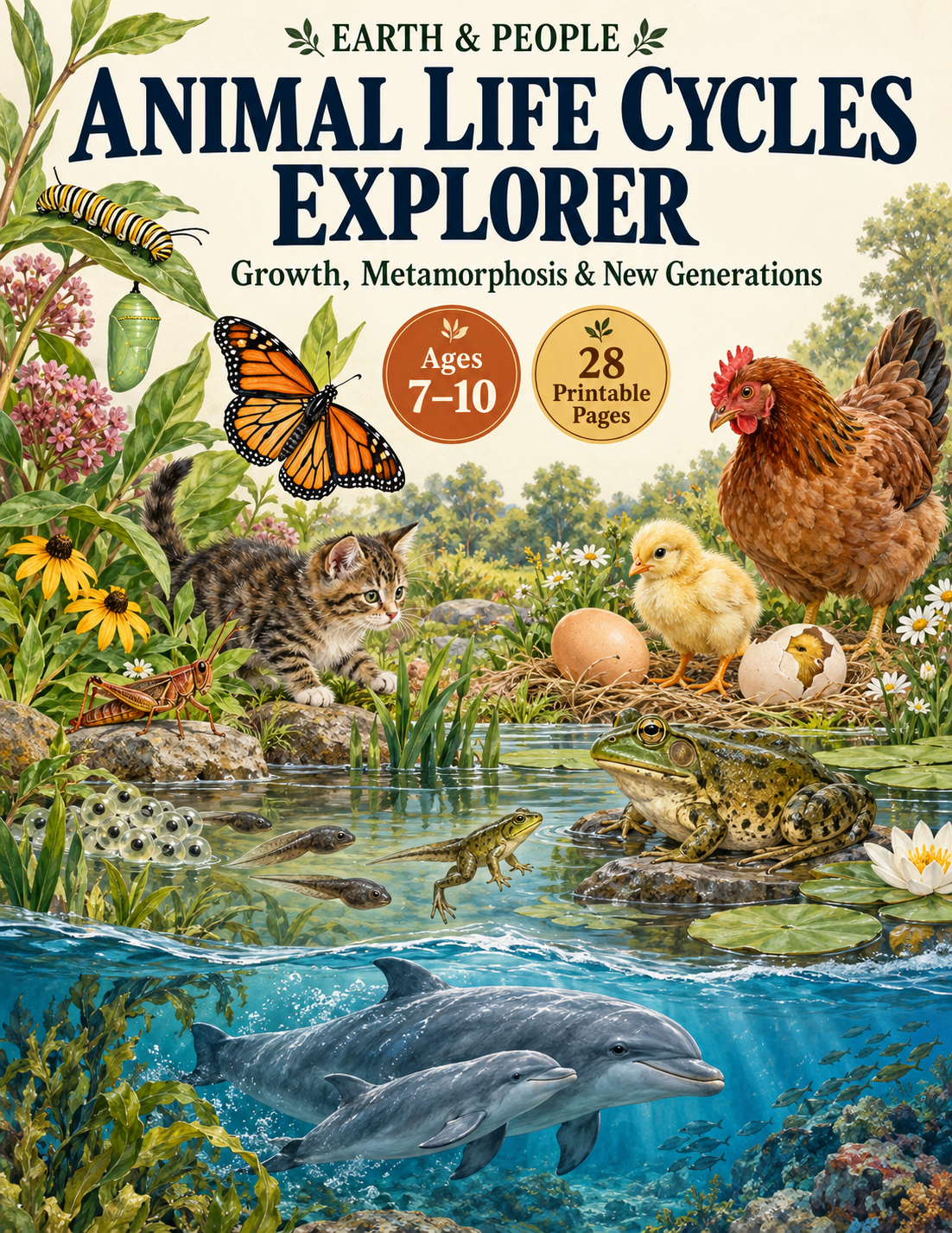
In Animal Life Cycles Explorer: Growth, Metamorphosis & New Generations (a 28-page printable unit designed for ages 7–10), students directly untangle this relationship:
- A developing chick inside an egg shell does not forage for seeds; it depends on stored yolk nutrients and steady, uninterrupted incubation warmth.
- A newborn kitten cannot chew meat; its closed eyes and immature digestive system require direct nursing from a mother cat.
- An adult bullfrog actively hunts insects with powerful jumping legs, while its aquatic tadpole grazed algae through simple scraping mouthparts.
When children recognize that an organism’s survival depends on having the right resources at each distinct phase of development, life science becomes tangible. This mirrors how botanical systems operate across their life histories; just as young seedlings rely on stored cotyledon energy before developing mature photosynthetic leaves—a process detailed in our guide to the Plant Life Cycle Workbook—developing animals depend on stage-specific nourishment before their adult structures emerge.
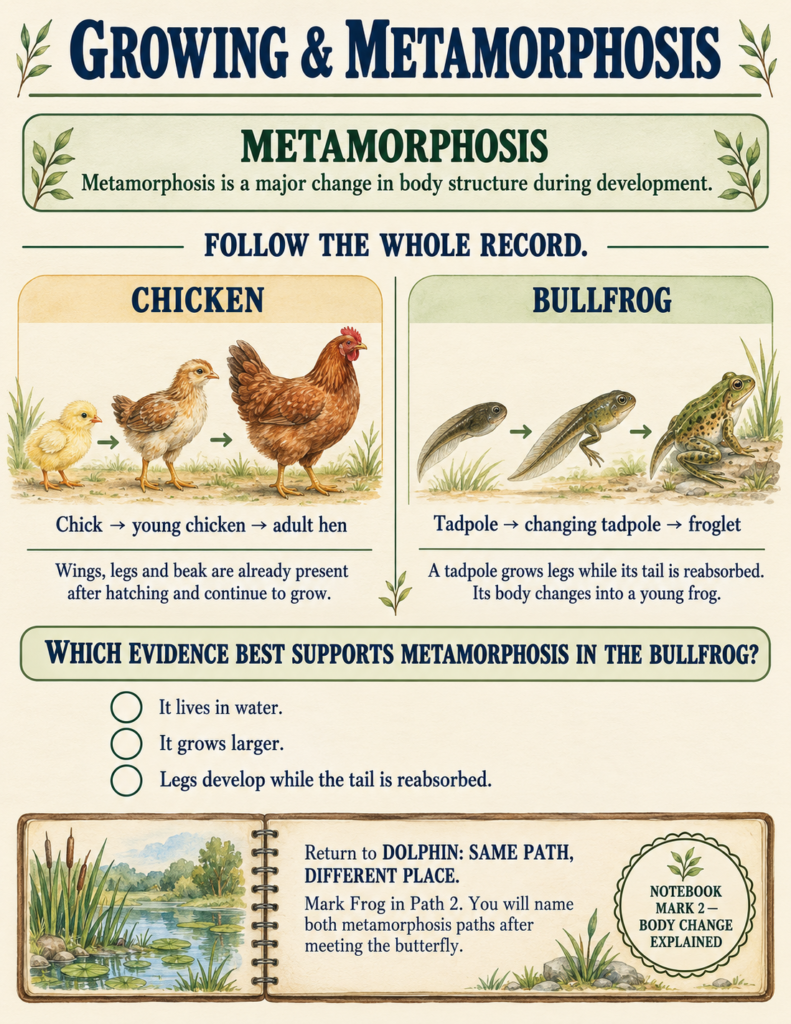
Metamorphosis: Reabsorption Versus Sudden Replacement
Ask a child how a tadpole loses its tail, and the most common answer is: «It falls off into the water».
Rather than relying on vague descriptions, Animal Life Cycles Explorer guides students through high-resolution field records to observe the actual biological mechanism. Children track a North American bullfrog through four distinct phases: egg mass, aquatic tadpole, developing froglet, and air-breathing adult. They inspect how hind legs sprout, front limbs emerge, and internal tissues gradually reabsorb the tail to fuel dramatic anatomical remodeling.
This careful anatomical tracking trains children to demand physical proof before drawing scientific conclusions. Much like paleontology students who inspect fossil limbs and skull structures to identify true dinosaurs rather than grouping every prehistoric reptile into one category—an approach central to our Dinosaur Workbook for Kids—young biologists learn to look past surface impressions and identify the anatomical evidence that defines true biological transitions.

Two Questions, Three Developmental Pathways
Elementary science curricula frequently confuse students by throwing terms like complete metamorphosis, incomplete metamorphosis, and direct development onto a single test without a clear decision tree.
The workbook eliminates this confusion through a clear diagnostic framework built on two sequential questions:
- Question 1: Does the complete record show metamorphosis?
- If NO: The animal undergoes Growing Without Metamorphosis (e.g., cat, dolphin, chicken), retaining its fundamental body plan from birth to adulthood while growing larger and altering proportions.
- If YES: Proceed to Question 2.
- Question 2: Is there a pupa stage?
- If YES: Metamorphosis With a Pupa (such as the monarch butterfly developing through a chrysalis, also called complete metamorphosis in insects).
- If NO: Metamorphosis Without a Pupa (such as a grasshopper nymph molting directly into a winged adult, or a frog developing from a tadpole).
Children also confront the widespread myth that a pupa is merely an animal «sleeping» inside a silk sleeping bag. By comparing a monarch chrysalis (the bare pupal stage itself) with a moth’s external silk cocoon, students discover that a pupa is a period of intense structural reorganization where larval chewing mouthparts are rebuilt into an adult nectar-feeding proboscis.

[IMAGE INSERT] Book: Animal Life Cycles Explorer Page: 15 Use: Displays the quantitative molting data lab, showing how exoskeleton measurements increase in stair-step graphs rather than smooth linear curves. Alt text: Mathematical graph comparing head capsule measurements of grasshopper nymphs and caterpillars across developmental molts. Optional caption: Quantitative growth: measuring how rigid exoskeletons force insects to grow in sudden, stepped molts. [/IMAGE INSERT]
Stepped Growth: The Mathematics of Molting
Mammals and birds grow gradually; their soft tissues and bones expand in a continuous curve. Insects, however, live inside a rigid exoskeleton.
In the «Read the Growth Data» lab, students analyze empirical head capsule width measurements for both a grasshopper nymph and a caterpillar. Because hard chitin cannot stretch, the numbers tell an unexpected story:
- Observations 1 and 2: $1\text{ mm}$
- Molt Event
- Observations 3 and 4: $2\text{ mm}$
- Molt Event
- Observations 5 and 6: $3\text{ mm}$
Children plot these numbers onto a stair-step graph, discovering that while internal soft tissues grow continuously, visible dimensions increase in sharp, punctuated jumps.
Connecting physical data to periodic rhythms helps young learners see that natural cycles operate through predictable rules. Just as orbital geometry and gravitational alignments govern oceanic cycles on Earth—as explored in our breakdown of the Moon Phases and Eclipses Workbook—the physical constraints of an exoskeleton dictate the precise mathematical rhythm of insect growth.
Furthermore, these life cycle stages anchor dynamic marine and terrestrial ecosystems. Floating planktonic larvae, grazing tadpoles, and adult predators each occupy specific ecological niches. In the same way that ocean food webs rely on billions of microscopic coral planula larvae and grazing herbivores to sustain limestone reefs—a living balance examined in our Coral Reef Ocean Life Workbook—terrestrial habitats depend on every developmental stage to keep nutrients and energy circulating.

The Model Repair Lab: Thinking Like a Biologist
What elevates Animal Life Cycles Explorer beyond typical elementary printables is its dedicated focus on scientific modeling and critique. On the «Model Repair Lab» spread, students do not merely look at correct charts; they audit three flawed diagrams:
- Model A (Butterfly): Identifies a missing transition between the caterpillar and adult, requiring learners to restore the pupa.
- Model B (Grasshopper): Validates a correct incomplete sequence where a nymph with wing pads emerges directly as a winged adult without a pupa.
- Model C (Cat): Flags a critical conceptual error: the diagram labels an arrow from Adult Cat to New Kitten as «Grows Into.» Students repair the model by crossing out the phrase and replacing it with «Next Generation,» cementing the truth that individuals grow, reproduce, and pass life forward rather than cycling into their own offspring.
Practical Integration for Home and Classroom
Because the workbook includes full answer keys, guided evidence prompts, and an open-ended «Life Cycle Field Guide» capstone, it requires zero specialized preparation:
- Homeschool Science Block: Complete two pages daily over a focused two-week unit, combining the activities with backyard observations of garden insects or tadpoles.
- Elementary Science Stations: Set up laminated copies of the «Two Unfamiliar Lives» mystery cases (ladybug versus dragonfly) for collaborative partner deduction.
- Screen-Free Science Journaling: Use the capstone field guide pages as an assessment tool where students illustrate, label, and defend the developmental pathway of an animal of their choice.
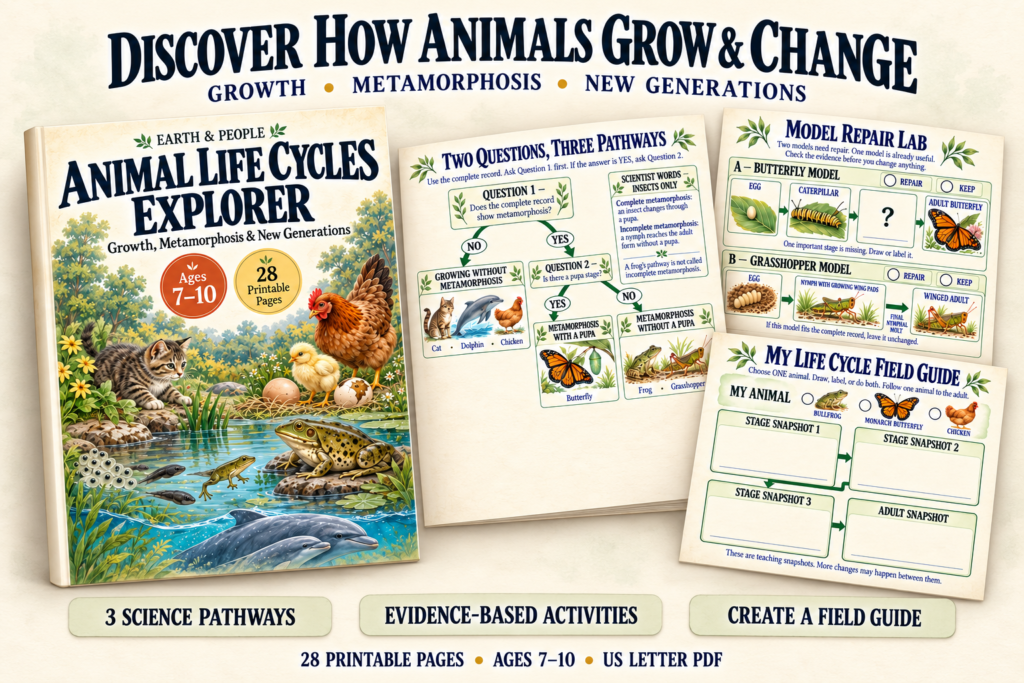
If you are looking for an educational printable that replaces simplistic cut-and-paste wheels with authentic developmental biology, data interpretation, and model auditing, Animal Life Cycles Explorer gives young learners the scientific framework to understand how life truly begins, transforms, and renews