Why a Volcano Is Not Just a Cone: Teaching Earth Science Through Real Geological Evidence
Mention volcanoes to a third-grader, and their mind immediately jumps to an explosion of red fizz bubbling out of a brown papier-mâché mountain. For decades, the baking soda and vinegar eruption has been the centerpiece of elementary geology units. Yet after the red foam drains away, children are often left with a persistent misconception: they assume that every volcano is an identical steep triangle waiting to detonate without warning.
Real geology is far more nuanced, diverse, and interconnected. Some volcanoes do not build cones at all; they erupt as glowing curtains along miles-long cracks in the ground, spread into broad shields as wide as mountain ranges, or collapse into sunken crater basins after magma chambers drain.
Moving past dramatic eruption stunts requires shifting from spectacle to earth systems science. An inquiry-driven volcano workbook for kids guides young learners to look beneath surface explosions, training them to analyze five interconnected lenses—Source, Material, Path, Landform, and Change—to understand how Earth’s internal heat continuously reshapes global landscapes.

Escaping «The Cone Trap»
The first obstacle in elementary earth science is learning that shape alone does not define a landform.
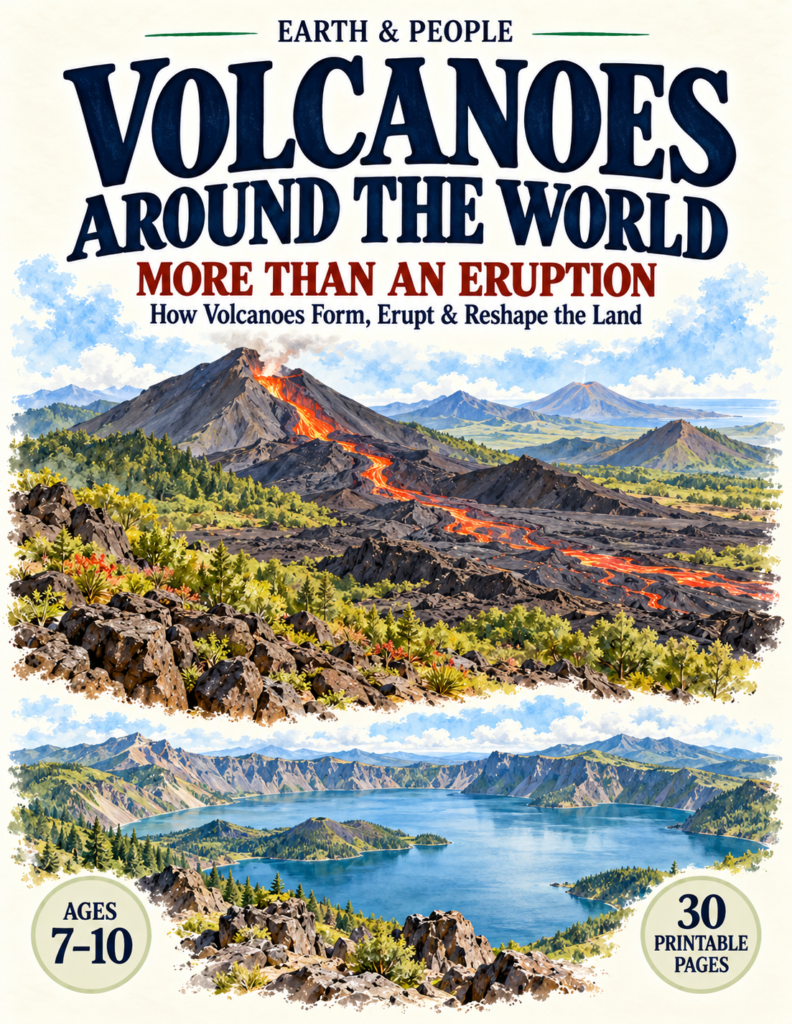
In Earth & People: Volcanoes Around the World (a 30-page printable unit designed for ages 7–10), children confront this directly on page two in an exercise called «The Cone Trap». Students examine field notes from four contrasting landscapes:
- A jagged alpine peak made purely of folded rock layers without any local ash or lava.
- Broad, gently sloping plains with hardened basalt flows spreading from a central fissure.
- A steep cinder hill built from loose pyroclastic fragments.
- A rounded depression surrounded by steam vents with unconfirmed origins.
Rather than jumping to conclusions based on appearance, students must find direct material evidence—hardened lava flows or volcanic ash layers traced to a vent—before labeling a site volcanic.
This habit of demanding physical evidence mirrors how young astronomers analyze planetary bodies. Much like evaluating surface imagery, impact craters, and atmospheric densities across terrestrial worlds—an approach detailed in our Solar System Explorer Workbook—young geologists learn that understanding a planetary surface requires identifying the physical mechanisms that created it.
[IMAGE INSERT] Book: Volcanoes Around the World Page: 8 Use: Highlights the viscosity fluid mechanics model comparing honey and water to explain why runny basalt forms broad shields while sticky silica-rich lava forms steep domes. Alt text: Science worksheet modeling lava viscosity with honey and water on an inclined plane to explain volcanic slope profiles. Optional caption: Viscosity dictates profile: runny magma travels far to build broad shields, while sticky magma piles up close to the vent. [/IMAGE INSERT]
Fluid Dynamics: Why Magma Thickness Dictates Mountain Profiles
Why is Hawaii’s Mauna Loa shaped like a wide warrior’s shield, while Mount Fuji rises as a towering, symmetrical cone?
Standard textbooks often treat volcano profiles as arbitrary trivia. Volcanoes Around the World turns this difference into a fluid dynamics investigation using a simple incline model:
- Runny Magma (Modeled by Water): Spreads quickly and travels great distances across gentle slopes before cooling, gradually stacking thin layers into broad shield volcanoes like Mauna Loa.
- Sticky Magma (Modeled by Honey): Resists flow, creeps slowly, and piles up steeply around the vent, trapping expanding gases that generate explosive ash clouds and alternating rock strata like Mount Fuji.
By grasping viscosity, children understand why different magmas produce entirely different eruption styles and geographic hazards.

Local Eruptions, Global Footprints
Children often view volcanic eruptions as localized disasters that end once the lava cools. Volcanoes Around the World broadens this view to planetary systems.
In the case study of the 1991 Mount Pinatubo eruption in the Philippines, learners trace two distinct material pathways:
- Heavy Ash Particles: Coarse rock fragments fall back to Earth quickly, blanketing local villages and river valleys.
- Aerosolized Gases: Sulfur dioxide travels into the stratosphere above rain clouds, reacting with water vapor to form microscopic reflective droplets that circulate globally.
Students analyze real satellite evidence showing that these reflective particles bounced incoming sunlight back into space, temporarily dropping global surface temperatures. This dynamic introduces children to atmosphere-lithosphere feedback loops, demonstrating that Earth’s geological interior and atmospheric climate are deeply linked.

Primary Succession: From Barren Basalt to Living Ecosystems
Volcanoes do not merely destroy landscapes; they create brand-new land.
On the Surtsey island spread, students follow an undersea eruption off the coast of Iceland that broke the ocean surface between 1963 and 1967. Once the basalt cooled, scientists turned the island into a living laboratory to observe primary ecological succession:
- Ocean currents washed buoyant, salt-tolerant sea rocket seeds onto fresh black sand beaches.
- Offshore gale winds carried light, hairy willow seeds across open water.
- Migrating seabirds deposited seeds inland, their droppings simultaneously fertilizing the nutrient-poor volcanic ash.
This living transformation connects earth science directly to botanical life cycles. Just as young botanists investigate how seeds rely on specific moisture, warmth, and dispersal strategies to germinate and anchor into soil—concepts explored in our Plant Life Cycle Workbook—young geologists discover that volcanic rock provides the essential mineral foundation for new plant communities to take root.
Auditing Scientific Models and Human Hazards
Rather than relying on passive reading comprehension, the workbook culminates in critical thinking and land-use planning labs.
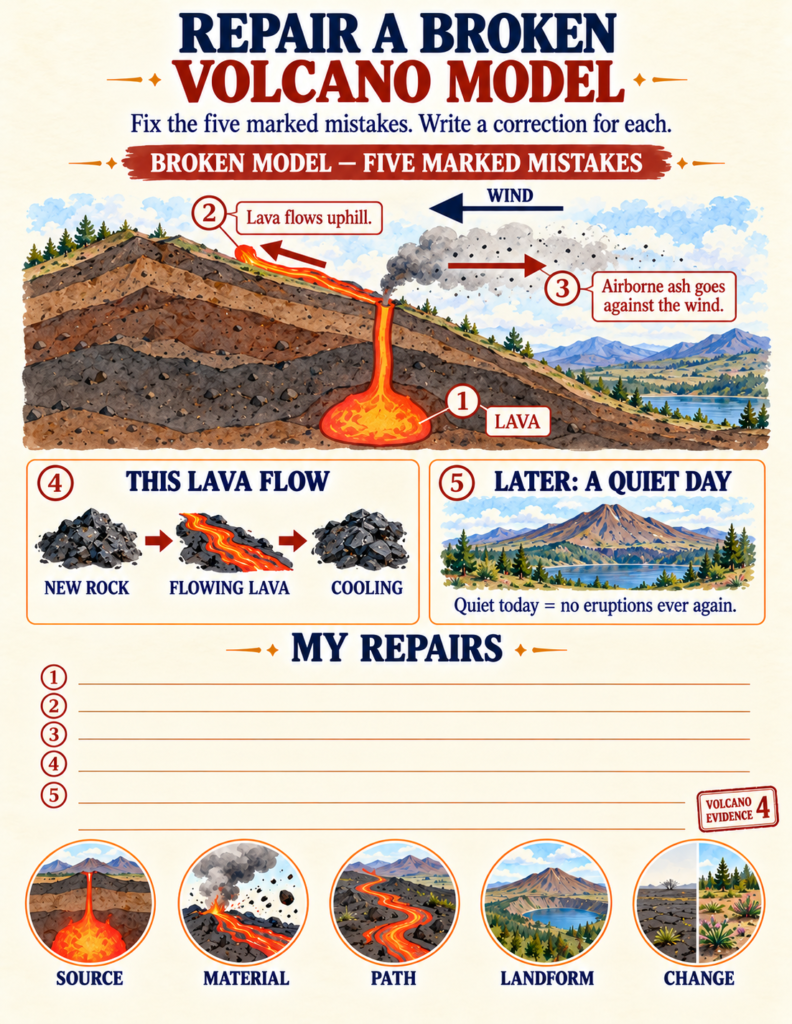
On the «Repair a Broken Volcano Model» spread, learners audit a diagram containing five deliberate geological errors:
- Magma incorrectly labeled as surface lava underground.
- Lava depicted flowing impossibly uphill.
- Airborne ash blowing backward against the wind arrow.
- Lava instantly cooling into rock without a transition phase.
- A quiet day mislabeled as proof that a volcano is extinct forever.
Students also evaluate human settlement choices in the Mount Etna hazard simulation. Guided by a four-part rule set, children analyze slope angles, soil quality, lava flow paths, and ashfall zones to choose the safest, most productive location for a family farm.
This exercise mirrors the spatial trade-offs communities face worldwide. Much like urban planners who balance transport corridors, water access, and terrain boundaries—a central challenge in our Countries and Capitals Workbook—students learn that living alongside dynamic natural landforms requires evaluating physical risks and geographic resources.
Practical Implementation for Home and Classroom
Because Volcanoes Around the World is self-contained with clear diagrammatic models, field scenarios, and full answer keys, it adapts cleanly to various teaching schedules:
- Homeschool Earth Science Unit: Complete two pages daily over three weeks for a comprehensive, screen-free geology study.
- Elementary Science Stations: Set up laminated copies of the «Which Flow Fits the Clues?» mystery lab (differentiating lava, lahars, and pyroclastic flows) for collaborative group problem-solving.
- Capstone STEM Modeling: Use the «Build a Volcanic Landscape» cross-section challenge as an authentic end-of-unit assessment where students draw, test, and defend a landscape under shifting wind and rain conditions.
If you are looking for an educational printable that trades vinegar foam for authentic geological reasoning, plate tectonic models, and real-world hazard analysis, Volcanoes Around the World provides young scientists with an engaging, structured expedition through Earth’s living geology.