More Than Endless Grass: Teaching Grassland Ecology Through Living Systems and Field Evidence
When children picture a grassland, they often envision an empty, endless expanse of yellow turf punctuated by grazing zebras or roaming bison. Choosing an inquiry-based savanna and grassland workbook for kids is the most effective way to help young learners see that an open plain is actually a complex, interconnected living system. A thoughtful savanna and grassland workbook for kids demonstrates that what happens below the soil is just as vital as what grazes above it, showing how living root systems, seasonal water pulses, migratory routes, and decomposers sustain one of Earth’s most resilient biomes.
Standard classroom printables often reduce grassland ecology to superficial animal checklists and predator-prey coloring pages. Children memorize that lions hunt zebras, but they miss the foundational physical science making that chase possible: how grass plants protect their vital growing points near the soil line, how heavy grazing demands adequate rest intervals for regrowth, and why a fire-blackened field is not dead, but clearing room for renewed sprouts. When science focuses only on charismatic animals, children miss the underlying cause-and-effect systems governing life on Earth.

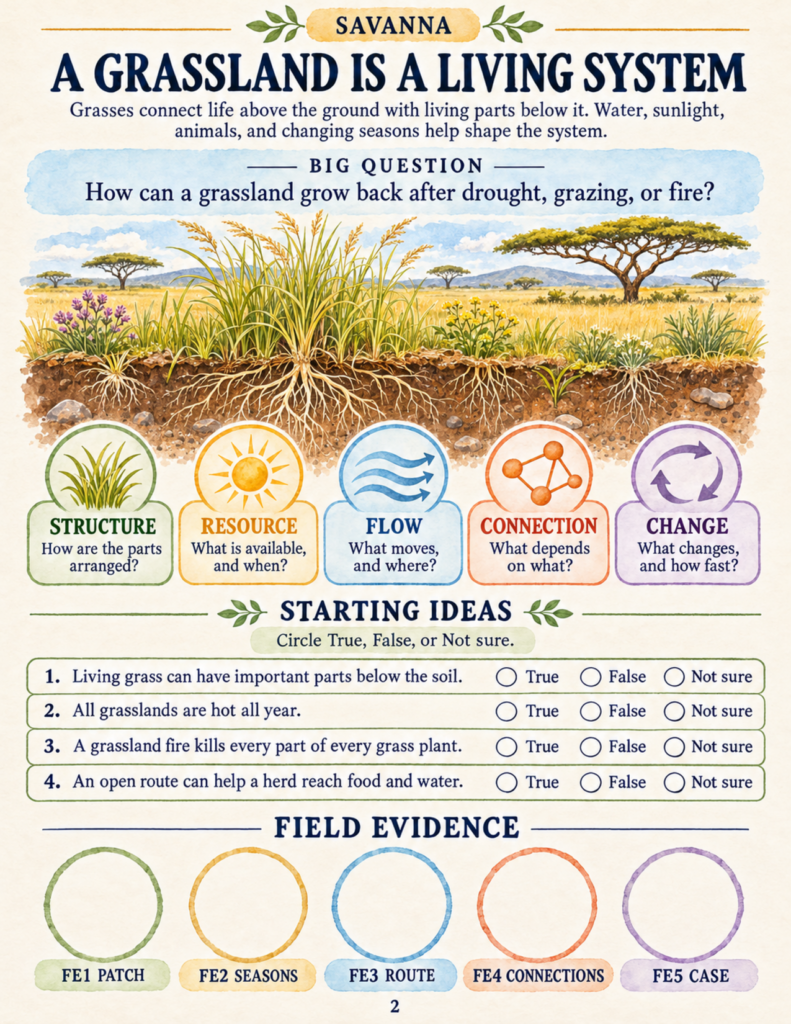
In Savanna & Grassland Explorer: Roots Below, Herds Above (a 30-page printable unit designed for ages 7–10 by TinyJoy Studio), learners step into the role of field naturalists. Rather than filling in blanks, children investigate a central Big Question: How can a grassland grow back after drought, grazing, or fire? Across five foundational scientific lenses—Structure, Resource, Flow, Connection, and Change—students evaluate diagrams, analyze fair-test growth experiments, trace water movements, and repair broken ecosystem models.
The Hidden Half: Root Architecture and Growing Points
The first major conceptual breakthrough in studying grasslands is looking beneath the surface. In lush forests, trees invest enormous energy into woody trunks and high canopies; in grasslands, up to half or more of a plant’s living biomass is anchored securely underground.
Savanna & Grassland Explorer introduces children to the anatomy of grass shoots before flowering. Students learn that while trees grow new foliage from exposed branch tips, grasses keep their critical growing points positioned at or near the soil line. When a grazer clips leaf tips or a fast-moving fire scorches dry blades, the plant does not die—as long as the underground roots store energy and the basal growing point remains undamaged, fresh shoots can emerge as soon as moisture arrives.
To broaden this physical understanding of how underground reserves and living networks adapt across different environments, pairing this study with our nature workbooks for kids helps young naturalists compare deep prairie taproots and savanna bunches with dense woodland floor communities.

Controlled Experiments: Rest Intervals and Grazing Pressure
Rather than merely asserting that grasslands recover, the workbook introduces children to quantitative scientific experimentation. On pages 9 and 10, students examine a simulated 14-day plant clipping experiment:
- Group A (Clip Once, Then Rest): Grass clipped back to 6 cm on Day 0 and allowed to recover reaches 18 cm by Day 14.
- Group B (Repeated Clipping): Grass clipped down to 6 cm every 3 days reaches only 8 cm on Day 14.
- Group C (Unclipped Control): Continues natural upward growth from 20 cm to 26 cm.
By interpreting this data table, children solve a critical challenge: Why does the final height of Group B fail to reveal all the growth that actually took place? Students discover that Group B grew repeated new leaf tissue, but relentless clipping constantly removed it. Through this fair-test analysis, young learners grasp rotational grazing and understand that pastures require dedicated resting periods to thrive.
Cultivating this habit of analyzing raw data tables, variables, and physical forces shares a direct parallel with investigating atmospheric dynamics and planetary mechanics. For families exploring physics, celestial cycles, and planetary surfaces, our earth and space science bundle for kids provides the same inquiry-driven framework to help students audit models and read scientific evidence.
Hydrology and Movement: Infiltration, Niches, and Migrations
Grasslands are dynamic environments defined by seasonal rhythms. In tropical savannas, rainy months bring rapid flushes of green growth, while dry seasons shrink watering pools and wither surface foliage.
On page 13, students evaluate water models, tracking three simultaneous paths: infiltration (water soaking deep into soil storage), runoff (excess water flowing over ground into hollows), and evaporation (moisture returning to the atmosphere). When surface resources dry up, animals must respond. Children discover that herbivores avoid direct competition through dietary partitioning: zebras graze coarser upper grasses, wildebeest graze tender shoots, and tall giraffes browse high acacia branches.
When resources shift regionally, herds must travel. In the «Herd Route Detective» challenge (page 16), students map migratory journeys between resource points, discovering that if an artificial fence cuts off a corridor to water, a herd cannot complete its seasonal trek even if grass is abundant elsewhere.
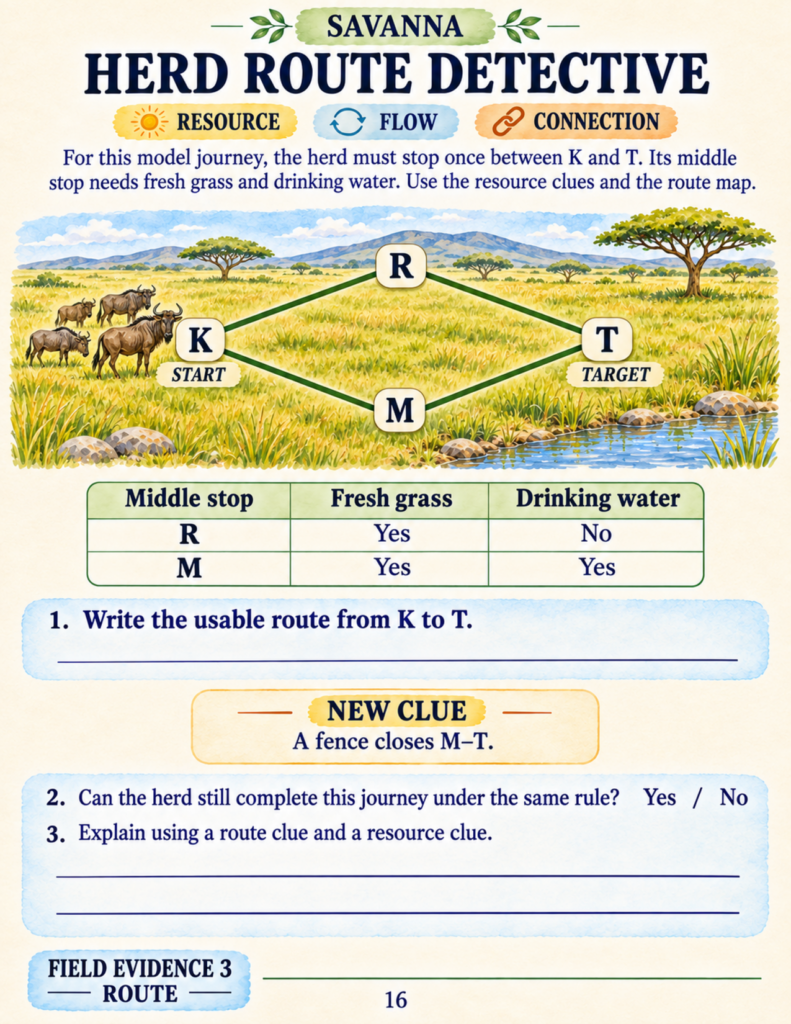
Mapping open landscapes, corridor barriers, and regional habitats builds foundational spatial awareness. To help children develop strong cartographic reasoning, field sketching habits, and compass-reading skills, exploring our explorer skills workbook bundle gives young learners practical tools to navigate and document the terrain around them.
Nutrient Cycling: Decomposers, Fire, and Human Stewards
A common misconception among elementary students is that energy and nutrients behave identically in an ecosystem. Savanna & Grassland Explorer clearly distinguishes these two flows: energy moves through feeding links and radiates away as heat, requiring continuous solar input, while nutrients cycle continuously through the soil web.
Pages 18 and 19 guide children through the nutrient loop:
- Dung beetles roll and bury herbivore waste, moving organic matter into the subterranean layer.
- Fungi and soil bacteria decompose litter, releasing dissolved minerals into ground moisture.
- Grass roots absorb these dissolved nutrients, fueling new shoots.
- Fast-moving seasonal fires turn dry thatch into nutrient-rich ash, clearing old growth so sunlight can reach newly emerging blades.
Children also discover that humans have shaped these ecosystems for thousands of years. Indigenous peoples of the Great Plains long used controlled, low-intensity cultural burns to manage plant health, renew grazing grounds, and maintain landscape balance.
Understanding how human communities actively cooperate with natural habitats forms a vital bridge between environmental science and social studies. Exploring how different cultures build communities, adapt shelter, and interact with regional geography through our people and places workbook bundle helps students understand the enduring relationship between societies and landscapes.
Connecting these ancient land-management practices to historical evidence mirrors the investigative habits taught across our interactive history for kids curriculum, where students evaluate primary sources, artifacts, and societal timelines through evidence rather than rote memorization.

Practical Integration for Home and Classroom
Because Savanna & Grassland Explorer features self-contained models, scaffolded evidence cards, and complete solution guides for all 27 core investigation pages, it fits effortlessly into diverse learning routines:
- Homeschool Biome & Ecology Unit: Complete two pages daily over three weeks for a comprehensive, screen-free life science block.
- Science Centers & Collaborative Stations: Laminate the «Patch Detective» (page 5), the «Nutrient Pathway» (page 18), and the «Broken Grassland System» audit (page 25) for small-group evidence deduction.
- Independent STEM Warm-Ups: Use the comparison spreads between African savannas and North American prairies (pages 3 and 12) as morning critical thinking prompts.
If you are looking for an educational resource that replaces shallow animal coloring pages with authentic botanical anatomy, data-driven experiments, and systems-based ecological reasoning, Savanna & Grassland Explorer provides elementary learners with a structured, inspiring expedition across our planet’s living plains.