Beyond the Animal Checklist: Teaching Global Ecology Through Interconnected Living Systems
When elementary students study Earth’s habitats, they are usually handed a predictable checklist: color a toucan in South America, circle a clownfish in an ocean scene, or sketch a camel on an empty dune. Investing in a comprehensive biomes and ecosystems workbook bundle for kids is the most effective way to replace disconnected trivia with genuine systems thinking. A thoughtfully engineered biomes and ecosystems workbook bundle for kids helps young scientists recognize that our planet is not an assortment of isolated nature postcards, but a collection of dynamic, interconnected living systems where physical geography, sunlight, moisture flows, and biological webs work together to sustain life.

Standard classroom printables often fracture natural science into superficial categorization exercises. Children spend weeks memorizing animal diets in isolation, missing the fundamental physical mechanisms governing each biome: why lush tropical forests grow out of nutrient-poor dirt, how coral polyps construct wave-breaking limestone barriers from seawater, why grassland roots store vital growing points beneath the soil, how temporary woodland pools act as fish-free amphibian sanctuaries, or how an insulating winter snowpack protects small mammals from freezing Arctic gales. When biomes are treated merely as homes for charismatic animals, children lose the chance to see how energy, water, and minerals continuously cycle across the globe.
The Biomes & Ecosystems Explorer Bundle (a 5-workbook printable collection for ages 7–10 by TinyJoy Studio) unites five foundational ecosystems into an expansive 150-page hands-on curriculum. Spanning Rainforest Explorer, Coral Reef & Ocean Life Explorer, Savanna & Grassland Explorer, Wetlands Explorer, and Arctic & Tundra Life Explorer, the bundle equips young naturalists with diagnostic toolkits, controlled experiment tables, cutaway models, and empirical case files. Across every environment, students apply five core scientific lenses—Structure, Resource, Flow, Connection, and Change—training them to read the natural world as real field ecologists.
1. Tropical Rainforests: Canopy Gradients and the Soil Paradox
The journey across Earth’s living realms begins in the dense equatorial canopy, where students quickly dismantle the textbook «layer cake» model. Rather than treating the emergent, canopy, understory, and forest floor layers as rigid horizontal shelves, learners explore how overlapping vegetation creates fluid, vertical microclimates of light, wind, and humidity.
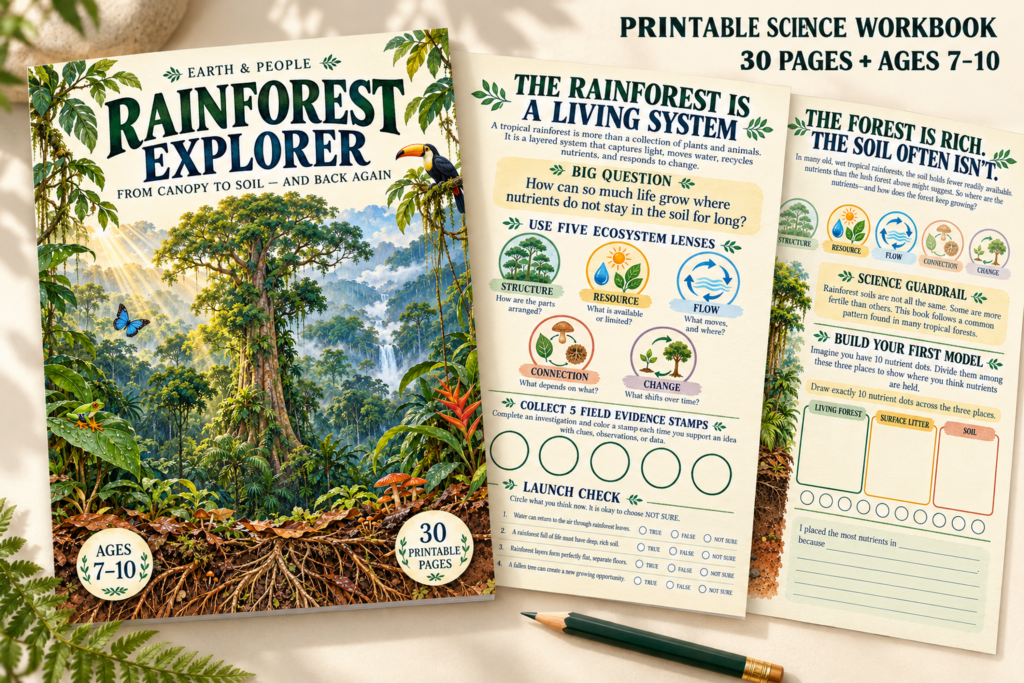
Children solve one of ecology’s most fascinating puzzles: the tropical nutrient paradox. How do some of the tallest, most biologically dense forests on Earth flourish when tropical soils hold almost zero mineral reserves? Through controlled leaf-decay mass data, students discover that intense warmth and relentless moisture accelerate decomposer activity. Instead of storing nutrients indefinitely in a deep soil bank, the rainforest operates a lightning-fast recycling loop, absorbing dissolved minerals straight from falling litter back into shallow root networks before heavy rains wash them away. As explored in our dedicated study of the tropical rainforest workbook, children track throughfall precipitation, analyze plant epiphytes, and audit broken food webs using field evidence.
2. Coral Reefs: Animal Architecture and Marine Symbiosis
Transitioning from terrestrial canopies to warm tropical waters, the bundle dives beneath the ocean surface to examine ecosystems built entirely by biological architects. When children first see a coral reef, they often mistake it for colorful undersea rock or blooming marine flora.
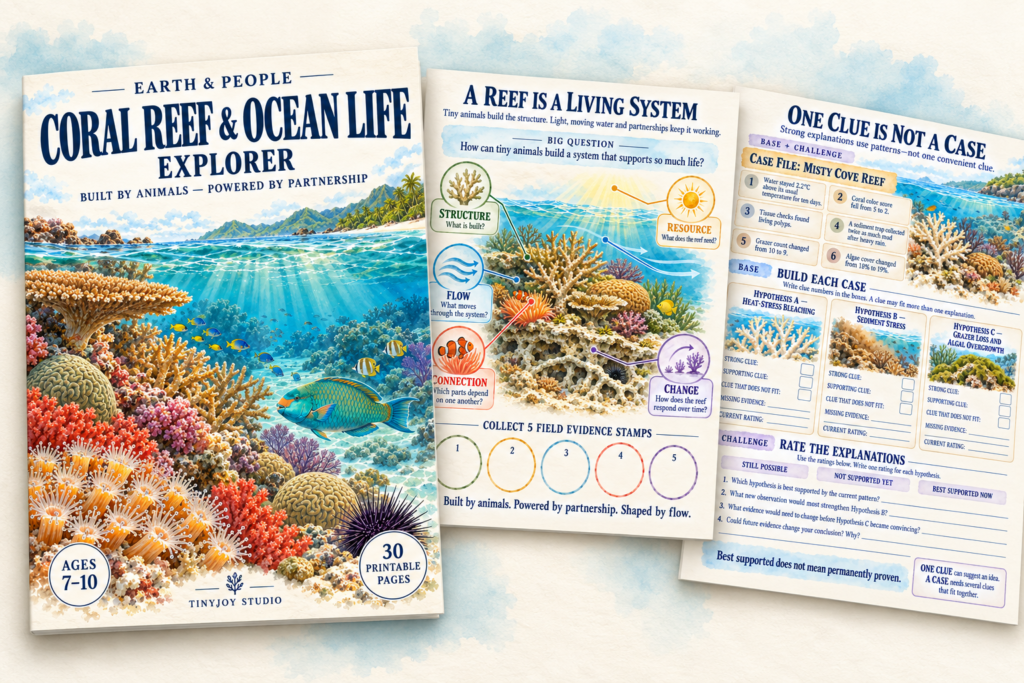
Students examine the microscopic anatomy of coral polyps, identifying the tentacles, mouth, and soft tissue that prove coral is an animal. They investigate the vital intracellular partnership between polyps and symbiotic algae (zooxanthellae), learning that corals receive both structural food from microscopic solar photosynthesis and physical shelter in return. By calculating ocean depth light transects and studying hydrodynamic wave friction, learners understand why healthy barrier reefs protect mainland shores from storm surge erosion. As detailed in our review of the coral reef ocean life workbook, students evaluate bleached coral data, map herbivore grazing loops, and model sustainable marine reserves using real field transects.
3. Savannas and Grasslands: Roots Below and Herds Above
Moving out onto open terrestrial plains, the bundle counters the common misconception that grasslands are flat, empty wastelands. Savanna & Grassland Explorer directs children’s attention underground, where up to half of a grass plant’s living biomass is securely anchored.

Students investigate the unique anatomy of grass shoots, discovering that while woody trees grow from exposed branch tips, grasses keep their vital growing points nestled near or below the soil line. This physical adaptation explains how grasslands survive constant animal grazing, seasonal droughts, and periodic wildfires. Through quantitative 14-day clipping experiments, children calculate how grass recovery requires dedicated rest periods, connecting plant physiology to rotational livestock management and wild herd migrations. As explored in our walkthrough of the savanna and grassland workbook for kids, students trace water infiltration, map migration corridors blocked by artificial fencing, and discover how Indigenous cultural burns renew fertile pastureland.
4. Wetlands: Hydrological Budgets and Seasonal Nurseries
Wetlands are frequently misunderstood as stagnant, mosquito-filled ditches, yet they function as the vital kidneys and flood sponges of Earth’s watersheds. Wetlands Explorer grounds wetland ecology in measurable hydrology, water movement, and plant adaptations.

Children investigate how emergent wetland plants, such as cattails, survive waterlogged soil devoid of subterranean air: their stems contain internal aerenchyma channels that funnel atmospheric oxygen straight down to buried root systems. Students also evaluate fluid channel experiments, measuring how dense vegetation creates physical drag that slows floodwaters and drops suspended silt to the bottom. In the vernal pool module, learners uncover an ecological paradox: seasonal summer drying is precisely what protects developing frog and salamander larvae, as temporary pools prevent predatory fish from establishing permanent populations. As examined in our guide to the wetlands workbook for kids, children analyze weekly water calendars, calculate basin inflow and outflow budgets, and evaluate human wetland restoration projects.
5. Arctic and Tundra: Active Layers, Insulating Snow, and the Summer Rush
The final module takes young researchers to the extreme circumpolar north, dismantling the myth that the Arctic is an empty, frozen desert. Arctic & Tundra Life Explorer explores the geology and climate mechanisms of high-latitude environments.

Children map the two-tier soil model, contrasting permanently frozen permafrost with the shallow seasonal active layer that thaws just enough during warm months to support dwarf shrubs and cushion plants. Through thermal profiles, students investigate the subnivean space, discovering that trapped air inside a deep snow blanket can keep ground runways at a mild -4°C while outside air plunges to a lethal -20°C. Furthermore, the workbook introduces the critical concept of phenological mismatch: migratory shorebird chicks must hatch during the precise two-week peak of insect emergence; if warming weather shifts insect hatching earlier, the food supply collapses before the chicks arrive. As detailed in our breakdown of the arctic and tundra workbook for kids, students analyze terrain micro-habitats, examine mutualistic lichen partnerships, and audit long-term polar climate records.
A Complete Screen-Free Life Science Curriculum
Because every workbook in the collection includes self-contained data models, transparent evidence cards, model audits, and full 30-page answer keys, the bundle adapts seamlessly to diverse home and classroom schedules:
- A Full-Year Elementary Ecology Program: Work through one complete workbook every 6–8 weeks for an immersive, screen-free life science and geography spine.
- Thematic Biome Deep Dives: Align individual modules with seasonal rhythms—exploring wetlands during spring snowmelt, grasslands during autumn, or the tundra during winter freezes.
- Collaborative STEM Inquiry Centers: Print and laminate diagnostic capstone labs—such as «Repair a Broken Ecosystem Model»—for small-group peer evaluation and evidence-based debate.
If you are looking for an educational resource that replaces passive coloring packets with genuine botanical cross-sections, quantitative fluid trials, spatial food webs, and authentic systems thinking, the Biomes & Ecosystems Explorer Bundle provides young learners with an inspiring, structured expedition across our living world.