Why Good Business Decisions Are Made Before You Know the Outcome: Teaching Opportunity Cost and Capacity to Kids
When children first encounter money lessons in elementary school, they are usually given two narrow tasks: counting coins on a worksheet or running a pretend lemonade stand where every customer buys happily and profit is guaranteed. Choosing a thoughtful business workbook for kids transforms how young learners think about work, time, and limited resources. Instead of memorizing textbook definitions before they have ever faced a tough choice, an effective business workbook for kids puts students in charge of real operational trade-offs—where accepting one customer automatically means turning another away, and every promise must be kept even when surprise demand arrives later.
In real entrepreneurship, the hardest decisions happen before the outcome is known. A shop owner rarely gets to see the entire day’s customer line at 9:00 AM. Teaching children to evaluate limited equipment, weigh guaranteed early bookings against uncertain late arrivals, and separate the quality of a decision from sheer luck builds analytical habits that reach far beyond basic arithmetic.
Inside Weekend Wheels: Learning Economics Through Experience First
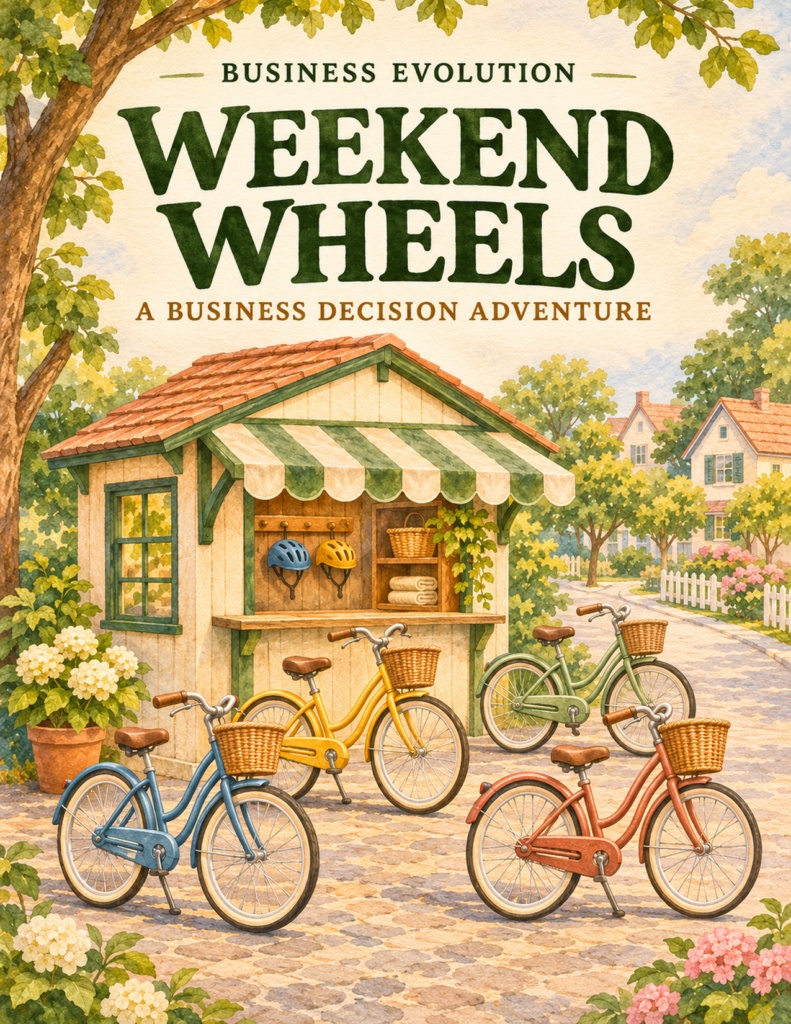
Weekend Wheels: A Business Decision Adventure is the flagship standalone release in TinyJoy Studio’s 10-book Business Evolution series. Rather than front-loading jargon, the curriculum follows a five-step learning cycle—Do It → See the Result → Name It → Use It Again → Review It—so economic vocabulary arrives after the child has felt the dilemma firsthand.
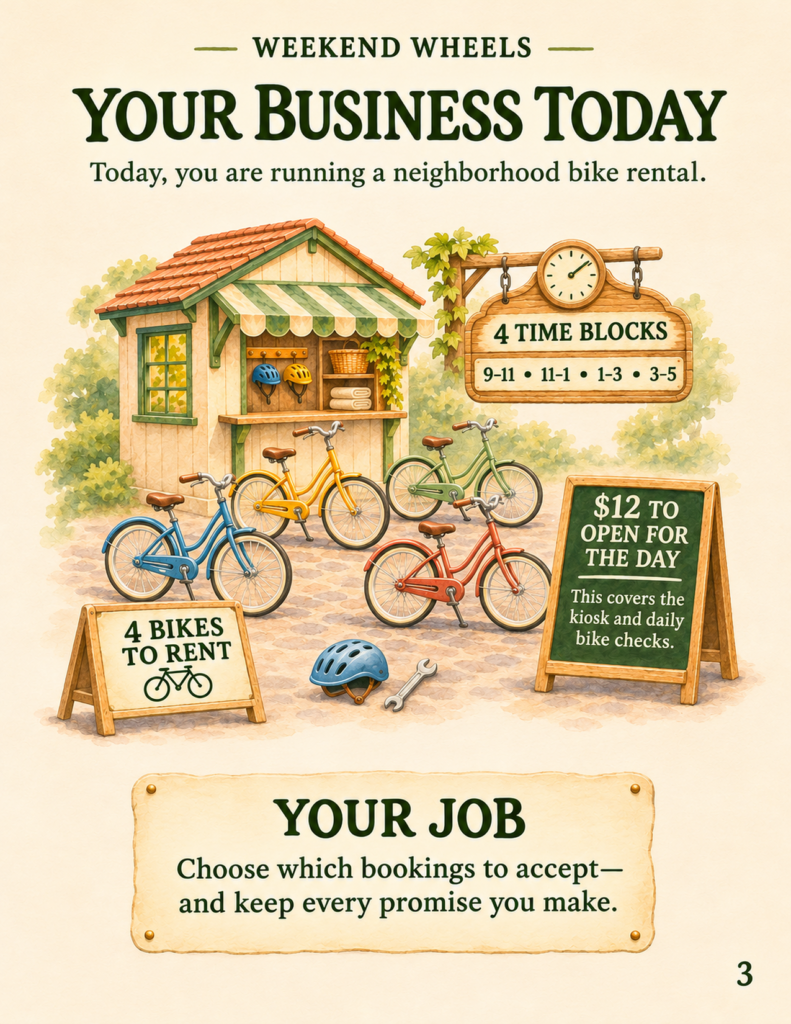
Inside the 35-page main student workbook, learners manage a neighborhood bike rental kiosk across a busy weekend:


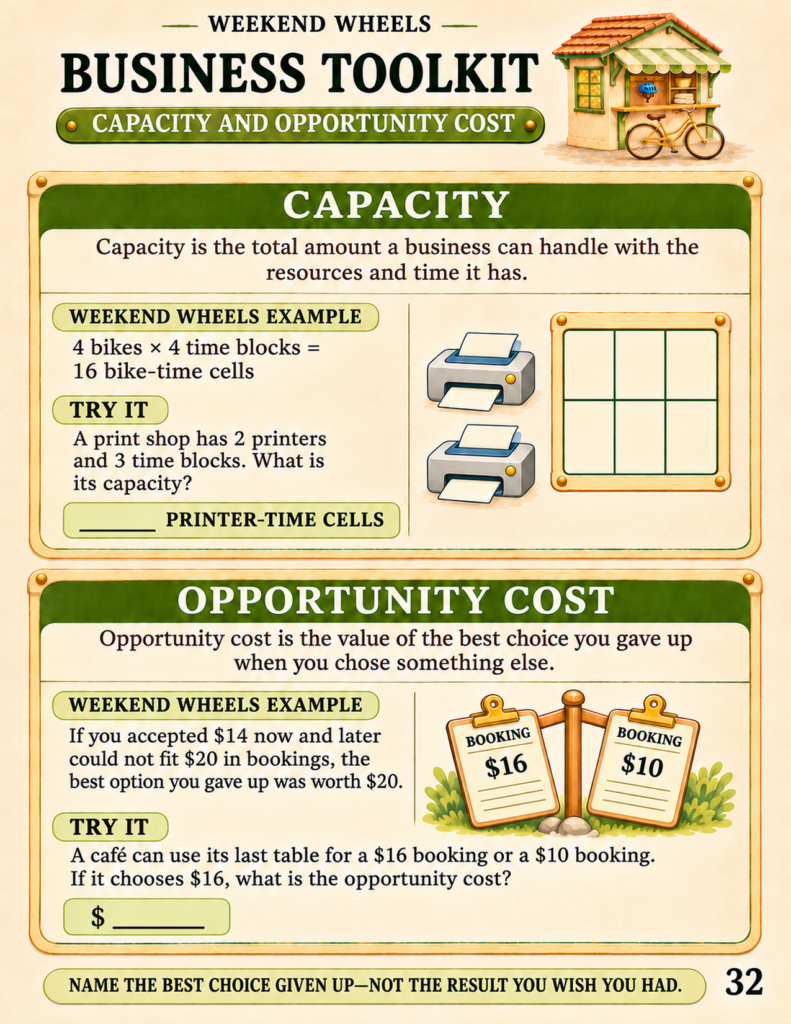
- The 4 × 4 Capacity Grid (Pages 3–10): With 4 bikes and 4 two-hour time blocks (9–11 AM, 11 AM–1 PM, 1–3 PM, and 3–5 PM), the business has an exact capacity of 16 bike-time cells. Customers pay $5 for 1 block, $9 for 2 blocks, $12 for 3 blocks, and $14 for a full-day 4-block rental. After a smaller 2-bike Guided Round to master overlap-free scheduling, students step into the full weekend.
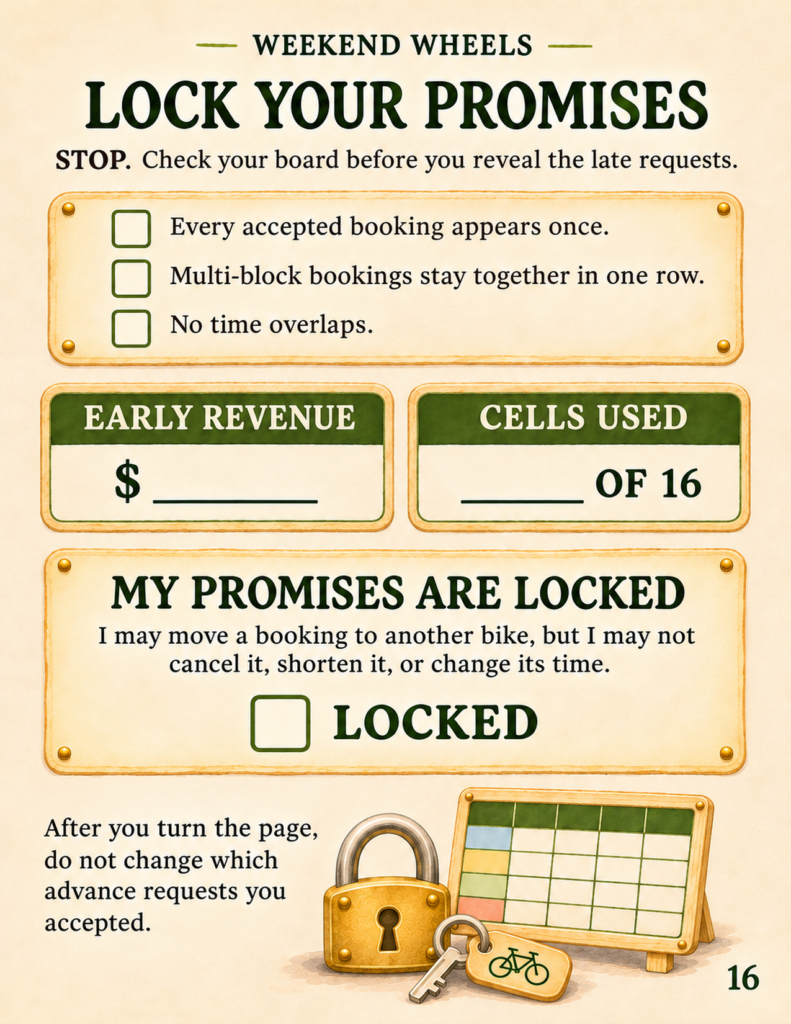
- Saturday — Locked Promises & Late Demand (Pages 12–23): Seven advance requests arrive before opening, totaling $65 if every bike is filled immediately. Before turning the page to reveal late walk-in requests, the child must check LOCKED. Once locked, an accepted booking can shift to another bike row, but it can never be canceled or shortened. Only after locking their plan do students discover seven $5 last-minute requests—learning immediately whether reserving open capacity paid off or whether a full-day $14 booking blocked $20 worth of late riders.
- Sunday — Same Rules, Zero Late Requests (Pages 24–30): Sunday begins with seven fresh advance requests, but when the child turns the page to the late wave, the phone stays completely quiet ($0 late revenue). Comparing Saturday and Sunday side by side teaches a vital business truth: a cautious plan that leaves space open can still be a sensible decision under uncertainty, even when no late customers show up.

Why This Listing Goes Beyond a One-Time Workbook
Unlike disposable worksheets that are finished once and shelved, the complete Weekend Wheels printable package is engineered as a modular, replayable tabletop learning system:
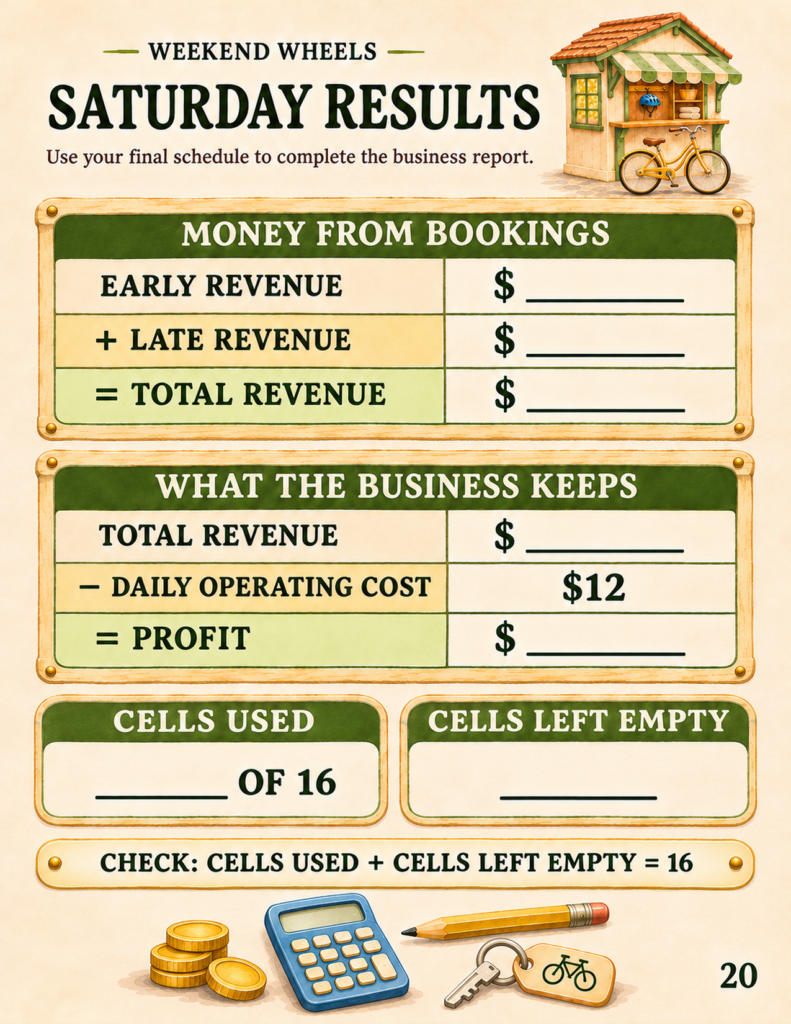
- Two Replay Modes & A 32-Card Booking Deck (6 Printable Pages): Using the cut-apart deck of 32 booking cards (including 4 «No New Booking» blank cards), a coin, and reusable Blank Booking Schedules and Business Results sheets, children can run fresh business days repeatedly. In Controlled Replay, they test different strategies against the original Saturday requests; in Brand-New Business Day, they draw 6 random first-wave cards, lock their grid, and toss a coin twice to draw 2, 4, or 6 second-wave cards.
- A 9-Page Grown-Up Companion & Rubric: Parents and teachers receive full math tables for every strategy (Fill Now, Hold 1 Bike, Hold 2 Bikes), coaching prompts that avoid giving away answers, and a free-response rubric focused on reasoning without hindsight.
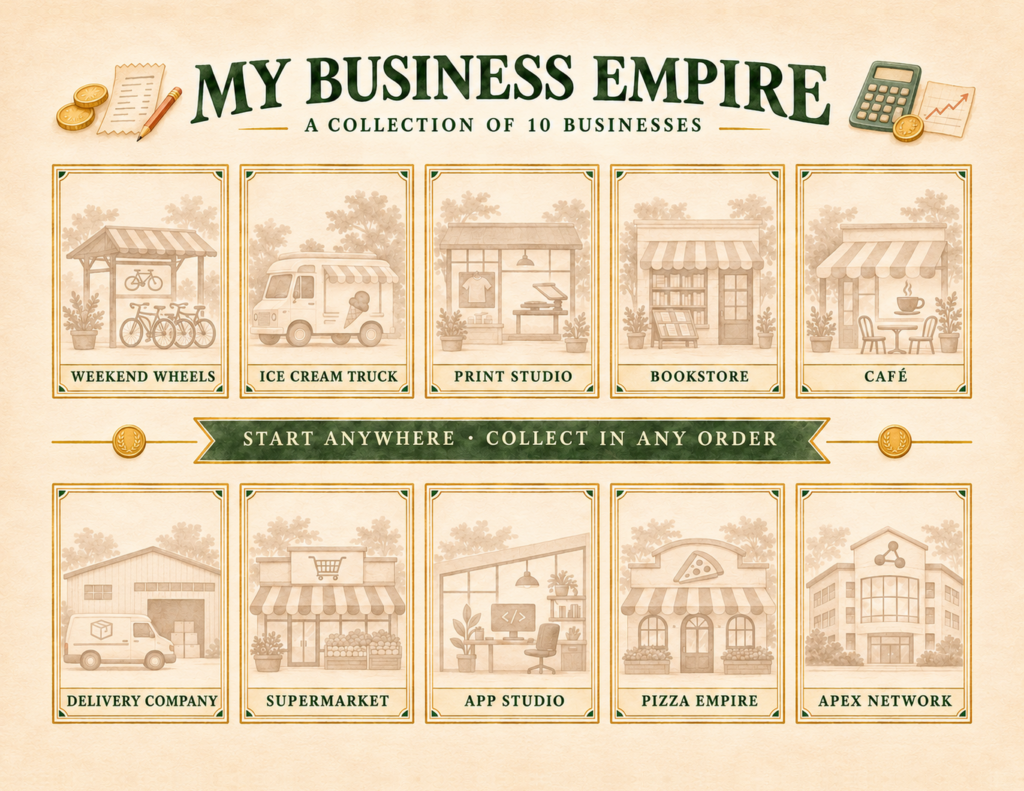
- The 10-Business Collector Portfolio (My Business Empire): Completing the Owner Review on Page 34 unlocks a cut-out Weekend Wheels business card on Page 35 to add to the My Business Empire portfolio. The broader Business Evolution line spans 10 standalone business adventures that can be started in any order—including Ice Cream Truck (Forecasting & Inventory), Print Studio (Quality Control & Rework), Bookstore (Cash Flow & Cash Reserves), Café (Team Roles & Workflow), Delivery Company (Logistics & Deadlines), Supermarket (Pricing & Demand), App Studio (Market Research), Pizza Empire (Scaling), and Apex Network (Supply Chains).


Connecting Commerce to History and Geography
Understanding how real businesses manage scarce capacity, transport routes, and unpredictable customer demand pairs naturally with broader social studies exploration. Seeing how merchants, trade networks, and resource bottlenecks shaped past civilizations enriches an interactive history for kids curriculum, while mapping how local shops, delivery corridors, and regional economies operate across continents complements a geography learning path for kids.

Practical Ways to Use Weekend Wheels at Home and School
Requiring only standard US Letter paper, a pencil, scissors, and a single coin, Weekend Wheels fits smoothly into multiple learning routines:
- A Two-Week Homeschool Economics Unit: Work through the Guided Round and Saturday simulation in Week 1, then complete Sunday, the Business Toolkit definitions (Capacity, Opportunity Cost, Revenue, Cost, Profit), and Owner Review in Week 2.
- Family Game Night & Sibling Challenges: Print extra copies of the Blank Booking Schedule so siblings or parents can draw from the same 32-card wave and compare how different risk tolerances perform.
- Classroom Math & Critical Thinking Stations: Use the Worked Replay Example in the Grown-Up Guide as a model case before letting small groups run their own coin-toss business days.
If you want a ready-to-print resource that moves financial education beyond coin-counting drills into real capacity planning, opportunity cost, and decision-making under uncertainty, Weekend Wheels gives young thinkers an engaging, replayable launchpad into how businesses actually work.