Ultimate Hands On Geography Curriculum for 1st to 3rd Grade
When homeschool parents plan their social studies and science lessons for early elementary students, geography is often pushed to the back burner. For many of us, our own memories of childhood geography involve memorizing endless lists of state capitals, coloring flat, uninspiring maps, and reading dense paragraphs about agricultural exports. It felt dry, disconnected, and tedious.
However, children between the ages of 6 and 9 (Grades 1 through 3) are at a magical developmental crossroads. According to educational psychologists, children in this phase are transitioning into the «concrete operational» stage. They are deeply curious about the world beyond their neighborhood, fascinated by wild animals, and eager to understand how things work. Yet, they still require concrete, tactile, sensory-rich experiences to anchor abstract concepts into long-term memory.
If you try to hand a 7-year-old a traditional middle-school textbook, you will be met with frustration and tears. But if you give them scissors, glue, a compelling adventure story, and a physical passport to fill with earned badges, their eyes light up. They don’t just learn geography—they experience it.
In this comprehensive guide, we will break down what makes an effective hands on geography curriculum for 1st to 3rd grade, why DIY lesson planning often leads to homeschool burnout, and how you can implement an effortless, gamified curriculum that your children will actually beg to open every single morning.
What 1st to 3rd Graders Actually Need in a Geography Curriculum
To build a curriculum that sticks, we must first strip away the misconception that early elementary geography is just about memorizing names on a globe. For 1st through 3rd graders, true geographical literacy is built upon three foundational pillars:
- Spatial Literacy and Mapping: Understanding relative direction (North, South, East, West), reading simple legends, recognizing how a spherical Earth translates onto a flat map, and identifying the differences between continents, oceans, countries, and cities.
- Earth Science and Ecosystems: Connecting geography to the natural world by exploring why extreme climates exist, how tectonic plates shape mountains and islands, where ocean currents flow, and how animals adapt to specific global biomes.
- Cultural Empathy and Global Awareness: Stepping outside of their personal bubble to realize that children across the globe eat different foods, build different styles of homes, and celebrate unique traditions—all while sharing the exact same core human values.
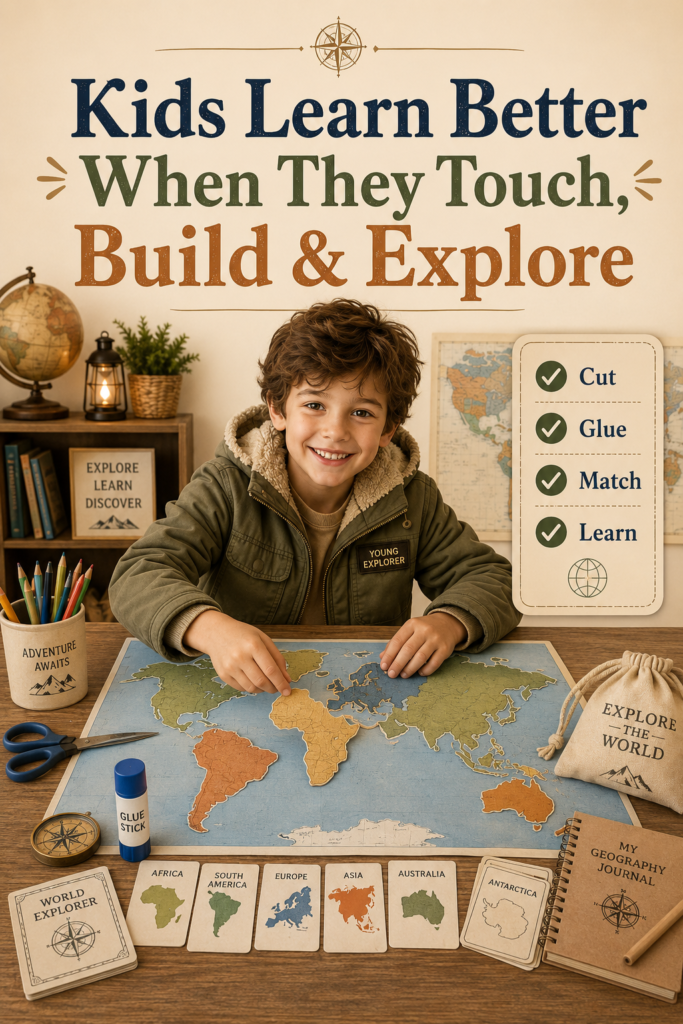
When these three pillars are taught through passive reading alone, retention drops significantly. Children need to touch, cut, build, navigate, and solve problems to truly internalize how our massive planet fits together.
(To understand why kinesthetic activities dramatically boost comprehension in early elementary students, read our deep dive on why educational games help kids learn better.)
5 Must-Have Elements of a Tactile Elementary Curriculum
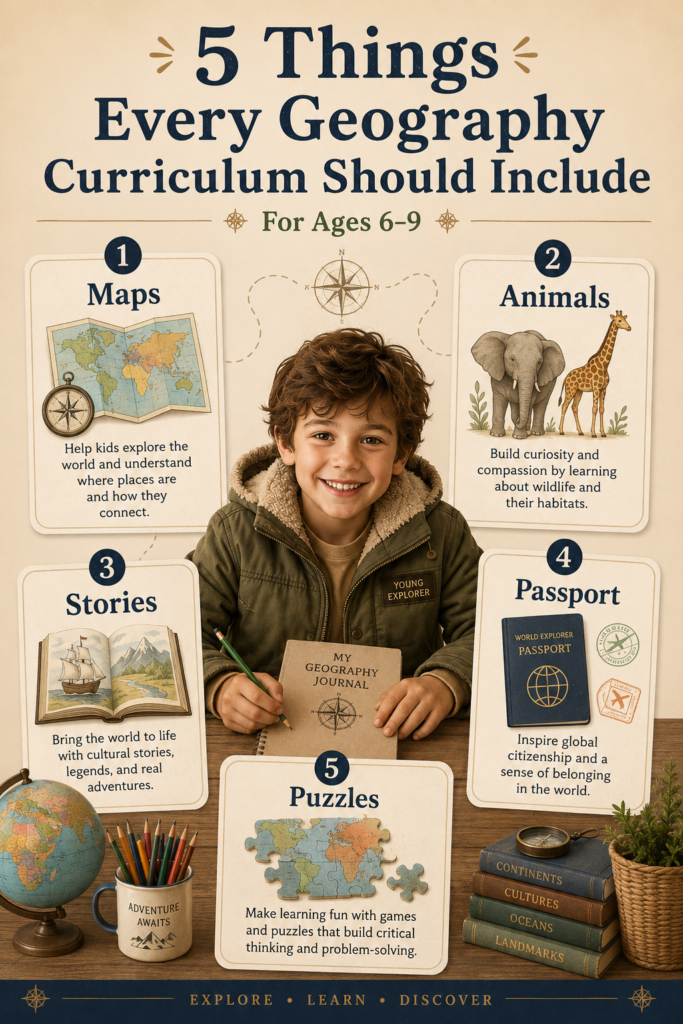
If you are evaluating a hands-on geography curriculum for your homeschool or afternoon enrichment, make sure it includes these five non-negotiable elements designed specifically for the 6-to-9 age bracket:
1. Tactile Fine-Motor Integration
At ages 6 to 9, children are still refining their fine-motor control, handwriting stamina, and hand-eye coordination. A superior geography curriculum integrates physical manipulation directly into the learning process. Look for activities that require carefully cutting out continental shapes, pasting biome stickers onto regional maps, tracing equator lines, and physically assembling puzzles. Physical manipulation creates spatial memory anchors that reading alone cannot replicate.
2. Narrative-Driven Exploration
Children are naturally wired for storytelling. Abstract facts like «The Pacific Ocean is the largest ocean» are easily forgotten. However, when a child is invited to join an enthusiastic character on a rescue mission across the Pacific, navigating around coral reefs and avoiding volcanic islands, that geographical fact becomes part of a memorable narrative. Storytelling transforms dry data into an emotional adventure.
3. Gamified Progression and Collecting
Why do early elementary students spend hours organizing trading cards or unlocking achievements in video games? Because the human brain thrives on visible progress and completion loops! An effective curriculum leverages this psychological drive by utilizing passport systems, collectible visas, and earned badges. When a child completes a lesson and physically glues a new Visa Stamp into their personal passport booklet, they receive an immediate dopamine reward that builds intrinsic motivation for the next lesson.
4. Zero-Prep Simplicity for Parents
Let us be honest about homeschool reality: As parents, our time and energy are finite resources. You might find a brilliant 12-step salt-dough mountain craft on Pinterest, but if it requires buying special clay, waiting 48 hours for it to dry, and spending an hour cleaning up your kitchen, you will eventually stop doing it. A sustainable curriculum must be open-and-go. The physical engagement should come from clever paper engineering, printable puzzles, and structured workbook challenges—not exhausting parent preparation.
5. Interdisciplinary Connections
Geography should never exist in a vacuum. The best hands-on curricula naturally weave in elementary science (such as marine habitats and weather patterns), language arts (reading folklore from different continents), and basic math (comparing the sizes of landmasses or calculating distances). This cross-curricular approach mirrors how the real world works and reinforces concepts across your entire homeschool day.
(Discover how integrating animal habitats and biological science enriches geographic exploration in our guide on how animal activity books make learning more fun.)
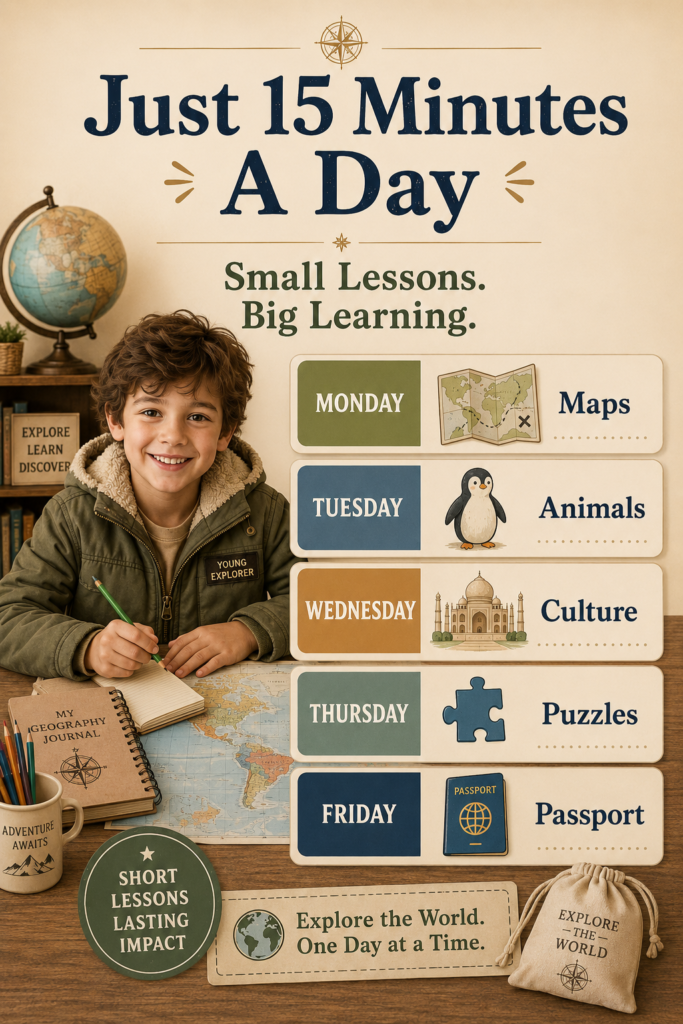
Sample Weekly Schedule: 15 Minutes a Day to Global Literacy
One of the greatest advantages of a well-structured, hands-on geography curriculum is that it does not require hours of rigid desk time. At this age, short, focused bursts of interactive play are far more effective than long lectures.
Here is how you can easily structure a high-retention, open-and-go geography loop into your homeschool week using just 15 to 20 minutes per day:
| Day of the Week | Core Focus Area | Sample Hands-On Activity | Parent Prep Time |
| Monday | Spatial Mapping | Tracing continent outlines and labeling the 5 major oceans with color-coded pencils. | 1 Minute |
| Tuesday | Earth Science | Navigating an «Iceberg Maze» to understand polar currents and glacier formations. | Zero Prep |
| Wednesday | Biomes & Animals | Cutting out native animal badges and matching them to their specific continental habitats. | 2 Minutes (scissors/glue) |
| Thursday | Cultural Discovery | Exploring global landmarks and reading a short folktale from the target region. | Zero Prep |
| Friday | Gamified Review | Completing the regional challenge, cutting out the official Visa Stamp, and pasting it into the Passport! | 2 Minutes |
Why «DIY Pinterest Curriculum» Leads to Homeschool Burnout
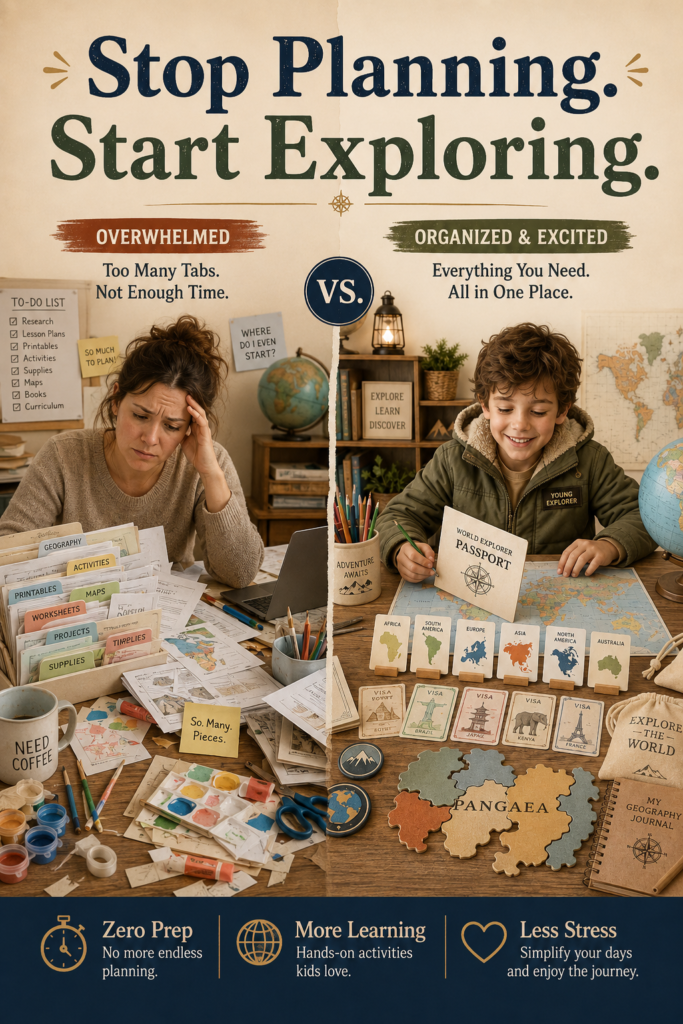
Many dedicated parents start the school year with immense enthusiasm, determined to build their own hands-on geography curriculum from scratch. They print random coloring sheets from ten different websites, buy expensive crafting supplies, and spend Sunday nights bookmarking elaborate science experiments.
By November, reality hits. The disjointed worksheets end up crumpled at the bottom of a drawer, the craft supplies create overwhelming clutter, and the sheer mental load of inventing a cohesive lesson plan every week leads to severe burnout. Without a unified framework, children fail to see how the individual activities connect, and parents feel like they are constantly falling behind.
To maintain consistency throughout the entire school year, you need a professionally designed framework that does the heavy lifting for you. You need a curriculum that provides the tactile joy of DIY crafts combined with the effortless, structured progression of a premium workbook.
(To learn more about structuring educational progress without parental burnout, explore our article on geography learning through adventure and progression.)
Meet Your Homeschool Solution: The World Explorer Series
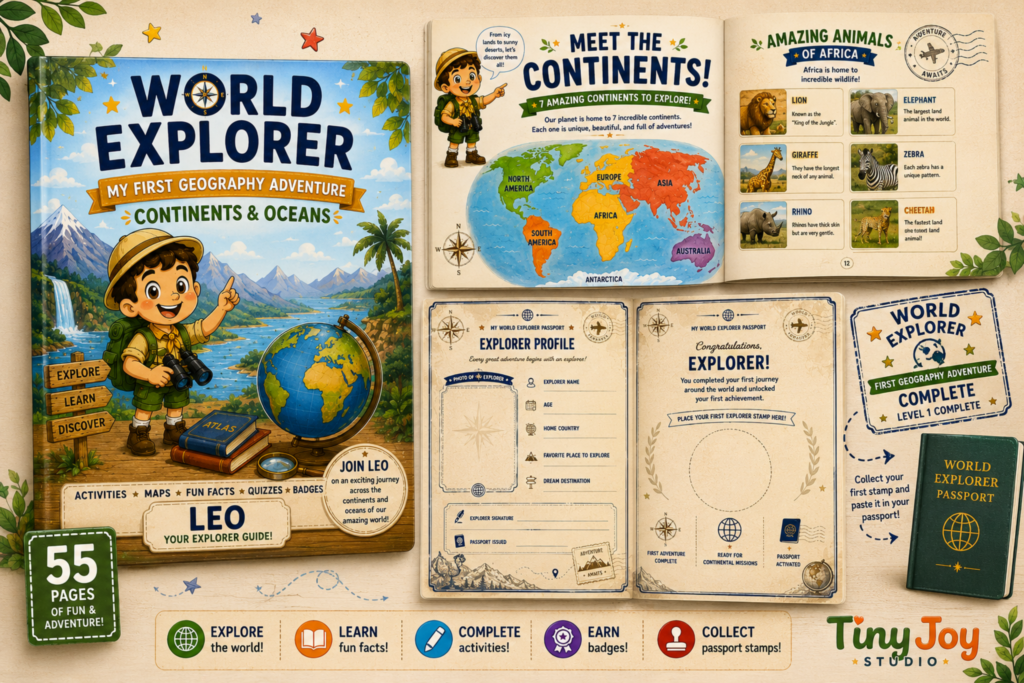
If you are searching for the ultimate hands-on geography curriculum for your 1st to 3rd grader—one that requires zero prep work, eliminates boring memorization, and ignites a genuine love for our planet—look no further than Level 1: Continents & Oceans from the acclaimed World Explorer Series by Tiny Joy Studio.
Designed specifically by educators and homeschool designers for 6- to 9-year-olds, this comprehensive printable curriculum replaces passive textbook reading with an interactive, open-and-go global expedition. Led by an inspiring cartoon guide named Leo, your child step-by-step uncovers the mysteries of our Earth through puzzles, paper engineering, and captivating storytelling.
Why Homeschool Families Praise Level 1:
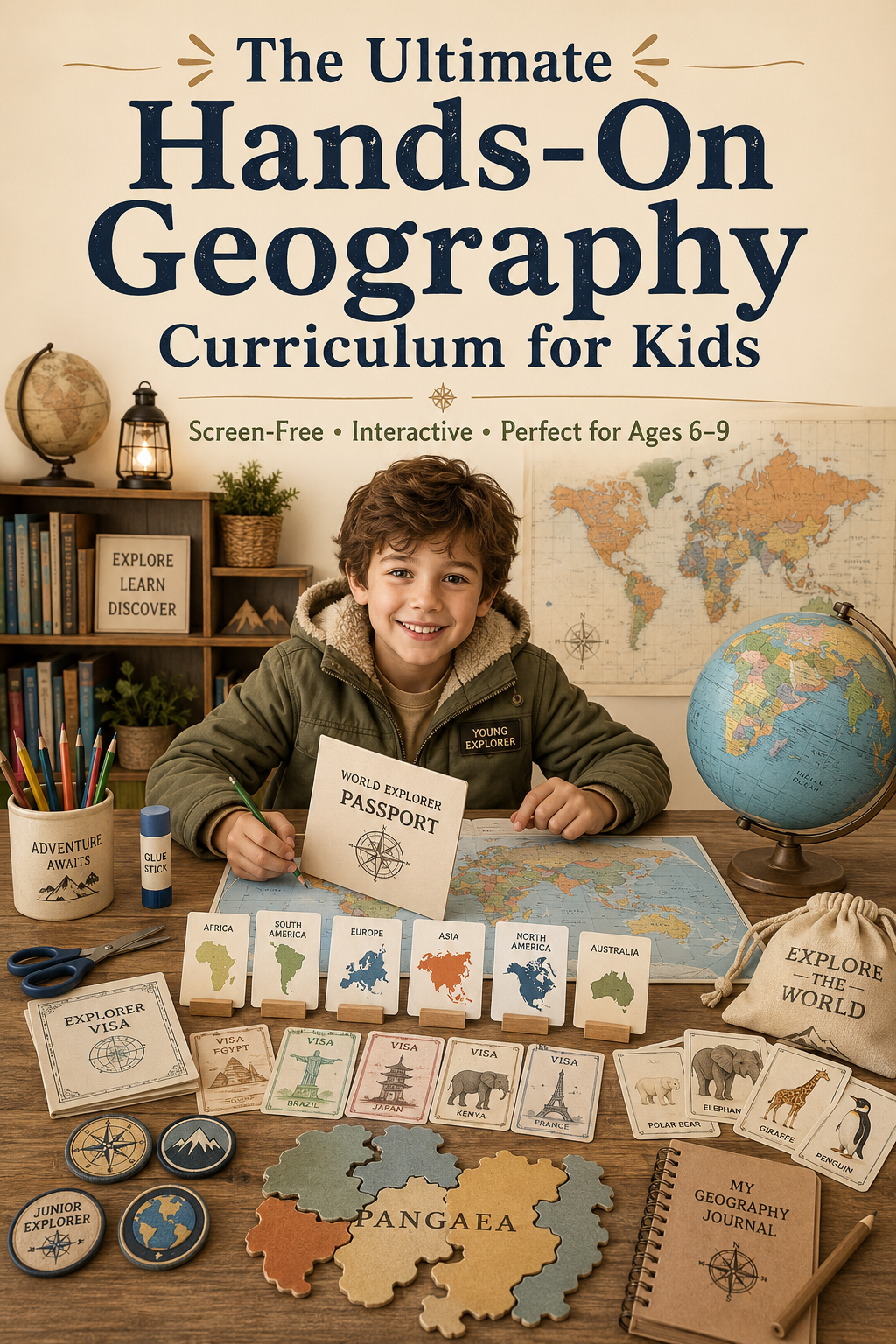
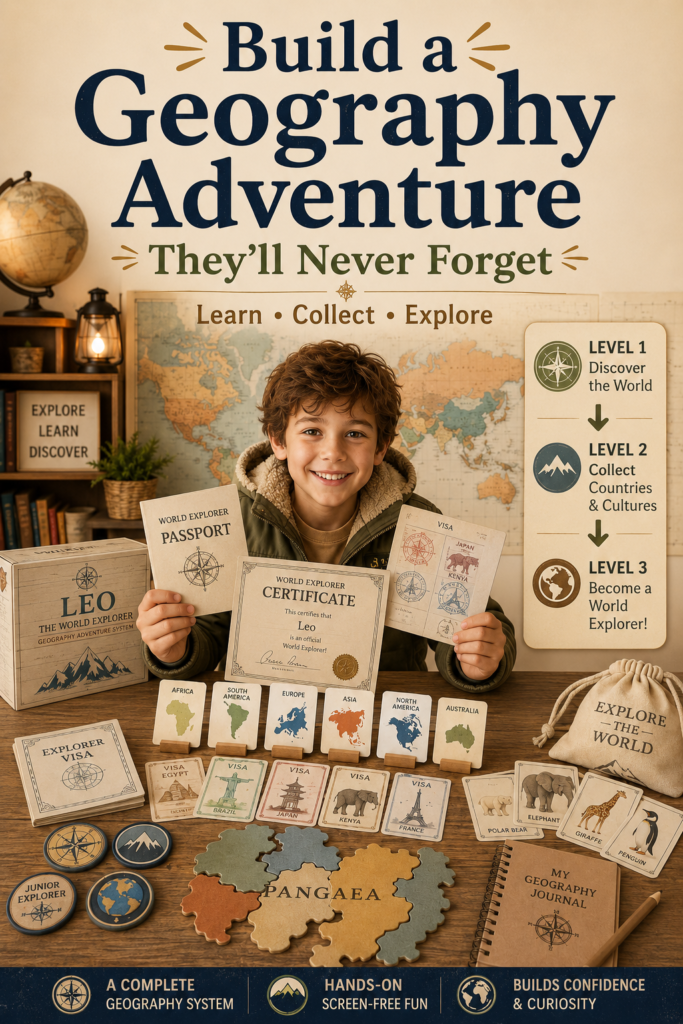
- The Universal Passport Ecosystem: At the heart of the Tiny Joy Studio method is the Universal World Explorer Passport. Your child begins their journey by personalizing their official booklet—writing their name, recording their age, and drawing their explorer portrait. This simple act creates instant emotional ownership over their learning.
- A Structured 3-Level Progression: Unlike random activity packs, the Universal Passport is built to grow with your child across their elementary years, featuring 38 dedicated collection slots:
- Level 1 (The Foundation): Mastering foundational earth science, tectonic plates, ocean currents, and the major continents with the Continents & Oceans Activity Book.
- Level 2 (The Continents): Earning 8 Continental & Ocean Visas by taking deep, interactive dives into specific regional biomes and cultures.
- Level 3 (The Countries): Earning 30 distinct Country Visas by zooming in on individual nations, landmarks, and global traditions!
- 100% Tactile and Kinesthetic: Say goodbye to passive reading! In Level 1, your child will physically cut out continent shapes to solve Pangaea puzzles, navigate marine rescue ships through ocean currents, match climate zones to native wildlife, and decode spatial mapping legends. Every lesson requires active brain and hand participation.
- Earned Dopamine Rewards: When your child masters a continental zone or solves an earth science challenge, they don’t get a meaningless checkmark. They earn beautiful, illustrated Badges and Visa Stamps that they carefully cut out and glue directly into their Universal Passport. It transforms homeschooling into a rewarding, gamified quest!
- Instant, Budget-Friendly Digital Delivery: Available exclusively via Etsy as high-resolution printables, you never have to worry about expensive shipping fees or waiting for physical mailers. You can download the entire curriculum instantly, print exactly what you need at home, and start your global expedition within five minutes!
Final Thoughts: Raise a Global Citizen Today
Teaching geography to 1st, 2nd, and 3rd graders should be one of the most exciting parts of your homeschool day. It is a chance to open your child’s eyes to the breathtaking diversity of our planet, foster deep empathy for other cultures, and build critical spatial and scientific skills that will serve them for a lifetime.
You don’t need exhausting prep work, messy clay crafts, or dry academic textbooks to make geography memorable. All you need is a structured adventure, tactile engagement, and a passport waiting to be filled with earned achievements.
Ready to transform your elementary social studies routine into an unforgettable daily quest? Grab your scissors, colored pencils, and glue sticks. Download your copy of Level 1: Continents & Oceans and set up your child’s very own Universal Passport today directly via the Tiny Joy Studio Etsy Shop.
The world is too big and exciting to learn about from a boring textbook—let’s go explore it!