How to Teach Moon Phases, Eclipses, and Tides as One Connected System
Ask an elementary student why the Moon changes shape each month, and you will almost certainly hear a common misconception: “Earth casts a shadow on it.”
If you press a bit further and ask why eclipses do not occur every single month during a New or Full Moon, or how an orb 238,000 miles away pulls two opposite sides of Earth’s oceans into tidal bulges, even textbook diagrams often fail to provide a clear answer.
Standard science printables tend to treat the Moon like a static vocabulary matching task. Children trace eight crescent and gibbous outlines, perhaps scrape cream off chocolate sandwich cookies, and memorize phase names without ever understanding the spatial perspective that creates them.
Overcoming these persistent misconceptions requires shifting from flat 2D drawings to three-dimensional orbital mechanics. A truly effective moon phases and eclipses workbook approaches the cosmos as an interconnected mechanism, where position, lighting angles, observer perspective, and gravity work simultaneously.
Why Lunar Science Demands 3D Systems Thinking
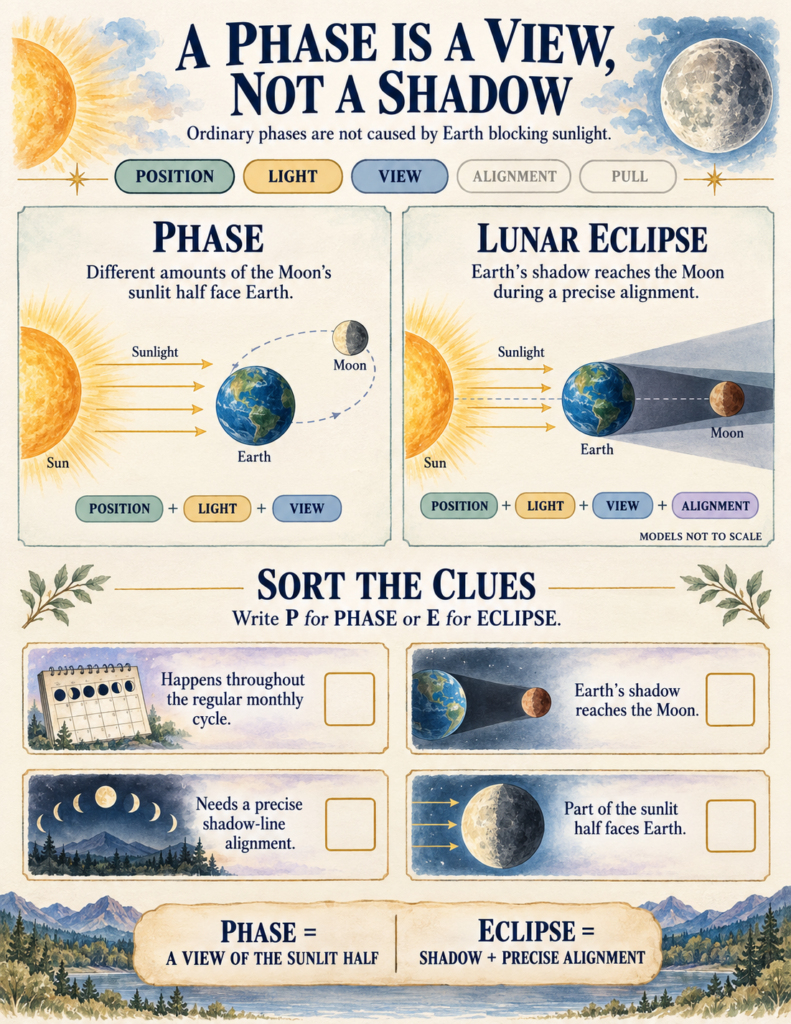
When children study astronomy through disconnected worksheets, they struggle to separate lighting from shadowing. They fail to grasp that outside of a rare lunar eclipse, exactly one-half of the Moon is always illuminated by the Sun. The phase we observe from our backyard is simply our changing vantage point of that sunlit half as the Moon travels around Earth.
This orbital reality bridges directly to broader astronomical principles. Once a child understands how the Moon circles Earth while Earth orbits the Sun, their perspective expands to the broader architecture of our solar neighborhood.
To help young learners see how these gravitational paths fit into our broader planetary neighborhood, exploring our guide to Solar System Explorer Workbook provides a natural bridge from lunar orbits to interplanetary exploration.
Untangling Phases from Planetary Shadows
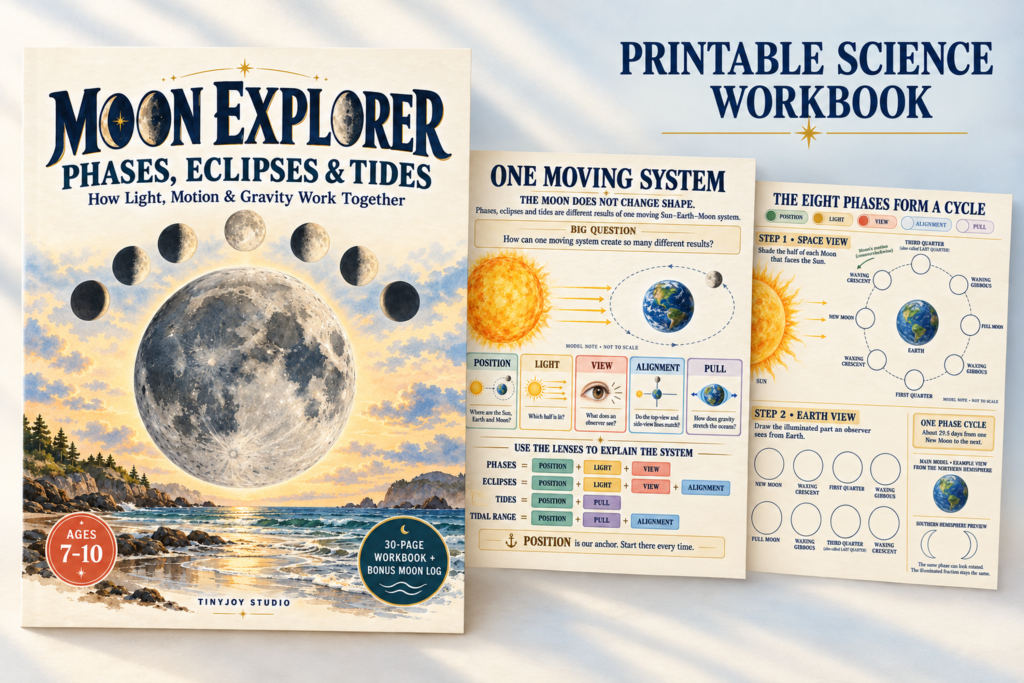
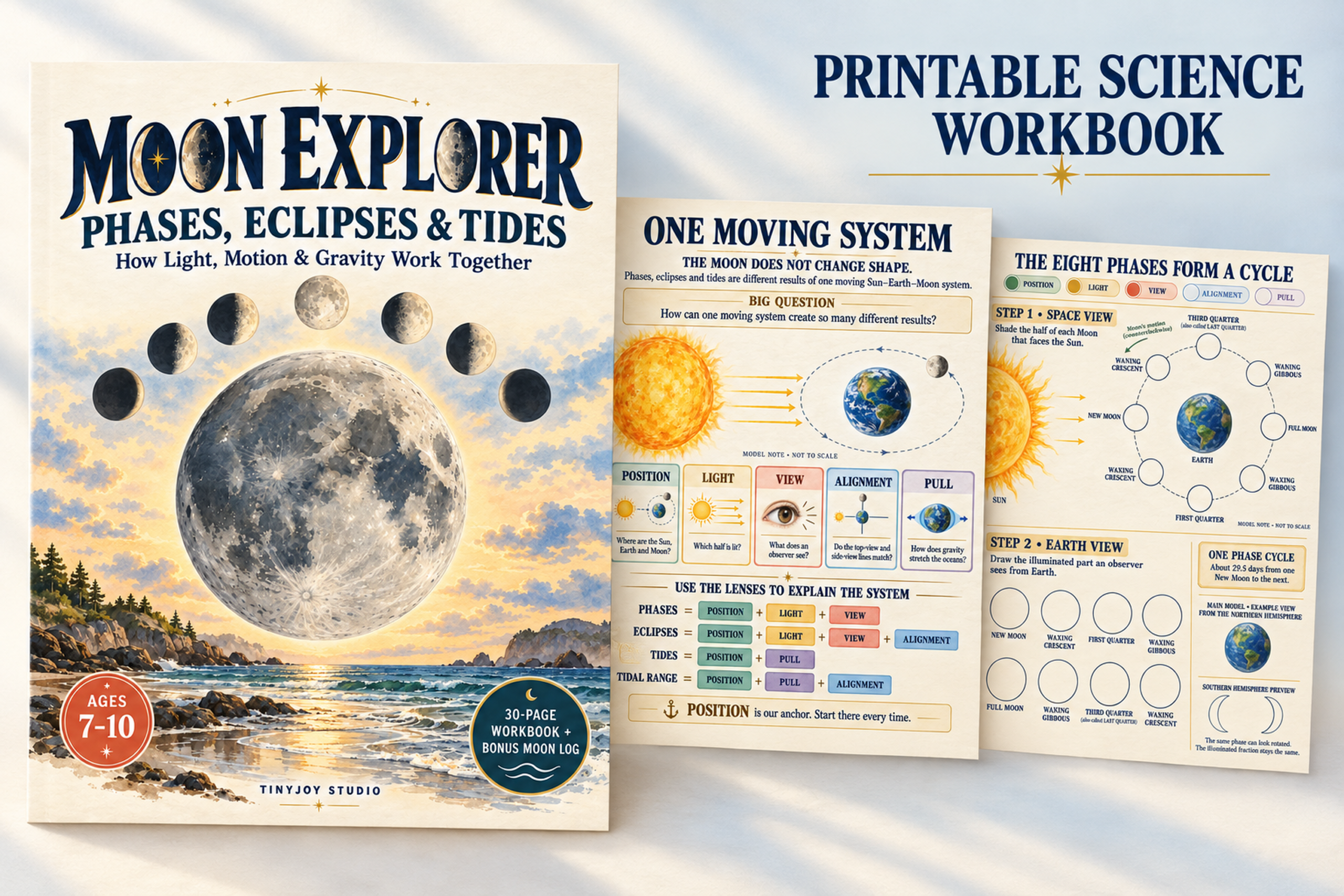
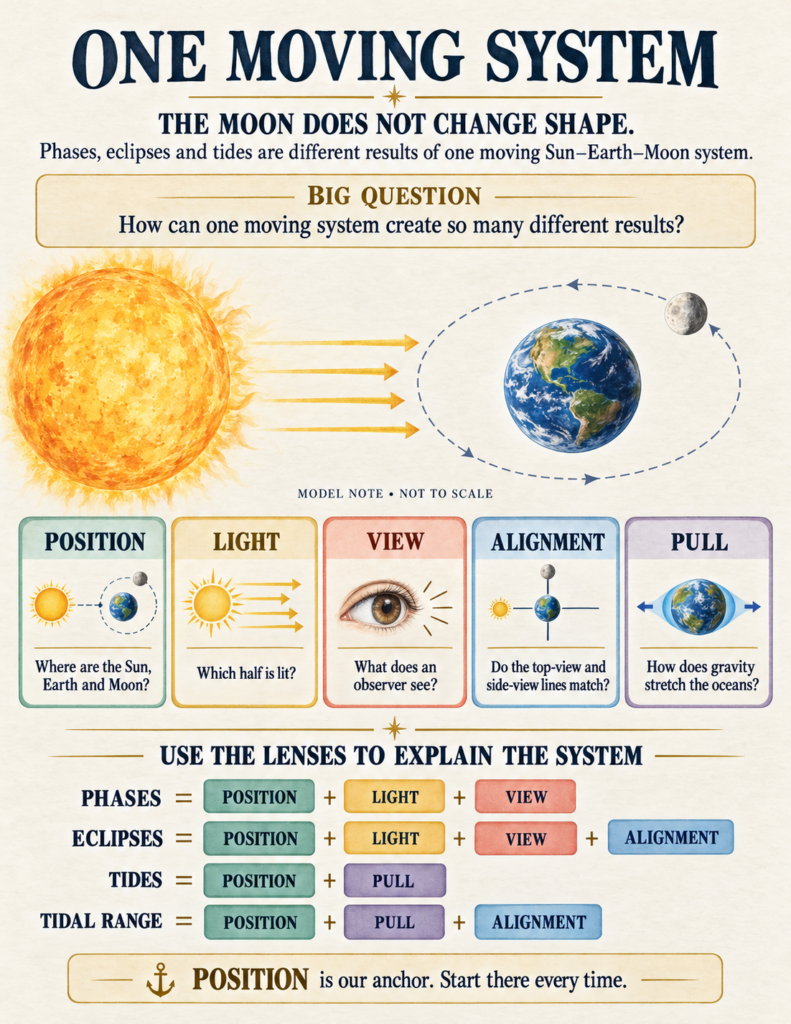
Designed for children ages 7–10, the 30-page Moon Explorer: Phases, Eclipses & Tides directly confronts elementary misconceptions using five analytical «Moon Lenses»: Position, Light, View, Alignment, and Pull.
Instead of presenting an eclipse as an everyday occurrence, the workbook separates the concept of a perspective view from a physical shadow line:
- Phases ($Position + Light + View$): Sunlight continually covers half the lunar sphere. Our view changes as the Moon advances along its orbit, revealing differing slices of the illuminated half.
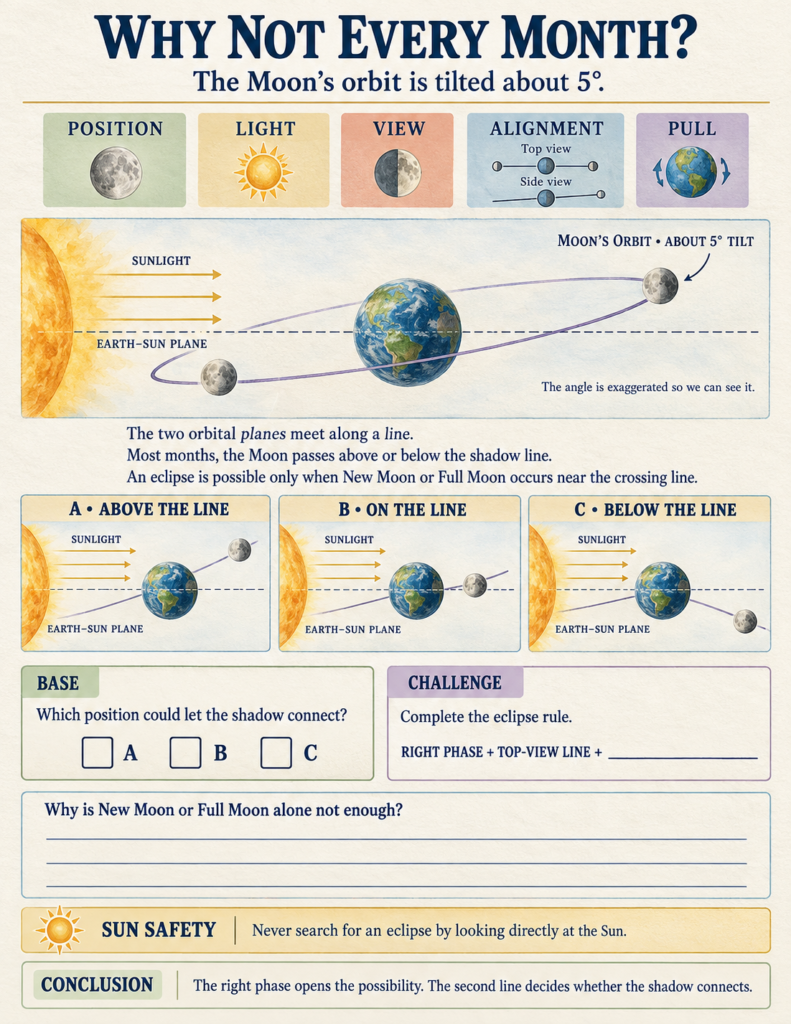
- Eclipses ($Position + Light + View + Alignment$): An eclipse demands strict spatial geometry. Because the Moon’s orbital path is tilted roughly $5^\circ$ relative to the Earth-Sun plane, the Moon passes safely above or below Earth’s shadow cone during most months.
By evaluating both top-view orbital paths and side-view shadow lines, children deduce why a New Moon or Full Moon alone is never enough to trigger an eclipse.
They examine how the two orbital planes cross, learning that both the horizontal line and the vertical alignment must match precisely before an umbral shadow can connect.
Linking Gravitational Pull to Living Earth Systems
Astronomy is not an isolated discipline confined to outer space; cosmic mechanics directly shape terrestrial habitats. In Moon Explorer, students discover that the same position that determines a sky phase also dictates oceanic movement on Earth.
Through guided data analysis, learners explore gravitational tidal bulges:
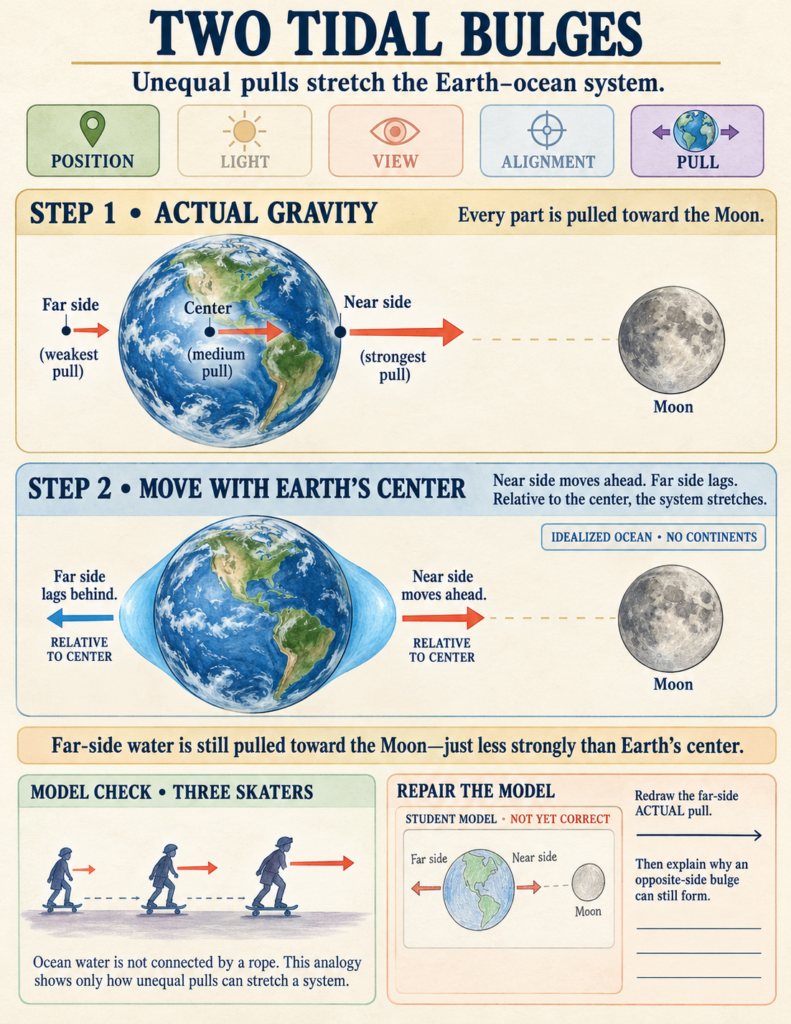
- Differential Gravity: Gravity acts on every part of our planet, but distance weakens its intensity. The near-side ocean is pulled toward the Moon more strongly than Earth’s solid center, while the far-side ocean experiences the weakest pull, causing water to lag behind and form two simultaneous bulges.
- Spring vs. Neap Tides: During New and Full Moons, the Sun and Moon pull along the exact same spatial axis, compounding their force to create higher tidal ranges (spring tides). During Quarter phases, their perpendicular orientation produces smaller tidal ranges (neap tides).
Understanding these oceanic rhythms helps children see how planetary forces regulate living environments on Earth. Just as celestial gravity moves ocean tides, continuous environmental loops move water, light, and nutrients across our planet’s biomes.
To see how global water cycles and solar energy sustain complex biological habitats, exploring our review on Rainforest Explorer Workbook reveals how sunlight and moisture power diverse biomes from the canopy down to the soil.
From Astronomical Data to Coastal Geography
In the culminating capstone case study, The Harbor Point Case File, students apply everything they have practiced to solve an integrated real-world puzzle:
- An observational sky log notes a round Moon rising near sunset.
- A tide gauge records a massive 4.2-meter tidal range.
- Yet, no eclipse occurred in the sky.
Students synthesize the data: the Full Moon alignment explains the large spring tide, the absence of an eclipse confirms the Moon passed above Earth’s shadow line, and local funneling in the narrow harbor amplified the water height.
This exercise shows children that science does not exist on isolated worksheets—it interacts with coastal shape, ocean depth, and geography.
Human history and settlement patterns have always been deeply tied to these geographical realities. For parents looking to integrate physical science with geopolitical history, our overview on Countries & Capitals Workbook demonstrates how coastal harbors, inland waterways, and terrain trade-offs influenced where human civilizations built their greatest administrative centers.
Practical Strategies for Home and Classroom
Because Moon Explorer is self-contained with embedded model audits, observational field logs, and full answer keys, it adapts cleanly to various instructional schedules:
- Homeschool Astronomy Block: Work through two pages per day over a 3-week unit, tracking the real sky using the included 14-observation Moon Log.
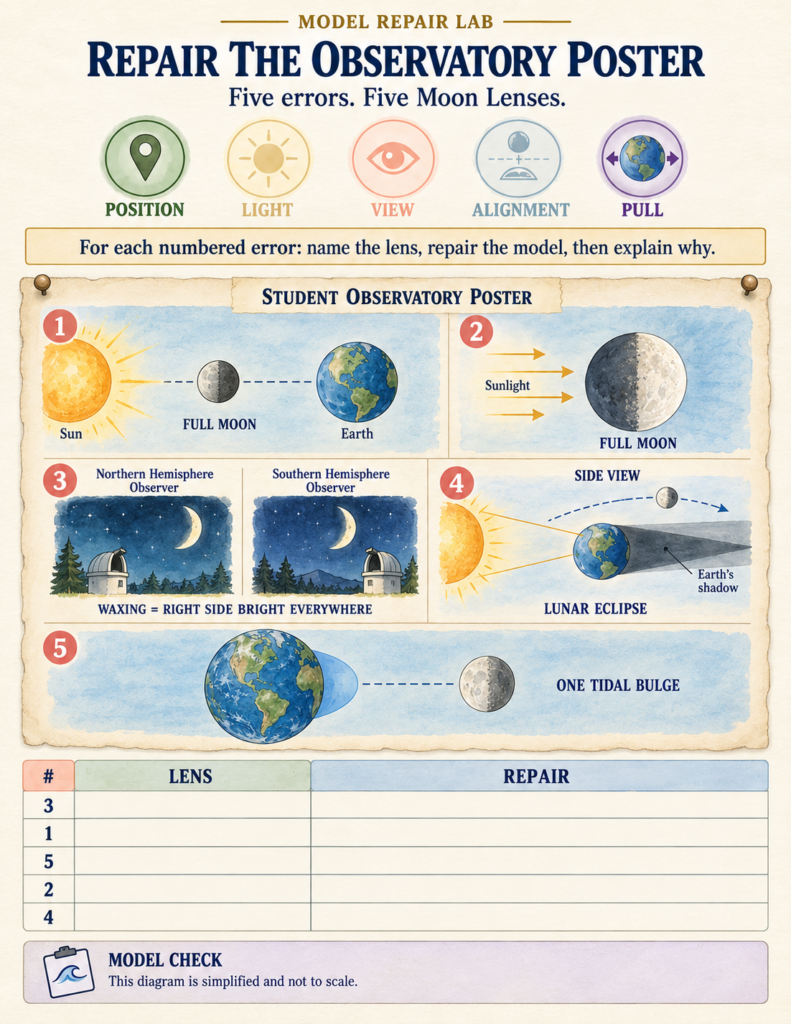
- Classroom Science Centers: Laminate model repair sheets (such as the «Observatory Poster Repair») for collaborative small-group discussions.
- Observational Homework: Have students complete short evening sky logs to verify that the illuminated fraction grows and shrinks over a predictable 29.5-day cycle.
If you are ready to replace memorization drills with genuine spatial reasoning, orbital modeling, and gravitational discovery, Moon Explorer offers an engaging, structured journey through our dynamic night sky.