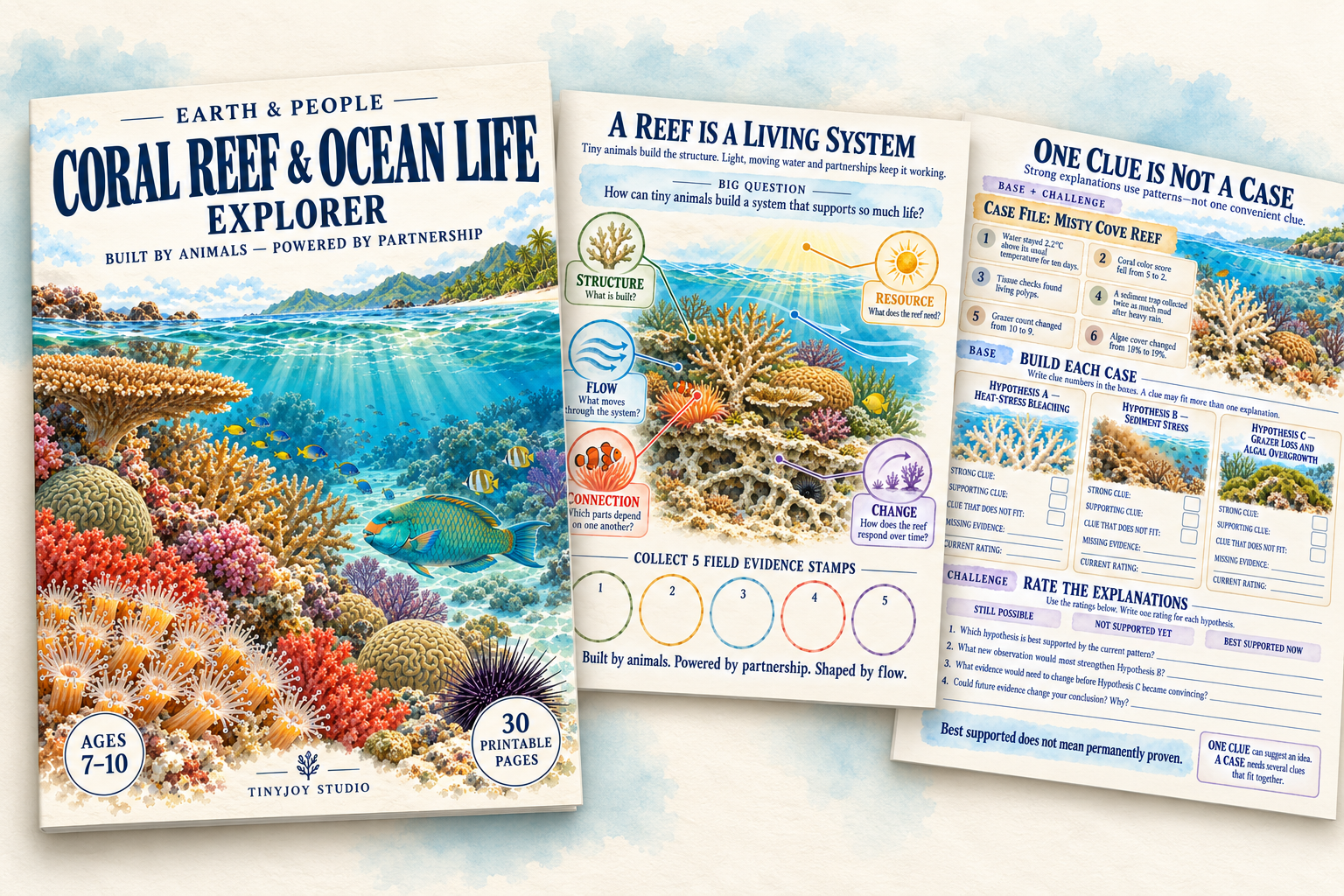
Coral Is an Animal: Teaching Marine Ecology Through Real Field Data
If you ask an eight-year-old whether a coral reef is an animal, a plant, or a rock, you will almost certainly get an energetic debate. It looks like colorful stone, it roots to the seabed like a bush, yet it catches plankton with stinging tentacles.
Most elementary ocean curriculum glosses right over that wonder. Worksheets typically provide a cartoon clownfish, a sea turtle, and a vocabulary word search. Children finish the unit knowing that reefs are colorful and endangered, but completely unaware of how a colony of soft-bodied polyps can construct limestone barriers large enough to buffer coastlines from storm waves.
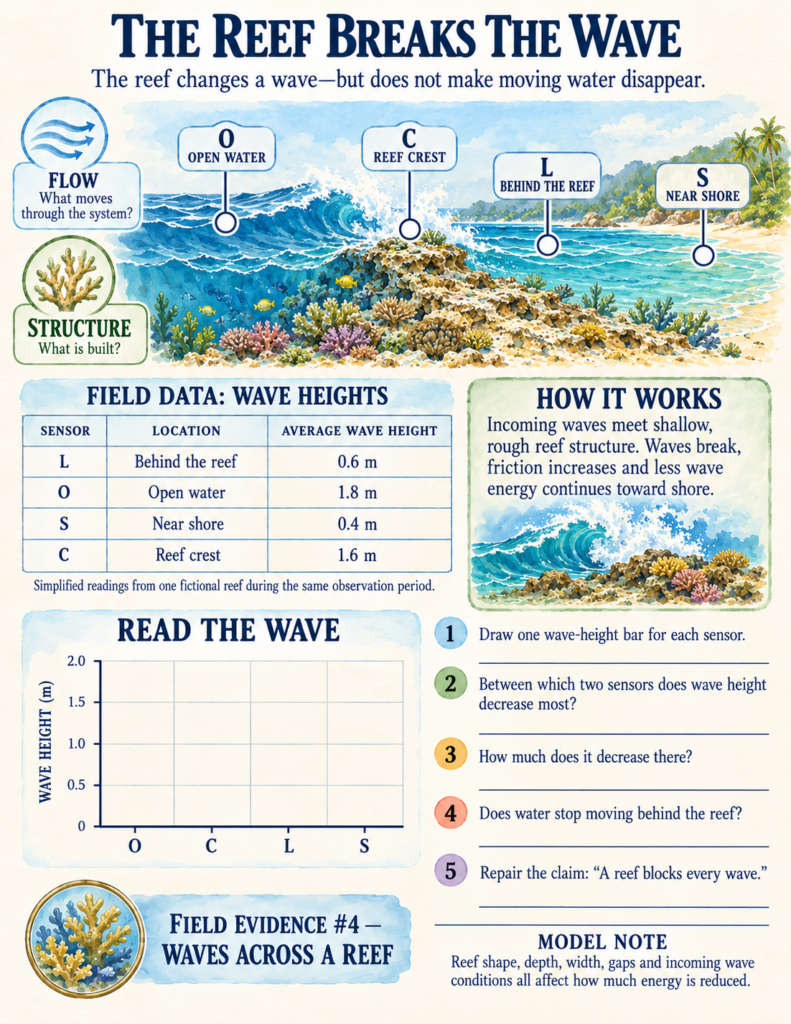
Bridging the gap between surface-level nature trivia and authentic ecological reasoning requires a hands-on approach. A well-crafted coral reef workbook does not ask students to color pre-drawn sea creatures; it puts them in the boots of a marine biologist analyzing depth transects, charting wave friction, and auditing scientific models.
The Architecture of an Animal-Built World
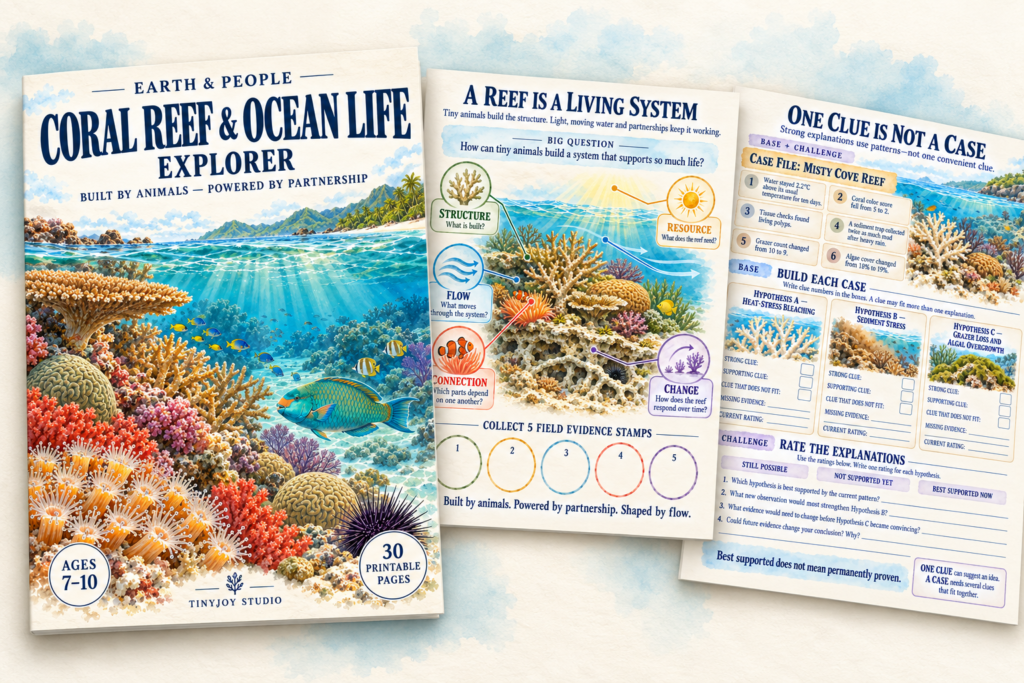
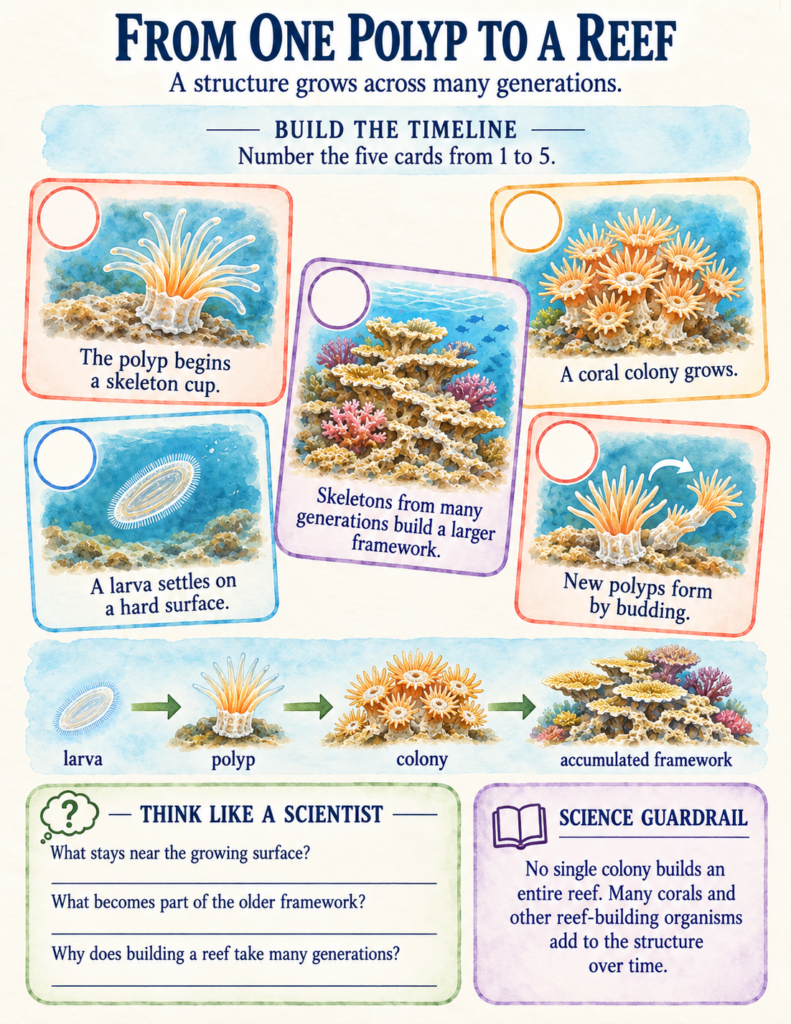
Before children can understand ocean food webs, they must understand who builds the foundation. In Coral Reef & Ocean Life Explorer (a 30-page printable unit geared toward ages 7–10), the study begins with a foundational reality check: a reef is not a single giant organism, nor is it lifeless rock.
The live animal is actually a thin «living skin» of soft polyps sitting atop generations of accumulated calcium carbonate skeletons. Students trace the life timeline of a reef builder step-by-step:
- A free-swimming planula larva drifts until it locates hard substrate.
- The settled polyp secretes a hard limestone cup.
- It multiplies by budding, expanding into an interconnected colony.
- Over decades and centuries, colonies fuse and accumulate into monumental marine topography.
Just as human settlements adapt their architecture to natural trade routes and regional terrain—a concept we explored in our look at Countries & Capitals Workbook—corals engineer physical structures that permanently reshape coastal waterways.
Hydrodynamics and the Geometry of Growth
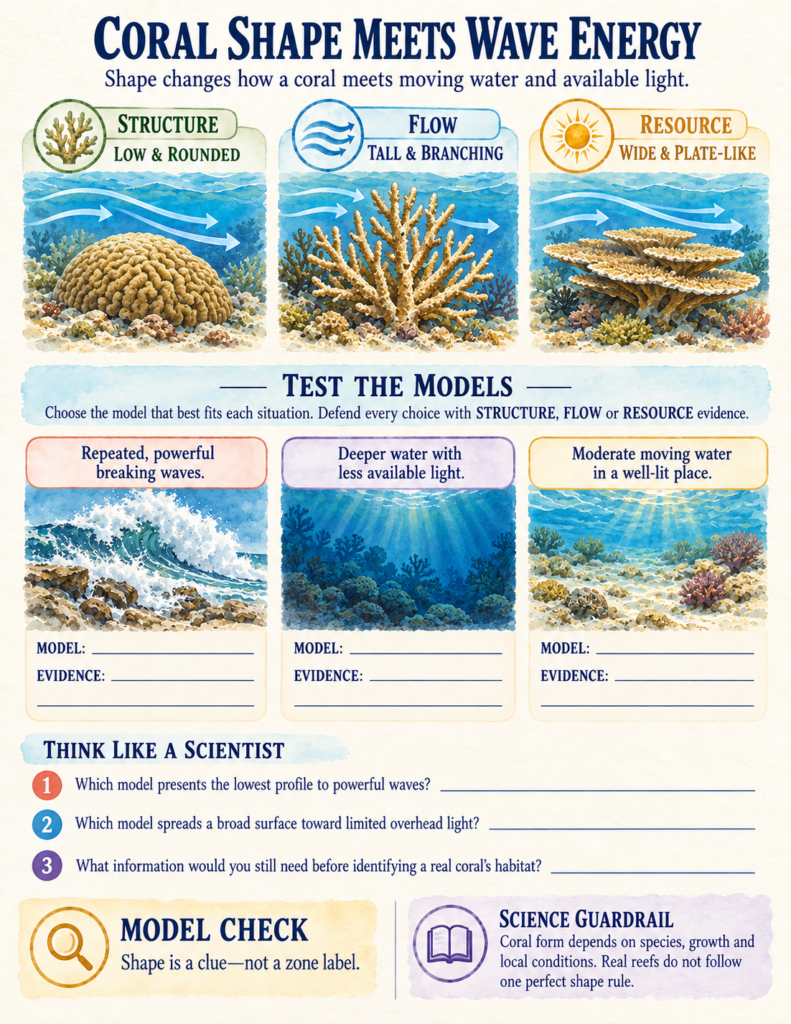
Why are some corals shaped like massive rounded boulders, while others branch out like antlers or form flat, stacked dinner plates?
Standard science texts treat these shapes as random aesthetic variations. Coral Reef Explorer turns them into an engineering puzzle governed by fluid dynamics and light availability:
- Low & Rounded Corals: Expose a minimal profile to minimize drag, allowing massive colonies to withstand crushing surf at the reef crest.
- Tall & Branching Corals: Maximize surface area to catch suspended food particles in moderate, well-lit currents.
- Wide & Plate-Like Corals: Spread horizontally in deeper water, acting like solar panels tilted toward fading overhead rays.
Students test these principles through the «Reef Transect Lab,» plotting observational stations from the sheltered lagoon across the turbulent crest down into the fore-reef slope.
Understanding how physical gradients govern living systems is a universal scientific thread. When students study how canopies filter sunlight in terrestrial biomes—as detailed in our guide to Rainforest Explorer Workbook | URL: https://tinyjoystudio.com/tropical-rainforest-workbook-living-systems/—they notice the exact same vertical stratification at work beneath the sea.
Resolving the «Rich Soup» Paradox
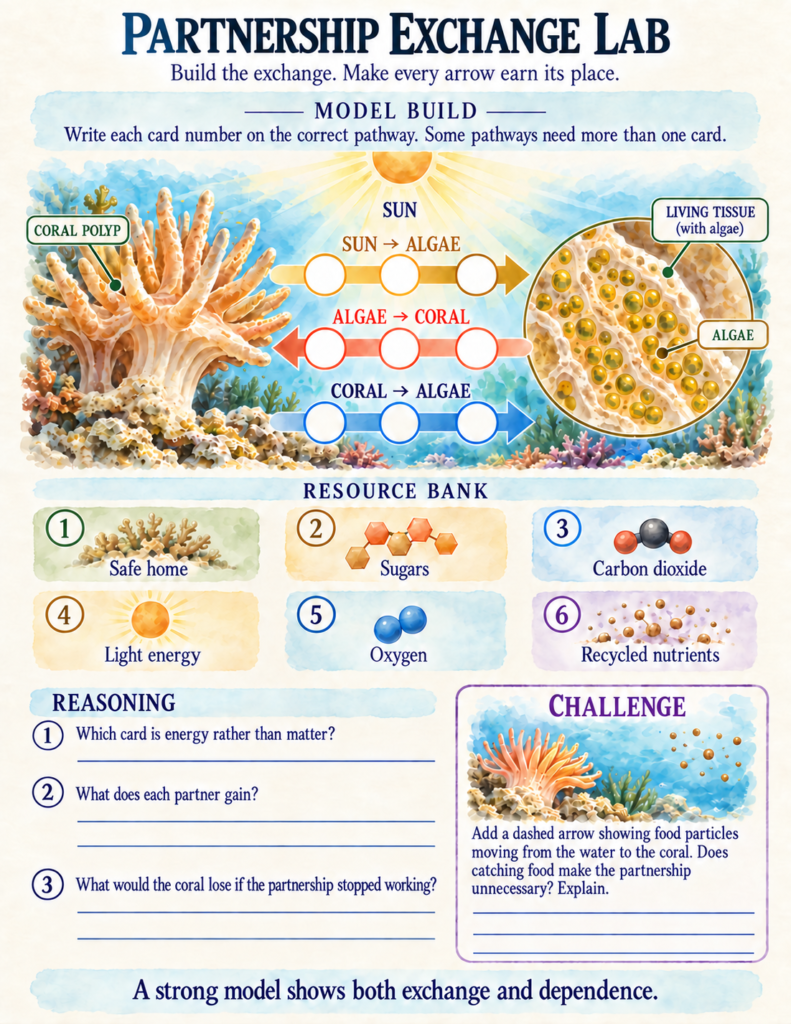
One of the greatest scientific paradoxes tackled in the workbook is known as Darwin’s Paradox: Why do coral reefs teem with boundless life when the tropical ocean water surrounding them is crystal clear and virtually devoid of dissolved nutrients?
Children often assume clear water equals an endless soup of dissolved plant food. The workbook guides students to audit and dismantle that assumption:
- The Symbiotic Engine: Microscopic algae living safely inside the coral’s translucent tissues capture sunlight to produce glucose and oxygen. In return, the coral supplies sheltered carbon dioxide, nitrogen, and phosphorus.
- Tight Nutrient Loops: Instead of allowing metabolic waste to wash away into open ocean currents, the reef system captures, recycles, and retains materials in a nearly closed cycle between decomposers, algae, grazers, and corals.
This dynamic mirrors planetary conservation laws throughout science. Much like the delicate balance of gravity and inertia keeping planetary bodies in stable orbits—which we discussed in our article on Solar System Explorer Workbook —a living reef survives only through an unbroken mechanical and chemical equilibrium.
Analyzing Real Field Surveys and Bleaching Events
Coral Reef Explorer stands out because it treats children as capable field scientists who evaluate multi-variable tables rather than passive readers.
In the «Grazer Field Survey,» students review counts of parrotfish and sea urchins across three distinct reef patches. By comparing grazing visits per hour with macroalgae percentage and new larval settlement, learners deduce that herbivores are crucial space-makers: without constant grazing, aggressive seaweeds crowd out juvenile coral larvae.
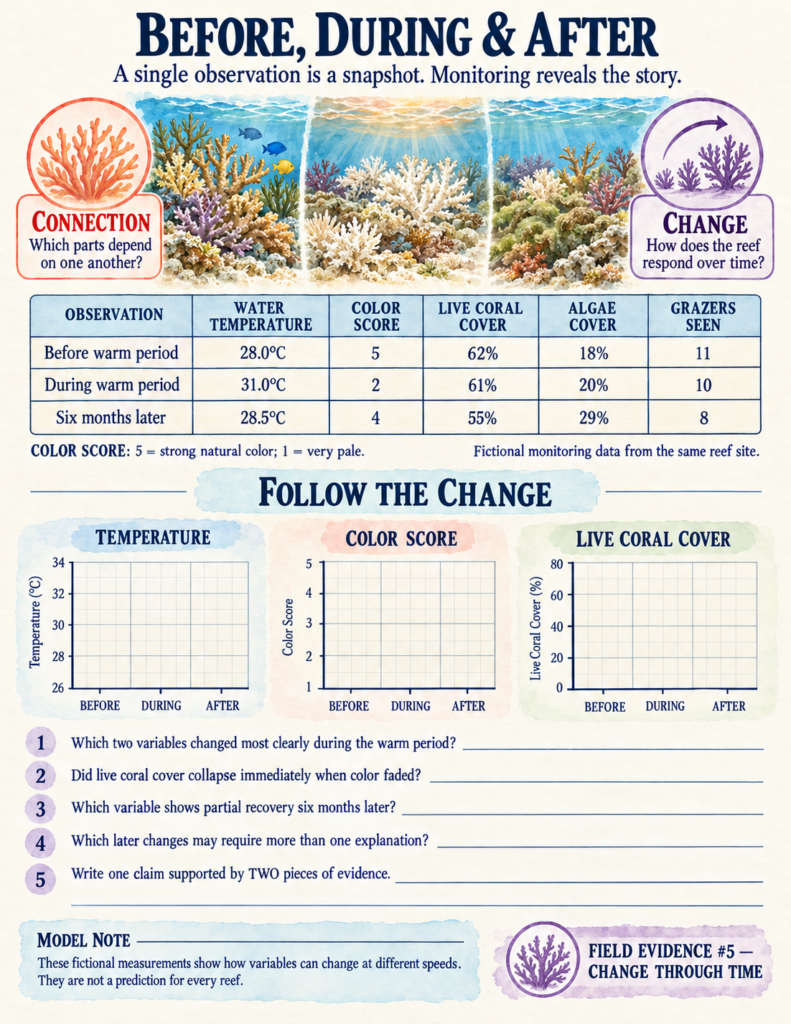
Similarly, the workbook demystifies the phenomenon of coral bleaching. Rather than presenting it as instant death, students analyze the cellular mechanism: prolonged thermal stress forces the coral to expel its photosynthetic partners.
Through the «Before, During & After» monitoring lab, children track temperature spikes from $28.0^\circ\text{C}$ to $31.0^\circ\text{C}$, noting that while tissue color collapses from a healthy score of 5 down to 2, live coral cover remains intact at 61%.
Students evaluate the recovery trajectory, proving with empirical data that bleached coral is under extreme physiological stress, yet fully capable of regaining its symbionts if waters cool in time.
Practical Ways to Integrate Marine Ecology
Because all investigations, graphic organizers, and multi-variable data charts are self-contained with complete answer keys, Coral Reef Explorer requires zero complicated lab equipment:
- Homeschool Ocean Science Block: Spend 15–20 minutes daily across a three-week immersive unit, using the embedded Field Evidence Log to track comprehension.
- Classroom Science Stations: Set up laminated copies of the «Sunset Reef Field Report» or «Misty Cove Case File» for collaborative peer-review and hypothesis rating.
- Culminating STEM Portfolio: Have learners complete the final «Build & Defend» capstone, drafting an interconnected diagram that integrates wave energy, nutrient loops, and grazer dynamics onto a single unified seascape.
If you want to replace passive ocean coloring packs with rigorous scientific reasoning, genuine hydrodynamic physics, and authentic field data, Coral Reef & Ocean Life Explorer gives your young naturalist a comprehensive view beneath the waves.