The Sky Is Not Flat: Teaching Constellations and Stargazing Through Evidence
When elementary children look at a constellation chart, they naturally assume they are viewing a flat picture hung across the sky. Finding an authentic constellations workbook for kids that dismantles this flat-sky illusion is essential for teaching genuine observational astronomy. This hands-on constellations workbook for kids guides young observers to realize that connecting dots on paper is simply our viewpoint from Earth, while the stars themselves are scattered across tremendous depths of three-dimensional space.
Standard classroom worksheets rarely challenge that flat perspective. They hand children a sheet with printed lines connecting Orion or Cassiopeia, tell the mythological story of a hunter or queen, and leave out the actual spatial physics. Children end up believing that the stars forming a pattern are physically close neighbors, bound together like a cluster of grapes in space.

Moving past basic dot-to-dot games requires treating the sky as a physical environment governed by measurable light, spatial depth, observer position, and time. In Star Explorer: Constellations & the Night Sky (a 30-page printable workbook plus bonus sky log designed for ages 7–10), young scientists use five dedicated «Sky Lenses»—Light, Pattern, Depth, Observer, and Time—to decode the night sky using real astronomical evidence.
The Illusion of Neighbors: Why Star Patterns Lack Depth
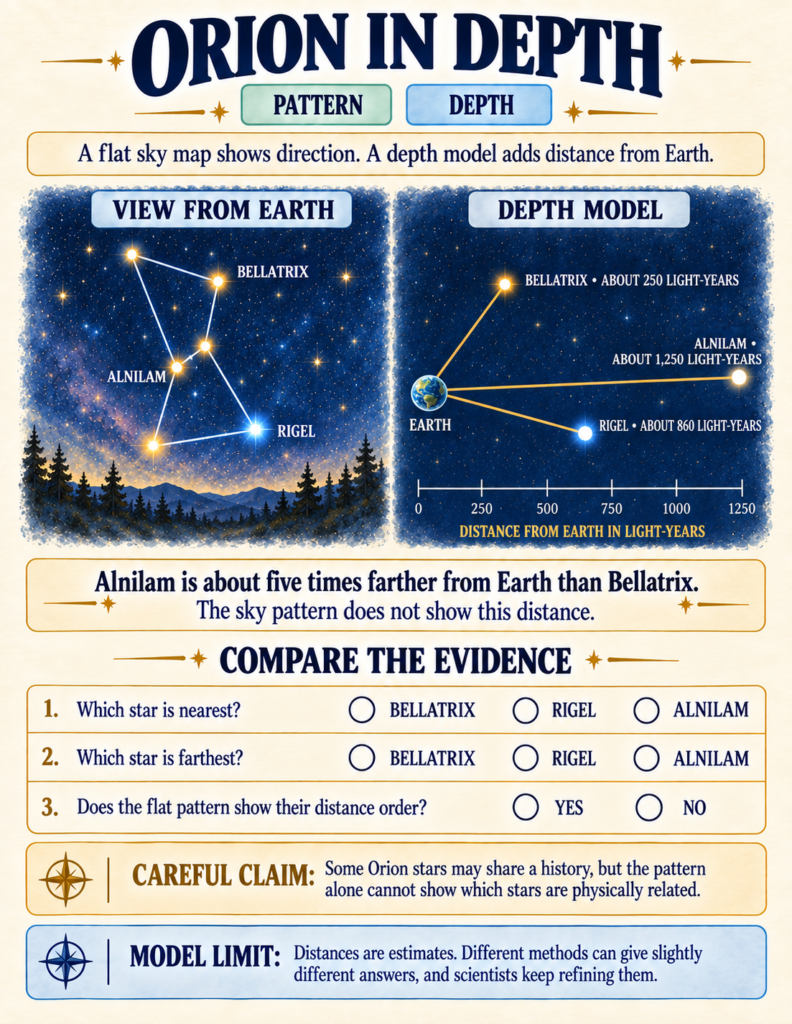
The central breakthrough in elementary astronomy occurs when a student understands perspective. A constellation is a line-of-sight pattern, not a physical cluster of stars traveling together.
In Star Explorer, children investigate this concept through the «Orion in Depth» case file:
- Bellatrix: Sits approximately 250 light-years from Earth.
- Rigel: Shines across roughly 860 light-years of interstellar space.
- Alnilam (Middle Belt Star): Lies at an astonishing distance of around 1,250 light-years.
From our backyard, these stars look like near neighbors outlining a hunter’s torso and belt. But in the workbook’s three-dimensional side-view depth model, Alnilam sits five times deeper into space than Bellatrix. Children learn that a constellation is an alignment seen from our planet’s specific address in the Milky Way, not a physical object in space.
Evaluating how visual representations require critical assessment mirrors planetary science modeling. Just as textbook diagrams frequently distort interplanetary distances to fit all eight planets onto a single page—a problem examined in our guide to the Solar System Explorer Workbook—stargazing maps flatten vast light-year chasms onto a two-dimensional sheet.

Does Brighter Mean Closer? Resolving the Light Paradox
Ask any child why one star blazes brilliantly while another is a faint speck, and their immediate response is: «The bright one is closer».
Star Explorer directly attacks this assumption on the «Does Brighter Mean Closer?» spread by comparing two famous winter beacons:
- Sirius (Canis Major): The brightest-looking star in Earth’s night sky, situated just 8.6 light-years away.
- Rigel (Orion): Appears dimmer than Sirius, yet gives off vastly more true light—because it sits roughly 860 light-years away.
Students realize that Rigel is nearly 100 times farther than Sirius. If both stars were parked at the same distance from Earth, Rigel would dazzle like a spotlight while Sirius would appear modest. Through this comparison, learners understand that apparent brightness is a combination of intrinsic light output and spatial distance.
Children also explore star colors, discovering that an orange-red giant like Betelgeuse (~3,500 K) has a cooler surface than a blue-white supergiant like Rigel (~12,000 K), teaching them that color reveals surface temperature rather than age or distance.

Celestial Mechanics: Why Constellations Turn Across the Night
Another common point of confusion is finding a constellation at 8:00 PM and discovering it tilted upside down or shifted westward by midnight. Children often wonder if the stars moved independently or broke apart.
On the «Cassiopeia Turns with the Sky» spread, learners investigate circumpolar motion:
- What Changes: Position and orientation across the sky.
- What Stays Constant: Proportional star spacing and the geometric shape of the «W».
- The Clockwork Rate: Earth’s axial rotation causes patterns to appear to turn counterclockwise around Polaris at roughly $15^\circ$ per hour ($30^\circ$ every two hours).
Students trace pointer stars (Merak and Dubhe in the Big Dipper) five star-gaps across the dark to locate Polaris, discovering that the North Star’s value lies in its position directly over Earth’s northern axis rather than its brightness.
Connecting celestial movement to biological rhythms illustrates the broader unity of science. Just as day length and seasonal sunlight cycles govern how plants produce and transport sugars—mechanisms explored in our Plant Life Cycle Workbook—Earth’s daily spin and yearly orbit dictate which star patterns are visible above our horizon during any season.

The Four-Minute Shift and Shifting Night Views
Why is Orion celebrated as a winter constellation in the Northern Hemisphere, while Cygnus rules summer evenings?
Star Explorer introduces children to the difference between solar time and sidereal observation in «The Four-Minute Shift»:
- Because our 24-hour clocks follow the Sun while Earth simultaneously moves along its orbital path, Earth faces the same distant stars roughly 4 minutes earlier each day.
- Over 14 days, that difference accumulates to approximately 56 minutes (~1 hour earlier).
- Over 28 days, stars appear at the exact same location nearly 2 hours earlier.
This subtle daily progression explains why constellations drift across the evening sky month by month, gradually ushering in new star patterns as the seasons turn.
Understanding how seasonal changes regulate habitats on our home planet provides a direct counterpart to cosmic observation. Just as continuous moisture cycles, heat, and seasonal weather govern living canopies—a balance analyzed in our review of the Tropical Rainforest Workbook—planetary geometry determines when and where our night sky unveils its seasonal landmarks.
Auditing the Observatory Poster: Thinking Like an Astronomer
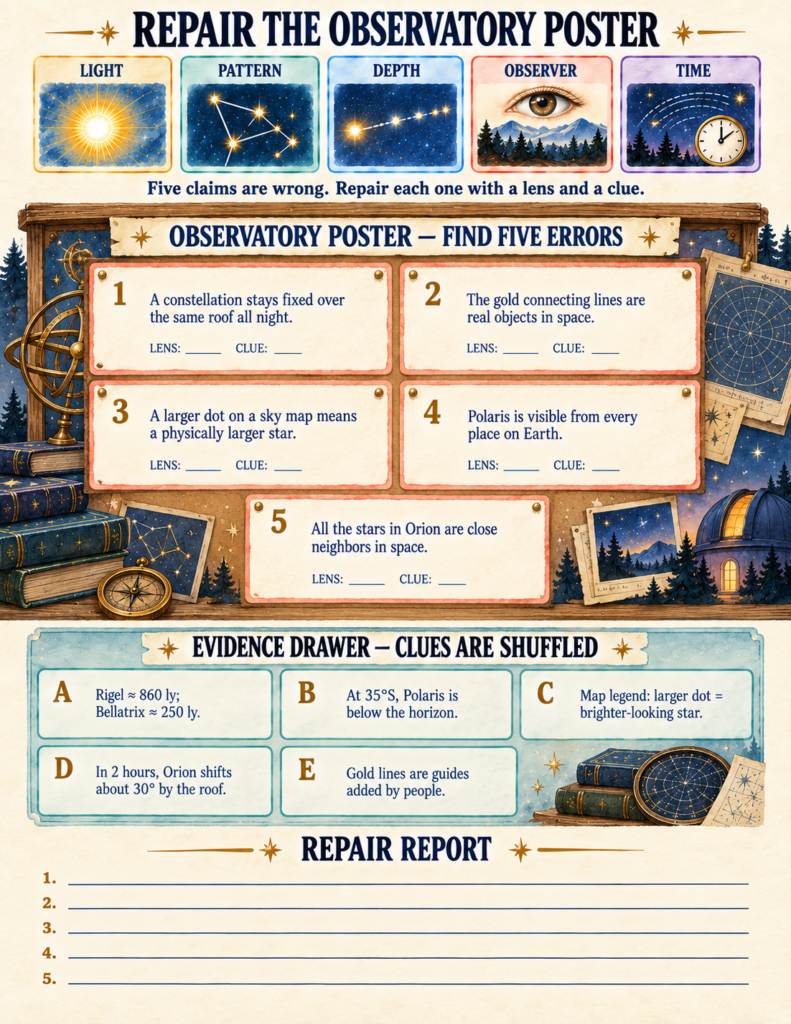
What elevates Star Explorer above ordinary activity books is its strong emphasis on scientific skepticism and claim evaluation. In the «Repair the Observatory Poster» lab, students audit a museum placard containing five widespread astronomical errors:
- Error 1: «A constellation stays fixed over the same roof all night» (corrected using the Time lens: Earth’s spin shifts stars ~15° per hour).
- Error 2: «Gold connecting lines are real objects in space» (corrected using the Pattern lens: lines are human-made guides).
- Error 3: «A larger dot on a sky map means a physically larger star» (corrected using the Light lens: dot size shows apparent brightness from Earth).
- Error 4: «Polaris is visible from every place on Earth» (corrected using the Observer lens: at 35°S in the Southern Hemisphere, Polaris sits below the horizon).
- Error 5: «All stars in Orion are close neighbors in space» (corrected using the Depth lens: Rigel is ~860 ly away while Bellatrix is ~250 ly).
By learning to calibrate claims against physical evidence, children develop scientific reading habits that protect them from hasty conclusions across all STEM subjects.
Practical Implementation for Home and Classroom
Because Star Explorer includes self-contained observation logs, field maps, and complete answer keys, it fits effortlessly into a variety of educational settings:

- Homeschool Astronomy Unit: Complete two pages daily over three weeks, pairing indoor lessons with evening sky walks using the included 4-observation «Bonus Sky Log».
- Backyard Star Parties: Use the «Choose a Good Stargazing Session» criteria (evaluating moon phases, cloud cover, horizon clearance, and artificial light pollution) to plan family outdoor viewing.
- Independent STEM Warm-Ups: The self-checking rotated pattern challenges (like identifying Orion or the Big Dipper when turned at strange angles) serve as excellent spatial-reasoning morning work.
If you are looking for an educational printable that replaces mythological coloring pages with authentic three-dimensional geometry, observational tracking, and genuine astronomical inquiry, Star Explorer provides young stargazers with a clear, reliable pathway through the living cosmos.