Why Fossils Are Clues, Not Just Old Rocks: Teaching Paleontology Through Evidence
When elementary children encounter the word «fossil,» their minds immediately conjure massive dinosaur bones towering inside museum glass cases. Finding an authentic fossils workbook for kids that expands their understanding beyond giant skeletons is essential for genuine earth science literacy. A well-structured fossils workbook for kids shows young naturalists that Earth’s dynamic past is preserved in many forms—from fragile fern leaf venation pressed in shale and burrows carved through ancient mud to delicate insects trapped in golden tree resin and petrified tree rings.
Standard classroom printables often reduce paleontology to passive vocabulary drills. Students memorize that fossils are «remains of old things» and color cartoon ammonites, yet they struggle to explain the difference between an animal’s physical tooth and the ripple mark left by its footstep. They are left assuming that every fossil is turned to stone, unaware that amber preserves original organic tissues without mineral replacement, or that a hollow shell impression represents an entirely different formation path than a solid mineralized cast.
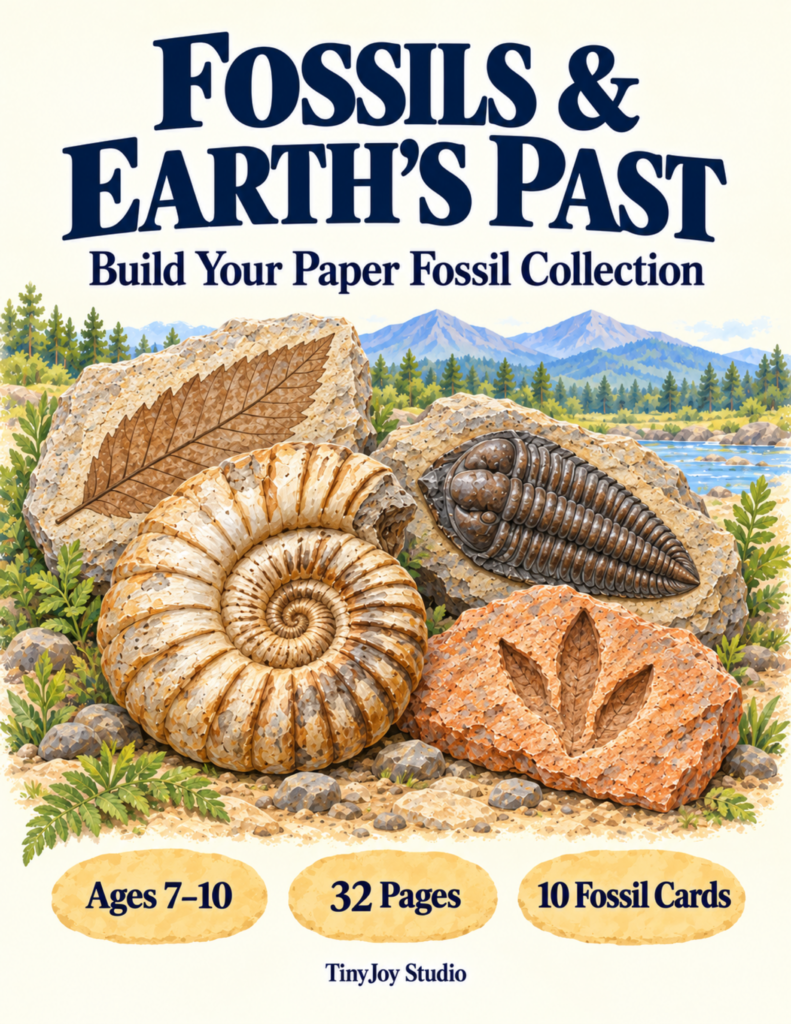
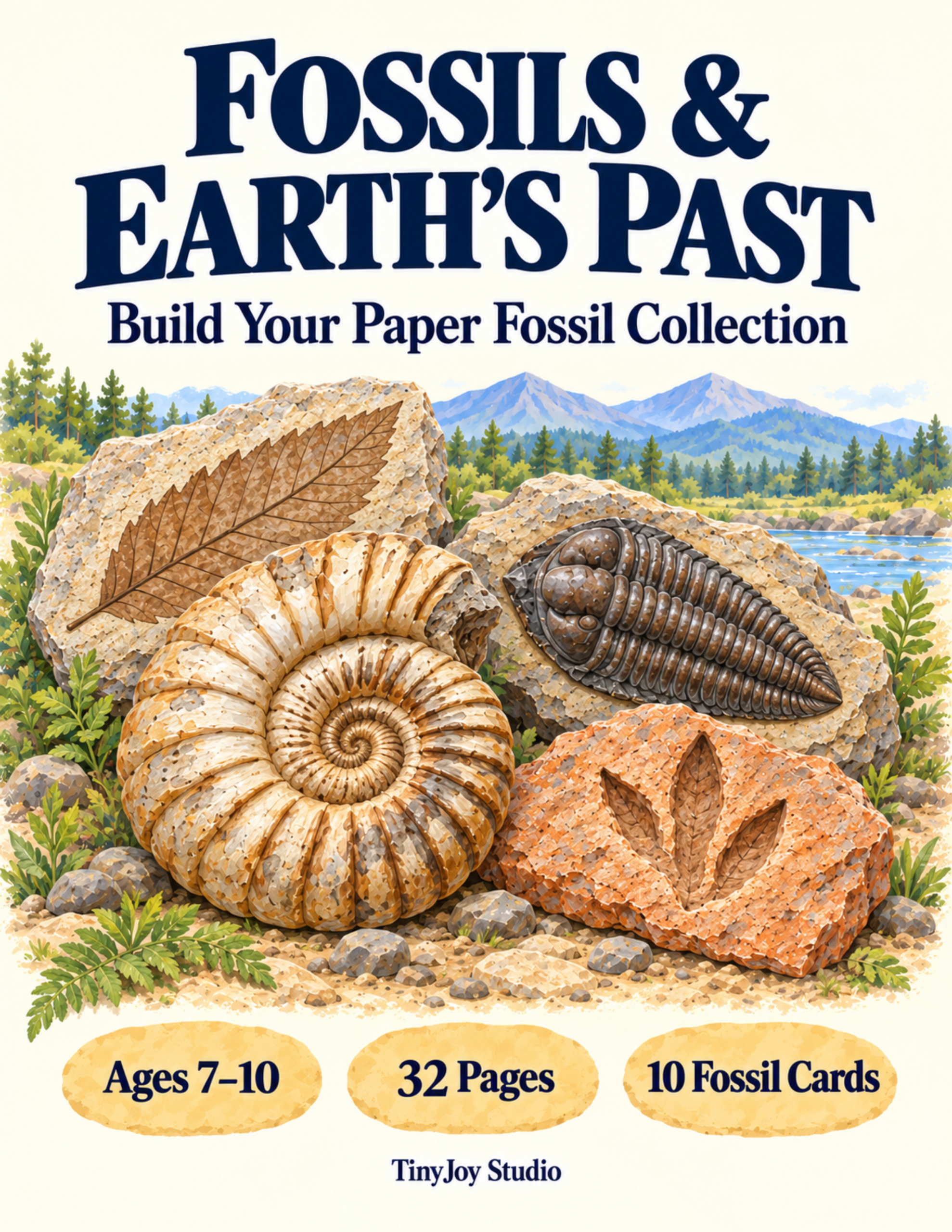
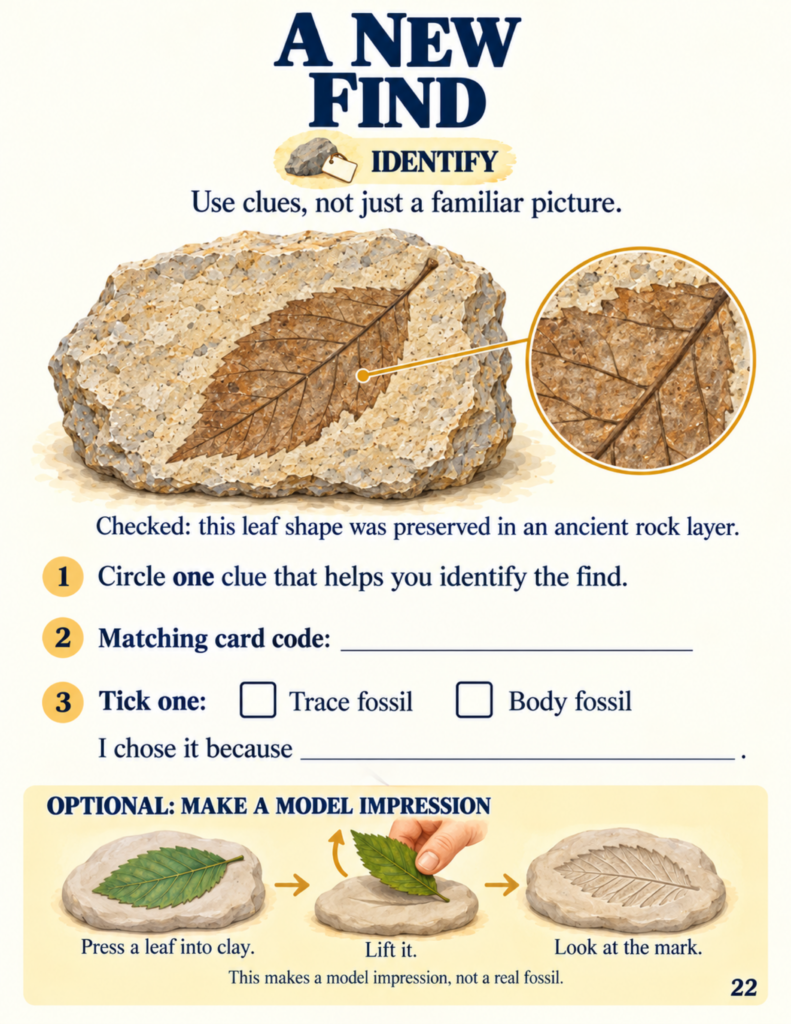
In Fossils & Earth’s Past: Build Your Paper Fossil Collection (a 32-page printable workbook designed for ages 7–10 by TinyJoy Studio), children do not merely memorize prehistoric facts—they work as field scientists using a four-step investigative cycle: Look (notice clues), Check (use helpful facts), Identify (choose a name), and Explain (tell its preservation story).

Body or Trace: Diagnostic Classification
The foundational distinction in paleontology begins with what a specimen actually records. On page 4, young investigators learn to categorize finds into two major biological branches:
- Body Fossils: Specimens that preserve an actual body part or its physical shape—such as a spiral ammonite shell (F01), a flattened leaf outline (F03), a sharp shark tooth (F10), or petrified wood rings (F07).
- Trace Fossils: Records of an organism’s activity, behavior, or presence preserved in sediment—such as a three-toed footprint (F02), an animal burrow tunnel (F06), or coprolites (fossil droppings, F08).
Children immediately confront nuanced scientific tests: is a flat mark in rock always a trace fossil? By comparing a flat footprint with a compressed leaf fossil, they realize that geometry alone can deceive. The flat footprint records an action (a step pressed into mud), while the flat leaf preserves a biological structure (veins and blade shape), categorizing it firmly as a body fossil.
Developing this habit of interrogating physical evidence matches the analytical mindset we foster across our curiosity books for kids in the Curious 25 series, where curious minds investigate everyday phenomena through bite-sized, critical inquiry.

Mold, Cast, and Resin: More Than One Way to Preserve
Elementary science curricula often teach children that fossils are simply «bones turned to stone». Fossils & Earth’s Past systematically dismantles this oversimplification by analyzing distinct taphonomic mechanisms:
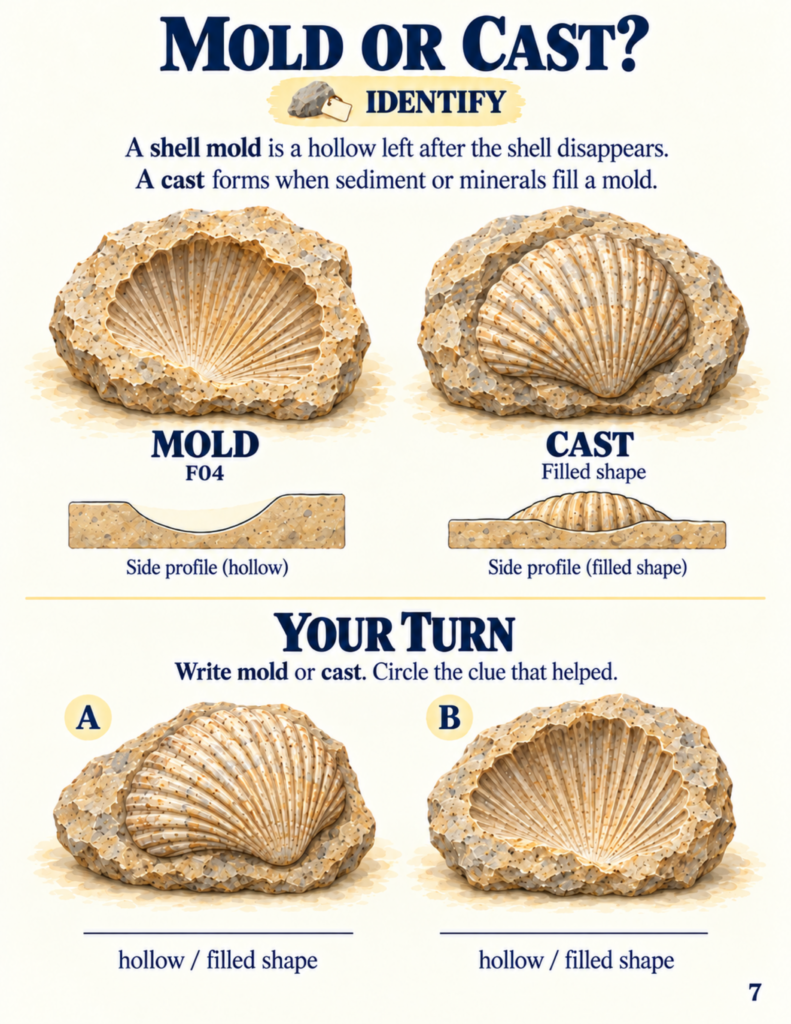
- Molds vs. Casts: On page 7, students examine shell fossils to distinguish between a hollow cavity left behind after an original shell dissolves (a mold) and the solid, raised three-dimensional replica formed when minerals or sediment later fill that hollow (a cast).
- Permineralization: In petrified wood (F07), groundwater dissolved with silica slowly replaces organic plant cells molecule by molecule, faithfully preserving growth ring patterns in hard stone.
- Resin Entombment: An insect trapped in ancient tree resin (F09) becomes amber over millions of years. Students answer the pivotal question—Are all fossils made of stone?—with a clear No, proving that fossilization encompasses organic resin entrapment as well.
Tracing how plant matter interacts with environmental minerals connects seamlessly with botanical systems. Just as modern plants rely on internal vascular systems to distribute water and dissolved minerals to living cells—a process explored in depth in our Plant Life Cycle Workbook—fossilized wood reveals how those identical cellular structures could be preserved when silica-rich fluids penetrated ancient timber.
Stratigraphy: Reading the Rock Pages of Earth
Fossils cannot be understood in isolation from the geological strata that cradle them. In the stratigraphic reasoning spread «Older or Younger?», students investigate undisturbed sedimentary layers to apply the Law of Superposition:
- Lower layers were deposited earlier in time, meaning the deepest undisturbed rock is the oldest.
- Upper layers were deposited later, making them relatively younger.
- The workbook guides students to recognize relative dating limits: while a cliff section tells us whether Layer A is older than Layer D, the visual strata alone cannot reveal the layer’s exact numerical age in millions of years.
Children learn to read a rock cliff as a historical document: an ancient seabed layer with ammonites at the base was later buried by middle sediments, capped by an upper terrestrial layer containing buried leaves, and finally exposed millions of years later by surface weathering and river erosion.
Connecting physical strata to the chronological unfolding of time bridges earth science directly with historical education. Just as geologists use rock layers to reconstruct the sequence of prehistoric environments, historians use physical artifacts, ruins, and written records to reconstruct human eras—a multidisciplinary method built into our interactive history curriculum for elementary learners, where students trace civilizations through primary evidence rather than memorized dates.

Spatial Mapping, Look-Alikes, and the Field Guide Capstone
As students advance toward fieldwork, the workbook introduces spatial recording and scientific skepticism:
- Grid Mapping: On page 15, learners plot specimen coordinates across a 4×4 topographic grid (recording ammonite F01 at D3 and leaf F03 at B1), teaching children that knowing where a fossil was excavated on a grid coordinate map is just as vital as identifying its species.
- Fossil or Look-Alike: On page 18, children evaluate tricky specimens. They discover that a branching dendrite pattern in rock is not a fossil fern, but a mineral crystal growth, teaching young observers that biological shape alone is not definitive proof of past life.
- The 10-Card Paper Collection: The workbook includes 10 double-sided cards (F01–F10) that children cut, fold, and glue to build their own hands-on paper fossil cabinet, matching each find against a field guide entry where they document visible clues, classification, and a multi-stage preservation story.
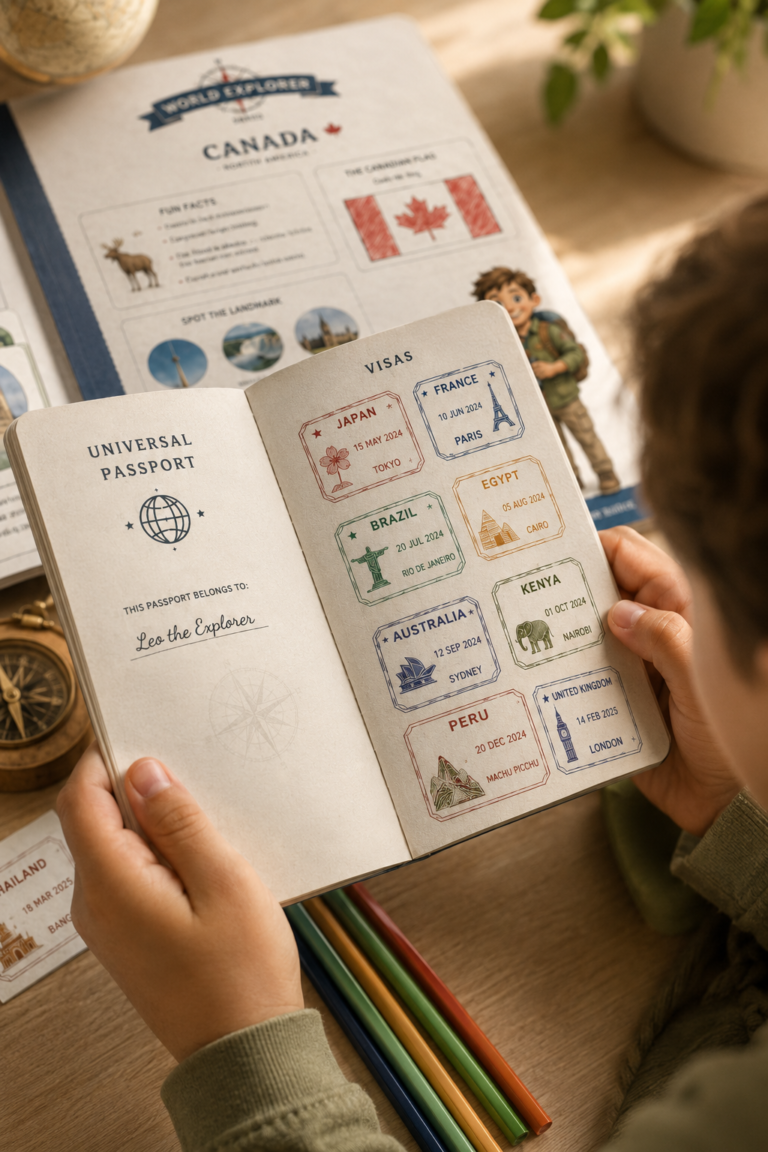
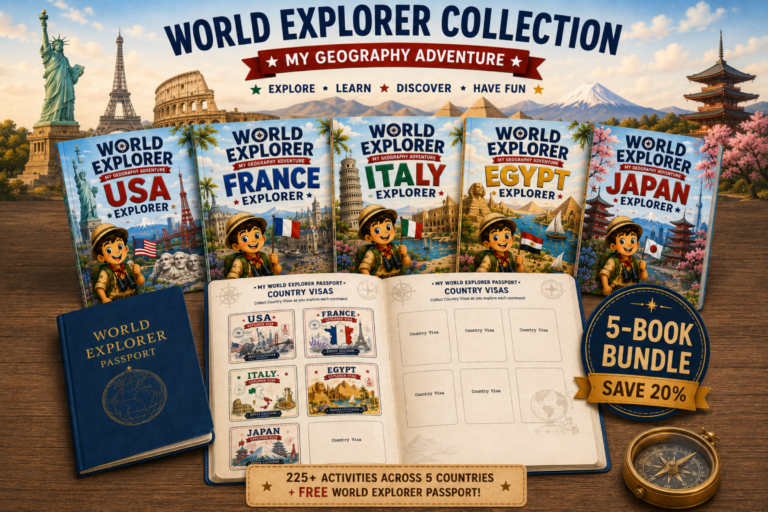
This emphasis on spatial mapping, coordinate grids, and hands-on portfolio assembly reflects the inquiry-driven approach of TinyJoy Studio’s broader geographic curriculum. If your child thrives on hands-on mapping, environmental exploration, and real-world project portfolios, exploring how we approach project-based learning in homeschooling through our World Explorer series will give you a comprehensive blueprint for integrating cartography, culture, and physical landscapes into your home routine.
Practical Integration for Home and Classroom
Because Fossils & Earth’s Past is self-contained with double-sided fossil cards, guided deduction checklists, and a complete answer key, it requires zero specialized laboratory supplies:
- Homeschool Geology & Paleontology Unit: Work through two pages daily across a focused three-week block, pairing paper cards with outdoor gravel searches and hand lens observations.
- Co-op Science Stations: Set up laminated copies of the «Fossil Finder» dichotomous key (page 16) and «Fossil or Look-Alike?» (page 18) for small-group collaborative problem-solving.
- Hands-On Capstone Project: Have students complete their personal «My Field-Guide Entry» (page 24) and «My Find’s Story» (page 25) to earn the printable «Fossil Explorer Certificate» (page 26).
If you are looking for an educational printable that trades passive dinosaur coloring for authentic fossil classification, stratigraphic reasoning, and hands-on collections, Fossils & Earth’s Past equips young explorers with the scientific tools to decode the rock archive beneath our feet.