More Than Soggy Ground: Teaching Wetland Ecology Through Living Water Systems and Field Evidence
When children encounter a marsh, bog, or shoreline, their immediate impression is often just murky water and soggy mud. Choosing an evidence-based wetlands workbook for kids is the most effective way to help young learners discover that these damp landscapes are among the hardest-working living systems on Earth. Rather than presenting wetlands as permanent, stagnant ponds, a thoughtfully structured wetlands workbook for kids shows that water levels rise, fall, and sometimes disappear entirely, driving specialized survival adaptations in every plant root, developing tadpole, and decomposing microbe anchored to the basin.
Standard elementary habitat printables frequently reduce aquatic biomes to an oversimplified cartoon pond with a frog sitting on a water lily. Children memorize that herons eat fish, but they miss the core physical science behind the wetland: how soil can look bone-dry on top while remaining completely waterlogged below, how submerged roots survive oxygen scarcity using internal air canals, and why a pool that completely dries up in summer can be a safer nursery for amphibians than a permanent lake. When habitat lessons treat water as an unchanging backdrop, children lose the chance to see how hydrology governs living communities.

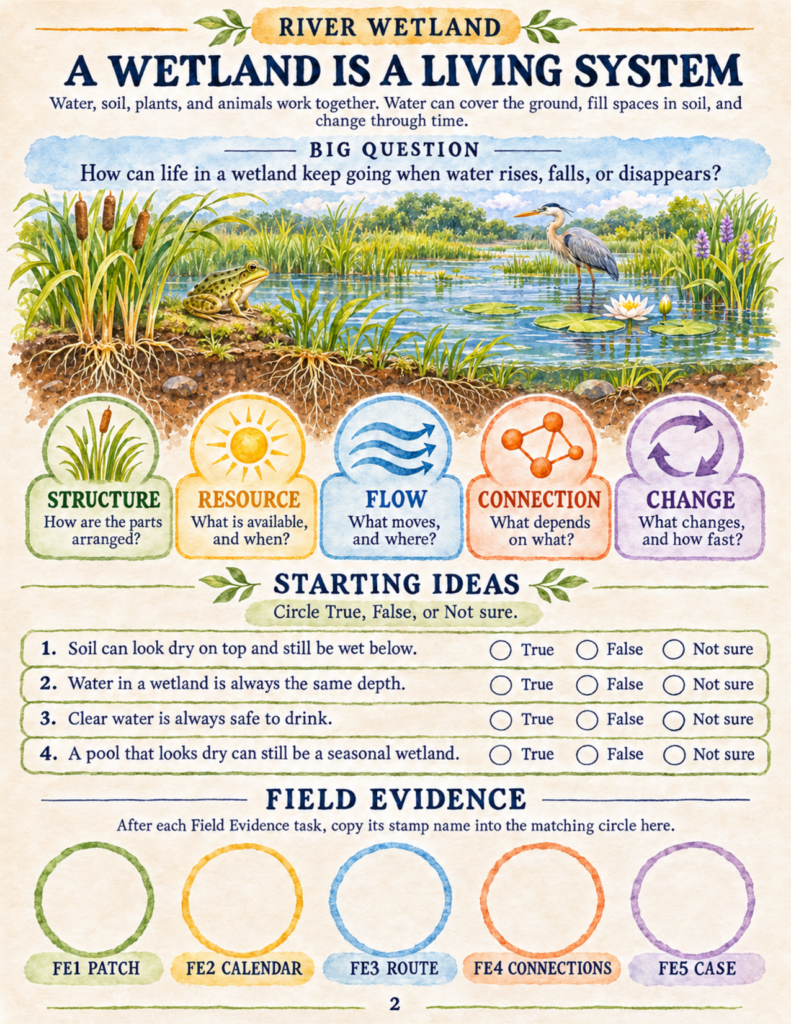
In Wetlands Explorer: Changing Water • Connected Life (a 30-page printable unit study designed for ages 7–10 by TinyJoy Studio), learners step into the boots of wetland field researchers. Rather than filling out passive vocabulary drills, students investigate a central Big Question: How can life in a wetland keep going when water rises, falls, or disappears? Across five foundational scientific lenses—Structure, Resource, Flow, Connection, and Change—children evaluate cutaway diagrams, analyze weekly hydroperiod data, balance water inputs and outputs, and repair flawed ecological models.
Subterranean Oxygen and Botanical Plumbing
The first major scientific breakthrough in wetland study is looking beneath the waterline. When soil particles remain saturated with water over long periods, the spaces that usually hold atmospheric air become completely flooded. As living roots and microorganisms breathe, dissolved oxygen in the ground is rapidly used up, creating an oxygen-starved subterranean environment.
Wetlands Explorer reveals how emergent wetland vegetation solves this challenge. On pages 6 and 7, students examine magnified cross-sections of plants like cattails. They discover specialized spongy tissues filled with continuous open air passages (aerenchyma) that function like internal snorkel tubes, channeling oxygen from above-water leaves straight down into buried roots and rhizomes. They contrast this internal plumbing with floating water lilies, which anchor their root systems in dark bottom mud while spreading broad, buoyant pads across the surface to absorb sunlight.
To broaden this understanding of how plant tissues engineer physical adaptations to survive environmental stress, pairing this study with our nature workbooks for kids helps young naturalists compare wetland air tubes with the deep moisture-storing taproots and fire-resistant crowns of other world biomes.

The Water Calendar: Hydrological Budgets and Moving Edges
Unlike lakes with stable concrete borders, a wetland’s defining feature is dynamic movement. On pages 9, 10, and 11, students explore how changing water levels continuously redesign the available living space.
Through the «Water Calendar» investigation (page 10), children learn that evaluating a habitat requires repeated visits over time rather than a single visit. When comparing two wetland patches that both contain surface water in Week 3, students analyze longitudinal data tables to discover that Patch A remains submerged for six consecutive weeks, while Patch B dries down after only three. On page 11, children observe that as water levels drop from high to low, the physical earth does not move—instead, the shoreline shifts across the shelf, exposing damp mud banks for foraging herons and concentrating aquatic insect larvae in deeper central basins.
Students also balance basin water budgets on page 13, calculating how water volume changes when inputs (precipitation and river inflow) are measured against outputs (channel drainage, soil percolation, and evaporation).

Tracing how solar heating drives evaporation and regional rainfall pulses shares a direct connection with broader planetary science. For homeschool families seeking to connect terrestrial hydrology with atmospheric cycles and planetary mechanics, our earth and space science bundle for kids provides an evidence-based pathway to explore solar radiation, weather patterns, and planetary systems.
Silt Trapping and the Illusion of «Safe Water»
Wetlands are frequently celebrated as «nature’s water filters,» but classroom materials rarely explain the physical mechanics behind this process. Wetlands Explorer grounds water filtration in concrete fluid physics and empirical data.
On page 19, learners evaluate a controlled trial comparing two waterways carrying identical loads of 20 suspended sediment particles:
- The Open Channel: Water rushes through in just 2 minutes, leaving behind only 2 particles while 18 pass straight through.
- The Planted Wetland Channel: Dense stems, plant roots, and winding bends create physical friction, slowing transit time to 6 minutes and allowing 13 particles to settle to the bottom, so only 7 exit the basin.
Yet the workbook challenges young scientists with a critical qualification: Does filtering out visible floating mud prove the water is safe to drink? Children discover that while wetland plants trap physical debris and settle out cloudiness, clear water can still harbor dissolved chemical contaminants and microscopic bacteria, dismantling a widespread outdoor myth.

Learning to survey terrain gradients, trace water channels, and identify drainage basins develops vital field skills. To help children cultivate confident outdoor navigation, elevation reading, and field documentation habits, pairing this study with our explorer skills workbook bundle gives young naturalists practical tools to map and record real-world landscapes.
The Paradox of the Seasonal Pool
One of the most engaging investigations in the workbook explores an ephemeral habitat: the seasonal vernal pool (pages 21–22). These temporary woodland hollows fill with snowmelt and spring rain, only to dry into leaf-litter hollows by late summer.
Children confront a fascinating ecological paradox: seasonal drying is precisely what protects the pool’s residents. Because the pool dries up every summer, fish cannot establish permanent populations. This creates a temporary, fish-free nursery where amphibians like frogs and salamanders can safely lay delicate egg masses and complete their aquatic larval development without being eaten by swimming predators. If well-meaning humans «improve» the pool by digging it deeper or cutting an inlet canal from a river to keep it flooded year-round, fish move in, consume eggs and larvae, and collapse the amphibian nursery.
Examining how human construction projects—from installing narrow road culvert pipes to cutting agricultural drainage ditches—alter natural waterways bridges ecology with cultural geography. Exploring our people and places workbook bundle helps students understand how human settlements organize around floodplains, build civil infrastructure, and balance local development with landscape stewardship.
Tracing these engineering choices and environmental modifications over time mirrors the historical evidence-gathering taught across our interactive history for kids curriculum, where students evaluate physical records, human decisions, and timeline changes through primary evidence rather than speculation.

Practical Integration for Home and Classroom
Because Wetlands Explorer features structured evidence cards, self-contained data models, and complete answer keys for all 27 core investigation pages, it integrates seamlessly into a variety of educational settings:
- Homeschool Freshwater Ecology Block: Complete two pages daily over three weeks for a comprehensive, screen-free life science study.
- Collaborative Science Centers: Laminate spreads like the «Wetland Patch Detective» (page 5), the «Water Calendar» (page 10), and the «Repair a Broken Wetland Model» lab (page 25) for small-group problem-solving.
- Outdoor Field Trip Companion: Take pages 11, 12, and 24 to a local boardwalk, nature center, or pond edge to survey water depths, spot emergent plants, and track shorebird foraging zones.
If you are looking for an educational printable that replaces passive coloring drills with authentic hydrology, botanical adaptations, and ecosystem resilience, Wetlands Explorer provides elementary learners with a structured, inspiring expedition through our planet’s living wetlands.