Why Color Is a Clue, Not a Name: Teaching Mineralogy and Crystal Physics Through Evidence
Hand an elementary student a piece of purple amethyst alongside a chunk of purple fluorite, and they will almost certainly announce that both specimens are the exact same mineral. Finding an authentic minerals and crystals workbook for kids that dismantles this visual color trap is foundational for early scientific literacy. A well-structured minerals and crystals workbook for kids trains young geologists to realize that color is merely a surface clue, not an identity, and that true mineral classification requires verifying a specimen’s underlying crystal lattice, hardness, luster, and powder streak.
Standard elementary science printables often reduce geology to decorative gem photos. Children memorize that diamonds are sparkly and emeralds are green, but they cannot explain why scraping a brassy mineral across white porcelain separates fool’s gold from real gold, why cutting quartz into shiny jewelry facets does not turn it into a diamond, or why crystals grow without being living creatures.
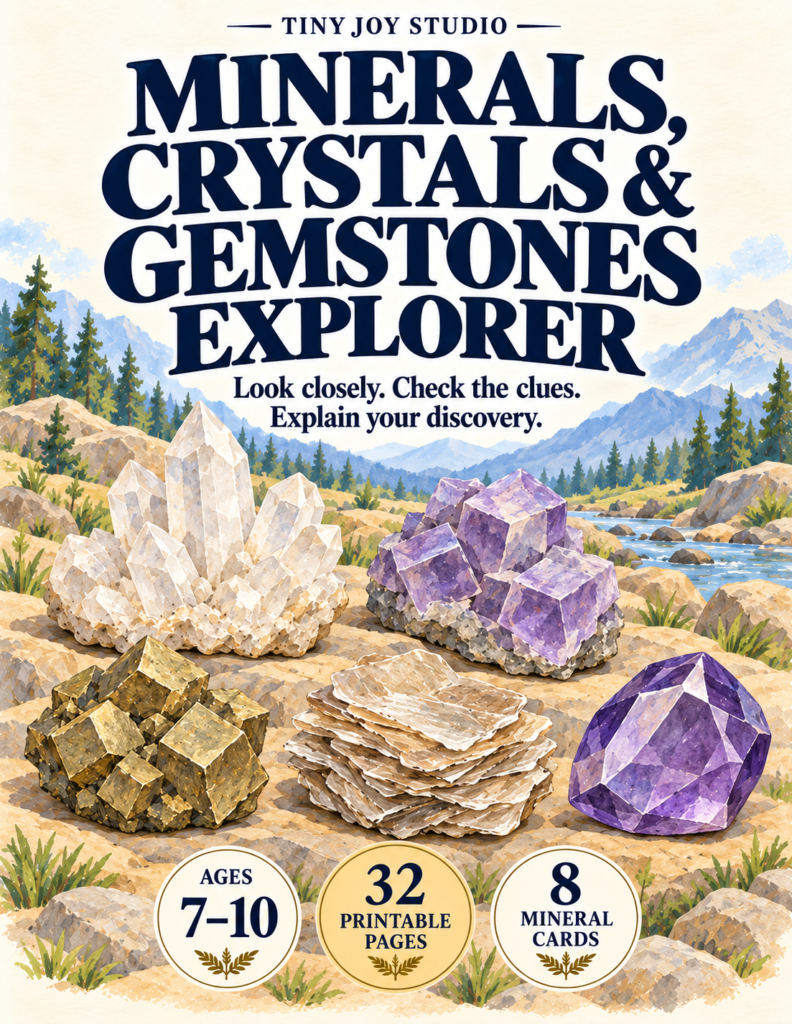
In Minerals, Crystals & Gemstones Explorer (a 32-page printable workbook with 8 double-sided cutout mineral cards designed for ages 7–10 by Tiny Joy Studio), children do not need physical lab kits or dangerous acid drops. Instead, they work as mineral forensic detectives through a four-step investigative cycle: Look (notice observable traits), Check (read a standardized test record), Identify (match multiple clues), and Explain (defend how the sample formed).

Escaping the Color Trap: The Scientific Testing Toolkit
The foundational turning point in mineralogy occurs when children learn that different minerals can share the exact same hue, while a single mineral family can display an entire rainbow of varieties.
On page 4, students confront a classic conundrum: sample B is purple quartz, while sample C is purple fluorite. How does a scientist tell them apart when visual inspection fails? Minerals, Crystals & Gemstones Explorer equips students with standardized physical tests:
- Luster vs. Transparency: On page 5, learners distinguish how a surface reflects light (metallic in pyrite, glassy in quartz, or pearly in muscovite mica) from how much light passes through the solid.
- True Scratch Hardness: On page 6, students learn that a powder smudge wipes away, while a genuine scratch leaves a permanent indented groove in the softer material.
- The Mohs Scale: On page 7, children apply Friedrich Mohs’ relative hardness ranks from 1 (talc) to 10 (diamond). They discover that M01 quartz (rank 7) easily scratches M03 fluorite (rank 4), instantly resolving the purple mineral mystery without guesswork.
- The Streak Test: On page 8, students examine the color of a mineral’s fine powder left on an unglazed porcelain plate. While both brassy pyrite and native gold share a golden surface shine, pyrite leaves a diagnostic dark greenish-black streak, while real gold leaves yellow powder.
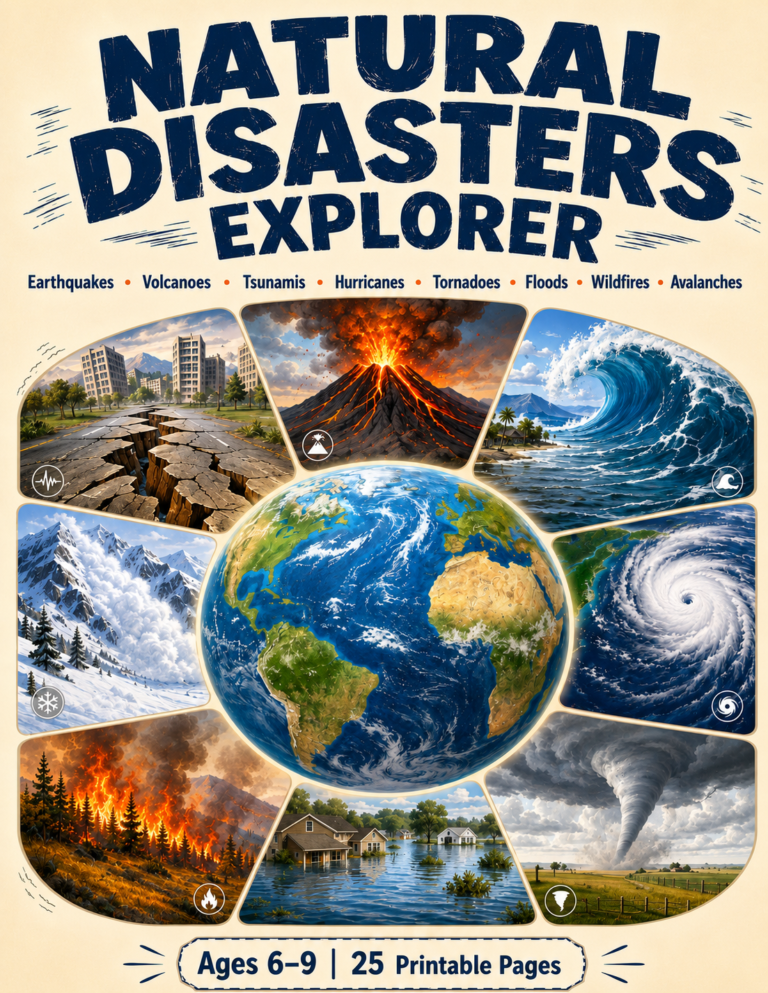
Understanding how solid mineral grains form the bedrock of crustal landforms is essential to physical geology. For families exploring how deep tectonic pressure, plate boundaries, and volcanic forces continuously reshape our planetary surface, our Dynamic Earth Workbook Bundle provides a rich, hands-on extension into earth dynamics and active mountain systems.

Crystal Geometry: Order on the Inside
What actually separates a mineral from ordinary hardened mud or glass? The secret lies hidden beneath the surface in atomic order.
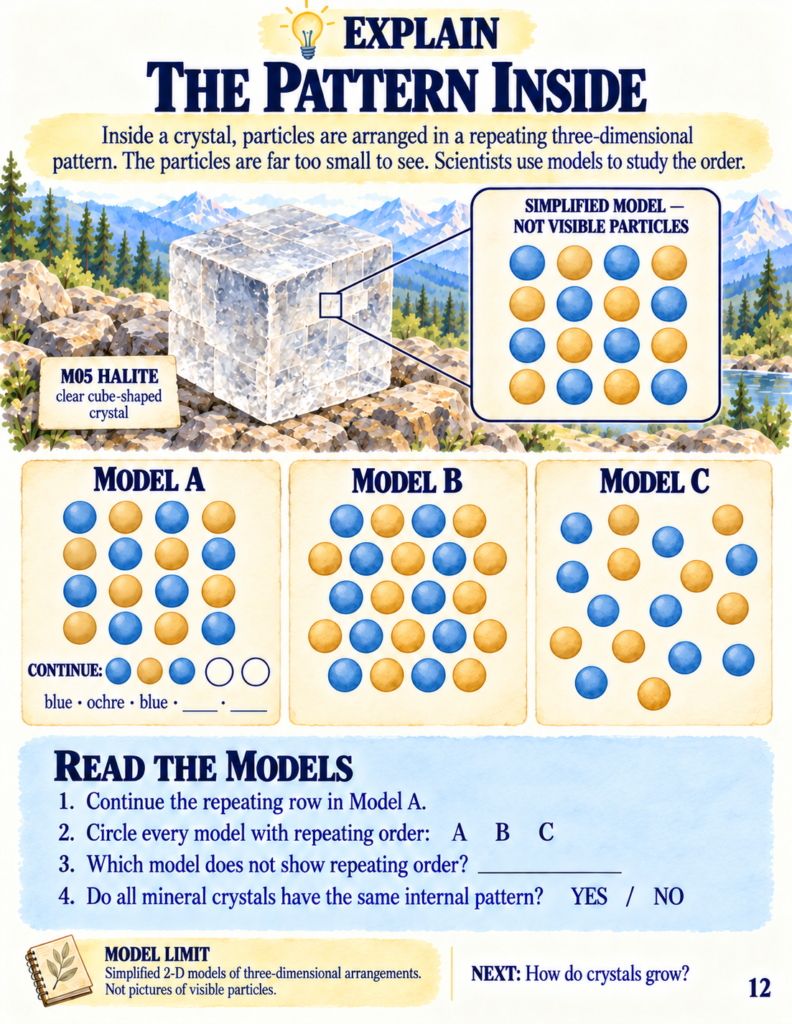
On page 12, students analyze two-dimensional particle models:
- Ordered Lattices (Models A & B): Show alternating particles aligned in repeating, predictable geometric rows.
- Disordered Structures (Model C): Show scattered, random particles.
Children learn that a crystal is defined by an orderly, repeating internal arrangement of atoms. On page 13, the workbook answers an essential conceptual question: How do crystals grow if they are not alive? Crystals do not grow through biological cell division; they grow when dissolved mineral ions precipitate out of cooling liquid solution, cooling volcanic magma, or recrystallize inside solid metamorphic rock under immense heat and pressure, locking into the pre-existing geometric framework.
Furthermore, students investigate growth conditions on page 14: when quartz grows into an open cavern pocket, it forms six-sided prisms with pointed termination faces. But when it grows crowded against neighboring mineral grains inside granite, it cannot form exterior points. Children learn a vital geological rule: a rounded or broken quartz grain is still a crystal on the inside, even if its exterior points are missing.
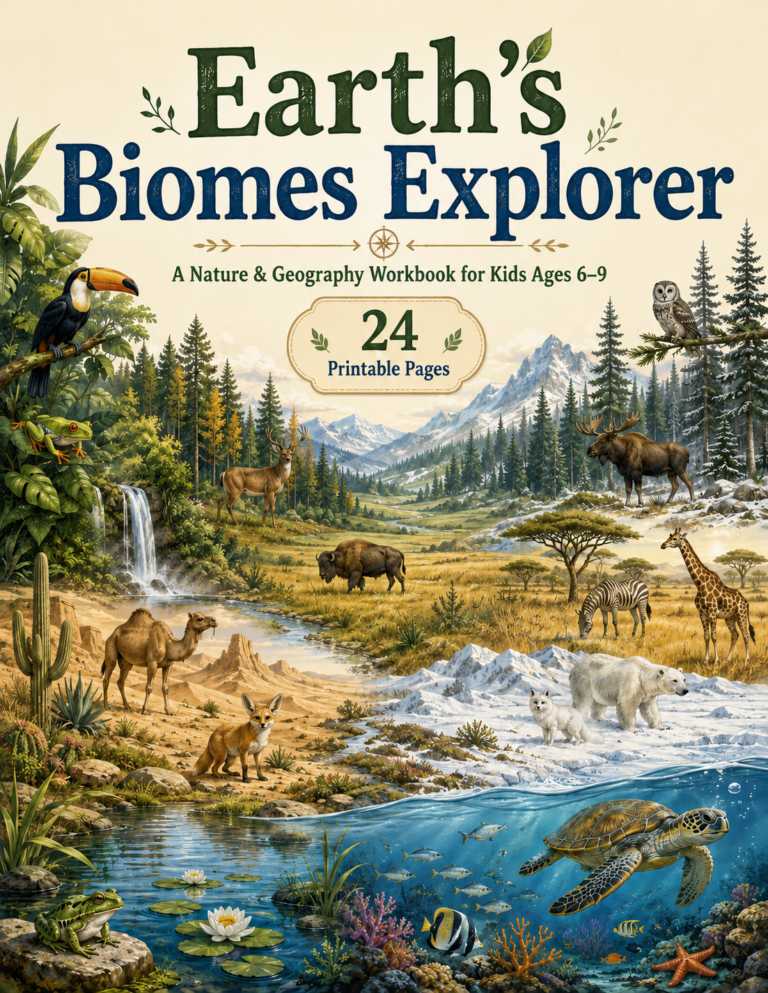
Connecting crystal growth to outdoor biomes shows how minerals shape living habitats. To see how plants extract dissolved mineral nutrients from weathering rock and soil moisture across worldwide ecosystems, our Nature Workbooks for Kids provides an engaging cross-disciplinary study of living adaptations.
Mineral, Crystal, or Gemstone: Untangling the Vocabulary
One of the most confusing hurdles for young students is sorting out overlapping geological terminology. A child might see a cut amethyst and struggle to understand whether it is a rock, a crystal, a mineral, or a gemstone.
On page 3, Minerals, Crystals & Gemstones Explorer untangles these relationships with precision:
- Mineral: A naturally occurring solid with a specific chemical composition and an ordered internal atomic structure (e.g., quartz, calcite, halite).
- Crystal: A solid whose particles repeat in an orderly geometric pattern, often forming flat external faces when given space.
- Gemstone: A mineral or natural material chosen by human culture for beauty, rarity, and decorative use.
- Rock: A natural solid aggregate made of one or more minerals (like granite, which is assembled from interlocking grains of quartz, feldspar, and mica).
Children discover that a single natural object can fit multiple definitions: a naturally grown quartz point is simultaneously a mineral, a crystal, and a gemstone variety. Furthermore, on page 18, students learn that not all gemstones are minerals: organic materials like amber (fossilized tree resin) and pearls (formed by mollusks) lack a crystalline mineral structure, yet are prized as traditional gemstones.
Connecting geological formations to Earth’s most breathtaking global sites gives children an expansive appreciation of natural wonder. In our Amazing Earth Adventures Workbook Bundle, students journey into colossal crystal caves, deep limestone caverns, and desert salt flats to see how mineral saturation creates dramatic natural monuments across continents.

Human Uses and the Forensic Mineral Delivery
On page 22, the workbook bridges mineralogy with applied human engineering:
- Graphite: Soft and layered, easily shearing away to leave smooth, dark gray marks on paper as the core of pencils (not toxic lead).
- Muscovite Mica: Splits into thin, flexible, transparent sheets that resist intense heat and block electrical currents, making it an ideal industrial insulator.
- Diamond: Ranked at 10 on the Mohs scale, industrial diamond dust is embedded into steel saw blades and grinding wheels to cut through reinforced concrete and hard stone.
The workbook culminates on page 24 in «Final Mission 1: The Mixed-Up Mineral Delivery». Acting as museum lab technicians, children unpack three unlabelled crates:
- Mystery A: A pale, slanted rhombohedral block, glassy luster, hardness 3 $\rightarrow$ diagnosed as M02 Calcite.
- Mystery B: Brassy metallic cubes leaving a dark greenish-black streak $\rightarrow$ diagnosed as M06 Pyrite.
- Mystery C: Pearly stacked sheets separating into flexible layers $\rightarrow$ diagnosed as M08 Muscovite Mica.
By learning how historic civilizations quarried, traded, and engineered regional minerals into tools, architecture, and cultural currency, children connect natural science with human society. In our People and Places Workbook Bundle, students explore how diverse global communities build their homes, trade routes, and traditions around the natural resources of their landscapes.

Practical Integration for Home and Classroom
Because Minerals, Crystals & Gemstones Explorer is completely self-contained with standardized test records, diagnostic keys, 8 printable double-sided mineral flashcards, and a complete answer key, it requires zero specialized mineral kits:
- Homeschool Geology Unit: Complete two pages daily over three weeks, combining book lessons with the included 8 cutout mineral cards (M01–M08) to practice multi-property sorting games.
- Classroom Science Stations: Laminate the «Choose the Next Check» flowcharts (page 10) and «Repair the Mineral Display» spread (page 23) for cooperative peer-auditing challenges.
- Independent STEM Inquiry: Use the salt evaporation crystal-growing log (pages 15–16) as a guided home observation project, training children to separate direct observation from causal explanations.
To strengthen your young geologist’s spatial orientation, field mapping, coordinate logging, and compass navigation skills, our Explorer Skills Workbook Bundle equips children with practical fieldwork tools to record specimens and map rock outcrops in the great outdoors.
If you are looking for an educational printable that replaces passive gemstone trivia with authentic physical property testing, 3D atomic modeling, and forensic deduction, Minerals, Crystals & Gemstones Explorer gives young earth scientists a structured, inspiring foundation in real mineralogy.