Small Lives, Big Science: An Insects Field Unit for Kids That Builds Real Habits of Mind
When elementary children explore a lawn or trail, their instinct is often to scoop up every tiny creature and cram it into a plastic jar. Finding a thoughtfully sequenced insects field unit for kids that replaces frantic bug-catching with disciplined, gentle field investigation is essential for genuine life science learning. Rather than treating small invertebrates as disposable novelties, a well-structured insects field unit for kids teaches young scientists to look closely, analyze diagnostic physical evidence, respect delicate micro-ecosystems, and leave living creatures undisturbed.
Early nature study often swings between two frustrating extremes: superficial bug scavenger hunts that end the moment an ant is spotted, or dry textbook chapters filled with Latin vocabulary that drain the excitement from outdoor discovery. Children are left assuming that every small crawler is an insect, unaware of the rigorous morphological boundaries separating spiders, worms, and beetles, or how an insect’s physical mouthparts dictate its ecological role in nature.

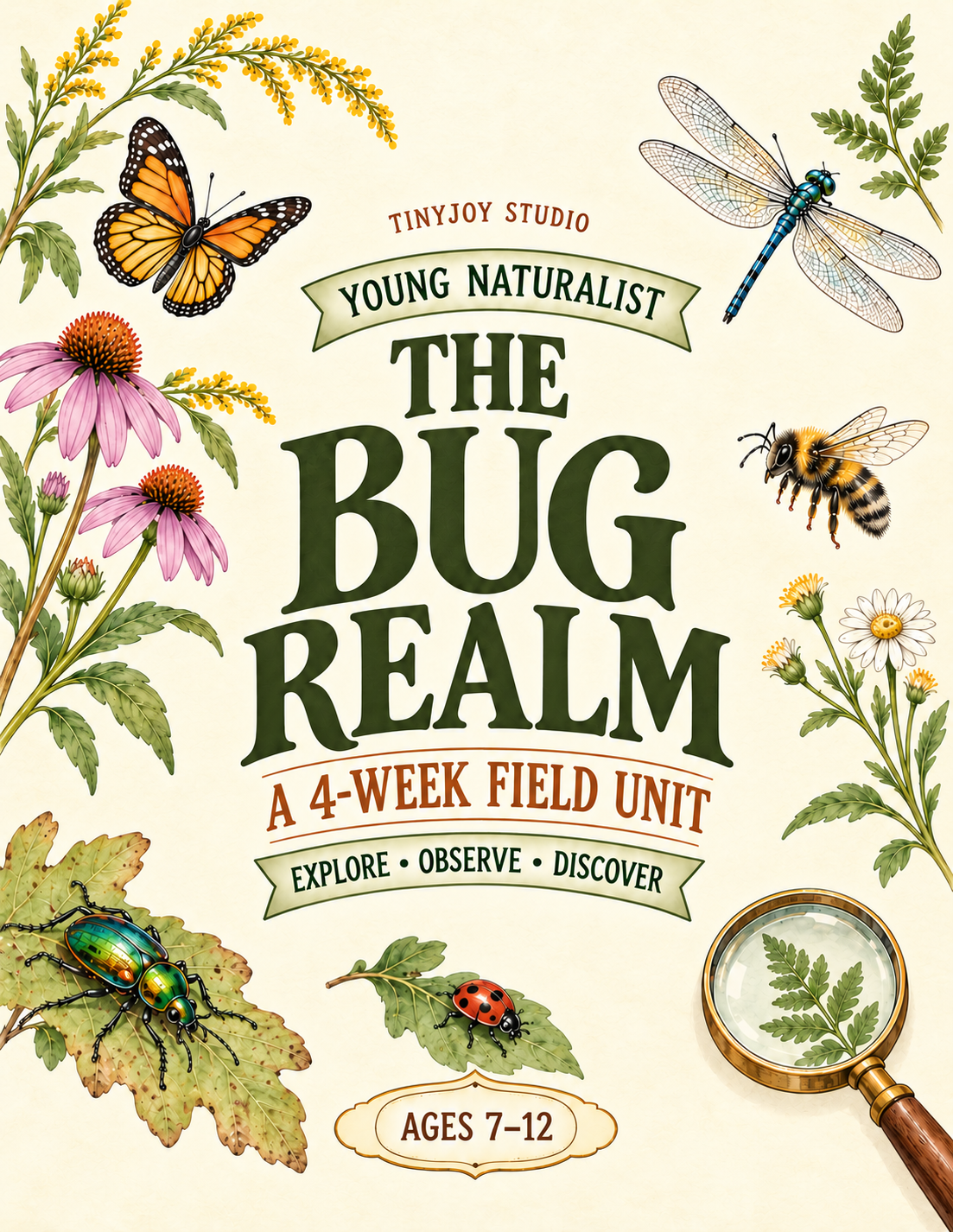
In The Bug Realm: A 4-Week Field Unit (designed for ages 7–12 by TinyJoy Studio), children take a major step forward in their scientific journey. While our standalone field companion—explored in depth in our guide to the nature journal for kids—focuses on open-ended mindfulness and basic sensory awareness, The Bug Realm launches the first of nine thematic four-week investigations. It provides a structured, month-long scientific deep dive into anatomy, microclimates, developmental metamorphosis, and ecosystem services.

A Predictable 4-Week Rhythm: Learn, Think, Go, Observe, Make, Check
Elementary science thrives on a steady, repeatable learning pulse. Across four flexible weeks (planned as 3 to 4 short sessions of 15–20 minutes each), The Bug Realm guides students through a structured progression:
- Week 1: Who Is an Insect? (Body Clues): Isolating the anatomical baseline—head, thorax, abdomen, six legs attached strictly to the thorax, and two antennae.
- Week 2: Where Do Bugs Live? (Microhabitats): Examining localized microclimates, bark textures, moisture gradients, and specialized camouflage.
- Week 3: How Do Bugs Grow? (Life Stages): Untangling complete metamorphosis (with a pupa) from incomplete development (nymphs without a pupa).
- Week 4: What Jobs Do Bugs Do? (Nature Jobs): Mapping the ecological services insects perform as pollinators, recyclers, predators, and essential food for wildlife.
Every single week follows the same intentional cycle: Learn a concept, Think through a visual challenge, Go into the field, Observe specific criteria, Make a physical or creative model, and Check discoveries using a weekly diagnostic check.
This pedagogical discipline of connecting physical structures to specific spatial conditions mirrors the methods children use when analyzing landscapes. When students explore how terrain, rivers, and climate barriers shape global human settlements through our geography learning path for kids, they apply this exact same analytical habit: evaluating the physical properties of a place before drawing conclusions about how organisms live within it.

Zero Sightings Are Still Data: The Three Observation Sources
Field science does not always deliver a scripted show. One of the most groundbreaking features of The Bug Realm is how it handles the realities of outdoor observation:
- The «Zero Sightings = Data» Principle: If a child sits beside a flower bed for ten minutes on a windy afternoon and spots zero insects, the investigation has not failed. In this curriculum, children record the time, temperature, and habitat conditions, learning that finding nothing is valid scientific data that teaches when and why creatures seek shelter.
- Multi-Source Accessibility: Fieldwork should never be derailed by bad weather, seasonal snow, or physical limitations. For every observation sheet, students choose their observation source: Outdoors (a real green space), a detailed Photo, or the book’s composite Home Field Scenes (pages 28–29).
- Safety for Sting Allergies: For families managing insect sting allergies, the included Flower Garden and Fallen Log composite scenes provide rich, evidence-based exploration from the safety of the kitchen table.
Teaching children to record what they actually see rather than what they expect to see builds scientific skepticism. Just as young astronomers learn to separate optical illusions from true celestial mechanics across our earth and space science bundle for kids, young entomologists learn that direct evidence must always outrank casual assumption.

Metamorphosis Without the Confusion: Auditing Growth Paths
Elementary science curricula frequently confuse students by throwing terms like «incomplete metamorphosis» onto a worksheet without a visual decision tree.
The Bug Realm cuts through this confusion in Week 3 by contrasting two explicit developmental pathways:
- With a Pupa (Complete Metamorphosis): Exemplified by the monarch butterfly (Egg — Larva/Caterpillar — Pupa/Chrysalis — Adult). Children discover that a pupa is not a sleeping animal, but an intense structural reorganization where chewing caterpillar mouthparts are rebuilt into an adult nectar siphon.
- No Pupa (Incomplete Metamorphosis): Exemplified by the stink bug (Egg — Nymph — Adult). Students cut and arrange life cycle cards to prove that a nymph looks like a smaller, wingless adult that molts directly toward maturity without ever entering a pupal case.
Students learn to evaluate growth evidence like forensic investigators. When they find an egg cluster on a leaf underside, the curriculum reminds them of the ethical field rule: observe without touching, never peel eggs off living plants, and understand that taking life stages indoors disrupts natural survival rates.
This rigorous evaluation of physical artifacts and sequential records reflects the analytical mindset taught in our interactive history for kids curriculum. Whether evaluating ancient historical primary sources or tracking physical insect developmental molts, students learn that every physical object tells an unbroken chronological story when read with care.

Unlocking the Center: The Discovery Mosaic Reward System
Unlike standalone nature workbooks that conclude with a simple generic sticker, The Bug Realm introduces an engaging collectible capstone that connects the entire Young Naturalist series:
- The Capstone Discovery Piece: Upon finishing Week 4’s final mission, the young explorer earns the official $3 \times 2$-inch Bug Realm discovery piece located on page 31.
- The 9-Part Mosaic Poster: Families print the bonus My Nature Discovery Mosaic poster at 100% / Actual Size. The poster features nine designated tiles arranged in a $3 \times 3$ grid: Sky & Weather, Feathers & Tracks, Night Sky & Seasons, Leaf & Tree Hunters, The Bug Realm, Garden & Pollinators, Rocks & Earth, Forest Floor Secrets, and Pond & Water Life.
- The Center Anchor: The Bug Realm unlocks the absolute centerpiece of the entire nine-unit puzzle. When children cut and paste this piece onto the central slot, they reveal the vibrant heart of the forest ecosystem—watching their overarching naturalist poster come alive piece by piece as they progress through future units.

Practical Ways to Implement This Unit at Home
Because The Bug Realm requires zero expensive laboratory gear—calling only for pencils, crayons, child-safe scissors, a glue stick, and an optional magnifying glass—it adapts effortlessly into any family schedule:
- A Focused 4-Week Homeschool Block: Dedicate 15–20 minutes three days per week to move through one thematic week at a time, pairing page exercises with brief backyard or patio walks.
- A Spring or Summer Science Intensive: Run the unit during peak insect season, using outdoor tallies and the «10-Minute Bug Job Watch» to track live pollinators and predators in local parks.
- All-Weather Independent Study: In winter or rainy weather, rely on the high-resolution Home Field Scenes (pages 28–29) to complete every clue sheet, tally chart, and capstone challenge without setting foot outside.
If you are looking for an educational, screen-free resource that transforms everyday backyard bugs into rigorous life science, ethical observation, and an exciting collectible adventure, The Bug Realm provides your young explorer with the ultimate field guide to the living world beneath our feet.