Interactive Food Chain Activities for Kids: A No-Prep Ecosystems Unit Study
If you have ever tried to explain to a child how a hawk, a snake, a grasshopper, and a patch of grass are all connected, you know it can be a bit tricky. When teaching science to children ages 6 to 9, abstract concepts simply don’t work. Kids need to see it, touch it, and map it out. Finding the right food chain activities for kids can transform a dry science lesson into a thrilling investigation of the natural world.
Understanding ecosystems is a foundational block of early science education. It teaches children that every single living creature—no matter how small or seemingly insignificant—has a vital job to do on our planet. But as homeschool parents or busy educators, putting together a cohesive, visually appealing lesson plan about producers, consumers, and decomposers can take hours of late-night Pinterest scrolling.
Today, we are going to explore the easiest, most engaging ways to teach your kids about the circle of life, energy transfer, and nature’s delicate balance—all without tearing your hair out over prep work!
1. Start with the Basics: Living vs. Nonliving Things
Before a child can understand how a food chain works, they must first understand what makes up an ecosystem. An ecosystem is simply a place where living things and nonliving things interact.
Many young learners assume that if something moves (like a cloud or a river), it must be alive, or if something is still (like a tree), it might not be. Start your unit study with a fun sorting activity. Go on a backyard scavenger hunt and ask your child to point out the living and nonliving elements. A rock? Nonliving. A mushroom? Living!
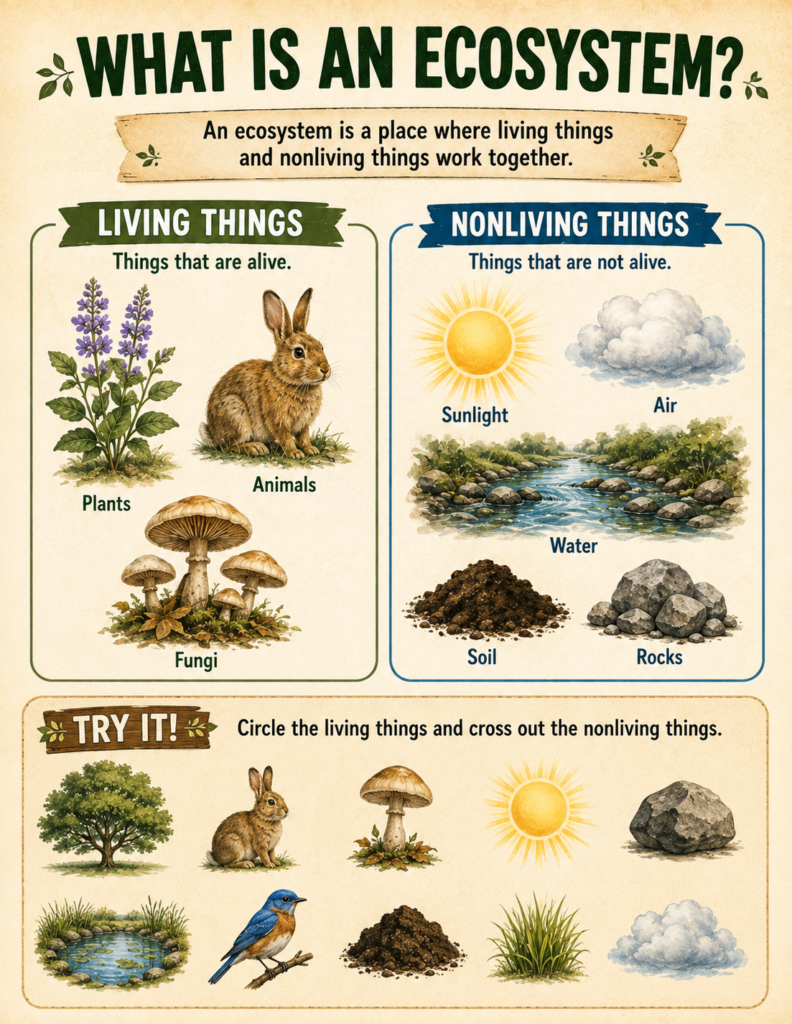
Try this at home: Have your child draw a line down the middle of a piece of paper. On one side, they can draw or list all the living things they see outside (birds, grass, bugs). On the other, the nonliving things (sunlight, dirt, rocks, water). This simple exercise sets the stage perfectly for deeper learning and is a great way to incorporate project based learning in homeschooling.
2. Meet the Ecosystem Crew: The Jobs of Nature
In any functional society, everyone has a job. The same goes for nature! Once your child grasps what an ecosystem is, it is time to introduce the four main roles in every food chain.
- The Sun: The ultimate boss. It provides the raw energy required for almost all life on Earth.
- Producers: These are the magic-makers (plants, algae) that use the sun’s energy to make their own food.
- Consumers: The animals that cannot make their own food and must eat plants or other animals to survive.
- Decomposers: Nature’s recycling crew (fungi, bacteria, worms) that break down dead things and return nutrients to the soil.
Kids love giving things titles and categories. When they realize that a mushroom isn’t just a plant, but rather a «Decomposer,» it feels like they have learned a secret password to the natural world.
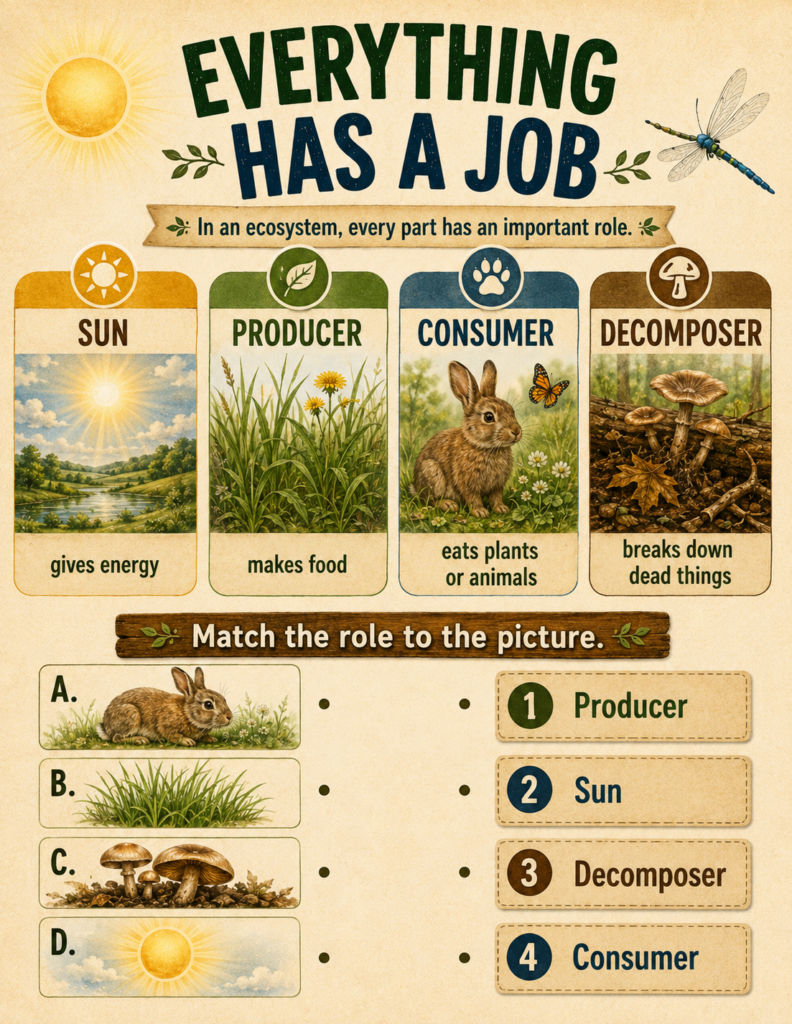
To make this stick, try turning it into a game. Shout out an item—like «Apple Tree!»—and have your child yell back «Producer!» Then shout «Lion!» and wait for them to eagerly shout «Consumer!» It is a highly effective way to make learning fun for kids .
3. The Dietary Habits: Herbivores, Carnivores, and Omnivores
Once we know who the consumers are, we need to sort them by what is on their dinner plate.
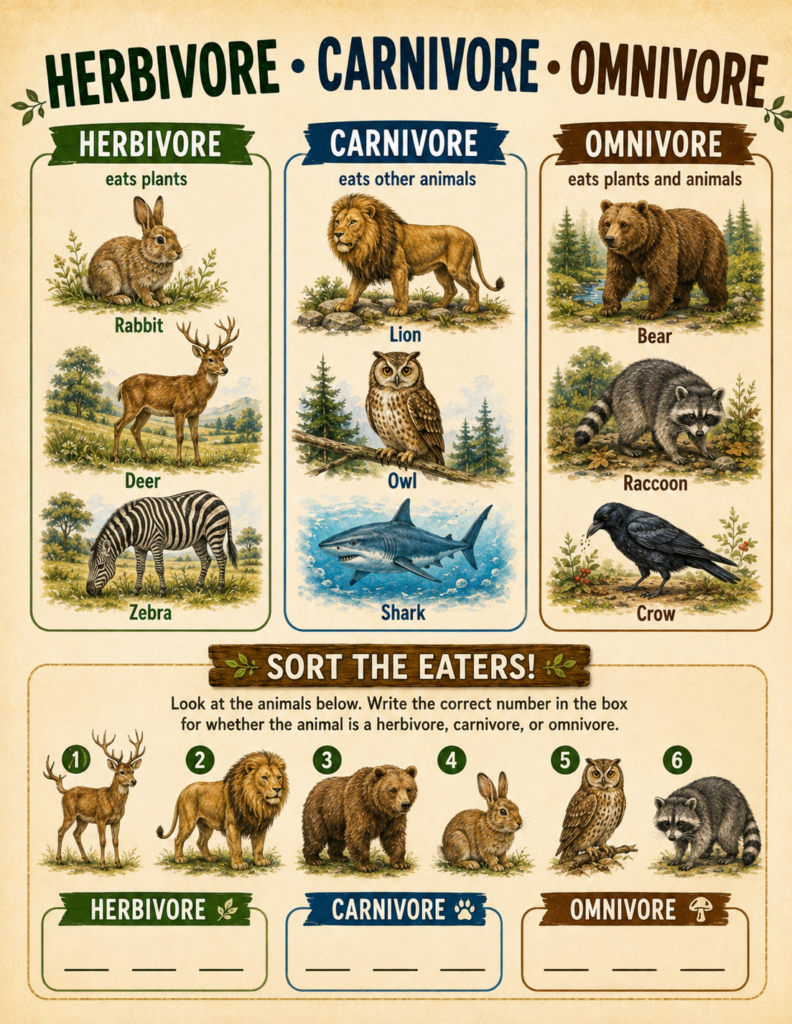
- Herbivores: The plant-eaters (like rabbits and deer).
- Carnivores: The meat-eaters (like owls and lions).
- Omnivores: The flexible eaters who love both (like bears, raccoons, and humans!).
Understanding these dietary categories helps children predict how an animal fits into a food web. If your child struggles to remember the terms, use a visual sorting activity. You can cut out pictures of animals from old magazines and create three piles on the floor.
If you want a truly structured, open-and-go solution that handles all of this for you, having a dedicated activity book is a lifesaver. This is especially helpful if you are trying to implement screen free activities during a long afternoon indoors.
4. Connecting the Dots: Building the Chains and Webs
Now comes the ultimate puzzle—putting it all together! A food chain always starts with the sun and shows a single path of energy. For example: Sun → Grass → Grasshopper → Frog → Snake.
Have your kids practice drawing the arrows. Emphasize that the arrow points in the direction the energy is flowing (into the belly of the animal that eats it!).
Once they master a single chain, introduce the Food Web. A food web is much more realistic because most animals eat more than one thing. What happens if the frogs disappear? Suddenly, the grasshopper population explodes, and the snakes go hungry. This teaches children a beautiful lesson in environmental empathy and conservation: every piece of the puzzle matters. Teaching these concepts early is a wonderful way to raise a global citizen who cares about Earth’s delicate balance.
The Ultimate «No-Prep» Solution for Parents
We know you want to provide these rich, hands-on science experiences for your kids. We also know you don’t have three hours to design worksheets, draw food webs, and create vocabulary cards from scratch.
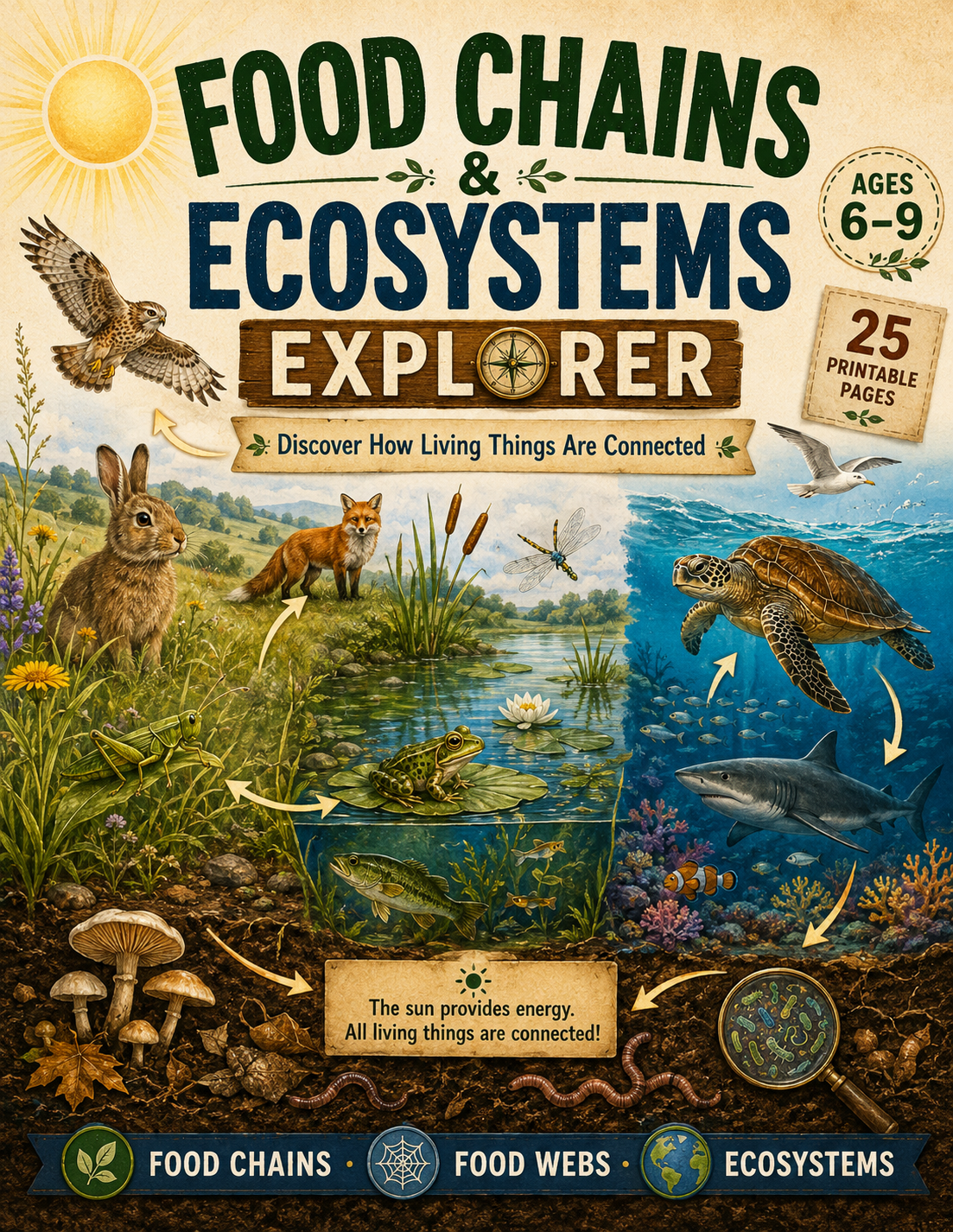
That is exactly why we created the Food Chains: Ecosystems Explorer activity book at Tiny Joy Studio!
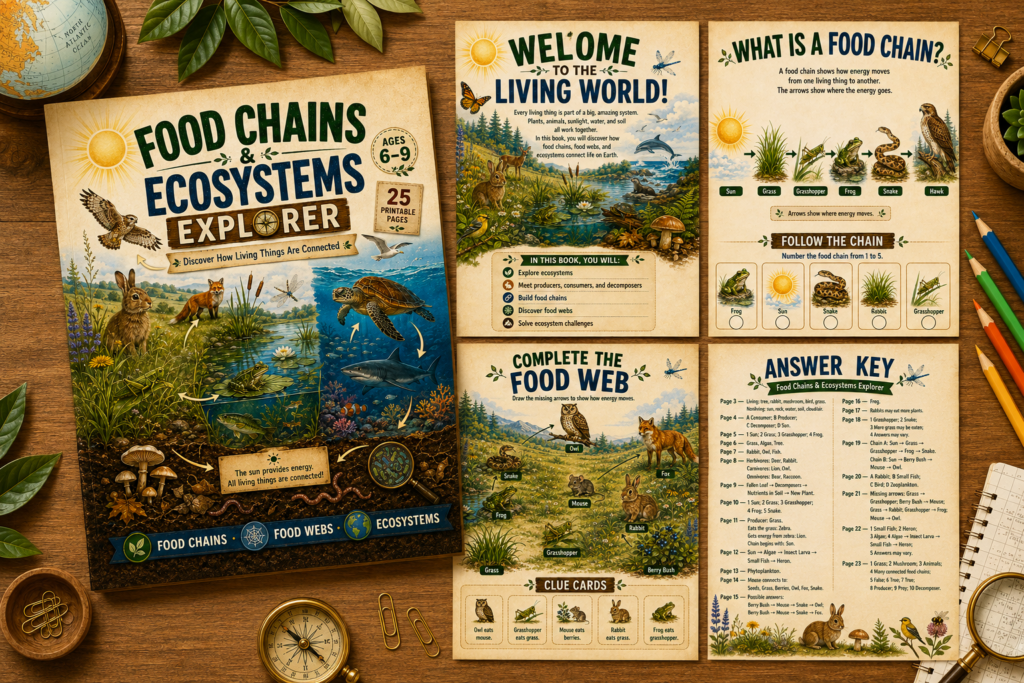
This beautifully illustrated, printable workbook is designed specifically for kids ages 6-9. It takes them on a guided journey through the living world. Inside, they will:
- Identify living vs. nonliving things.
- Master the roles of producers, consumers, and decomposers.
- Sort herbivores, carnivores, and omnivores.
- Solve interactive food web puzzles and ecosystem challenges.
The best part? It requires zero prep. Just print it out, grab some colored pencils, and let your young scientist get to work! It perfectly complements our World Explorer geography series, bridging the gap between studying animals on a map and understanding how they survive in their habitats.
Ready to start your scientific adventure today?