Why Mammoths Never Met T. rex: Teaching Ice Age Science Through Evidence and Documentary Editing
Children fascinated by prehistoric giants often absorb dramatic nature documentaries and picture books without realizing where hard fossil proof ends and artistic guesswork begins. When parents look for a meaningful ice age workbook for kids, they quickly discover that most elementary resources lump dinosaurs, woolly mammoths, and saber-toothed cats into a single undifferentiated snowstorm. Instead of cultivating scientific reasoning, typical activity packs ask children to color generic glaciers and memorize monster trivia.
True paleontology works more like forensic editing than memorizing names. Scientists examine physical remains—teeth, bones, preserved hair, and trapped pollen—and carefully distinguish what those clues directly show from what they merely suggest. Teaching elementary learners to recognize the boundary between direct evidence, reasonable inference, and genuine unknowns equips them with a foundational scientific habit that applies across every subject they study.
Escaping the «One Frozen World» Myth
One of the most persistent misconceptions in elementary earth science is that the Pleistocene epoch was a single, unbroken sheet of global ice where every prehistoric creature lived side by side. In reality, the Ice Age spanned from roughly 2.6 million to 11,700 years ago and cycled through colder glacial phases and warmer intervals. Even more importantly, woolly mammoths never crossed paths with Tyrannosaurus rex, which vanished about 66 million years earlier.
Understanding how deep geological time unfolds requires the same chronological discipline children build when exploring human civilizations through an interactive history for kids curriculum. Before learners can explain why an animal thrived in a given habitat, they must place it in the right era and the right region.
The Science Director Framework: Evidence, Inference, or Unknown?

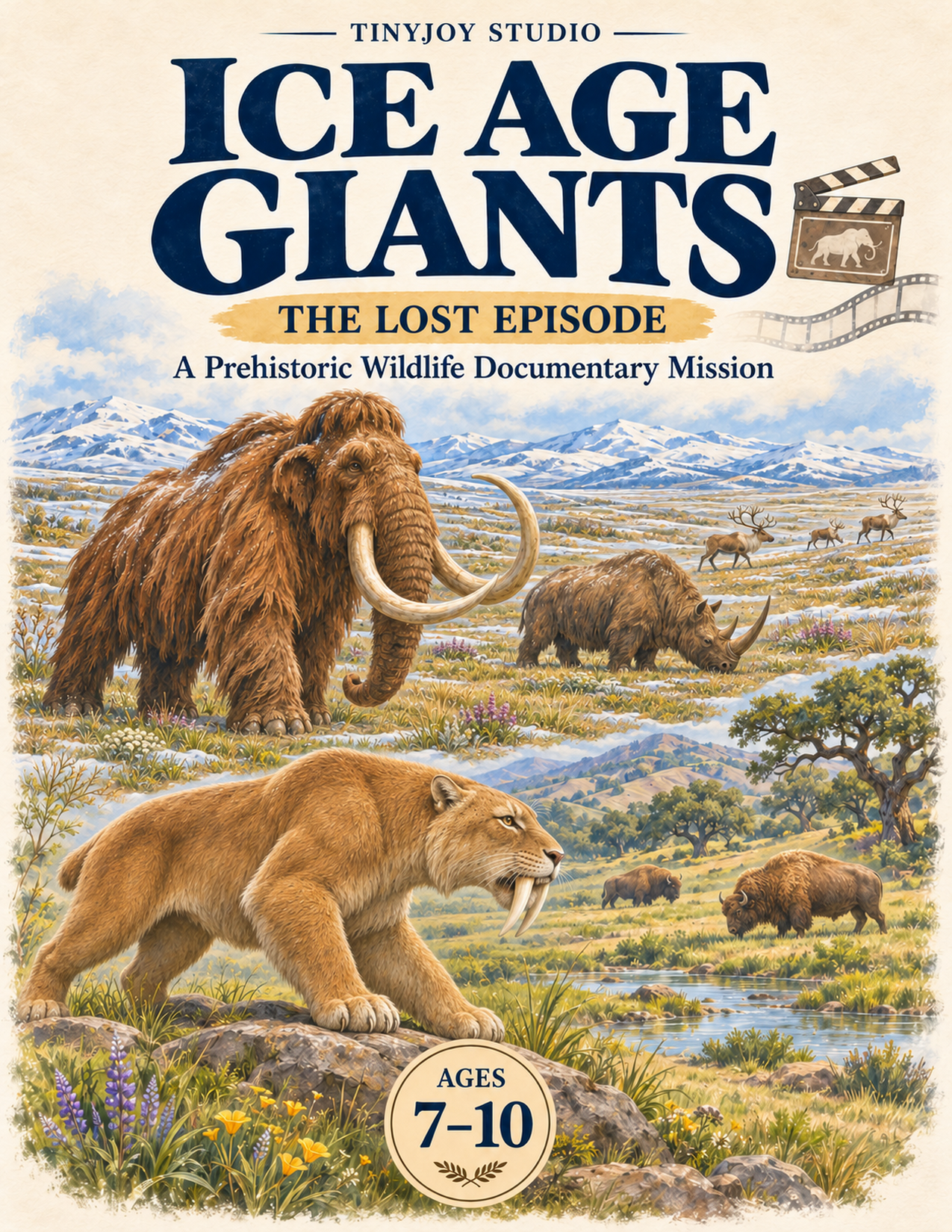
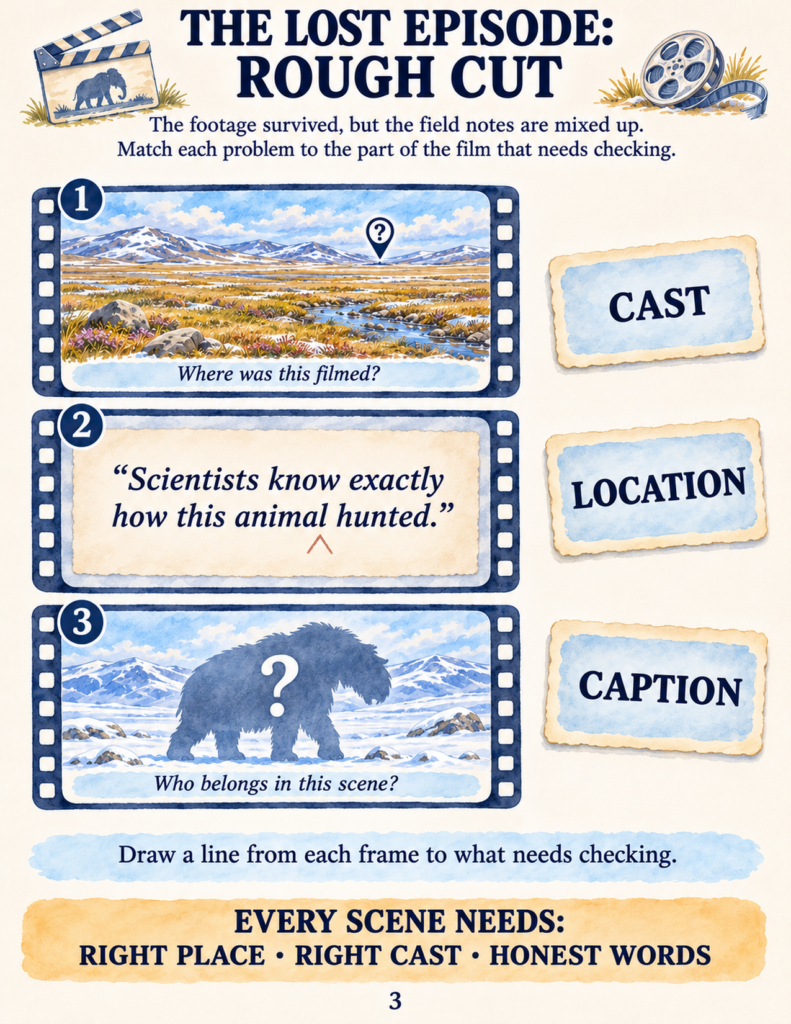
Designed for ages 7–10, Ice Age Giants: The Lost Episode (part of the Prehistoric Earth Evidence Missions series) solves the problem of passive fact-gathering by casting the child as a Science Director finishing an incomplete wildlife documentary. Every scene in the rough cut suffers from mixed-up field notes, misplaced animals, or exaggerated voiceover claims.
To approve or fix the footage, learners master a three-part analytical filter:
- Evidence (E): Something directly found or measured, such as permafrost-preserved mammoth hair or ridged grinding molars.
- Inference (I): A logical idea supported by physical clues, such as concluding that a thick undercoat helped hold in body heat.
- Unknown (U): A detail the physical record cannot yet answer, such as the exact fur pattern of every woolly mammoth or the precise group size of every cave lion hunt.

Two Distinct Ice Age Worlds: Mammoth Steppe and Ice Age L.A.
Rather than treating the Pleistocene as one uniform landscape, the workbook divides the documentary mission into two contrasting regional ecosystems. Comparing how climate, terrain, and preservation mechanics differed across continents connects paleontology directly to a broader geography learning path for kids and reinforces how physical terrain shapes life in a world landscapes workbook bundle for kids.
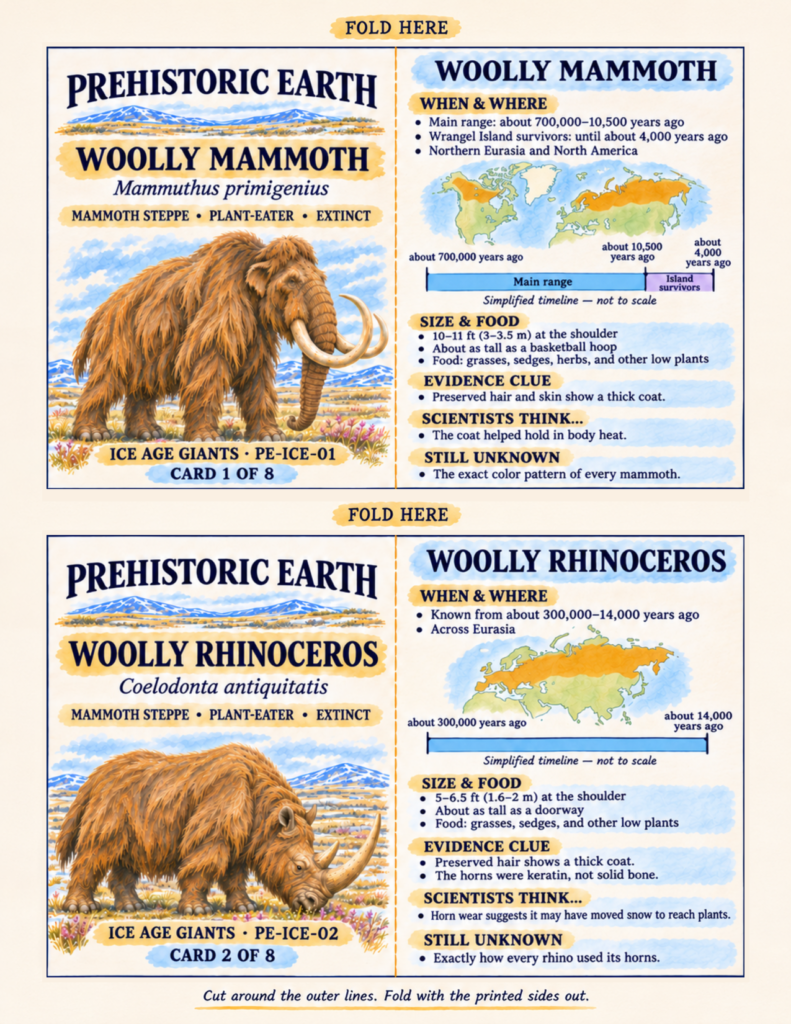
- Part 1: The Mammoth Steppe. Learners scout an open, cold, dry grassland rich in low plants, grasses, and forbs rather than barren deep snow. They examine how permafrost preserved stomach contents, skin, and hair, and compare four iconic residents: the woolly mammoth (Mammuthus primigenius), woolly rhinoceros (Coelodonta antiquitatis), cave lion (Panthera spelaea), and reindeer (Rangifer tarandus). A dedicated «Then and Now» comparison shows that while mammoths and woolly rhinos went extinct, reindeer survived into the modern Arctic—proving that survival does not mean ecosystems remained static.
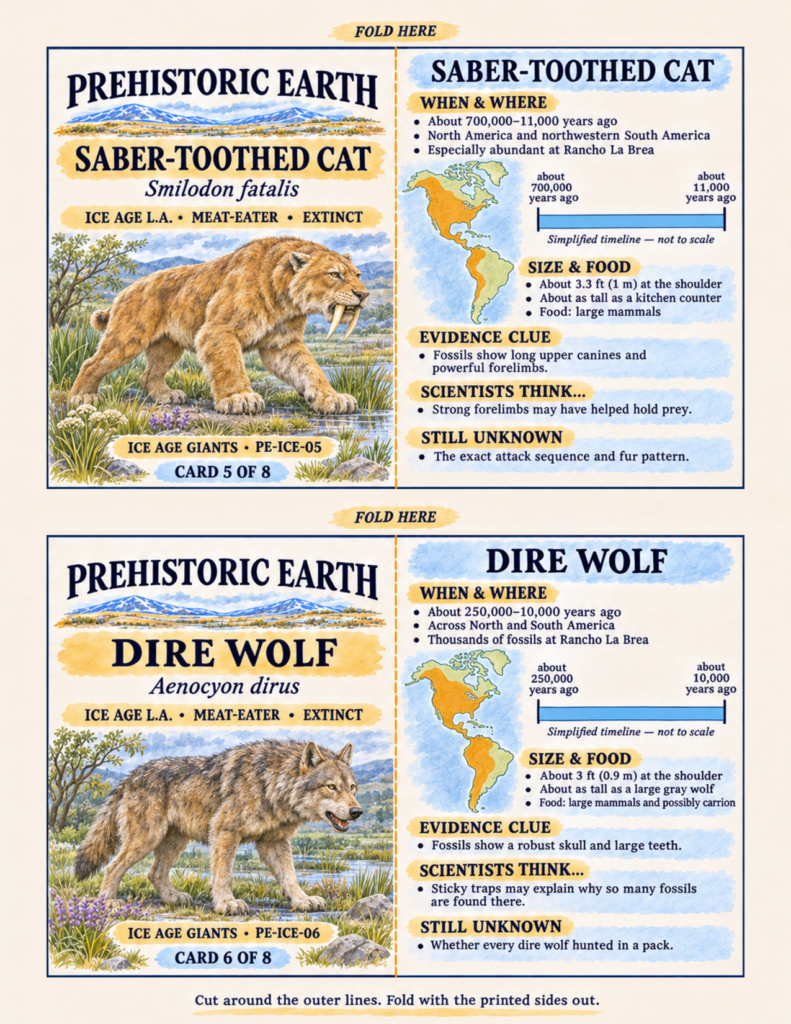
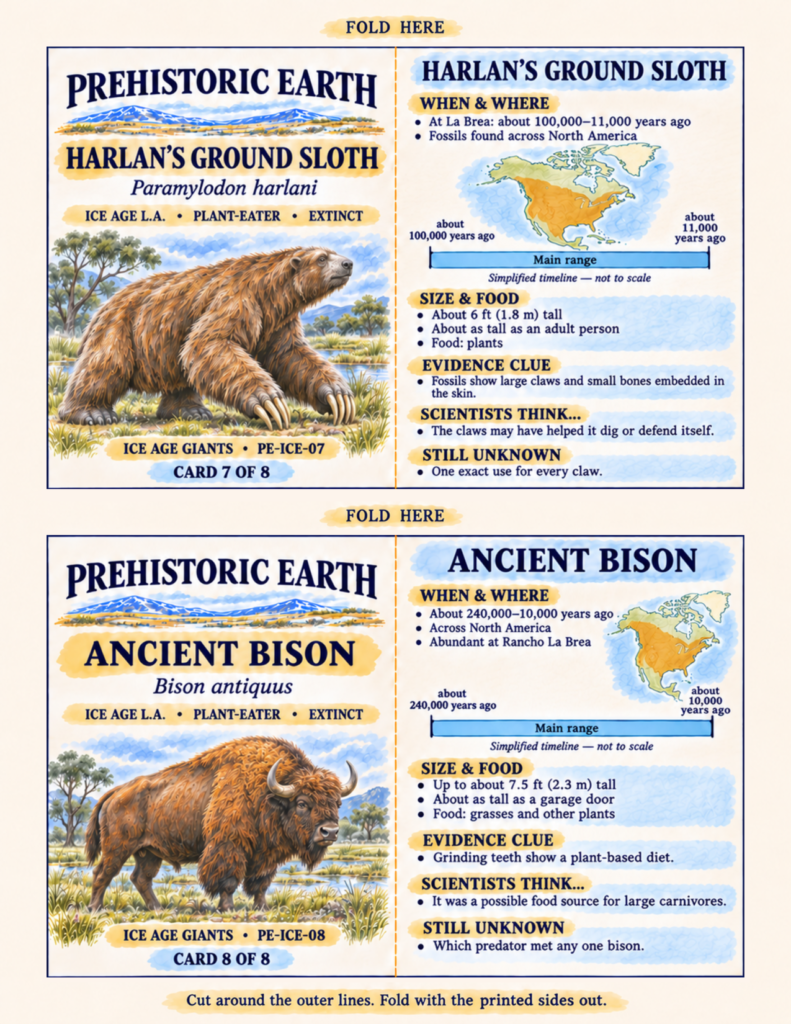
- Part 2: Ice Age Los Angeles. Shifting to southern California, students investigate a cooler, wetter woodland and open-ground habitat that was never buried under a continental ice sheet. Through a four-step geological sequence, they trace how natural asphalt seeped to the surface at Rancho La Brea, trapping herbivores and subsequently luring predators and scavengers into the sticky pools. This explains why predator fossils—like Smilodon fatalis and dire wolves (Aenocyon dirus)—appear in disproportionate numbers alongside Harlan’s ground sloth (Paramylodon harlani) and ancient bison (Bison antiquus).


Auditing Overclaims and Building the Final Cut
Across its 38 printable pages, the workbook consistently challenges children to catch scientific overclaims. Learners inspect tooth morphology—contrasting smooth, pointed carnivore teeth and meat-shearing carnassials against broad, ridged mammoth molars—to fix inaccurate voiceovers. They audit food web diagrams using solid lines for broad dietary categories and dashed lines for specific predator-prey encounters that no human ever filmed.
Evaluating spatial locations, scale timelines, and multi-variable evidence cards mirrors the analytical discipline children practice in an explorer skills workbook bundle or when testing planetary models in an earth and space science bundle for kids.
In the culminating Editing Room and Final Cut chapters, students use cut-out Scene Bank tiles to assemble six verified documentary frames, revise overconfident captions using careful qualifiers like may and suggests, and sign off on their completed Science Director Checklist. The packet also includes eight foldable, double-sided Prehistoric Earth Evidence Cards featuring range maps, size comparisons (such as comparing a woolly mammoth to a basketball hoop), and an answer key for independent or co-op review.


Practical Integration for Homeschool and Classroom
Because every activity relies on visual observation, structured sorting, and concise reasoning rather than dense textbook lectures, Ice Age Giants: The Lost Episode adapts smoothly to several learning settings:
- Two-Week Homeschool Unit Study: Complete two to three spreads per session, separating Part 1 (Mammoth Steppe) and Part 2 (Ice Age L.A.) across two focused weeks.
- Media Literacy and Science Crossover: Pair the Caption Check pages with clips from real wildlife documentaries so children can practice spotting where narration shifts from observed fossil facts to dramatic speculation.
- Small-Group or Family Card Review: Print and fold the eight Prehistoric Earth Evidence Cards so siblings or lab partners can quiz one another on anatomical clues, timelines, and remaining scientific mysteries.
If you want a ready-to-print way to take prehistoric wildlife study from passive trivia to genuine evidence analysis, Ice Age Giants: The Lost Episode gives learners ages 7–10 a structured, screen-free mission through two unforgettable Ice Age worlds.