Why Good Paleontology Changes Its Mind: Teaching Dinosaur Science Through Fossil Evidence
Children who love dinosaurs can often rattle off dozens of species names before they ever learn how paleontologists actually know what those animals looked like or how they behaved. When families search for a meaningful dinosaur workbook for kids, they quickly notice that most elementary printables stop at surface-level trivia: tracing dotted dino names, coloring generic volcanoes, or memorizing unverified superlatives about the fiercest predators. A well-crafted dinosaur workbook for kids takes a completely different approach—inviting young learners to examine real fossil clues, distinguish what a specimen directly shows from what it only suggests, and see why scientific explanations evolve as new discoveries emerge.
In genuine paleontology, a museum skeleton is rarely a complete photograph of a living animal. Early fossil hunters frequently had to work with scattered bones, missing limbs, or isolated teeth, leading to famous historical misinterpretations—from placing Iguanodon’s thumb spike on its nose to branding Oviraptor an «egg thief» before embryo fossils proved it was brooding its own nest. Teaching elementary learners that revising an earlier hypothesis in light of stronger evidence is a triumph of science—not a mistake—builds genuine critical thinking.

Separating Dinosaurs from Flying and Swimming Reptiles—and Deep Time
Two common misconceptions appear in almost every elementary dinosaur unit: assuming that every large prehistoric reptile was a dinosaur, and imagining that Stegosaurus and Tyrannosaurus rex battled one another in the same forest.
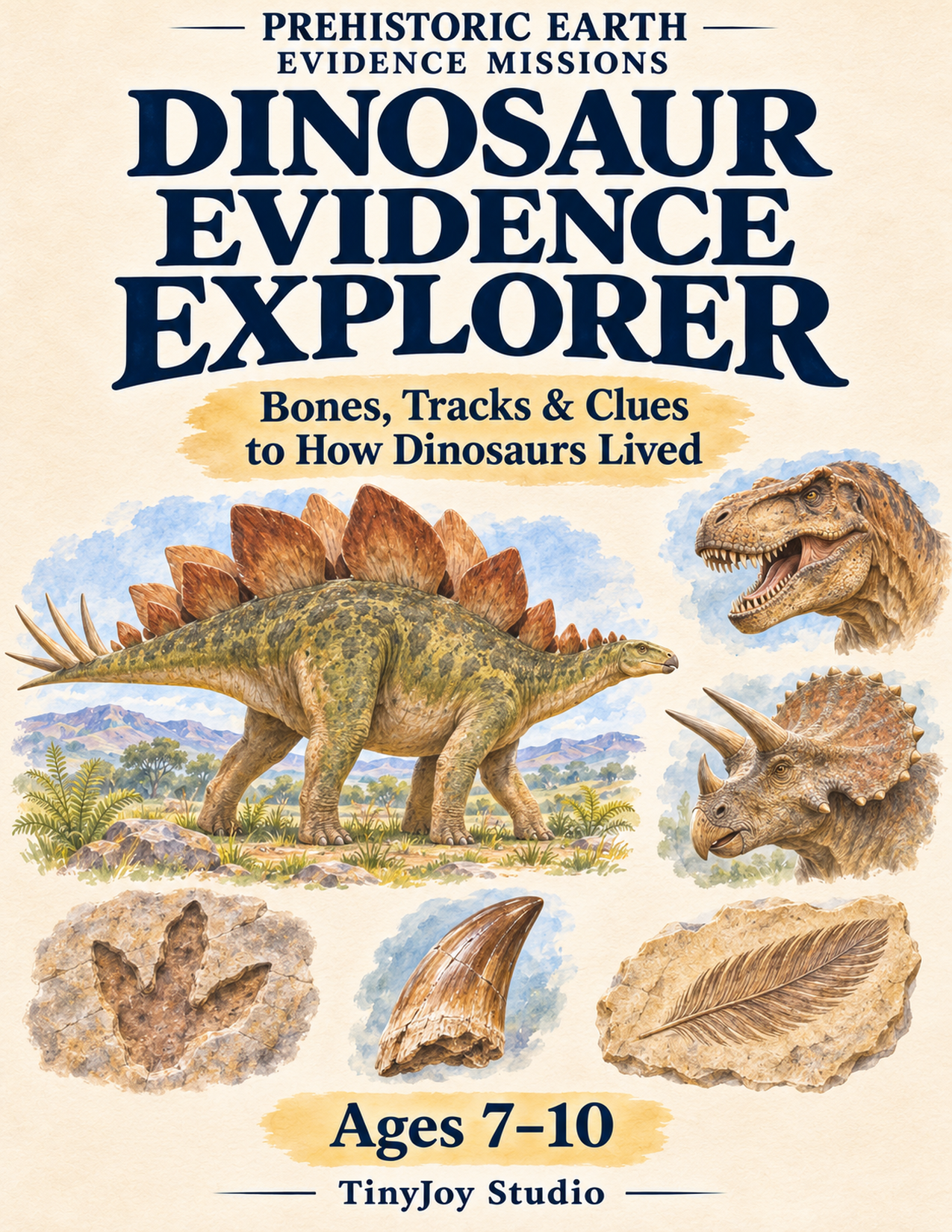
In Dinosaur Evidence Explorer: Bones, Tracks & Clues to How Dinosaurs Lived (a 38-page printable mission for ages 7–10 by TinyJoy Studio), students tackle both errors head-on:
- Anatomical Classification (Page 4): Learners inspect skeletal clues rather than body size or habitat. They discover that Pteranodon (whose wing was supported by one elongated finger) and Mosasaurus (a marine lizard with paddle-shaped limbs) belong to separate reptile branches, whereas modern birds sit directly inside Dinosauria due to shared theropod skeletal traits like a wishbone, swiveling wrist, and three forward toes.
- Geological Timelines (Page 5): Comparing real museum specimens—Sophie the Stegosaurus (~150 million years ago in the Late Jurassic) and SUE the T. rex (~67 million years ago in the Late Cretaceous)—children calculate that roughly 83 million years separated the two animals.
Pairing prehistoric timelines with later geological eras creates a seamless progression for young researchers. After exploring Mesozoic reptiles, families can follow the same evidence-first methodology into the Pleistocene with our companion ice age workbook for kids, or connect deep-time chronology to human civilizations using an interactive history for kids curriculum.

The Evidence Toolkit: Shows, Suggests, or Still Unknown?
At the heart of Dinosaur Evidence Explorer is a disciplined three-tier vocabulary that trains children to audit museum plaques and wildlife stories with precision:
- It Shows: Direct physical facts preserved in rock, such as four tail-spike bones on Sophie’s skeleton, lumpy healed bone tissue on nine of SUE’s ribs, or alternating dark and light bands preserved along a Sinosauropteryx tail.
- It Suggests: Supported inferences drawn from anatomy or trace clues, such as tail spikes aiding defense, SUE surviving long enough after injury for new bone to grow, or microscopic melanosomes pointing toward chestnut-to-reddish-brown tail stripes.
- Still Unknown: Questions the fossil record cannot answer yet, such as how often Stegosaurus swung its tail, what exact event broke SUE’s ribs, or what eye color Sinosauropteryx had.
When students evaluate Stegosaurus back plates on Page 10, they test a visitor’s claim that the plates were thick body armor. Seeing that the fossil plates are actually thin and fragile, learners revise the claim—recognizing that science changes when the evidence changes. This habit of testing physical models against hard data directly parallels how students evaluate planetary scale and celestial mechanics in an earth and space science bundle for kids.

Trackways, Substrates, and Paleoenvironments
Fossils are not limited to mineralized bones. Across Pages 11–14, students investigate trace fossils—footprints and trackways that capture moments of ancient movement.
- Reading Sauropod Trackways: Learners distinguish smaller crescent-shaped front handprints (manus) from larger, three-clawed hind footprints (pes), mark direction of travel, and bracket a single stride between successive same-side hind prints.
- The Print Lab: Comparing identical model foot impressions in dry loose sand, firm damp sand, and very wet mud, children see that soft sediment collapses and distorts toe outlines without the animal’s foot ever changing shape.
- Auditing Herd Claims: Examining parallel sauropod trackways, students learn why tracks support movement in the same direction while leaving exact timing and lifelong herd behavior open questions.
Reading sedimentary surfaces, ancient coastlines, and regional fossil distribution maps reinforces the exact spatial-reasoning habits children develop in an explorer skills workbook bundle, while connecting ancient floodplains and coastal basins to a broader geography learning path for kids and world landscapes workbook bundle for kids.

Solving Famous Paleontology Mysteries—and the 8 Cutout Evidence Cards
In the second half of the workbook, students step into four real historical case files:
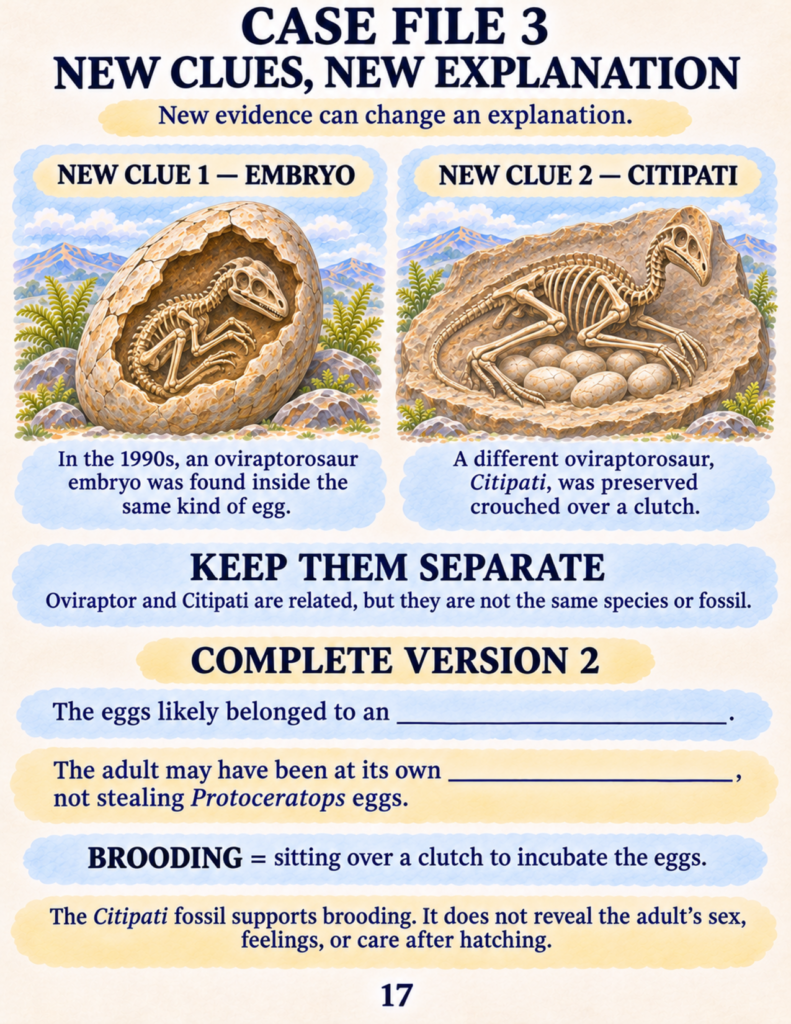
- Case File 3 (Oviraptor & Citipati): Tracing how a 1923 Mongolian skeleton found near eggs was mislabeled an «egg thief» until 1990s oviraptorosaur embryo fossils and an adult Citipati preserved crouched over its clutch revealed brooding behavior.
- Case File 4 (T. rex Arms): Tracking how a 1915 museum mount borrowed three-fingered Allosaurus hands until closer tyrannosaur relatives (Gorgosaurus) and late-1980s complete T. rex arm fossils confirmed two fingers.
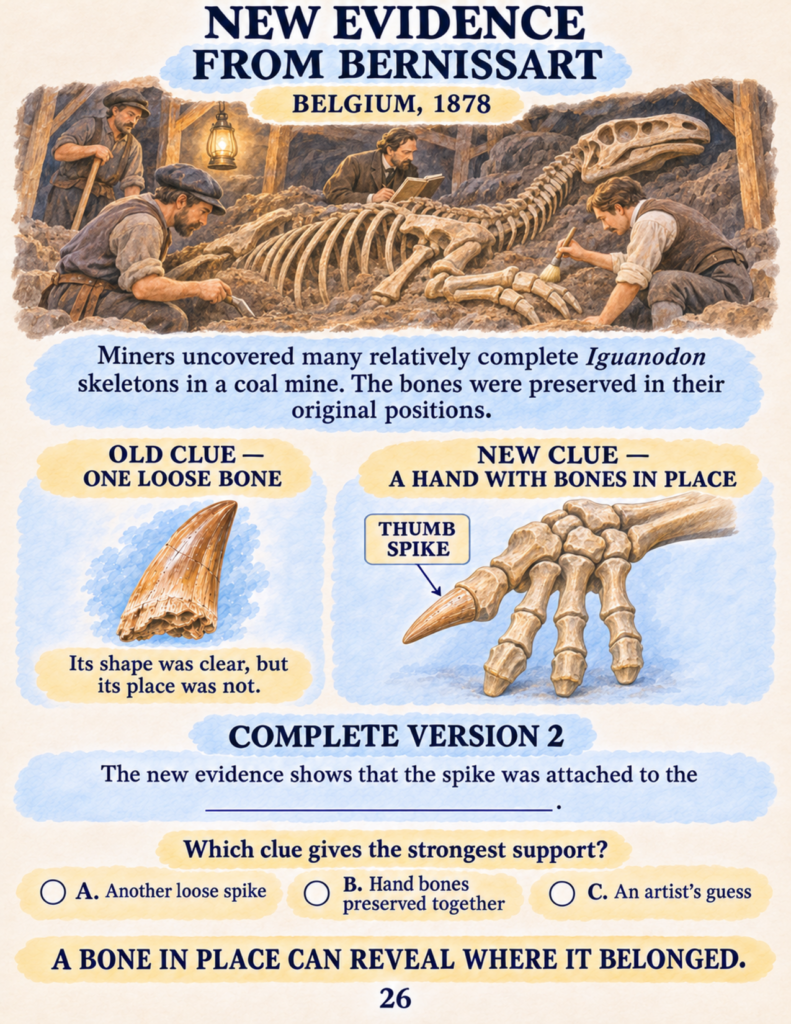
- Final Case (Iguanodon’s Thumb Spike): Returning to their un-erased Page 2 guess, learners examine the 1878 Bernissart coal-mine skeletons from Belgium—where articulated hand bones proved the mystery cone belonged on the thumb—and build their own revised museum panel.
As a hands-on bonus at the back of the packet, families also get eight foldable, double-sided Prehistoric Earth Evidence Cards (Triceratops, Stegosaurus, Tyrannosaurus rex, Baryonyx, Citipati, Yutyrannus, Sinosauropteryx, and Iguanodon). Each card pairs an illustration on the front with a time-and-range map, relatable scale comparisons (such as comparing a 30-foot Triceratops to a school bus or a 3.6-foot Sinosauropteryx to a baseball bat), an Evidence Clue, what Scientists Think, and what is Still Unknown on the back. Even better, Card 8 (Iguanodon) includes a «Spoiler: Open After Page 29» warning so children can solve the thumb-spike mystery through their own investigation before unlocking the final card for their deck.

Practical Ways to Use This Workbook at Home and School
With a two-sheet Answer Key and clear self-contained visual prompts, Dinosaur Evidence Explorer requires zero specialized supplies beyond a pencil, scissors, and optional modeling clay for the Page 13 footprint lab:
- Two-to-Three-Week Homeschool Paleontology Unit: Complete two pages per session, saving the Label Repair Lab (Page 23) and Revised Museum Panel (Page 28) as portfolio assessments.
- Museum Visit Prep: Work through Pages 3, 6, and 24 before a natural history museum trip so children know how to spot rebuilt plaster cast parts versus real fossilized bone and read exhibit labels critically.
- Interactive Card Deck Review: Print and fold the eight Prehistoric Earth Evidence Cards so siblings or classmates can cover the back, predict diet and habitat from the front artwork, and flip the card to check the fossil evidence.
If you want a ready-to-print way to turn a child’s love of dinosaurs into genuine scientific reasoning, hypothesis testing, and evidence literacy, Dinosaur Evidence Explorer gives learners ages 7–10 a structured, screen-free expedition through prehistoric life.