Why the Highest Price Doesn’t Win: Teaching Pricing, Demand, and Profit Through Controlled Store Tests
When children first start thinking about running a shop, almost every one of them reaches the same intuitive conclusion: charge the highest price possible so you make the most money. Choosing a well-structured pricing and demand workbook for kids helps young learners discover why real retail math rarely works that way. Rather than handing students a list of economic definitions to memorize, an effective pricing and demand workbook for kids puts them in charge of a neighborhood supermarket—testing different price tags on the exact same group of shoppers to watch how customer demand rises and falls with every dollar change.
In real commerce, raising a price earns more profit per item sold, yet simultaneously shrinks the number of people willing to buy. Finding the balance between margin and volume—and recognizing that the “best” price shifts whenever the product, the shoppers, or the store’s goal changes—builds applied mathematical reasoning that goes far beyond routine multiplication drills.

Controlled “What-If” Price Testing: Changing Only One Variable

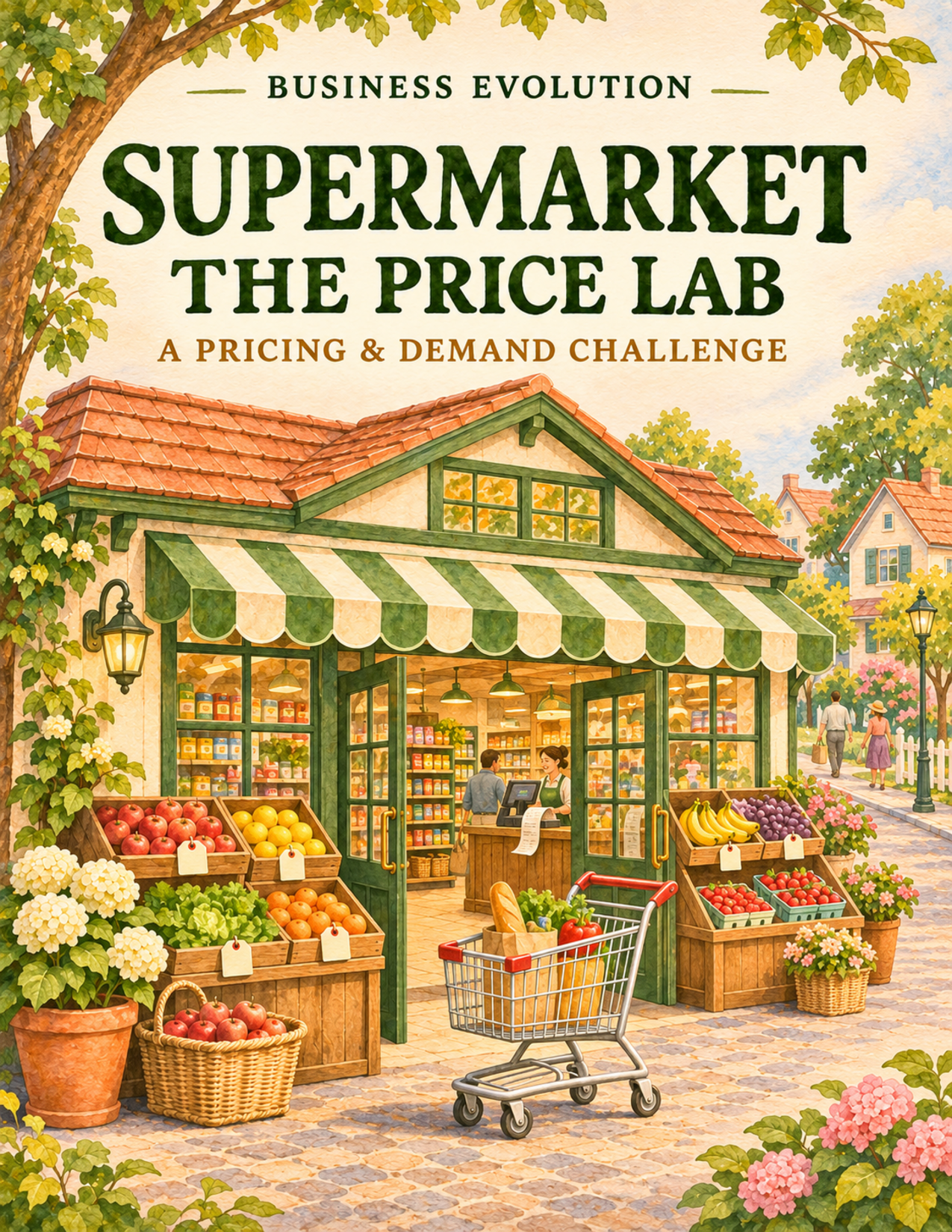
Supermarket: The Price Lab — A Pricing & Demand Challenge is a 32-page standalone adventure in TinyJoy Studio’s 10-book Business Evolution series. Like a controlled science experiment, the workbook introduces learners to What-If Price Tests: keeping the product, the shoppers, and the store goal identical while changing only the price tag.
Each shopper profile displays a clear “Most I’d Pay” ceiling. If the shelf price is at or below a shopper’s ceiling, they mark BUY; if the price exceeds it, they mark PASS. Across three escalating retail scenarios, students discover how demand shapes total profit:
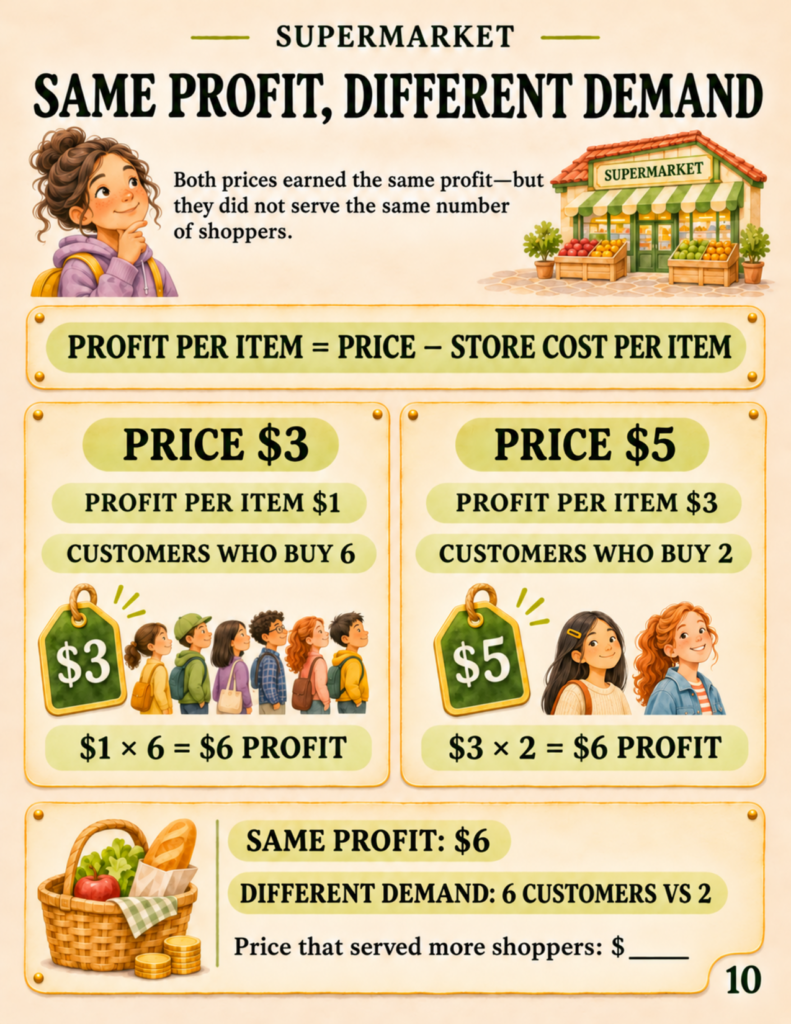
- Guided Round — Sunny Juice (Pages 7–11): Testing $3, $4, and $5 on a $2-cost juice bottle across six shoppers reveals a surprising tie. At $3, all 6 shoppers buy at $1 profit per bottle ($6 total profit); at $5, only 2 shoppers buy at $3 profit per bottle (also $6 total profit). Learners then predict and test the middle price ($4) to see how 4 buyers at $2 profit per bottle outperform both extremes with $8 profit.
- Main Challenge — Everyday Cereal (Pages 12–19): Scaling up to 12 shoppers, learners make a written prediction first, run two full BUY/PASS tests, and then learn a mathematical shortcut—multiplying Profit per Item × Customers Who Buy—to complete the third price column without repeating every individual tally.
- Final Challenge — Premium Snack Box (Pages 20–24): Raising the store cost to $4 per item and testing $6, $8, and $10 tags reinforces how higher unit costs shift the entire pricing ladder upward.

Shifting the Three Levers: Product, Shoppers, and Store Goal
Once learners master profit maximization, Pages 25–30 challenge a deeper assumption: is maximum profit always a business’s only objective?
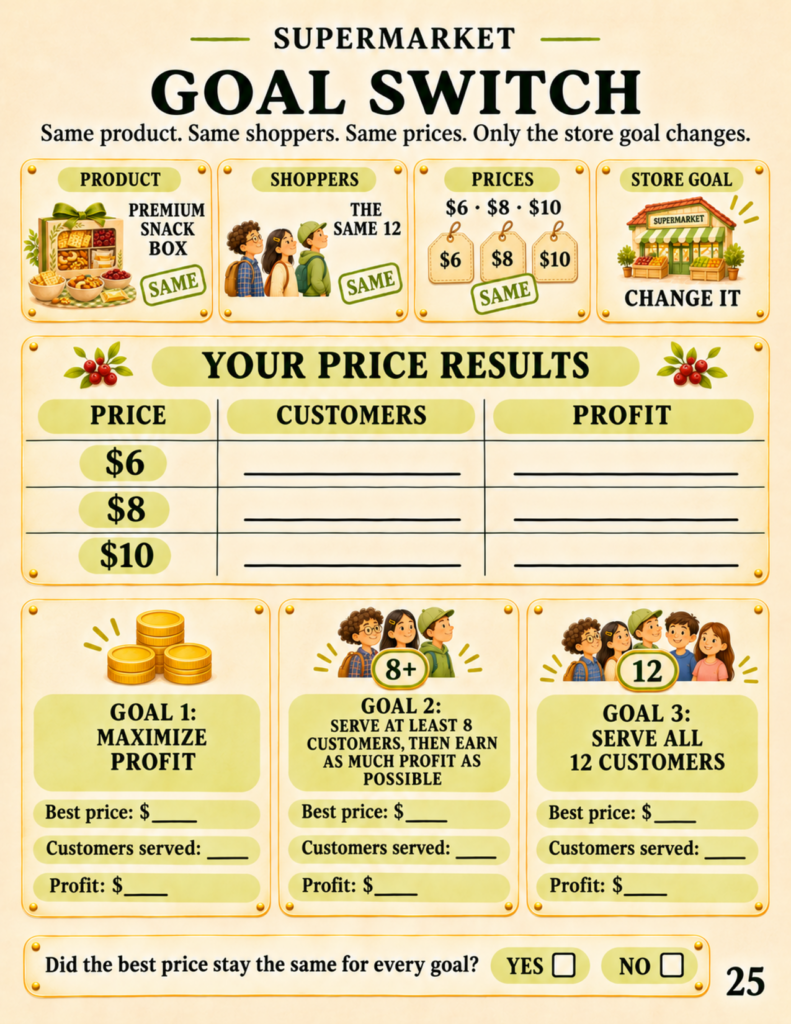
In Goal Switch (Page 25), students keep the Premium Snack Box and the exact same 12 shoppers, but test three different store goals:
- Goal 1 — Maximize Profit: Choosing $8 serves 8 customers and earns the highest profit ($32).
- Goal 2 — Serve at Least 8 Customers, Then Maximize Profit: Checking which price clears the customer threshold while protecting margin.
- Goal 3 — Serve All 12 Customers: Lowering the price to $6 brings every shopper through the door, requiring students to calculate the exact opportunity cost—the profit given up in order to serve the whole neighborhood.
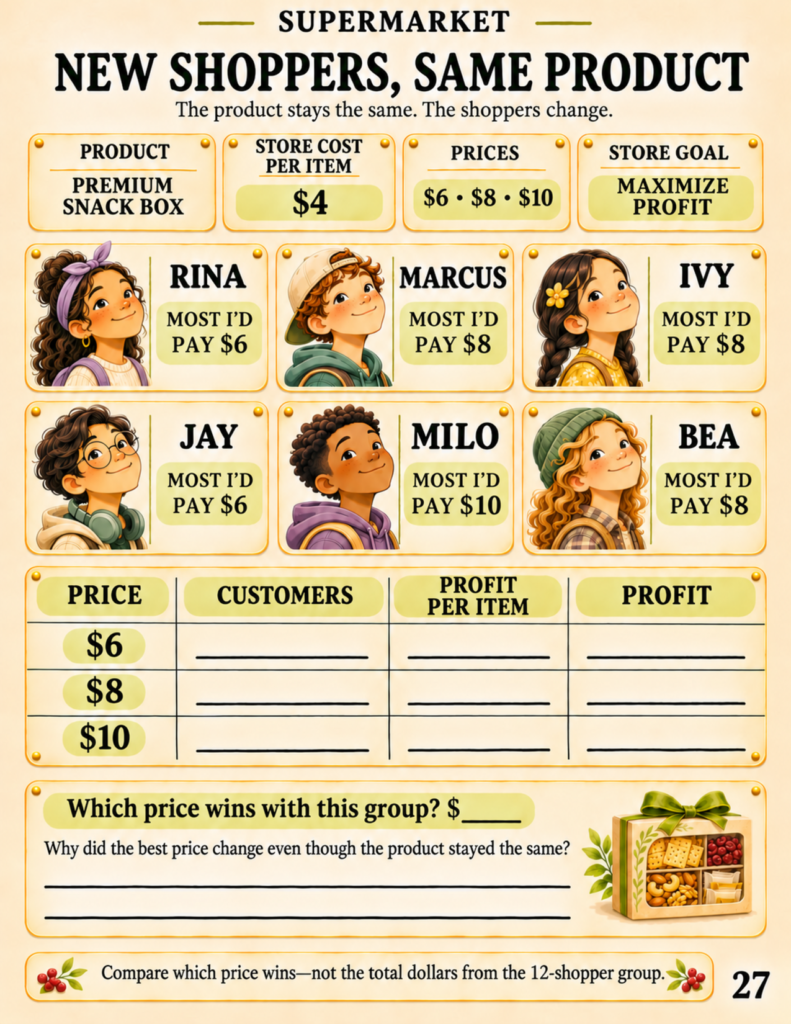
On Page 27 (New Shoppers, Same Product), students keep the snack box unchanged while introducing a new group of shoppers with different willingness-to-pay limits, proving that customer demographics alone can shift the winning price. By Page 30, learners synthesize all three pricing levers—Product, Shoppers, and Goal—into their own written Pricing Rule.

Connecting Variable Costs, Trade History, and Collector Progression
In the Business Toolkit (Pages 28–29), the workbook formalizes the formulas behind every test—distinguishing Revenue (Price × Customers), Total Cost (Store Cost per Item × Customers), and Profit (Revenue − Total Cost). It also highlights a key series connection: whereas our first Business Evolution release, Weekend Wheels (our flagship business workbook for kids), featured a fixed daily operating cost, Supermarket introduces variable costs that rise with every item sold.

Understanding how merchants price goods, weigh customer purchasing power, and adapt to local markets also pairs naturally with broader social studies units. Tracing how historic trade routes, marketplaces, and currency systems evolved across civilizations enriches an interactive history for kids curriculum, while examining how regional resources, supply distances, and local communities shape retail prices complements a geography learning path for kids.
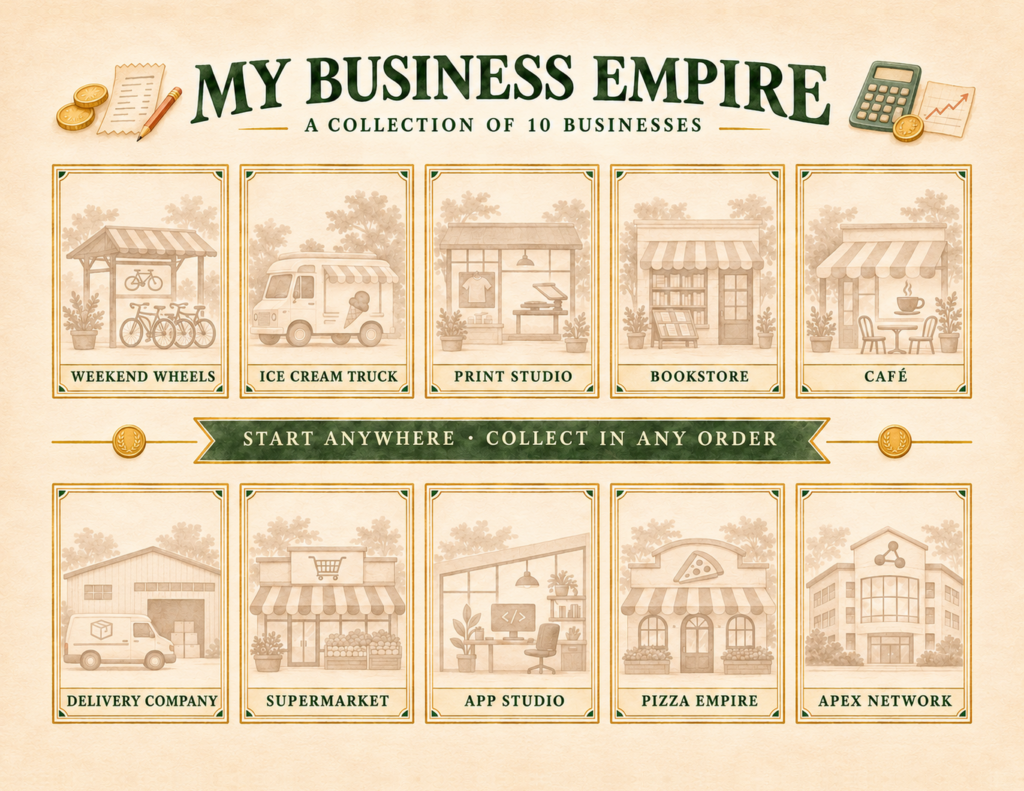
At the end of the book, completing the Pricing Review on Page 31 unlocks the cut-out Supermarket business card on Page 32—allowing learners to add another completed enterprise to their 10-book My Business Empire collector portfolio alongside Weekend Wheels and eight additional standalone business challenges.

Practical Ways to Use Supermarket: The Price Lab at Home and School
Requiring only standard printer paper, a pencil, and scissors for the final collector card, Supermarket integrates effortlessly into elementary and middle-grade routines:


- A Two-Week Homeschool Applied Math & Economics Unit: Complete the Sunny Juice guided round and Everyday Cereal challenge in Week 1, followed by the Premium Snack Box, Goal Switch trade-offs, and Business Toolkit in Week 2.
- Multiplication & Mental Math Reinforcement: Use the Revenue, Total Cost, and Profit per Item × Customers shortcut tables (Pages 18 and 24) to give multi-digit multiplication and subtraction immediate real-world purpose.
- Family Dinner Table Discussions: After completing Page 26 (What Did the New Goal Cost?), ask children to spot real examples at the grocery store—such as store-brand staples priced low for high volume versus specialty gift boxes priced higher for smaller crowds.
If you want a ready-to-print resource that turns multiplication, subtraction, and consumer decision-making into an engaging retail experiment, Supermarket: The Price Lab gives young thinkers a clear, structured framework for understanding how prices, customer demand, and profit truly work.