How to Build an Engaging Sweden Unit Study for Kids at Home
Planning a Sweden unit study for kids often starts with excitement and quickly hits a familiar wall. Most printable packets available online offer a flag to color, a word search, and three surface-level trivia facts—leaving parents scrambling to piece together actual geography, science, and cultural context on their own.
Elementary learners between ages 6 and 10 are capable of much deeper thinking. When given the right framework, children do not just memorize where a country sits on a map; they learn to connect physical landscapes with how people live, travel, and solve real-world problems.
Why Regional Geography Builds Real Analytical Skills
Studying a single country in depth teaches children how geography shapes daily life. Sweden provides an ideal case study because its environment shifts dramatically from southern farmlands and coastal archipelagos to dense pine forests and Arctic tundra north of the Arctic Circle.
When children examine why Stockholm is built across islands connected by bridges and ferries, or why northern cities like Kiruna experience the midnight sun and polar night, they practice cause-and-effect reasoning. Geography stops being a list of isolated capitals and becomes an interconnected system of climate, engineering, wildlife habitats, and human adaptation.
Moving From Passive Facts to Active Exploration
Genuine retention happens when kids act like field researchers rather than passive readers. Instead of reading a paragraph and filling in a blank from memory, young learners retain concepts when they read maps, interpret data charts, compare habitats, and apply engineering steps.
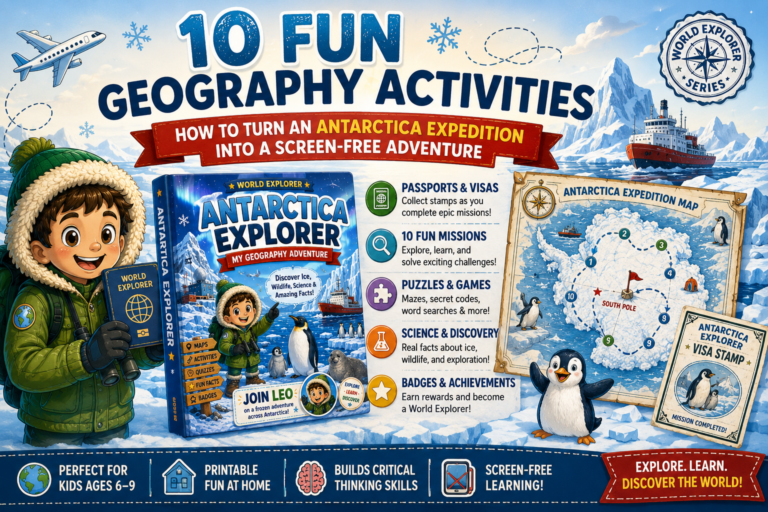
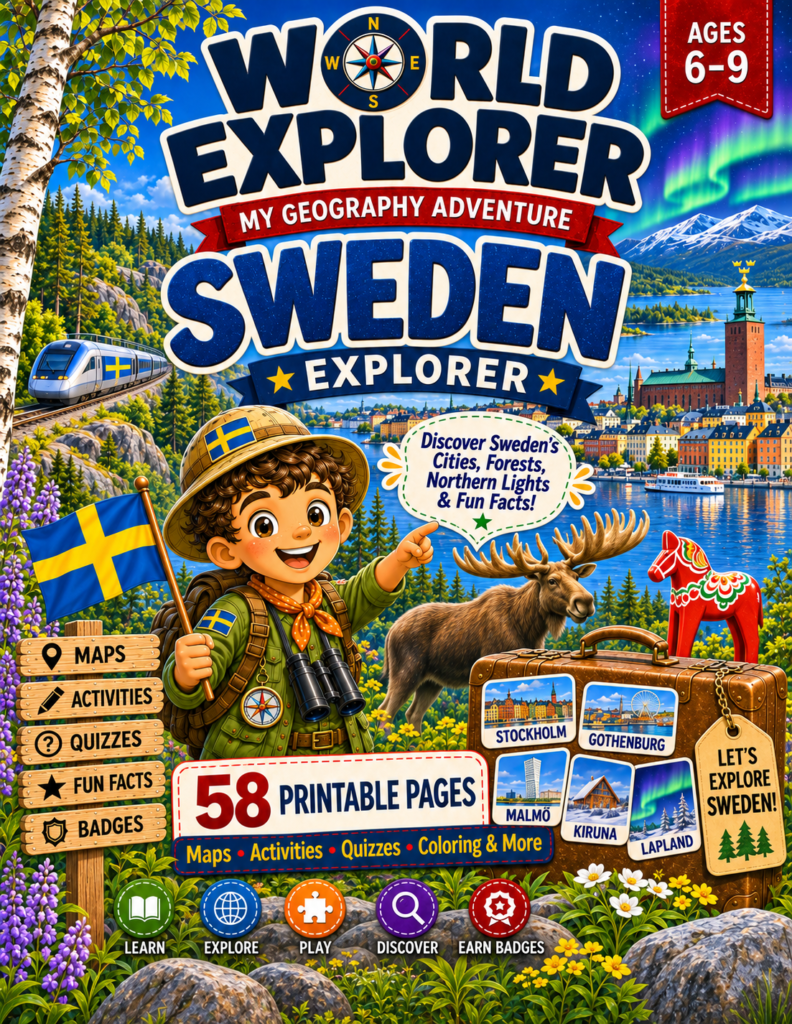
This inquiry-driven approach is the foundation of the TinyJoy Studio Learning Library and powers the World Explorer Series: Sweden Explorer workbook. Designed specifically for ages 6–10, this 58-page printable resource follows a young guide named Leo through nine structured missions across Sweden.

How the Sweden Unit Study for Kids Progresses
Rather than scattering random activities across pages, the workbook builds knowledge step by step across distinct thematic chapters:
- Spatial Reasoning and Map Reading: Kids begin by locating Sweden in Northern Europe, identifying neighboring Norway and Finland, and distinguishing between Northern, Middle, and Southern landscape regions. In the Sweden Map Challenge, students place six major cities—including Stockholm, Gothenburg, Malmö, Uppsala, Umeå, and Kiruna—onto a blank map and classify each by region.
- History and Everyday Engineering: Landmark lessons pair historical storytelling with mechanics. Children trace the 1628 sinking and 1961 recovery of the Vasa warship, then examine how canal locks on the Göta Canal use rising water to lift boats between elevation levels.

- Living Culture and Respectful Perspectives: Cultural pages introduce everyday Swedish life alongside the Indigenous Sámi people of Sápmi. Kids learn basic Swedish greetings (Hej, Tack, Hej då), explore traditions like fika, Midsummer, and Lucia Day, and discover Sámi duodji handicrafts, joik singing, and reindeer herding across northern Europe.
- Arctic Science and Data Interpretation: Heading north of the Arctic Circle, students explore Earth’s axial tilt to understand the midnight sun and polar night, followed by a visual breakdown of how solar wind and Earth’s magnetic field create the northern lights. Later, in Sweden’s Daylight Detective, children read a bar graph comparing Stockholm’s daylight hours across March, June, September, and December to calculate seasonal differences.

- Swedish Innovation and Environmental Stewardship: Students investigate real inventions—including the three-point safety belt, the Celsius temperature scale, the adjustable spanner, and space research at Esrange Space Center near Kiruna—before completing an Inventor Challenge blueprint of their own. Nature units highlight forest layers, Baltic wildlife, and Allemansrätten (the Right of Public Access), teaching children practical outdoor responsibility.
- Logic Puzzles and Collectible Rewards: To reinforce focus without screens, the final section includes a coordinate-style secret code, a 4×4 picture Sudoku, a broken postcard grid puzzle, and a multi-mission final quiz.

Practical Ways to Use This Workbook in Your Routine
Because the 58 pages include a complete three-page Explorer Answer Key, the packet adapts easily to different teaching setups:
- Multi-Week Homeschool Unit Study: Complete two to three pages per session over three or four weeks. Pair the Taste of Sweden page with baking cinnamon buns or reading an Astrid Lindgren chapter book aloud. Families building a structured year of learning adventures at home can easily slot this unit into a European geography block.
- Independent Morning Work or Co-Op Stations: The clear visual instructions allow confident readers (ages 8–10) to work independently, while younger learners (ages 6–7) can complete the map spotters, habitat matching, and coloring scenes with light parent guidance.
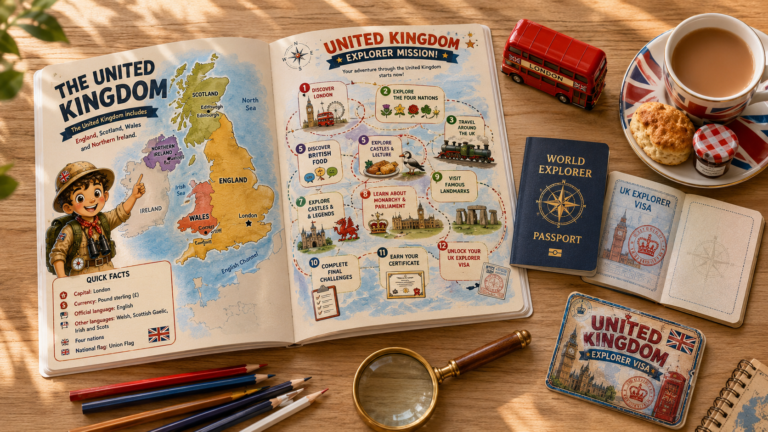
- Passport and Visa Collector Motivation: Children start by designing their own badge and setting a learning goal on page 2, and finish by earning a personalized Certificate of Exploration and a printable Sweden Explorer Visa for their World Explorer Passport. If your family is following our broader geography learning path for kids, each completed country builds a tangible record of their progress.


Ready to Start Exploring Sweden?
If you are looking for a thorough, screen-free Sweden unit study for kids that respects your child’s curiosity and saves you hours of lesson prep, the World Explorer Series: Sweden Explorer workbook gives you everything in one organized printable. You can also browse our full world geography curriculum for kids to see which destination your young explorer wants to visit next.