A Visit Is Not Delivery: Teaching Plant Pollination Through Evidence and Anatomy
Take an elementary class into a garden, point to a honeybee hovering over an apple blossom, and ask what is happening: every student will announce that the flower has just been pollinated. Pop culture and early science books have taught children a tidy, automatic script: bees visit flowers, pollination occurs, and fruit magically appears.
Yet in genuine botany, an insect resting on a petal proves only one thing: an animal stopped by. It does not prove that loose pollen brushed against the visitor’s body, that the insect touched the flower’s receptive stigma, or that the pollen was genetically compatible with that plant.
Teaching plant reproduction requires moving past surface assumptions to investigate the actual physical mechanisms of transfer. A well-crafted pollination workbook for kids transforms young learners into botanical field detectives who track pollen grains under microscopic magnification, test transfer surfaces with hands-on models, and distinguish insect feeding visits from actual reproductive deliveries.

Food Versus Cargo: Separating Pollen from Nectar
The most widespread misconception among elementary students is confusing the flower’s reward with its genetic cargo. Children frequently believe that pollen and nectar are interchangeable names for honeybee food.
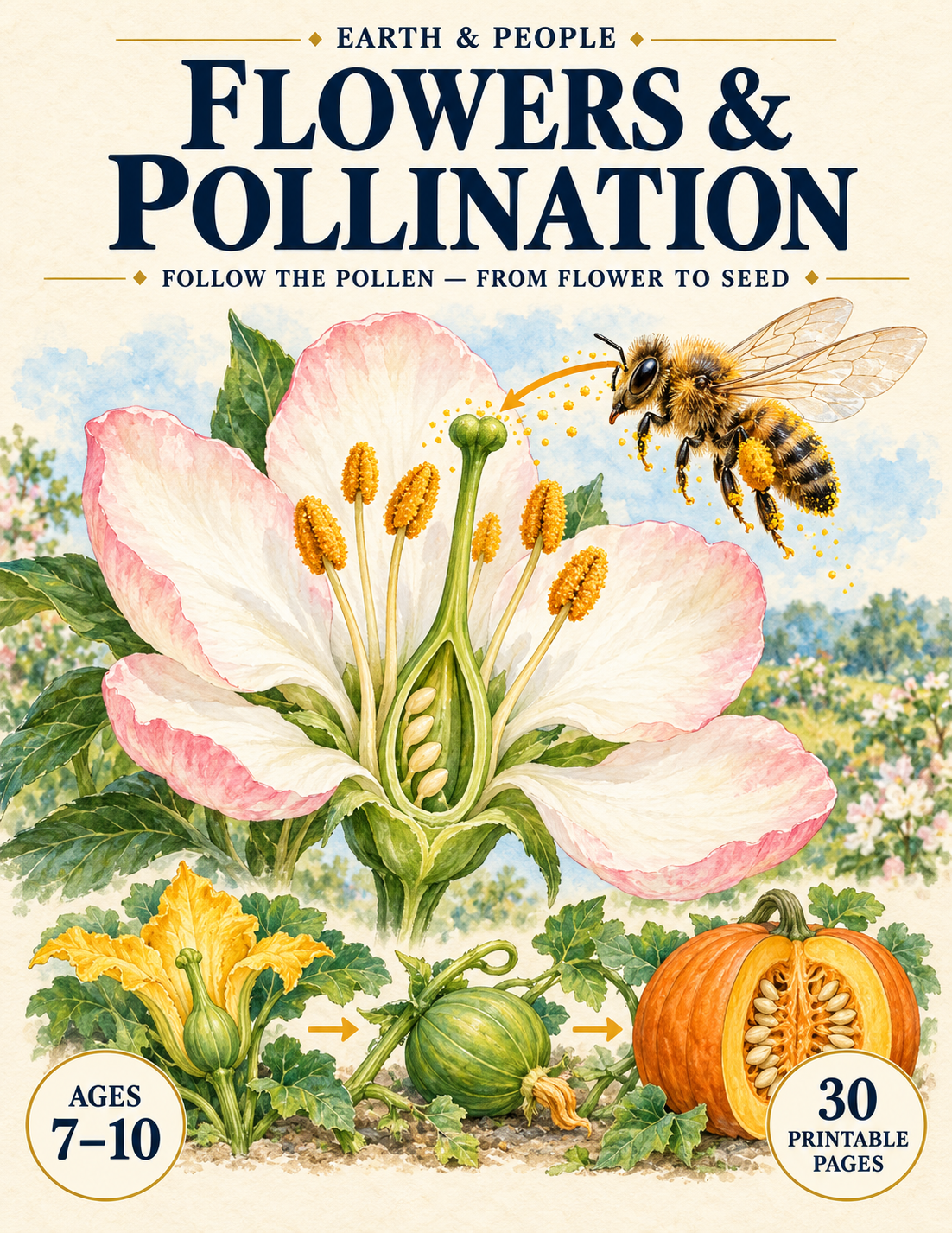
In Earth & People: Flowers & Pollination (a 30-page printable unit designed for ages 7–10), this myth is unraveled early on:

- Nectar: A carbohydrate-rich, sugary fluid secreted deep inside floral cups specifically to provide visiting foragers with immediate metabolic energy.
- Pollen: Microscopic grains produced inside the anthers that contain male reproductive cells essential for fertilization.
- The Food Paradox: While nurse bees collect surplus pollen to nourish developing larvae in the hive, the flower’s reproductive strategy depends entirely on loose body grains accidentally rubbing onto a receptive female stigma.
Children also confront the persistent error that «a pollen grain is a tiny seed». They learn that pollen is only a vehicle for cellular delivery; true seeds develop much later inside the protective ovary.
This distinction between an organism’s developmental stages parallels how young zoologists study life cycles. Just as animal embryos, nymphs, and adults require distinct conditions and structural milestones before producing the next generation—a sequence explored in our Animal Life Cycles Workbook—flowering plants must complete multi-step reproductive transfers long before a fruit forms.

Mechanical Geometry: Why Anatomical Fit Governs Delivery
Children often assume that any passing insect can pollinate any blooming flower. Flowers & Pollination demonstrates that successful pollination depends on precise mechanical fit.
In a cross-section activity featuring a deep tubular blossom, learners evaluate three different flower visitors:
- The Butterfly: Extends an ultra-long, slender proboscis straight to the nectar reservoir at the bottom while its body hovers entirely outside the petals, never touching the stigma.
- The Honeybee: Attempts to crawl down the tube, but its tongue is too short to reach the reward and its body bypasses the reproductive anthers entirely.
- The Hummingbird: Inserts its long bill into the nectar chamber, pressing its feathery forehead directly against the overhanging stigma to complete the circuit.
Students learn that drinking nectar does not make a visitor a pollinator. Without direct physical contact between the pollen-bearing body part and the flower’s receptive surface, the visit is simply a meal.

The Night Shift and Aerodynamic Transport
Elementary science curricula typically focus exclusively on daytime bees and butterflies, ignoring the fact that half of all pollination takes place after dark.
On «The Night Shift» spread, students investigate nocturnal floral adaptations:
- Pale white or cream-colored petals that reflect moonlight in dim night conditions.
- Intense, sweet fragrances released only after dusk to guide night flyers by scent.
- Synchronized active timetables matching nectar bats and hawkmoths between 8:00 PM and midnight.
Students also analyze non-animal delivery: abiotic wind pollination. By mapping corn tassels and receptive ear silks, learners see that wind-pollinated species trade flashy petals and sweet nectar for lightweight, aerodynamic grains released in enormous clouds.
Recognizing that natural systems follow strict mechanical alignments connects botany with planetary physics. Just as planetary bodies and orbital systems operate along predictable spatial geometries—as detailed in our guide to the Solar System Explorer Workbook—flower reproduction relies on overlapping operational windows, gravity, and fluid air currents to move particles between sources and targets.
Transfer Mechanics: The Pickup and Delivery Lab
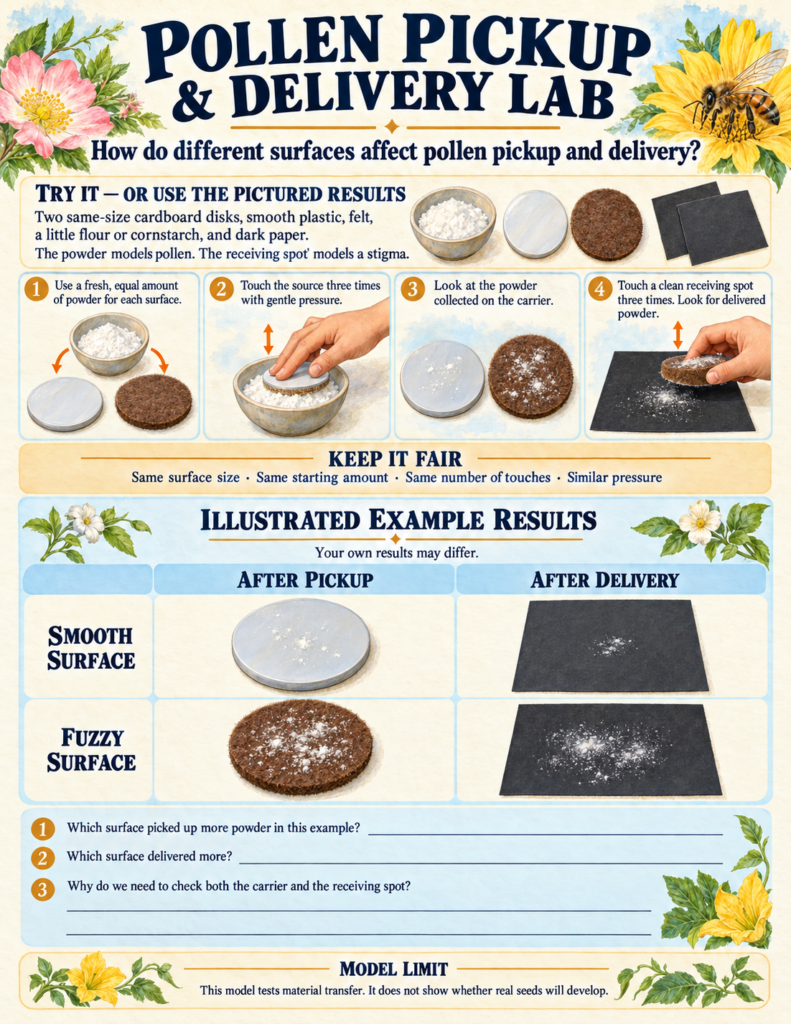
To prove why bees are uniquely effective pollinators compared to smooth-bodied insects like beetles, the workbook guides students through a controlled physical experiment: the «Pollen Pickup & Delivery Lab».
Using simple household materials—smooth plastic lids, textured felt discs, a pinch of flour, and dark paper—children isolate the variable of surface texture:
- The Pickup Check: The fuzzy felt carrier traps significantly more powder grains within its fibers than the slick plastic disc.
- The Delivery Check: When gently pressed against a clean receiving sheet, the textured surface releases dense clusters, whereas the smooth carrier leaves barely a smudge.
Students discover that a honeybee’s electrostatically charged body hairs are evolved harvesting tools designed to snag and release microscopic grains during flight.
This hands-on model illustrates the broader principle of biological structure matching function. In our overview of the Plant Life Cycle Workbook, we examined how vascular xylem and cotyledon energy stores serve specialized life-support roles; similarly, the microscopic spikes and textures of pollen grains directly dictate whether a plant can successfully reproduce.

The Mystery of the Missing Fruit: Real Agricultural Science
The culminating spread of Flowers & Pollination addresses real-world farm science in «The Mystery of the Missing Fruit».
Students are handed field notes from a pumpkin garden where a female flower opened, attracted visits from bees, and yet shriveled into a withered, dry knot instead of swelling into a pumpkin:
- Fact 1: Bees were observed visiting adjacent male flowers.
- Fact 2: The weather was exceptionally hot, and the soil was parched.
- Fact 3: The ovary stopped growing and dropped from the vine.
Children learn to avoid rushed conclusions. Rather than assuming bees failed to deliver pollen, they realize that extreme heat stress, inadequate water, or unviable pollen tubes can abort fruit development even after successful pollination has occurred.
This systems-level thinking links floral biology directly to human civilization and agriculture. Just as historic cities and capitals grew along fertile floodplains where climate, soil, and transport networks intersected—a trade-off explored in our Countries and Capitals Workbook—our global food supply depends on the delicate balance between pollinator habitats, seasonal weather, and crop physiology.
Practical Implementation for Home and Classroom
Because Flowers & Pollination provides self-contained observational case files, guided evidence prompts, and a comprehensive answer key, it requires minimal preparation:
- Homeschool Science Block: Complete two pages daily over two to three weeks, combining the lessons with backyard floral dissections using a hand lens.
- Elementary Science Stations: Print the «Visitor or Pollinator?» and «Repair a Broken Pollination System» spreads for collaborative partner discussions.
- Field Journal Companion: Use the capstone «Flower Watch» protocol to record live observations of local blossoms, training young learners to separate what they directly see from what they can scientifically prove.
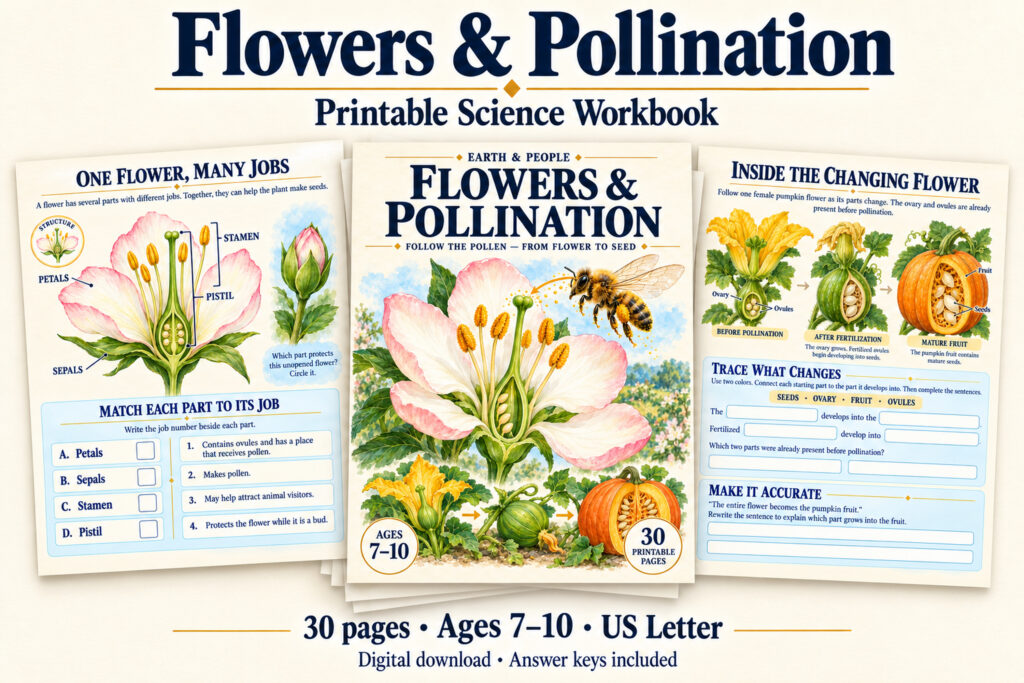
If you are looking for an educational printable that replaces simple coloring sheets with authentic anatomical inquiry, physical transfer testing, and genuine ecological reasoning, Flowers & Pollination gives your young botanist a clear, structured window into the living world.