Why Small Size Doesn’t Mean Simple: Teaching Entomology Through Evidence and Ecology
When young children explore the garden, they tend to classify every creeping, crawling creature as a «bug.» Finding an authentic insects workbook for kids that turns this everyday fascination into rigorous scientific thinking is essential for elementary biology. A well-structured insects workbook for kids guides learners to look past small size alone and test physical evidence—examining body divisions, counting limbs, analyzing specialized tools, and mapping living connections.
Standard classroom printables often treat insects as decorative clip art. Children color cartoon caterpillars, trace lines across simple matching sheets, and memorize isolated insect names without ever understanding functional anatomy or ecological roles. Consequently, learners struggle to explain why a spider or a centipede is not an insect, or how a bee’s fuzzy coat physically coordinates with flowering plants.

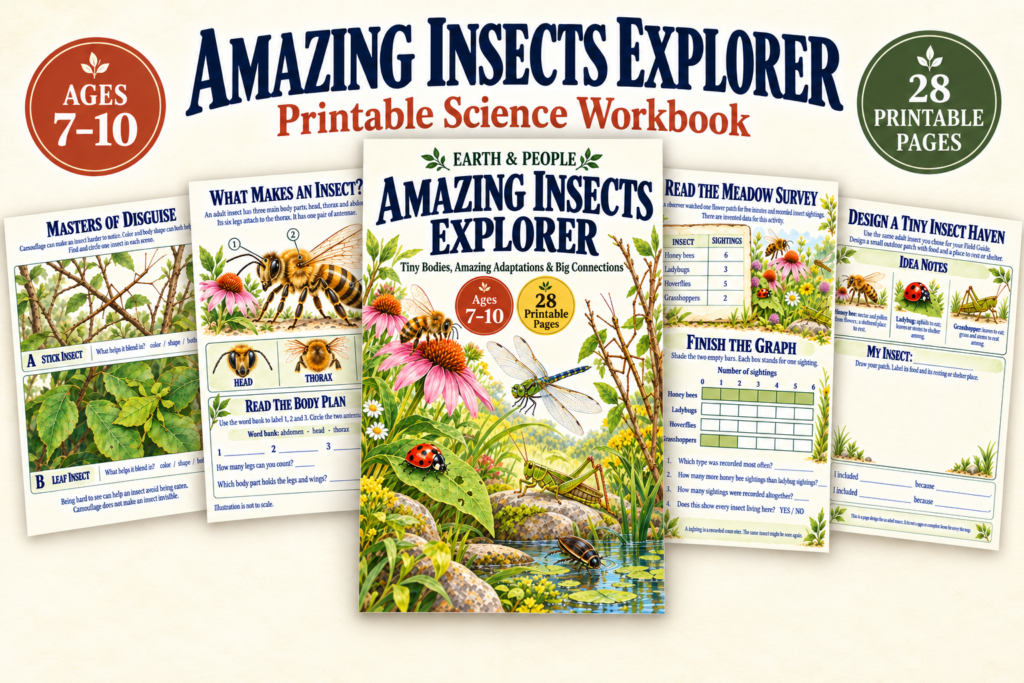
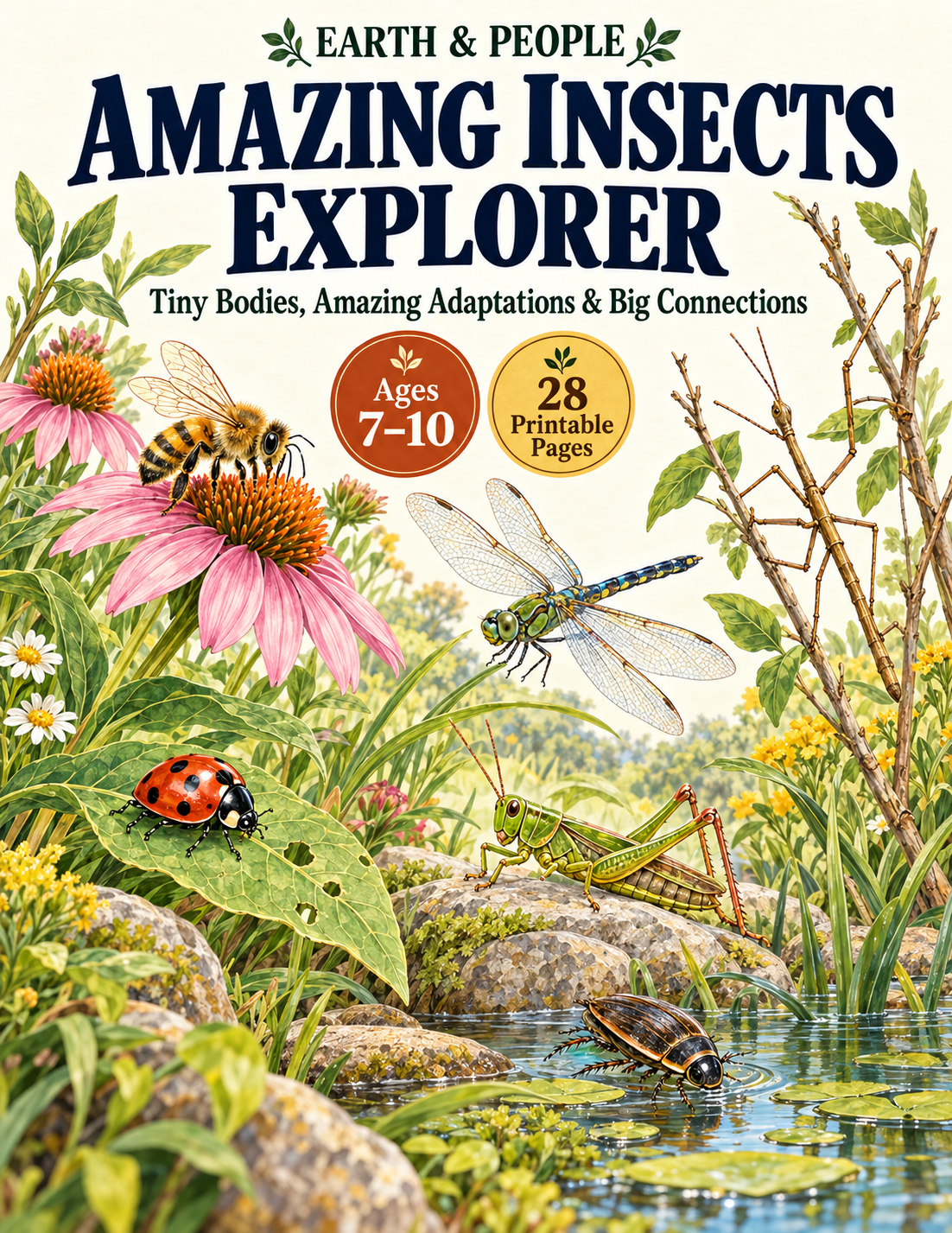
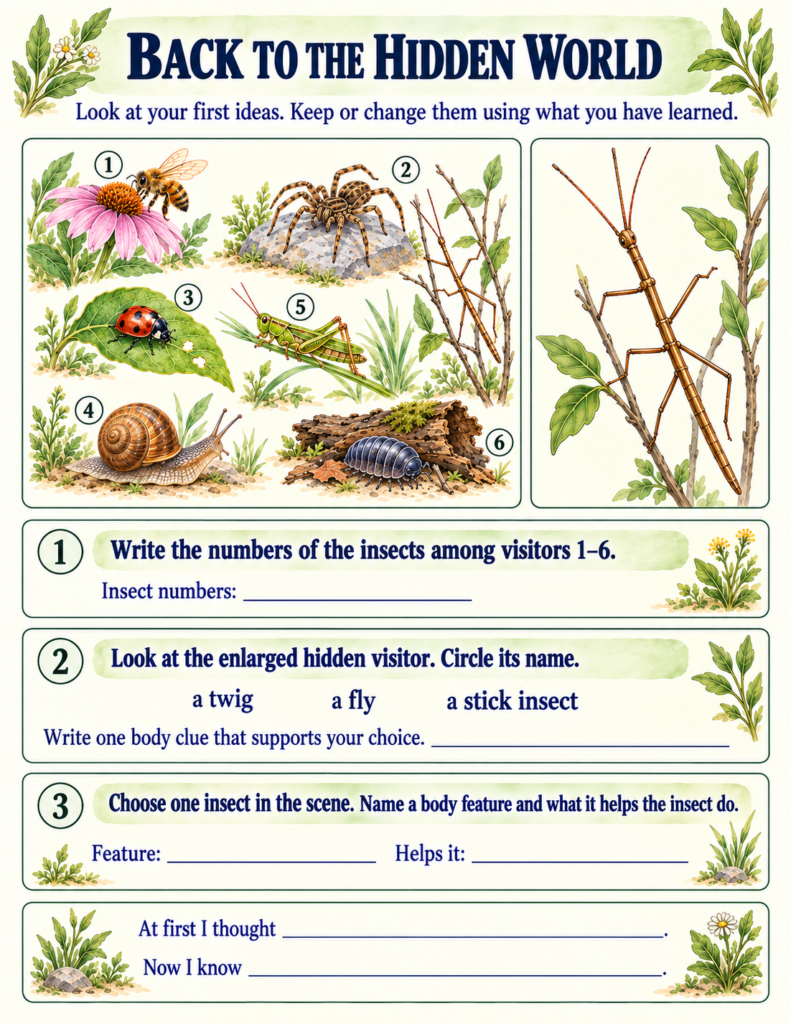
Moving from casual observation to genuine biological literacy requires an investigative framework. In Amazing Insects Explorer: Tiny Bodies, Amazing Adaptations & Big Connections (a 28-page printable resource designed for ages 7–10), young naturalists transition from casual observers into field scientists using real anatomical criteria, comparative biomechanics, and ecological modeling.
The Anatomical Blueprint: Testing the Insect Body Plan
Scientific classification begins with anatomical evidence. A recurring challenge for young students is determining what actually qualifies an organism as an insect.
In Amazing Insects Explorer, children establish the adult insect body plan using an anatomical study of the honey bee:
- Head: Houses sensory antennae and specialized mouthparts.
- Thorax: Serves as the motor center, anchoring exactly six legs and wings.
- Abdomen: Contains digestive, excretory, and reproductive organs.
Students immediately apply these diagnostic rules to test specimens. When examining a wolf spider, a woodlouse, and a centipede alongside a grasshopper and an ant, they realize that small size alone is never proof. A spider’s eight legs and two body sections disqualify it; a centipede’s multi-segmented trunk places it elsewhere. This diagnostic skill mirrors the precision taught in our Plant Life Cycle Workbook, where students isolate specific botanical structures like ovaries and cotyledons rather than guessing plant functions.

Form Follows Function: Biomechanics and Mouthparts
Insects have conquered nearly every terrestrial and freshwater environment on Earth thanks to specialized adaptations. Rather than presenting these adaptations as disconnected facts, the workbook groups them by physical challenges:
1. Specialized Locomotion
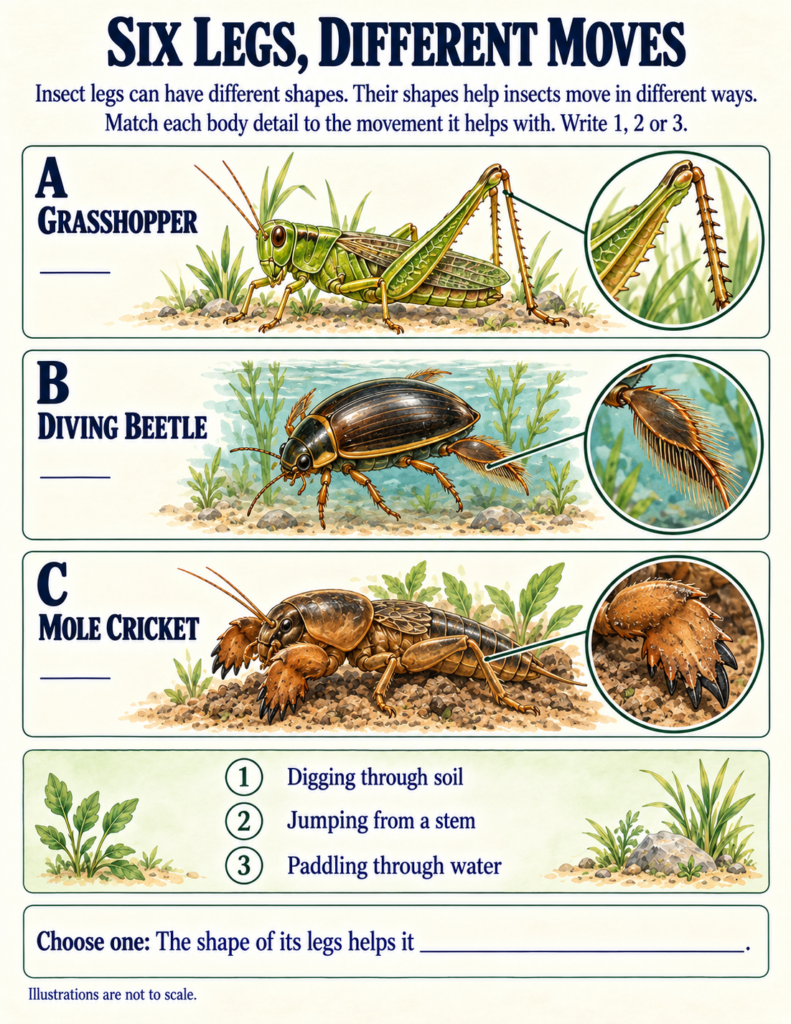
Children investigate how leg geometry determines physical movement:
- Jumping: The elongated, muscular hind legs of a grasshopper store and release kinetic energy.
- Digging: The shovel-like, broadened front forelegs of a mole cricket cut through compacted soil.
- Paddling: The flattened, fringed hind legs of a diving beetle act as biological oars in aquatic environments.
2. Mouthpart Engineering
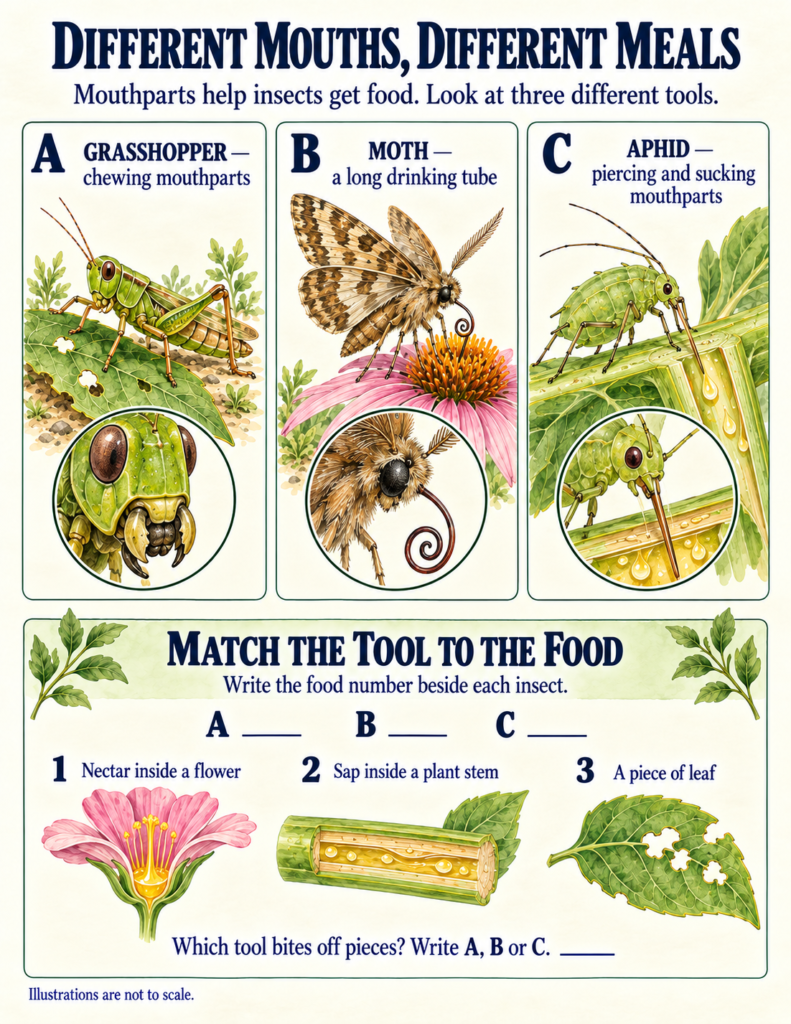
Mouthparts reflect an organism’s exact dietary niche. Children analyze chewing mandibles built to bite plant leaves (grasshopper), coiled proboscis tubes built to siphon deep nectar (moth), and piercing-sucking stylets built to tap fluid plant veins (aphid).
Investigating these specialized micro-tools helps children appreciate the complex survival strategies seen across diverse world biomes. Exploring our Tropical Rainforest Workbook provides a natural companion study, showing how specialized species navigate vertical canopy layers and microclimates.

Ecological Webs: From Pollinators to Decomposers
In nature, insects never exist in isolation; they serve as critical hinges in global energy flow. Amazing Insects Explorer moves students systematically through ecological interactions:
- Pollination Dynamics: Tracing how microscopic pollen grains adhere to a bee’s branched hairs and transfer to a neighboring blossom, facilitating plant seed reproduction.
- Predator-Prey Links: Following energy transfer from plant leaves to herbivorous aphids, and from aphids to predatory ladybugs and insectivorous birds.
- Decomposition & Nutrient Cycling: Highlighting the vital cleanup crew—such as dung beetles burying herbivore waste, partnering with fungi and bacteria to return rich organic nutrients to the soil.
Understanding how natural networks form bridges directly into human geography. In our Countries and Capitals Workbook, learners discover how human societies established trade networks along the very river corridors and agricultural landscapes sustained by insect pollination and soil cycling.
Model Auditing and Scientific Fieldwork
What truly sets this curriculum apart from routine worksheets is its focus on scientific skepticism and model critique. Students are not treated as passive consumers of science; they are trained as critical auditors.
On the «Model Repair Lab» spread, students identify and correct conceptual errors in scientific illustrations:
- Fixing a bee model where wings were incorrectly attached to the abdomen rather than the thorax.
- Reversing an improperly drawn food chain arrow so it correctly points from the food to the consumer.
They also evaluate real-world observational data. In the «Meadow Survey» and «What Can We Really Tell?» activities, children learn that seeing zero ants in a five-minute watch does not prove ants are absent from the habitat. They discover that field observations represent samples, not total population counts.
Analyzing data limitations in this way encourages the same critical modeling mindset required when evaluating cosmic distances and orbit models in our Solar System Explorer Workbook.
Practical Implementation for Home and Classroom
Because Amazing Insects Explorer includes self-contained field cards, observation frameworks, and full answer keys, it adapts effortlessly to various instructional settings:
- Homeschool Biology Unit: Work through two pages daily over two to three weeks, pairing the lessons with a backyard bug safari and magnifying glass.
- Elementary Science Stations: Print the «Six Legs, Different Moves» and «Masters of Disguise» spreads for collaborative, hands-on inquiry tables.
- Screen-Free Field Journaling: Have students complete the capstone «My Insect Field Guide» and «Design a Tiny Insect Haven,» challenging them to balance food sources with sheltered resting micro-habitats for their chosen specimen.
If you are looking for an educational printable that replaces mindless bug coloring with authentic morphological inquiry, biomechanical testing, and ecological reasoning, Amazing Insects Explorer gives your young naturalist a clear, inspiring window into the small world that runs our planet.