Why Five Senses Are Only the Beginning: Teaching Animal Perception Through Scientific Evidence
Most elementary biology lessons introduce sensory perception with a familiar poster of eyes, ears, a nose, a tongue, and hands. Choosing an evidence-based animal senses workbook for kids is one of the clearest ways to show young learners that human senses capture only a narrow slice of the physical clues circulating through nature. When thoughtfully designed, an animal senses workbook for kids moves students past memorizing five basic labels and challenges them to investigate how wildlife detects ultraviolet light, radiant heat, water wakes, weak electric fields, and Earth’s magnetic field.
Standard classroom printables frequently reduce animal adaptations to trivia flashcards—stating that owls see in total darkness or that bats are blind. Both claims are scientifically inaccurate. Without understanding the underlying physics and biology, children miss the foundational mechanism connecting every living organism to its surroundings: an environmental clue (stimulus) is detected by a specialized sensory tool, nerves carry a message to the brain, and the body produces a survival response.
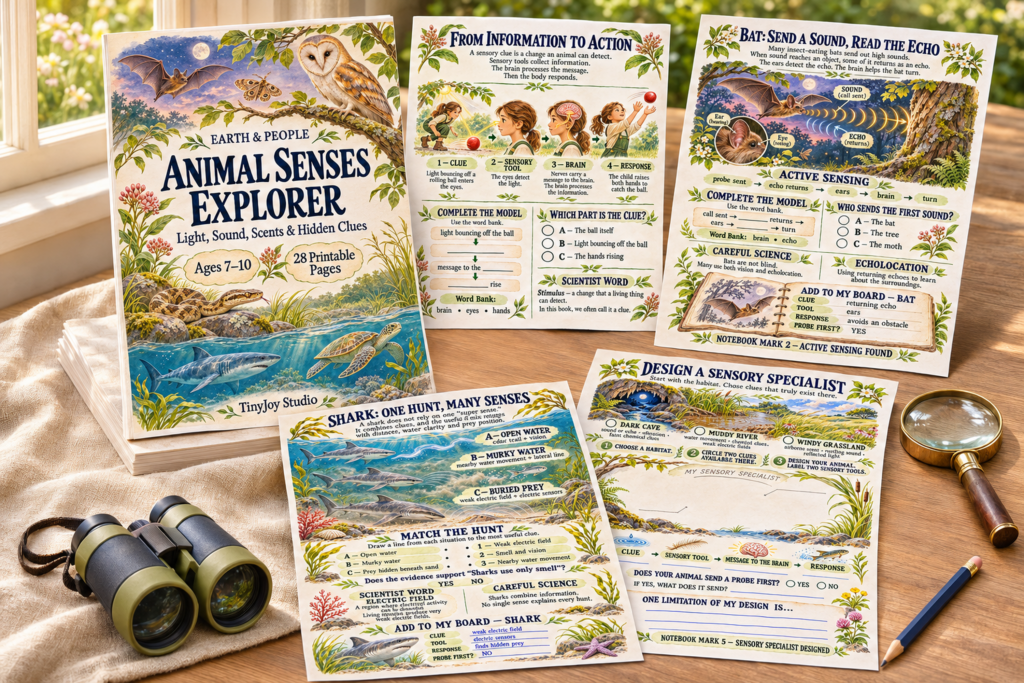
In Animal Senses Explorer: Light, Sound, Scents & Hidden Clues (a 28-page printable unit designed for ages 7–10 by TinyJoy Studio), children step into the role of sensory detectives. Rather than passively reading animal facts, learners build a running Sense Detective Case Board across eight diverse species, conduct safe hands-on sensory trials, audit flawed scientific claims, and engineer their own habitat-adapted organism.

Beyond the Familiar Five: Detecting Invisible Clues
A major strength of Animal Senses Explorer is how it systematically expands a child’s definition of sensory information. Early in the unit, students learn that human eyes require light to bounce off an object before entering the eye—proving why neither humans nor barn owls can see in complete, zero-light darkness. From there, the workbook introduces signals entirely outside human perception:
- Electromagnetic Clues: Bees detect ultraviolet (UV) patterns on petals that act as landing guides toward nectar, while pit vipers use facial pit organs to sense differences in radiant infrared heat emitted by warm-blooded prey.
- Chemical & Mechanical Clues: Garter snakes collect chemical particles with a forked tongue and transfer them to a specialized organ in the roof of the mouth, whereas female monarch butterflies taste leaf chemistry using sensory structures on their feet before laying eggs. Similarly, harbor seals track the lingering water wake of a passing fish with sensitive whiskers, while fish detect nearby pressure changes along their lateral line.
Understanding how organisms respond to specific environmental inputs pairs naturally with exploring how flora responds to light, moisture, and soil conditions in our Plant Life Cycle Workbook.

Active Probes vs. Passive Listening
One of the sharpest conceptual distinctions in the workbook separates passive sensing from active sensing. Most animals on the student’s Case Board—such as the barn owl pinpointing a rustling mouse through uneven ear timing, or a dog zigzagging upwind along a broken scent plume—receive clues already present in the habitat.
By contrast, insect-eating bats engage in active sensing by emitting high-frequency ultrasonic calls and reading the returning echoes to locate obstacles and prey. In a compelling ecological counterpoint, the workbook immediately pairs the bat with the noctuid moth, whose specialized hearing organ passively eavesdrops on those incoming ultrasonic calls to trigger an erratic, evasive flight path.

Multi-Sense Hunting and Earth’s Magnetic Map
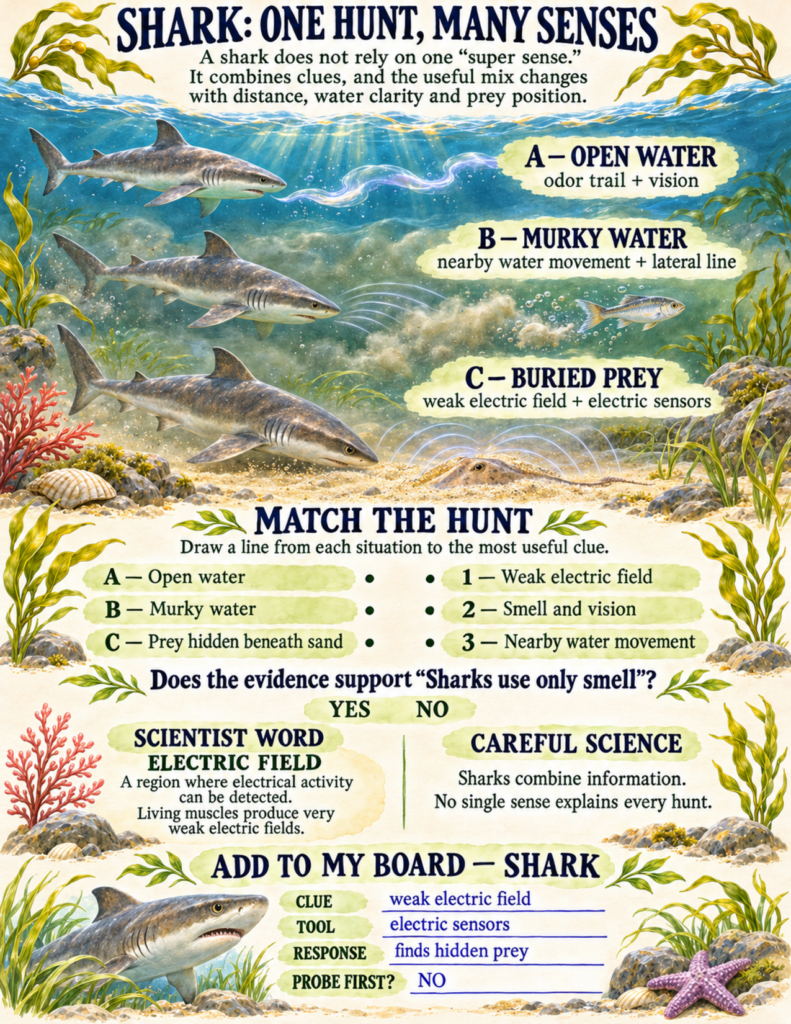
Real wildlife rarely relies on a single isolated ability. In the shark investigation, students analyze how hunting strategies shift with distance and water clarity: combining airborne or waterborne odor trails with vision in open water, switching to the lateral line in murky currents, and relying on electroreceptors to detect the faint electric fields produced by prey muscles buried beneath sand.
The workbook then moves to one of marine biology’s most fascinating mysteries: sea turtle navigation. Examining controlled tank experiments where researchers alter only the surrounding magnetic field while keeping water, light, and tank conditions identical, students see how turtles use Earth’s invisible magnetic map to hold their course—even though scientists have not yet pinpointed the exact cellular receptor. Investigating how planetary magnetism guides ocean migrations connects seamlessly with studying planetary forces and celestial navigation in our Earth and Space Science Bundle for Kids and tracing global habitats across our Geography Learning Path for Kids.
Fair Tests, Model Repairs, and Capstone Design
Rather than ending with recall questions, the final third of Animal Senses Explorer trains children in scientific reasoning and experimental critique:
- Data Interpretation: Students read bar graphs from repeated sea turtle trials to identify controlled variables and distinguish what data proves from what remains unknown.
- Model Repair Lab: Learners audit four scientific statements—keeping the accurate bat echolocation model while repairing flawed claims about snake tongues, shark smell, and owl night vision.
- Evidence Evaluation: In Which Evidence Supports the Claim?, children examine four experimental records, spotting why a scent test fails when the scented container is also the only blue box kept on the left—and learning why «cannot tell yet» is often the most honest scientific conclusion.
- Sensory Specialist Design: Finally, students revisit the hidden camouflaged katydid from the opening trail (discovering hearing organs located on its front legs) before designing their own habitat-adapted organism complete with sensory pathways and realistic biological limitations.
Families looking to pair these biological field-guide exercises with hands-on navigation and outdoor observation routines can explore our Explorer Skills Workbook Bundle or browse broader ecological unit studies across our Nature Workbooks for Kids.

Practical Ways to Use This Resource
Designed for learners ages 7–10 (roughly 2nd through 5th grade), Animal Senses Explorer requires zero specialized lab equipment. The safe, adult-guided home sensory trials use simple everyday items—cupping hands behind ears to test sound collection, pointing toward quiet sounds with closed eyes, and tapping a shallow bowl of water with a floating paper square to observe wave vibrations. With a comprehensive Grown-Up Guide, NGSS alignment notes (4-LS1-2 and 4-PS4-2), and a complete two-part Answer Key included at the back, the 28-page workbook works smoothly as a three-to-four-week homeschool life science unit, independent morning inquiry, or small-group classroom enrichment.
If you want a ready-to-print resource that takes elementary biology from memorizing five body parts to analyzing real sensory evidence, Animal Senses Explorer gives children a structured, engaging path through the hidden clues of the natural world.