Why a Fish-Shaped Body Doesn’t Make a Fish: Teaching Prehistoric Oceans Through Fossil Evidence
When children picture prehistoric oceans, they often imagine a single crowded aquarium where Megalodon, Tylosaurus, Plesiosaurus, and coiled ammonites all swim past the same coral reef. Choosing a thoughtfully sequenced ancient oceans workbook for kids helps young learners untangle those millions of years and see how paleontologists actually reconstruct vanished seas from seafloor rock layers. Rather than asking children to color generic sea monsters or memorize lengths from sensational TV shows, a strong ancient oceans workbook for kids trains them to separate anatomical group from swimming lifestyle and tie every detail of an ancient ecosystem to physical fossil clues.
In marine paleontology, a streamlined body can deceive the eye. Dolphins, sharks, tuna, and extinct ichthyosaurs all evolved sleek, torpedo-shaped bodies to solve the same hydrodynamic problem in open water, yet they belong to completely different vertebrate groups. Teaching elementary students to look past surface silhouettes and check skeletal structure, breathing organs, and rock formations turns marine science into genuine detective work.

Two Distinct Sea Windows: Jurassic England and Cretaceous Kansas

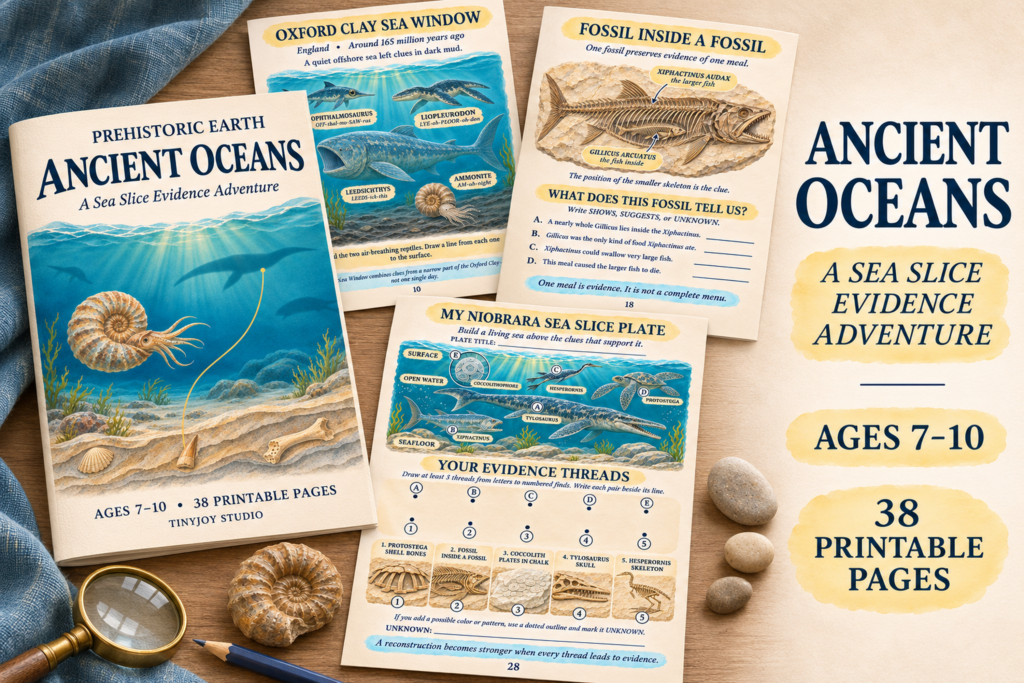
In Prehistoric Earth: Ancient Oceans — A Sea Slice Evidence Adventure (a 38-page printable mission for ages 7–10 by TinyJoy Studio), learners do not study one vague «prehistoric sea». Instead, they build two separate cross-sectional «Sea Slices»—placing living open-water creatures directly above the seafloor rock layers that preserve their remains:
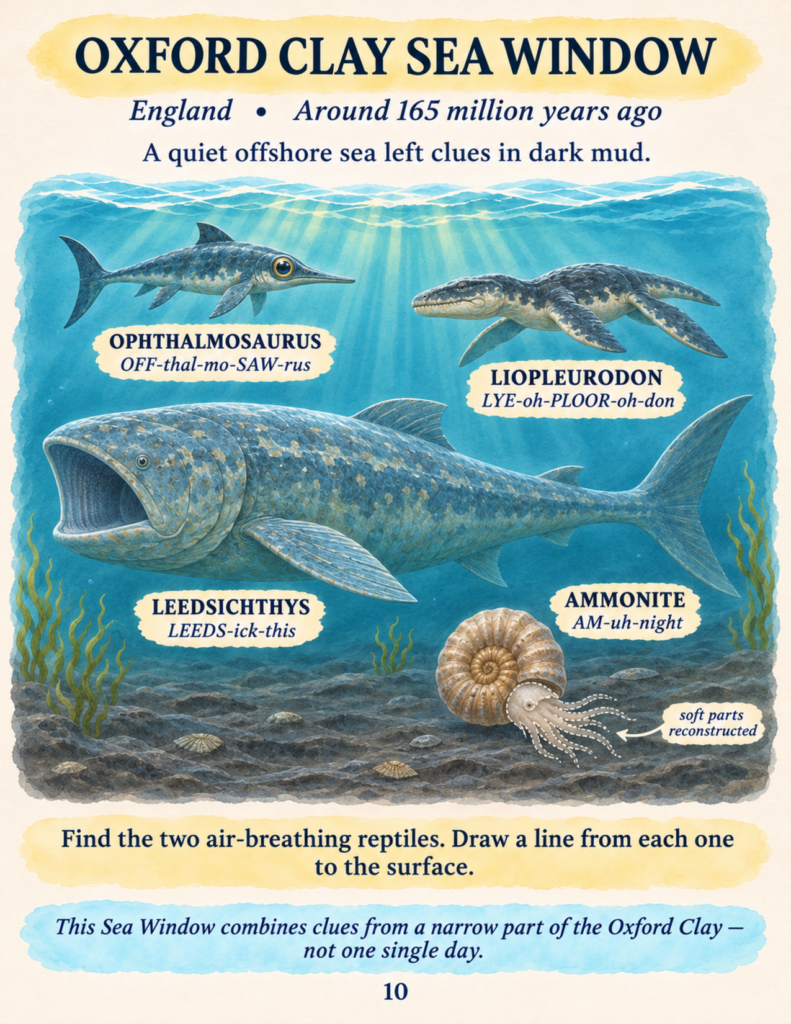
- The Oxford Clay Sea Window (Middle Jurassic, ~165 Million Years Ago): A quiet offshore sea with a muddy seafloor in what is now England. Here, students investigate the big-eyed ichthyosaur Ophthalmosaurus, the short-necked pliosaur Liopleurodon, the giant filter-feeding fish Leedsichthys, and coiled Kosmoceras ammonites.
- The Niobrara Chalk Sea Window (Late Cretaceous, ~82 Million Years Ago): A warm, shallow inland sea—the Western Interior Seaway—stretching across the middle of North America. Learners meet the mosasaur Tylosaurus, the predatory bony fish Xiphactinus, the flightless diving bird Hesperornis, the sea turtle Protostega, and microscopic coccolithophores whose tiny calcite plates built the Kansas chalk cliffs.
Filtering candidates by time and rock layer (Page 23) shows why Dunkleosteus (~360 million years ago) and Megalodon (~23–3.6 million years ago) cannot enter a Late Cretaceous Kansas scene. Pairing these Mesozoic marine windows with our companion dinosaur workbook for kids and ice age workbook for kids gives families a cohesive trilogy across land, sea, and glacial eras, while reinforcing the same chronological discipline children use in an interactive history for kids curriculum.

Group Versus Lifestyle: Air-Breathers, Gill-Breathers, and Convergent Shapes
Across Pages 6–12 and 17–24, the workbook dismantles the habit of calling every large swimming animal a fish or a dinosaur:
- Air or Gills? (Pages 6 & 10): Students classify marine animals by how they obtained oxygen. Air-breathing reptiles like Ophthalmosaurus and Liopleurodon and diving birds like Hesperornis had lungs and had to rise to the surface, whereas Leedsichthys and Xiphactinus extracted oxygen underwater through gills.
- Same Shape, Different Group (Pages 11 & 24): Comparing Ophthalmosaurus (an ichthyosaur reptile), Tylosaurus (a mosasaur marine lizard), Xiphactinus (a bony fish), and a modern dolphin demonstrates that streamlined bodies evolved independently to solve movement through water.
- Birds Inside Dinosauria (Page 17): Returning to the Niobrara Sea cast, learners discover that the flightless, foot-propelled diving bird Hesperornis is the only true dinosaur in the ocean scene because birds sit directly within the theropod dinosaur branch.
Auditing TV Superlatives and Historical Fossil Mix-Ups
Like every mission in the Prehistoric Earth series, Ancient Oceans teaches children to separate what a fossil Shows, what it Suggests, and what remains Unknown:
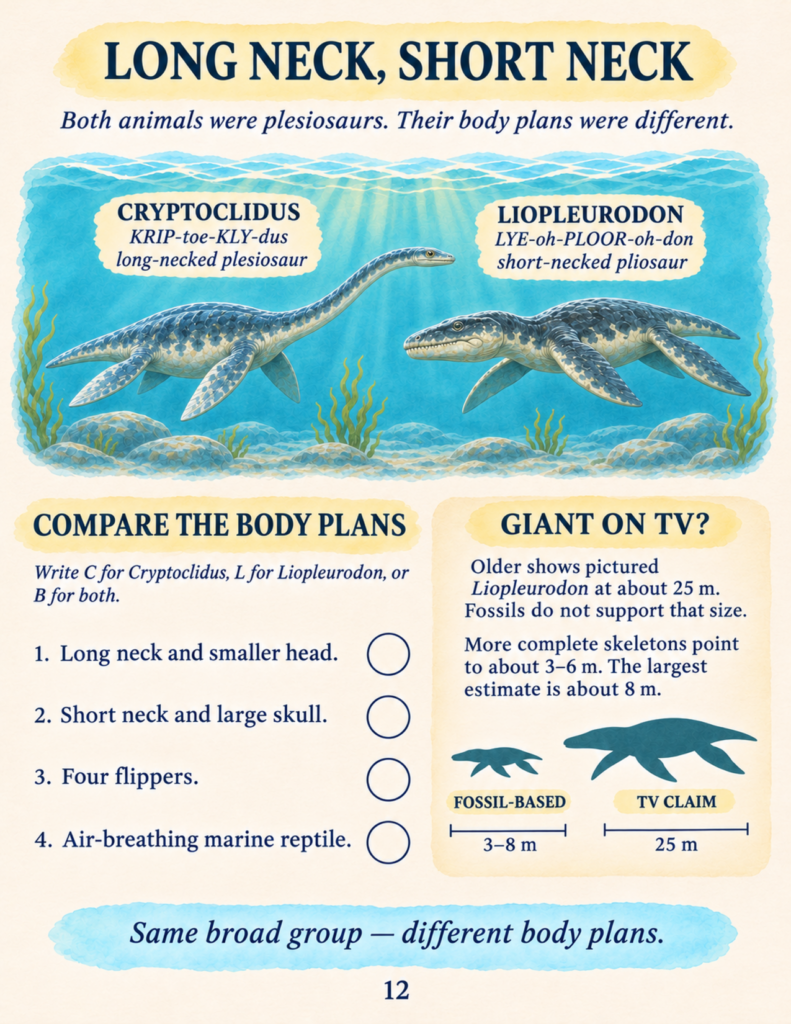
- Fact-Checking Sensational Size Claims (Page 12): Older television documentaries famously portrayed Liopleurodon as a 25-meter monster. By comparing TV claims against actual skeletal measurements (3–6 meters for most specimens, with the largest estimates near 8 meters), students learn to question dramatic media numbers.
- Reconstructing Partial Giants and Soft Bodies (Pages 13–14): Because no complete Leedsichthys skeleton exists, its ~16.5-meter length is an evidence-based estimate rather than a tape-measure fact. Similarly, coiled ammonite shells fossilize readily, while soft tentacles and skin colors remain reconstructions or unknowns.
- Fossil Inside a Fossil (Page 18): Examining a famous Niobrara specimen of Xiphactinus audax preserved with a nearly whole 6-foot Gillicus skeleton inside its ribs proves that Xiphactinus could swallow large prey—yet leaves open whether that final meal caused its death or what else was on its menu.
- Head on the Wrong End (Page 25): Students revisit Edward Drinker Cope’s 1868 Elasmosaurus reconstruction—where he accidentally placed the skull on the tip of the tail—and see how Joseph Leidy’s 1870 anatomical check of 72 neck vertebrae corrected the mistake.

Building the Niobrara Sea Slice and the 8 Cutout Evidence Cards
In the culminating Evidence Thread Lab and Sea Slice Plate (Pages 26–29), students assemble a verified reconstruction of the Late Cretaceous Niobrara Sea. Every organism placed in the sunlit surface, open water, or seafloor must be tethered by an «evidence thread» to a specific fossil find below—such as linking Protostega to reduced bony shell plates, Tylosaurus to a skull with stout conical teeth and a toothless snout tip, and coccolithophores to microscopic calcite plates in chalk. Any reconstructed skin pattern must be marked with a dotted outline and labeled UNKNOWN.
Understanding how marine basins shifted across continents, how chalk cliffs formed from microscopic ocean producers, and how fossil sites map onto modern England and Kansas connects ancient oceanography directly to a geography learning path for kids, a world landscapes workbook bundle for kids, and the spatial navigation skills practiced in an explorer skills workbook bundle, while reinforcing planetary earth-system cycles explored in an earth and space science bundle for kids.
At the back of the 38-page workbook, learners also receive eight foldable, double-sided Prehistoric Earth Evidence Cards (Ophthalmosaurus, Liopleurodon, Leedsichthys, Ammonite, Tylosaurus, Xiphactinus, Hesperornis, and Coccolithophores). Each card pairs full-color underwater artwork on the front with a time-and-location map, relatable size benchmarks (comparing Ophthalmosaurus to a family car or Tylosaurus to a school bus), an Evidence Clue, what Scientists Think, and what is Still Unknown on the back.

Practical Integration for Home and Classroom
Complete with a two-page Answer Key and self-contained visual prompts, Prehistoric Earth: Ancient Oceans requires only a pencil, scissors, and standard printer paper:
- Two-Week Homeschool Marine Paleontology Unit: Dedicate Week 1 to Oxford Clay sea skills and Jurassic reptiles (Pages 2–15) and Week 2 to the Niobrara Chalk sea, historical cases, and the final Sea Slice plate (Pages 16–30).
- Interactive Evidence Card Games: Print and fold the eight Prehistoric Earth Evidence Cards so children can study the front illustration, predict whether the organism breathed air or used gills, and flip the card to verify the fossil proof.
- Media Literacy Extension: After completing Page 12 (Giant on TV?), let students watch a short clip from a marine dinosaur documentary and practice spotting where narration shifts from observed bones to speculative size or hunting stories.
If you want a ready-to-print resource that moves marine prehistory beyond sea-monster trivia into stratigraphic reasoning, anatomical classification, and evidence-backed reconstruction, Prehistoric Earth: Ancient Oceans gives learners ages 7–10 a structured expedition through two unforgettable ancient seas.